
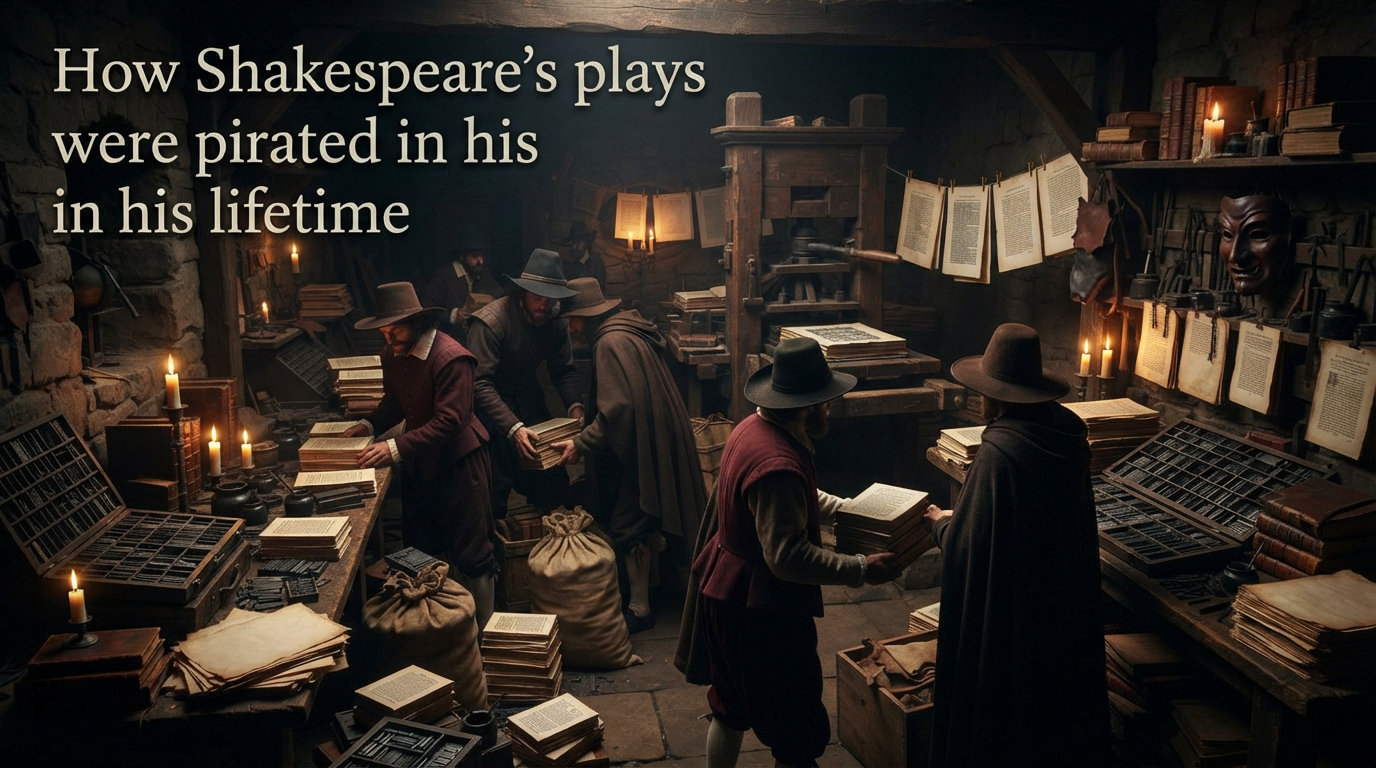
I have spent years reading about Shakespeare’s plays, and one of the most fascinating chapters in their history is also one of the most overlooked: how Shakespeare’s plays were pirated during his own lifetime. Long before copyright law existed, printers in London treated hit plays as easy money. They ran stolen, corrupt, sometimes barely recognizable versions of Shakespeare’s work off the press, and the playwright himself had almost no legal way to stop them.
When John Heminge and Henry Condell gathered Shakespeare’s plays for the First Folio in 1623, they opened their preface with a now-famous complaint. Earlier readers, they wrote, had been “abused” by “diverse stolen and surreptitious copies, maimed and deformed by the frauds of injurious impostors.” Those “stolen and surreptitious copies” are what scholars today call the “bad quartos” of Shakespeare’s plays.
In this guide, I will walk you through exactly how this piracy worked, who paid for it, and why it mattered. You will learn what a bad quarto is, how printers stole Shakespeare’s words, and how his fellow actors tried to fight back. I will also share some of the most famous examples of pirated plays, including Hamlet, Romeo and Juliet, and Henry V, and explain why the First Folio became the single most important book in English literary history.
Table of Contents
What Was Piracy in Elizabethan England?
Piracy of Shakespeare’s plays did not look like modern piracy. There were no laws protecting an author’s right to copy, sell, or profit from a written work. The concept of literary copyright did not exist in Shakespeare’s lifetime. What we now call “piracy” was, in the 1590s and early 1600s, simply the normal way that plays were published.
At the heart of London’s book trade stood the Stationers’ Company, a powerful livery company that controlled all legal printing in England. Printers registered the titles they intended to publish in a book called the Stationers’ Register. Once a title was entered there, the registered printer had an exclusive right to print it, and no other member of the Company could legally print the same work.
Here is the catch. Authors had no standing in that system. The Stationers’ Register was a register of publishers’ rights, not writers’ rights. A printer could buy a manuscript from an author once, but from that point on the text belonged to the printer, not the playwright. If a manuscript leaked, was stolen, or was sold to a second publisher, the original author had no legal claim to it.
For Shakespeare, this meant his plays were valuable only as long as his acting company performed them. The Lord Chamberlain’s Men (later the King’s Men) kept most of his manuscripts locked away in their prompt-book chests. They did this for two reasons: to keep plays exclusive to their company, and to prevent exactly the kind of piracy that ended up happening anyway.
Printers, on the other hand, had every reason to chase after those scripts. A new play by Shakespeare sold briskly. Printers like Andrew Wise, William Jaggard, and the operators behind the piratical “Pavier quartos” of 1619 treated Shakespeare’s work as a guaranteed commercial property.
The Stationers’ Register and the Absence of Copyright
The first English copyright statute, the Statute of Anne, did not arrive until 1710, more than a century after Shakespeare’s death in 1616. Before that, the only thing resembling protection came from royal patents, court patronage, and the Stationers’ Register itself.
The Register was useful for one specific kind of dispute: it let printers fight each other. If Printer A entered a play in the Register and Printer B printed it anyway, Printer A could complain to the Company and get an injunction. But if a printer simply stole a manuscript, or hired someone to take down a play by ear, neither the playwright nor his company had any practical legal remedy.
This is why scholars describe Shakespeare’s plays as having circulated through a kind of legal vacuum. Anything that left the playhouse, or anything someone could reconstruct from watching a playhouse, was fair game for the press.
The Bad Quarto Phenomenon Explained
Most Elizabethan plays were printed in a small, cheap format called a quarto. A quarto was a single sheet of paper folded twice, producing four leaves and eight pages of text. Quarto playbooks cost around sixpence, the price of a meal, which made them affordable for ordinary readers.
Shakespeare’s plays circulated in dozens of quarto editions during his lifetime, and many of them survive in multiple versions. Some of those quartos are clean, accurate texts that scholars call “good quartos.” Others are short, garbled, full of mistakes, and missing entire scenes. Those are the famous “bad quartos.”
The phrase “bad quarto” was coined by the bibliographer Alfred W. Pollard in his 1909 essay “Shakespeare Folios and Quartos.” Pollard, along with his colleague W. W. Greg, argued that bad quartos were not simply poorly printed. They were pirated texts, reconstructed from memory by people who had heard the play performed.
What Made a Quarto “Bad”?
Several features separate a bad quarto from a good one. A bad quarto is typically much shorter than the authoritative version, sometimes only half the length. It contains passages that look garbled, with lines that do not scan properly or make no narrative sense. It often includes stage directions that refer to actions a reader could not possibly have witnessed from the audience, which suggests the reporter was working from notes taken during a live performance.
Sometimes the language in a bad quarto is so clumsy that it sounds like a paraphrase of Shakespeare’s real verse. Scholars believe these passages were written down by someone trying to capture the gist of what an actor said, rather than transcribing the actual words.
The famous example is the “To be or not to be” soliloquy in Hamlet Q1, the 1603 first quarto. In that version, the speech runs to roughly half the length of the version we know from the Second Quarto (1604) and the First Folio. Hamlet Q1 also compresses the entire play of Hamlet down to about 2,200 lines, when the authoritative versions run closer to 4,000.
The Theory of Memorial Reconstruction
Pollard and Greg proposed that bad quartos were produced by “memorial reconstruction,” meaning that an actor, or perhaps a member of the audience with a good memory, watched a performance and then, weeks or months later, tried to write the play down from memory. They sold this reconstructed version to a printer for cash.
This theory has been challenged over the years. Some scholars now argue that bad quartos might be early drafts by Shakespeare himself, or abridged acting versions, or even reports taken down in shorthand during performances. Each new generation of Shakespeareans has offered its own take.
The Methods Pirates Used to Steal Shakespeare’s Plays
Shakespeare’s plays were pirated using at least four distinct methods. Some worked better than others, and each left its own fingerprints in the surviving texts.
Memorial Reconstruction
The first method, memorial reconstruction, is the one I described above. Someone with a strong memory, usually assumed to be an actor, would recreate a play after seeing it performed. The resulting text would be full of half-remembered lines, paraphrased speeches, and confused plot details.
Why would an actor do this? The short answer is money. Elizabethan actors were paid modestly, and selling a reconstructed play to a printer could earn a few shillings or even a pound or two, a meaningful sum in the 1590s.
Shorthand Reporting
The second method was shorthand reporting. Professionals trained in systems like Thomas Bright’s “Characterie” or John Willis’s “Stenographie” could take down spoken English at remarkable speeds. Some bad quartos show signs of being transcribed this way, including oddly grouped words and strange line breaks.
Whether professional stenographers actually attended theater performances in Shakespeare’s London is still debated. But the surviving texts show enough traces of note-taking that most scholars accept shorthand as one of the tools used to capture plays for the press.
Stealing Manuscripts
The third method was simpler and more direct: stealing the actual manuscript. A dissolute actor, a bribed scribe, or a servant with access to the playhouse could copy or steal the company’s prompt book and sell it to a printer. Several of Shakespeare’s quartos appear to derive from manuscript sources, not from performance at all.
This is exactly what Shakespeare’s company feared. It is also why the King’s Men kept their scripts under tight control and punished anyone caught leaking a play.
Counter-Measures by the Acting Company
To fight piracy, Shakespeare’s company gave actors only their own lines, never the full script. Each performer received a “part” containing just their cues and their speeches. Without the other actors’ parts, no single actor could reconstruct the entire play.
This explains an important clue in bad quartos. When you study a bad quarto carefully, you sometimes find that one character’s lines are well preserved while other characters are garbled. This pattern fits the theory that the person reconstructing the play had only their own part to work from.
Shakespeare himself is sometimes blamed for letting bad quartos appear. Some scholars believe he may even have colluded with printers at times, since an unauthorized edition could boost ticket sales for the original playhouse production. Whether or not that is true, no evidence has ever surfaced that Shakespeare tried to stop the pirates through legal action. He had no legal action to take.
Famous Bad Quartos: Hamlet, Romeo and Juliet, and Henry V
Let’s walk through the three most famous cases of Shakespeare’s plays being pirated. These are the examples I find myself returning to most often when I teach this material.
Hamlet Q1 (1603): The Most Famous Bad Quarto
The 1603 first quarto of Hamlet is the shortest and strangest version of the play. It runs only about 2,200 lines, while the Second Quarto (1604) and the First Folio version run closer to 4,000. It is so different, in fact, that for a long time scholars thought it might be an early “ur-Hamlet” by another writer.
Modern scholars generally accept that Hamlet Q1 was reconstructed from memory by an actor who played Marcellus, one of the minor roles. The evidence is in the text itself. The lines belonging to Marcellus and his fellow watchmen are often better preserved than the lines of Hamlet himself. This matches exactly what you would expect from an actor who had only his own part to work from.
Hamlet Q1 is also famous for being entered in the Stationers’ Register by the printers Nicholas Ling and John Trundell on July 26, 1602, before it was printed. The title page describes it as “The Tragicall Historie of Hamlet Prince of Denmarke” and is sometimes called “the bad quarto” even on its own frontispiece.
Romeo and Juliet Q1 (1597)
The first quarto of Romeo and Juliet was printed in 1597 by John Danter. It is roughly 200 lines shorter than the Second Quarto (1599) and the Folio version, and it contains a great deal of verse that does not scan properly.
Many scholars believe Romeo and Juliet Q1 was reconstructed from memory by someone who saw the play performed, perhaps using shorthand or written notes. The text has many of the usual memorial reconstruction fingerprints: garbled speeches, missing scenes, and oddly worded passages.
The Second Quarto of 1599, printed by Thomas Creede for Cuthbert Burby, claims on its title page to be “newly corrected, augmented, and amended.” This was almost certainly printed from Shakespeare’s manuscript, or from a very close copy of it, and it represents the play much as Shakespeare intended it.
Henry V (1600) and the “Pavier Quartos”
The 1600 first quarto of Henry V is one of the most corrupt texts in the Shakespeare canon. It is missing two entire choruses, it has different scene breaks, and it contains verses so mangled that scholars have spent decades trying to figure out what they originally said.
The 1602 second quarto was advertised on its title page as “newly corrected,” but it is just as bad as the first. Then in 1619, the publisher Thomas Pavier tried to bring out a collected set of Shakespeare’s plays, including Henry V, and these “Pavier quartos” became some of the most notorious pirated texts of the era.
Other famous bad quartos include the 1602 Merry Wives of Windsor, the 1609 Pericles (printed by Henry Gosson for William Jaggard), and the 1608 King Lear, which contains about 100 lines not found in the Folio version.
The First Folio: Shakespeare’s Friends Fight Back
By the time Shakespeare died in 1616, his company had lost patience with the chaos in the print marketplace. Heminge and Condell, both fellow actors in the King’s Men, decided to gather Shakespeare’s plays into a single, authoritative volume. The result was the First Folio, published in 1623.
The First Folio is one of the most important books ever published in English. Without it, around 18 of Shakespeare’s plays, including Macbeth, Julius Caesar, Twelfth Night, and The Tempest, would have been lost entirely. None of those plays survives in any authoritative quarto edition. They exist only because Heminge and Condell preserved them in the Folio.
What the First Folio Preface Says
The preface to the First Folio, addressed “To the most noble and incomparable pair of brethren, William Earl of Pembroke, &c. Lord Chamberlain to the King’s most excellent Majesty, and Philip Earl of Montgomery,” is where the famous complaint about piracy appears. Heminge and Condell write:
“It had been a thing, we confess, worthy to have been wished, that the author himself had lived to have set forth, and overseen his own writings; but since it hath been ordained otherwise, and he by death departed from that right, we pray you do not envy his friends the office of their care and pain, to have collected and published them; and so to have published them, as where (before) you were abused with diverse stolen and surreptitious copies, maimed and deformed by the frauds and stealths of injurious impostors, that the name of our friend is tamely and traditionally exposed to the lewd impudence of every lewd impostor, that thenceforth the reading of them might be made more safe, and the purchase of them more honourable.”
This passage did two things at once. It asked readers to stop buying bad quartos, and it announced that the Folio was the authoritative version of Shakespeare’s work. It worked. Within a few years, the bad quartos of many plays were pushed aside, and the Folio became the standard text from which all later editions descended.
The Maguire Study: Are Bad Quartos Really “Bad”?
One of the most interesting modern studies of bad quartos was conducted by Laurie Maguire, a Shakespeare scholar now at Oxford. In 1996, Maguire published a study where she asked student actors to reconstruct Shakespeare’s plays from memory, using only their assigned parts. The results were striking.
Maguire’s reconstructions looked remarkably like actual bad quartos. They had the same kind of garbled verse, missing lines, and odd paraphrases. This was strong evidence that memorial reconstruction really was the method behind bad quartos, and it has become a foundational study in the field.
Some scholars have pushed back, arguing that Maguire’s subjects were modern students with no Elizabethan training. But even so, her work has reshaped how we think about the bad quarto problem.
The Lasting Impact of Play Piracy on Shakespeare’s Legacy
Play piracy during Shakespeare’s lifetime left deep marks on the texts we read today. Some of the quartos printed during his life are the only surviving versions of those plays. Others were the basis for later, more accurate editions, including the Folio itself.
Without the First Folio, we would not have Macbeth, Twelfth Night, The Tempest, Julius Caesar, As You Like It, or Antony and Cleopatra. Those plays exist only because Heminge and Condell decided in the early 1620s that Shakespeare’s work deserved better than what the pirates had given it.
Piracy also shaped how we think about authorship in Shakespeare’s time. Because plays were considered the property of the playing company, not the writer, we have very few surviving manuscripts in Shakespeare’s own hand. The manuscripts we do have, including the famous “Sir Thomas More” pages, are partly in his handwriting only because no one thought to keep careful records of authorship at the time.
Modern Scholarship and the Bad Quarto Debate
Today, the bad quarto debate continues. Some scholars, like Graham Holderness and Bryan Loughrey, have argued that bad quartos may not be corrupt at all, but earlier, alternative versions of Shakespeare’s plays that he later revised. In that reading, Q1 Hamlet is not a stolen reconstruction, but a “first draft” of a play Shakespeare later rewrote.
Whatever the truth, the bad quartos remain essential evidence for anyone studying Shakespeare’s texts. They show us the messy, contested, commercial reality of the early modern stage, where playwrights, actors, and printers were all fighting over the same valuable commodity.
FAQs
Were Shakespeare’s plays published in his lifetime?
Yes. About half of Shakespeare’s plays appeared in quarto editions during his lifetime, beginning with Titus Andronicus in 1594. Some of these quartos were printed with Shakespeare’s cooperation, but many were pirated editions produced without his permission or involvement.
What is a bad quarto of Shakespeare?
A bad quarto is a short, corrupt, error-filled printed edition of a Shakespeare play, believed to have been reconstructed from memory or shorthand rather than copied from the author’s manuscript. Famous examples include Hamlet Q1 (1603), Romeo and Juliet Q1 (1597), and Henry V (1600).
Why were Shakespeare’s plays so frequently pirated?
There was no copyright law for authors in Shakespeare’s lifetime. Printers could publish any manuscript they could obtain, and they had strong financial incentives to print popular plays like Shakespeare’s. The absence of legal protection, combined with the popularity of Shakespeare’s work, made piracy both easy and profitable.
How did actors try to prevent their plays from being pirated?
Acting companies like the Lord Chamberlain’s Men kept their scripts locked away and gave each actor only their own lines, called a ‘part,’ rather than a full copy of the play. This made it harder for any single person to reconstruct and sell the entire play to a printer.
What is the First Folio and why does it matter?
The First Folio, published in 1623 by John Heminge and Henry Condell, was the first collected edition of Shakespeare’s plays. Without it, around 18 plays, including Macbeth, Twelfth Night, and The Tempest, would have been lost. It remains the most important book in English literary history.
Conclusion
Understanding how Shakespeare’s plays were pirated in his lifetime gives us a much richer picture of the man and his work. Shakespeare was not a polished literary author publishing through official channels. He was a working playwright in a busy commercial theater, surrounded by printers who wanted his scripts and actors who needed to protect them.
The bad quartos that emerged from this scramble for Shakespeare’s plays were a mixed blessing. They corrupted some texts, cut scenes, and mangled verse. They also helped spread Shakespeare’s fame across England and into print. Without those early, sometimes garbled editions, Shakespeare might have remained a playwright known mainly to playgoers in London, not the towering figure of world literature he became.
When Heminge and Condell finally gathered Shakespeare’s plays into the First Folio in 1623, they did something that no one had done for an English playwright before. They treated his work as worth preserving in full, with care, accuracy, and respect. That decision is the reason we still read Shakespeare today, more than four hundred years after his plays were first pirated in the streets of London.