
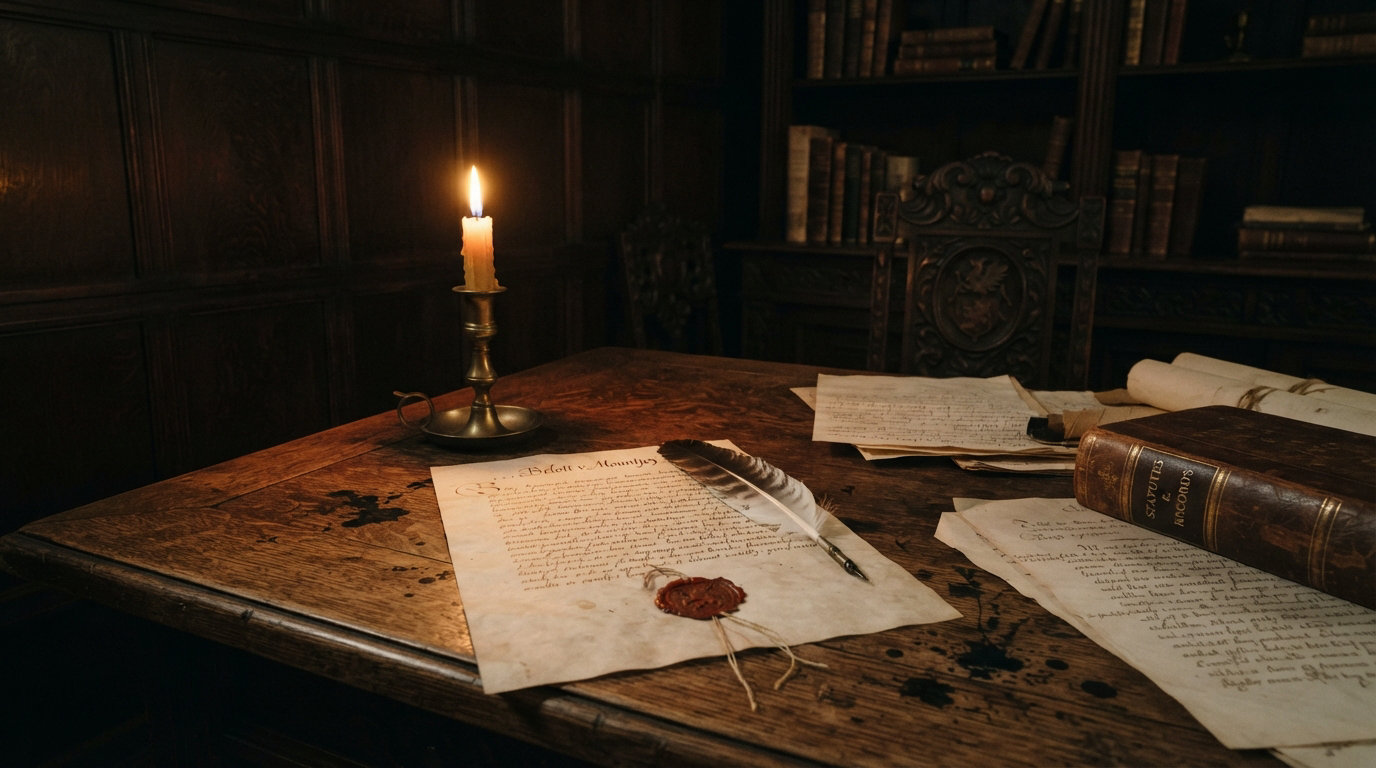
The Belott v Mountjoy lawsuit was a 1612 court case in which William Shakespeare testified as a witness in a family dispute over a promised dowry. I have spent years reading the surviving records from this curious little case, and I keep coming back to one simple fact: this is one of the only times we hear Shakespeare speak in his own voice about his own life, outside of his plays and poems.
For Shakespeare scholars, the records held at the National Archives under reference REQ 2/222/1 are gold dust. They place the playwright at a specific London address, name his close acquaintances, and let us glimpse how he moved through the households of immigrant craftsmen. In this guide, I will walk you through what the Belott v Mountjoy lawsuit reveals about Shakespeare’s life, why it matters, and how researchers use it today in 2026.
Table of Contents
What was the Belott v Mountjoy case about
The Belott v Mountjoy case was a private lawsuit filed in 1612 by Stephen Bellott against his former father-in-law, Christopher Mountjoy, over a promised dowry of around 50 pounds. The plaintiff’s name is sometimes spelled “Belott” and sometimes “Bellott” in the original court papers, which is why both forms appear in modern scholarship.
Stephen Bellott was a young Huguenot refugee who had come to London with his father Christopher Bellott to escape religious persecution in France. Christopher Mountjoy was a tiremaker, or “tyrewoman” as the trade was sometimes called, who made elaborate headdresses and headwear for the Jacobean court. In the closing years of Elizabeth I’s reign, Mountjoy had taken Shakespeare on as a lodger in his house on Silver Street, in the parish of St Olave’s near Cripplegate.
The dispute at the heart of the Belott v Mountjoy lawsuit was straightforward. Bellott claimed that Mountjoy had promised him a dowry of 50 pounds when he married Mary Mountjoy, Christopher’s daughter, in November 1604. He also said Mountjoy had agreed to leave him a further 200 pounds in his will. When Mountjoy refused to pay, Bellott brought the matter to the Court of Requests in Westminster, a civil court that handled relatively small claims for the poor.
The Mountjoy family had been part of London’s thriving French Protestant community for nearly two decades by this point. Marie Mountjoy, the matriarch, was a well-connected tiremaker who supplied headdresses and costume pieces for court masques performed before King James I and Queen Anne of Denmark. Her workshop at the Silver Street house was a small but important node in the network of craftspeople who dressed the early Stuart court.
The case dragged through the court system for several years after Shakespeare’s testimony. A second set of depositions followed in 1613, and the parties eventually settled the dispute out of court. Mountjoy’s will, when he finally died in the early 1620s, left Stephen Bellott only a small bequest, well short of the original 200 pounds the son-in-law claimed had been promised.
Shakespeare’s role as witness in the lawsuit
Shakespeare appeared in the Belott v Mountjoy case as a witness for the plaintiff, summoned to testify about his role in the marriage negotiations back in 1604. His deposition survives in the National Archives and includes one of only a handful of confirmed signatures of the playwright on a non-literary document.
The court interrogatories asked Shakespeare to confirm several specific facts. He was asked whether he had helped persuade Stephen Bellott to marry Mary Mountjoy. He was asked whether Mountjoy had promised a dowry. He was asked about the timing of the marriage settlement and whether the young couple had initially been reluctant to wed.
Shakespeare’s actual words, as recorded by the court scribe, are striking for their brevity. He confirmed that he had been a go-between in the marriage, that he had done Mr Mountjoy “right contented” service in the matter, and that he believed the promised dowry had been roughly 50 pounds. He added that Mary Mountjoy had been “worth” the dowry because her father valued her at the time at 100 pounds and the young Bellott’s portion was 50 pounds, equal to half her value.
It is unusual to find Shakespeare speaking this plainly in his own voice. In his plays and poems, his words are always mediated by character, narrator, or rhetorical mask. In the Belott v Mountjoy deposition, we get the bare, transactional language of a working playwright testifying about a household matter he clearly knew well.
The Court of Requests sat on 11 May 1612 to hear the first set of depositions, including Shakespeare’s. The case dragged on for several more years before being finally settled, but Shakespeare’s involvement was essentially complete after that single day of testimony. He was paid the standard witness fee for his appearance, the only direct payment we can document from his daily life in London.
What Shakespeare’s deposition reveals about his life
Shakespeare’s deposition in the Belott v Mountjoy case reveals four major facts about his life in London. It confirms his address, his social network, his standing in the Huguenot community, and his personal connections to the early Jacobean court through the Mountjoy workshop.
The most important biographical detail is the address. The deposition confirms that Shakespeare lodged with the Mountjoy family at their house on Silver Street in the parish of St Olave’s. This places him near the corner of Silver Street and Monkwell Street, only a short walk from the surviving evidence of his earlier residence in Bishopsgate. It also dates his residence in this particular house to roughly 1604 to 1605, the period of the marriage negotiations.
The Huguenot connection is the second major revelation. Stephen Bellott, his father Christopher Bellott, and the Mountjoy family were all members of London’s French Protestant refugee community. Shakespeare’s direct involvement in their affairs suggests he was comfortable moving between English and immigrant households, and that he was trusted to negotiate on intimate family matters. He was not, on the evidence of this case, a reclusive writer hidden away in an attic.
The third insight is social standing. Shakespeare testifies with the measured confidence of a respected neighbor. He is asked to evaluate dowry promises and was clearly in a position to know what the family had agreed to. The court treated him as a credible witness, and his testimony was given weight. This is the Shakespeare of the early Jacobean period, an established London professional in his late forties, no longer a rising young actor from Stratford.
The fourth detail is the connection to the court masque world. The Mountjoy workshop produced the elaborate tiremakers’ headdresses worn in the court masques staged for James I and Anne of Denmark. Shakespeare is widely believed to have had a role in writing the lost playCardenio performed at court in 1613, and his close working knowledge of at least one of the theatrical costumers fits the larger picture. The Belott v Mountjoy records help confirm that Shakespeare moved in the costume and staging world of the early Jacobean court.
Historical context of the Court of Requests and Huguenot London
The Court of Requests was a small civil court in Westminster that handled petitions from poor people, especially Londoners, who could not afford the higher fees of the King’s Bench or Chancery. It was the natural place for a journeyman Huguenot like Stephen Bellott to bring a private complaint against his father-in-law. The court kept detailed records of every deposition, which is why this case survives today.
The Huguenot community in early seventeenth-century London was substantial. Tens of thousands of French Protestants had fled to England, first after the St Bartholomew’s Day Massacre of 1572, and again after the revocation of the Edict of Nantes in 1685. They settled in particular neighborhoods, including the streets around St Olave’s Silver Street, and they worked as silk weavers, tiremakers, goldsmiths, and haberdashers.
Marriage among the Huguenots often followed continental customs. A formal dowry was negotiated through parents and a trusted go-between, and a written settlement was signed before the wedding. When Stephen Bellott claimed that Mountjoy had promised 50 pounds, he was invoking a tradition that would have been instantly recognizable to French, Dutch, and Italian refugee communities across London. Shakespeare’s role as a go-between in such a process reflects how thoroughly integrated he was with these customs.
In Elizabethan England more broadly, marriage was a financial and dynastic transaction as much as a personal one. The dowry was a concrete transfer of capital from the bride’s family to the new household, and disputes over promised sums were common. The Belott v Mountjoy case is unusual only because we have so much paperwork about it. Many similar disputes would have played out in the same court without surviving records.
Scholarly significance of the Belott v Mountjoy records
The Belott v Mountjoy lawsuit is one of the most cited primary sources in Shakespeare biography. The playwright’s signature on the deposition is one of only six that scholars agree are genuine, and the surrounding paperwork gives us his address, his social network, and his involvement in the daily life of immigrant London.
The film of Shakespeare’s signature on the deposition is in the National Archives at Kew. The Folger Shakespeare Library in Washington, DC, holds high-resolution images of the entire document, and the case is included in the Shakespeare Documented project, an online scholarly resource. Charles Nicholl’s 2007 book The Lodger Shakespeare draws heavily on these records and is now the standard secondary source for the case.
For modern researchers, the Belott v Mountjoy records are a model of how archival evidence can transform a literary biography. They show that even the most famous writer in the English language left a documentary trail through tax records, court cases, and marriage settlements, and that careful attention to these records can recover a richer picture of his everyday life.
Frequently asked questions
What does the Belott v Mountjoy lawsuit reveal about Shakespeare’s life?
The Belott v Mountjoy lawsuit reveals several key facts about Shakespeare’s personal life that we rarely see in other sources. It confirms his London address on Silver Street, his close ties to the Huguenot community, his role as a marriage go-between, and his standing as a respected neighbor in the parish of St Olave’s. The surviving deposition is one of only a handful of times we hear Shakespeare speak in his own voice about his own life.
What did Shakespeare’s deposition reveal?
Shakespeare’s deposition, given on 11 May 1612, revealed that he had lodged with the Mountjoy family on Silver Street and had personally served as a go-between in the 1604 marriage of Stephen Bellott and Mary Mountjoy. He confirmed that Christopher Mountjoy had promised a dowry of around 50 pounds and that he had been happy to help Mr Mountjoy in the negotiations. His testimony is one of only six confirmed signatures of Shakespeare on a non-literary document.
What was Shakespeare’s address in 1612 according to the lawsuit?
According to the Belott v Mountjoy lawsuit, Shakespeare lodged at the Mountjoy house on Silver Street in the parish of St Olave’s, near Cripplegate, around 1604 to 1605. This places him in north London, within walking distance of his earlier lodgings in Bishopsgate. The deposition is one of the few primary sources that gives us a specific street address for the playwright during this period of his life.
Why is Belott v Mountjoy important for Shakespeare’s biography?
The Belott v Mountjoy case is important because it provides rare documentary evidence of Shakespeare’s personal life, social standing, and London address outside of his own literary works. The National Archives hold the original deposition, the Folger Shakespeare Library has the full document, and Charles Nicholl’s 2007 book The Lodger Shakespeare uses these records to reconstruct Shakespeare’s daily life. Because so few primary sources survive for the playwright, any document where he speaks in his own voice is invaluable to scholars.
Conclusion
The Belott v Mountjoy lawsuit reveals more about Shakespeare’s life than almost any other surviving document from his lifetime. It confirms where he lived, who his neighbors were, and how he conducted himself in a small, private matter of household business. For a writer we otherwise know mainly through his public works, this rare glimpse into his everyday London life is one of the most valuable sources we have.