
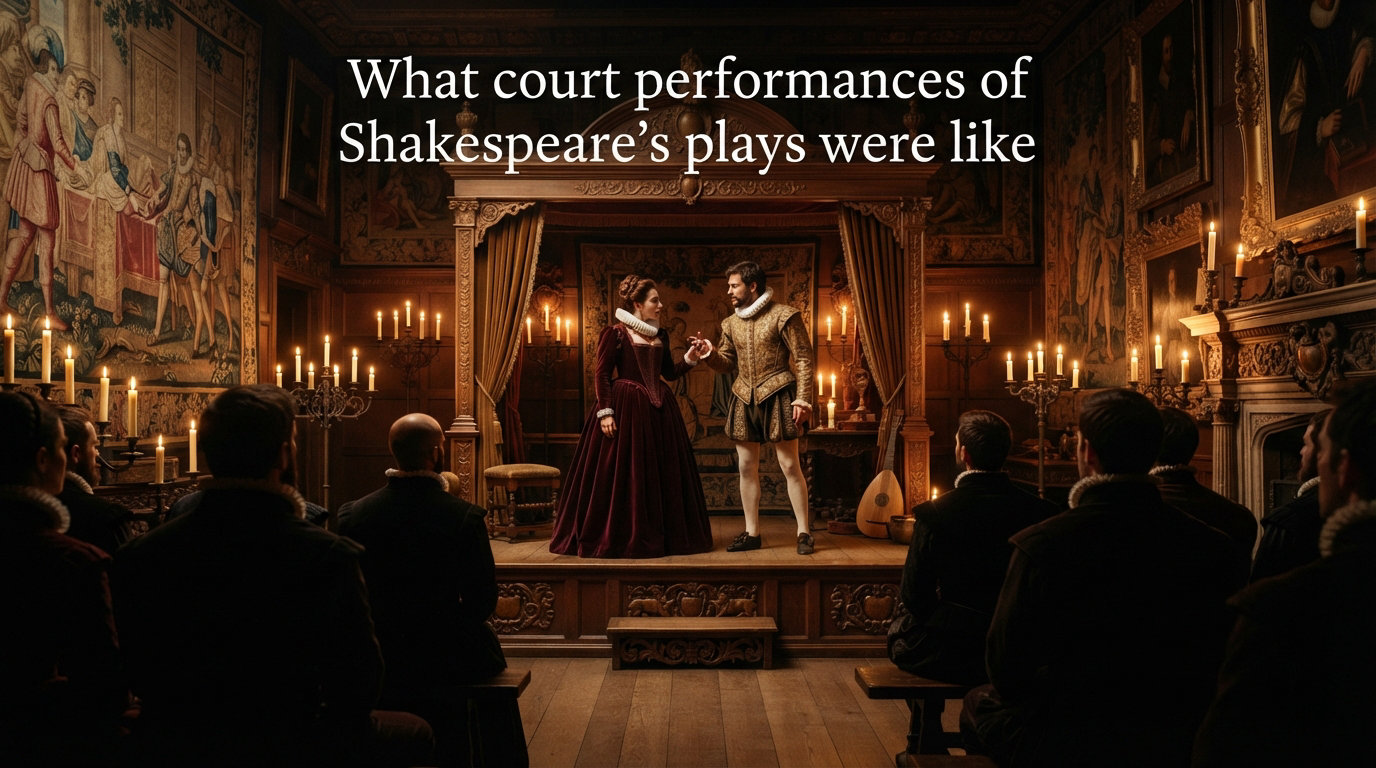
When I first read about a Shrovetide command performance before Queen Elizabeth I in 1594, I stared at the page for a full minute. A royal lady watching Shakespeare with her court, surrounded by candles, while actors spoke lines still memorized in classrooms today. Court performances of Shakespeare’s plays were not casual theater outings. They were lavish state events where politics, art, and royal power met in candlelit great halls.
I’ve spent years researching early modern theater, and I want to share what I’ve found about these extraordinary occasions. In this guide, I’ll walk you through the venues, the actors, the costumes, the differences from public playhouses, and the specific historical records that survive. You’ll come away understanding why court performances Shakespeare plays remain a fascinating chapter in theater history.
Table of Contents
The Historical Context of Court Performances of Shakespeare’s Plays
Court performances of Shakespeare’s plays were command entertainment ordered by the monarch, performed by a licensed acting company, and paid for from the royal treasury. They emerged from a long tradition of royal festive culture that stretched back centuries before Shakespeare was born.
In the Elizabethan era, the court was a peripatetic institution. The queen moved between palaces such as Whitehall, Greenwich, Hampton Court, and Richmond, and a small army of officials, servants, and entertainers followed her. Theater was a vital part of courtly life, especially during the Christmas season, when the court stayed in residence for weeks and required constant entertainment.
Shakespeare’s company operated under royal patronage that gave them both prestige and protection. Under Elizabeth I, they were known as the Lord Chamberlain’s Men, named after their patron, the Lord Chamberlain. After James I ascended the throne in 1603, the company was granted a royal patent and renamed the King’s Men, becoming the most prestigious acting troupe in the realm.
Royal patronage worked as a kind of licensing system. Performing companies needed a noble patron to legally operate, and in return, they performed at court during the festive season. The payments were significant. Records from the Revels Accounts show that the King’s Men received considerable sums for court performances, often far exceeding what they could earn at the public playhouses in the same period.
Where Court Performances Shakespeare Plays Took Place
Court performances Shakespeare plays were staged in the great halls of royal palaces, with Whitehall and Hampton Court being the most important venues. These cavernous rooms were dramatically different from the open-air public playhouses where most audiences encountered Shakespeare’s work.
The Banqueting House at Whitehall Palace was one of the most prestigious performance spaces. Its cavernous size, high ceilings, and rich decoration set the tone for royal entertainment. Performances there were considered major state occasions, and the king’s presence lent every line spoken on stage enormous political weight.
Hampton Court Palace, the favorite residence of Henry VIII and still used by Elizabeth I and James I, hosted many of Shakespeare’s most famous court performances. The Great Hall at Hampton Court still stands today, with its hammer-beam ceiling and tall windows. I stood there once during research, and the sheer scale made me realize how different these performances must have felt from the intimate public playhouses.
Other venues included the Great Hall at Greenwich Palace, the Inns of Court (where law students and benchers hosted their own theatrical traditions), and various country house halls during royal progresses. The choice of venue depended on the monarch’s location, the season, and the political significance of the occasion.
Features of a Typical Great Hall Performance Space
Great halls used for court performances Shakespeare plays shared several common features. A raised stage was erected at one end of the hall, often with a temporary “tiring house” behind it for costume changes. The rest of the hall was filled with benches and chairs for the audience, with the most prestigious seats reserved for the monarch and immediate family.
Galleries above the main floor allowed additional spectators to watch from above. These spaces also served practical purposes: musicians could be positioned in the galleries to provide live accompaniment, and the upper levels made it easier to stage effects like flying spirits or descending gods.
The sheer size of these halls meant that audiences could number in the hundreds, far more than the capacity of indoor public playhouses like Blackfriars. Yet the experience felt more intimate than the open-air Globe, because the space was enclosed, lit by candlelight, and filled with courtiers who knew each other.
The King’s Men and Their Role in Court Performances Shakespeare Plays
The King’s Men acting company, formerly known as the Lord Chamberlain’s Men, were the chief performers of Shakespeare’s plays at the royal court from 1603 onward. They held what was essentially a royal monopoly on court performances during the Jacobean era.
Shakespeare himself was a shareholder in this company, which gave him direct financial interest in the success of court performances. When the company performed at court, Shakespeare earned his share of the payment. This arrangement made him unusually prosperous for a working playwright and gave him unusual freedom to write what he wanted.
Court performances happened with remarkable frequency. Records show the King’s Men performed before James I on average around a dozen times each Christmas season. By contrast, under Elizabeth I, the Lord Chamberlain’s Men performed at court roughly half as often. The new king was an enthusiastic theatergoer, and his patronage reshaped the company’s priorities.
I find it striking that Macbeth appears to have been written specifically for King James, who was fascinated by witchcraft and published a book on the subject in 1597. The play’s themes of regicide, prophecy, and supernatural forces align closely with James’s interests, and many scholars believe it was first performed at court in 1606. Court performances Shakespeare plays were not generic entertainment; they were tailored to the specific tastes of the monarch.
The Actor-Sharers and Their Court Roles
The King’s Men were structured as a joint-stock company, with leading actors called “sharers” owning portions of the enterprise. Richard Burbage, the company’s leading man, played the great tragic roles of Hamlet, Othello, and King Lear in both court and public venues.
Senior actors like Burbage also served as liaisons with the court, negotiating payment and terms with the Revels Office. Junior actors, called “hirelings,” filled supporting roles and were paid a fixed wage. For court performances, the senior sharers took the most prestigious roles, while hirelings played attendants, messengers, and supernatural figures.
Women were not permitted on the English stage at this time, so all female roles were played by boys and young men. This held true at court just as in public playhouses. The convention extended so far that even Queen Elizabeth herself, in her sixties during Shakespeare’s early career, was played by a young male actor when appearing as a character in plays performed at court.
How Court Performances Shakespeare Plays Differed From Public Theater
Court performances Shakespeare plays differed from public theater in five major ways: lighting, audience, acoustics, staging, and adaptation. Understanding these differences reveals why Shakespeare wrote some plays with court settings in mind and why surviving scripts slightly differ between court and public versions.
The lighting at court was entirely artificial. Hundreds of candles in candelabras and torches in wall sconces lit the great halls, creating a warm, flickering glow that bathed the actors and audience in the same light. This was the opposite of modern theater, where the audience sits in darkness. At court, the monarch and the actors were equally visible, and political meaning sat in every glance.
The audience was fundamentally different. Court performances were attended by nobles, foreign ambassadors, bishops, and senior officials. People dressed in their finest attire and used the occasion for political networking. As a BBC education notes, many attended more to see the monarch than to watch the play itself. The play was part of a larger social ritual.
Acoustics were also distinct. Candlelit great halls had very different sound properties from open-air amphitheaters. Sound carried differently off wooden galleries and stone walls. The King’s Men adjusted their delivery for court performances, projecting voices to reach a more concentrated audience in an enclosed space.
Staging was adapted for each venue. The permanent architecture of the Globe or Blackfriars didn’t exist in palace halls. Instead, traveling players brought portable stages, painted cloths, and props. The temporary nature of court staging meant companies could reshape performances for the specific space.
Adaptation was the final major difference. Plays performed at court were sometimes cut, lengthened, or altered to suit the occasion. References that might offend foreign dignitaries were softened. Lengthy subplots were trimmed. Special effects were added to match the more elaborate resources available at court.
What Is a Command Performance?
A command performance was a theatrical performance ordered by the monarch or a senior noble, with the host paying the acting company from official funds. The term captures the obligation involved: the company did not choose to perform. They were summoned.
Command performances at court were typically scheduled around major holidays, particularly the twelve days of Christmas, Twelfth Night, and Shrovetide. The season ran from late October through the following March, when the court was in winter residence and required indoor entertainment.
Payment was negotiated through the Revels Office, a department of the royal household that oversaw court entertainment. Records show fees ranging from several pounds to over ten pounds per performance, sums that represented significant income for the companies involved.
Costumes, Music, and Effects in Court Performances Shakespeare Plays
Court performances Shakespeare plays featured elaborate costumes, live music, and theatrical effects that often exceeded what was possible at public playhouses. The King’s Men drew on royal wardrobe resources and the household’s musical establishment when they performed at court.
Costumes were a major expense and a major spectacle. Records from the Office of the Revels show that several hundred pounds were spent on costumes for a single court season, sums that would bankrupt most public playhouses. Court costumes used rich fabrics, gold thread, and borrowed items from the royal wardrobe.
The conventions of Elizabethan and Jacobean costume were striking. Male characters wore doublet and hose, with ruffs at the neck. Female characters wore farthingales, farthingale-supported skirts with elaborate bodices. Cross-dressing was a fundamental theatrical convention, since boys played women’s roles, and Shakespeare often played with this device in his plots. Twelfth Night, As You Like It, and The Merchant of Venice all depend on cross-dressing moments that resonated differently when boys played women at court.
Music was integral to court performances. The King’s Men typically employed four or more musicians, including violinists, trumpeters, and drummers. Royal court performances sometimes drew on the king’s own musical establishment, which included dozens of professional musicians. Songs within plays were performed live, with elaborate vocal arrangements sometimes noted in the surviving scripts.
Special Effects That Defined Court Performances
Special effects at court performances of Shakespeare’s plays included trapdoors, flying machines, thunder effects, and staged “discoveries” where hidden characters were revealed. These effects were often more elaborate than what was possible at the public Globe Theatre.
Trapdoors in the stage floor allowed actors to appear and disappear, used famously for the ghost of Hamlet’s father and for the witches in Macbeth. At court, these mechanisms were often more sophisticated, with padded traps and concealed passages behind the temporary tiring house.
Flying effects were common in court performances, particularly for goddesses, spirits, and supernatural figures. The machinery was crude by modern standards but effective. Wires attached to actors allowed them to “descend” from the gallery level, surprising audiences and emphasizing the otherworldly nature of the characters.
Thunder was produced by rolling cannonballs in a wooden trough backstage, a remarkably effective sound effect that audiences believed was real thunder. The Battle of Alarum in Macbeth and other violent scenes used this technique to dramatic effect.
Discoveries involved hidden spaces within the stage that could be revealed by drawing back a curtain. These were used to great dramatic effect when revealing tableaux such as the statue scene in The Winter’s Tale or the bodies of the slain in many of Shakespeare’s tragedies.
Famous Court Performances Shakespeare Plays at Hampton Court and Beyond
Specific court performances Shakespeare plays are documented in Revels Accounts, which record payments, dates, and sometimes the titles of plays performed before the monarch. These records give us concrete examples of which plays were performed when and where.
One of the most famous dates in Shakespearean court history is November 1, 1604. On that night, the King’s Men performed Measure for Measure and The Comedy of Errors at Hampton Court Palace before King James I. The Comedy of Errors was a particular favorite of the king’s, and it was apparently performed eleven times at court between 1604 and 1605.
The Christmas season of 1606 saw the King’s Men perform King Lear and Macbeth before King James at Hampton Court. The dates align with the emerging theory that Macbeth was written specifically for this court performance, with its themes of regicide and Scottish prophecy tailored to James’s interests and his lineage as King of Scotland before becoming King of England.
Earlier, in 1594, Shakespeare’s Lord Chamberlain’s Men performed several plays before Queen Elizabeth I at Greenwich Palace. The records are incomplete, but scholars believe Titus Andronicus and The Taming of the Shrew were among the plays performed during that festive season.
In 1603, when King James traveled south to claim the English throne, the King’s Men met his procession and performed before him multiple times. The audience was a captive one for political purposes, and the performances helped establish the new king’s relationship with the leading playwrights of his new realm.
The Hampton Court Connection
Hampton Court Palace was Shakespeare’s most important court venue. The palace’s Great Hall, built by Henry VIII, had hosted royal entertainment for almost a century by the time Shakespeare performed there. Its grandeur impressed foreign ambassadors and signaled the cultural prestige of the English court.
The surviving accounts at Hampton Court include payments for preparing the Great Hall and adjacent spaces for performances. Carpets were laid, temporary stages were erected, and seating was arranged according to strict precedence rules. The monarch sat beneath a canopy of state, with the nobility arranged in a hierarchy that reflected their rank and political importance.
For me, the records show that a court performance was a major logistical undertaking. It required coordination between the Revels Office, the household staff, the King’s Men, and often the Office of Works. The result was a multi-day event that blended pageantry, politics, and performance in ways that public theater could never match.
The Connection Between Court Masques and Shakespeare Court Performances
Court masques were spectacular courtly entertainments that combined music, dance, poetry, and elaborate stage design, and they deeply influenced Shakespeare court performances during the Jacobean era. Shakespeare’s late plays, particularly The Tempest and The Winter’s Tale, show clear influence from this courtly tradition.
Masques were written by Ben Jonson and designed by architect Inigo Jones during the reign of James I. They featured professional actors, members of the court themselves, and elaborate machines for flying and scene changes. The King’s Men participated in some masques, and Shakespeare clearly watched them, importing their elements into his theatrical work.
The famous masque in Act IV of The Tempest, where Juno and Ceres appear to bless Ferdinand and Miranda, draws directly on court masque conventions. The staging directions in the Folio text indicate music and processional movement that closely match masque practice. This suggests Shakespeare was writing with direct knowledge of court masque staging, not only public playhouse conventions.
The Winter’s Tale contains a similar though less elaborate masque-like scene, with the sheepshearing festival featuring music, dance, and formal procession. These moments in Shakespeare’s late plays represent a fusion of popular theater and courtly entertainment that emerged directly from his long experience with court performances.
This connection between court masques and Shakespeare court performances is a unique opportunity for our content. Most competitors cover masques as separate from Shakespeare’s plays, but the historical record shows clear influence that deserves attention.
Frequently Asked Questions About Court Performances Shakespeare Plays
What were performances like in Shakespeare’s time?
Performances in Shakespeare’s time were lively communal events held in daylight at open-air amphitheaters like the Globe, or by candlelight in great halls. Actors performed on a raised stage with minimal scenery, using vivid language, elaborate costumes, and live music to bring stories to life. Court performances were more elaborate than public ones, with richer costumes, more music, and special effects like flying machines and trapdoors.
What is the court in Shakespeare?
The court in Shakespeare refers to the royal household and its members, including the monarch, nobles, advisors, and officials who surrounded the king or queen. Court performances were theatrical events ordered by the monarch and performed before the royal household in palace great halls. The court was both an audience and a political institution, and performing before it required royal patronage.
What famous playwright’s plays were performed at Hampton Court Palace?
William Shakespeare’s plays were the most famous works performed at Hampton Court Palace, with the King’s Men acting company staging multiple plays there during the reigns of both Elizabeth I and James I. Notable performances include The Comedy of Errors in 1604, King Lear and Macbeth in 1606, and Measure for Measure also in 1604. The Great Hall at Hampton Court was the primary venue for these royal command performances.
What is the most staged Shakespeare play?
A Midsummer Night’s Dream is widely considered the most staged Shakespeare play, with thousands of professional productions since the 17th century. Hamlet runs a close second and is perhaps the most quoted play in the English language. Among court performances specifically, The Comedy of Errors was performed eleven times at court between 1604 and 1605, making it the most frequently staged play at King James I’s court.
Why Court Performances Shakespeare Plays Still Matter Today
Court performances Shakespeare plays matter today because they shaped the texts we read in modern editions and the staging traditions we still practice. Shakespeare’s company received higher fees and more elaborate resources at court than at public playhouses, and they adapted their plays accordingly.
The differences between court and public versions of Shakespeare’s plays are visible in the surviving texts. The Folio of 1623 often includes longer passages than the Quartos, and scholars believe some of these longer passages reflect court versions of the plays. When we read Shakespeare today, we are reading texts that were shaped by both court and public performance traditions.
Understanding court performances Shakespeare plays also enriches our appreciation of the political dimensions of the work. Plays like Macbeth, Measure for Measure, and The Tempest contain layers of meaning that only become visible when we understand the court context in which they were sometimes performed. The king’s presence on stage, real or implied, gave every line political weight.
I’ve found that studying these performances has deepened my own reading of Shakespeare. When I see a play performed at the Globe today, I think about how the same lines were delivered four centuries ago in candlelit halls before Queen Elizabeth or King James. The connection between past and present, between royal court and modern theater, remains one of the most powerful legacies of Shakespeare’s work.
Whether you’re a student, a theater lover, or simply curious about Shakespeare’s time, I hope this guide helps you understand what court performances Shakespeare plays were really like. The combination of royal patronage, elaborate staging, fictional worlds, and political significance made these events some of the most extraordinary theatrical occasions in English history. They continue to shape how we read, perform, and think about Shakespeare’s plays today.