
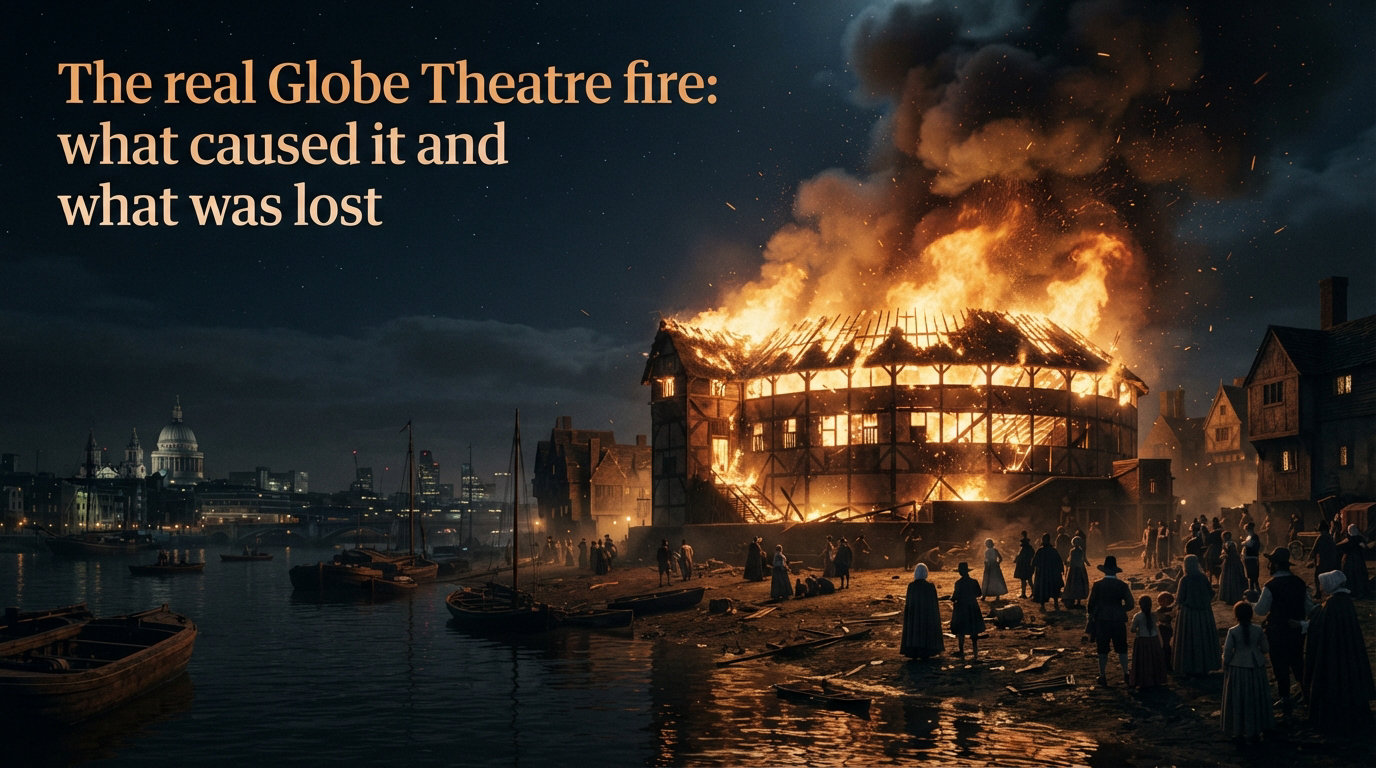
The real Globe Theatre fire of 1613 started on June 29, 1613, during a performance of Shakespeare’s Henry VIII (also called All Is True), when a stage prop cannon fired at the wrong moment and its sparks ignited the thatched roof over the stage. The entire wooden structure burned to the ground in under an hour, but remarkably no one was killed. If you have ever wondered what really happened that summer afternoon at the Bankside playhouse, here is the full story.
I have spent years researching Jacobean London playhouses, and the 1613 fire remains one of the most dramatic accidents in theatrical history. The combination of gunpowder, dry thatch, and an open-beamed timber roof made the original Globe a tinderbox waiting for a spark. Let me walk you through what caused the fire, what was lost when the flames died down, and how Shakespeare’s company rebuilt from the ashes.
Table of Contents
What caused the Globe Theatre fire of 1613?
The Globe Theatre fire was caused by a stage prop cannon misfiring during a performance of Henry VIII on June 29, 1613. A blank charge of gunpowder was fired to mark the entrance of King Henry at a masque scene in Cardinal Wolsey’s residence, but the wadding or sparks flew upward through the open stage roof and ignited the dry thatch.
The thatched roof, which covered the stage and most of the three-story wooden galleries, was the building’s most vulnerable feature. Unlike the tile roofs of more modern buildings, dry straw catches instantly from a single spark. Within minutes, the flames had spread along the length of the stage and into the galleries, where the audience sat on wooden benches.
Modern rebuilds of the Globe use fireproof materials, but the 1599 original relied on lime plaster over the outer walls and a wood-and-thatch roof. That combination was cheap to build and quick to repair, but lethal when exposed to a stage effect involving real gunpowder. Theatrical safety just did not exist in Jacobean London.
The performance of Henry VIII that night
The play being performed on the night of the Globe Theatre fire was Henry VIII, also known by its original title All Is True. It was a relatively new play, only three years old in 1613, and almost certainly written by Shakespeare in collaboration with John Fletcher, his younger successor at the King’s Men. The performance had been promoted with a playbill teasing the appearance of King Henry, which is why the theatre was full that afternoon.
The scene that triggered the disaster was the masque in Act One, Scene Four, where King Henry enters the great hall of Cardinal Wolsey. Staging manuals of the period suggest directors liked to use real-sounding cannon fire as a special effect for royal entrances. The problem was that the master of the props lit the cannon on a hot, dry summer day.
Audiences loved explosive theatrics, and the King’s Men had used prop cannons before without incident. The Bankside playhouse had become famous for combining drama with pyrotechnics, including the blaze effects in Henry VI Part One and the burning of Troy. This time, a single spark escaped the cannon’s muzzle and floated straight up into the roof.
Timeline of the fire: from spark to ashes
The Globe Theatre fire spread from a single spark to a full structural inferno in under one hour. The eyewitness account from Sir Henry Wotton describes the fire taking hold almost immediately after the cannon was fired, with the thatch catching so fast that the audience barely had time to react.
Here is the sequence of events as historians have reconstructed it:
- The cannon fires during the masque scene shortly after the play begins.
- Sparks or burning wadding land on the thatched roof and ignite it within seconds.
- Smoke is first mistaken for part of the special effects, delaying evacuation.
- The flames jump from the stage thatch to the timber-framed galleries above.
- Patrons flee into the yard and out of the exits onto Bankside.
- Within an hour, the entire roof has collapsed and the structure is a glowing ruin.
The fire was so complete that by the time the Thames watermen arrived with buckets, the wooden galleries were already falling inward. Bankside homeowners reportedly carried what they could from neighboring buildings, fearing the flames would spread along the timber-framed streets. The wind, fortunately, carried most of the embers downstream toward the river rather than into the city.
What was lost in the Globe Theatre fire
The Globe Theatre fire destroyed the entire playhouse building, including its stage machinery, props, costumes, and any company paperwork stored on site. While we have no precise inventory of what was inside, contemporary references make clear that the loss went well beyond the walls and roof.
Here is what historians believe was lost in the 1613 fire:
- The entire wooden structure of the Globe, including the three-tier galleries, stage, tiring house, and thatched roof.
- Costumes and props used by the King’s Men, including any elaborate coronation robes featured in Henry VIII.
- Set pieces and stage machinery, much of which had been custom-built for the theatre’s unique design.
- Prompt books, scripts, and musical scores stored in the tiring house or back rooms.
- Box office receipts and accounting ledgers kept by the company bursar.
- The “doors” or painted scenery panels used for indoor-style scenes in Henry VIII.
The financial loss on the building alone was estimated at around 1,400 pounds, a staggering sum at the time. To put that in perspective, a skilled craftsman in 1613 might earn around 20 pounds a year. The King’s Men faced losing their primary performance venue at the height of their commercial success, and they had to find funds quickly to rebuild.
Some scholars believe the company lost rare copies of plays in the fire, which is part of why so many of Shakespeare’s earlier works survive only in thin, sometimes imperfect quartos. The fire of 1613 may have been one of the first great losses of English dramatic literature, even though no human lives were claimed.
Eyewitness account: Sir Henry Wotton’s letter
The most famous eyewitness account of the Globe Theatre fire comes from Sir Henry Wotton, the former ambassador to Venice, who wrote a detailed letter to his nephew on July 2, 1613, just three days after the blaze. Wotton was in the audience that afternoon and described the fire with chilling precision.
In the letter, Wotton wrote: “Now, to set forth some particular of this fearful fire. The house, though it was thought invincible, was in the space of one hour utterly consumed, and not a stick of it standing, insomuch as it was thought some spirit of the air had been the author of that tragedy.”
Wotton also noted that the only injury came to a man whose “breeches” or trousers were set on fire by a falling spark, and who extinguished them with a bottle of ale carried by a quick-thinking friend. The humor of the moment, sitting alongside the terror of the loss, gives the letter its vivid, almost unbearable immediacy.
Wotton’s letter is one of the key primary sources used by historians to reconstruct what happened. Without it, we would have only the broad outlines from the King’s Men company records and the street ballad that was sold shortly afterward in London.
Casualties and the famous burned breeches
In the Globe Theatre fire of 1613, no one was killed and only one person was seriously hurt. Because the fire began during the early scenes of the play, the audience was still alert and not yet distracted by the action. People were able to walk out calmly at first, then run as the flames grew.
The single documented injury was the man whose breeches caught fire on a falling ember. He was reportedly saved when a friend doused him with a bottle of ale carried from the taproom. Beyond a few singed beards and burnt cloaks, the audience escaped largely unscathed.
It remains one of the most remarkable things about the 1613 fire. A wooden theatre packed with hundreds of people burned to the ground in under an hour, and yet no lives were lost. Many historians have called it the luckiest disaster in London’s history.
Rebuilding the Globe in 1614
The Globe was rebuilt in 1614 on the same Bankside site, opening later that year with a tiled roof instead of thatched. The decision to fireproof the new roof was a direct response to the 1613 disaster, and the King’s Men paid for the work partly from their own pockets and partly from a benefit performance arranged at court.
The cost of rebuilding was high, around 1,400 pounds, and the King’s Men took on additional shareholders to raise the capital. Shakespeare himself was reportedly a shareholder but by 1614 had largely retired to Stratford-upon-Avon, leaving the day-to-day management to John Fletcher and the company.
The rebuilt Globe stood for thirty more years until 1644, when the Puritans under Oliver Cromwell finally demolished it. By then, the playhouse had survived multiple close calls, including a second fire in 1614 that almost took down the new structure during construction. The eventual demolition marked the end of the original Globe and the beginning of nearly 350 years before Shakespeare’s playhouse was rebuilt again in London, this time with modern safety codes and a fireproof thatch.
FAQ
How did the fire start at the Globe Theatre?
The fire started when a stage prop cannon misfired during a performance of Henry VIII on June 29, 1613. Sparks or burning wadding flew into the thatched roof, which ignited instantly.
How many people died when the Globe Theatre burned down?
No one died in the 1613 Globe Theatre fire. The only documented injury was a man whose breeches were set on fire by an ember, and he was put out by a friend with a bottle of ale.
Why did the Globe Theatre have to be rebuilt in 1614?
The King’s Men rebuilt the Globe in 1614 because it was their primary performance venue and source of income. The new building used a tiled roof instead of thatch to prevent another fire.
Did Shakespeare stop writing after the Globe burned down?
Shakespeare did not write any new plays after the 1613 fire, though he may have collaborated on The Two Noble Kinsmen with John Fletcher in 1613 or 1614. He largely retired to Stratford-upon-Avon.
What play was being performed when the Globe caught fire?
The play being performed was Henry VIII, also known by its original title All Is True. It was a collaboration between Shakespeare and John Fletcher, written around 1611.
Conclusion
The real Globe Theatre fire of 1613 is the story of a single spark turning a Bankside afternoon into a historic disaster. A stage cannon fired during a performance of Henry VIII ignited the thatched roof, and the entire wooden playhouse burned to the ground in under an hour. Thanks to the quick evacuation and a fortunate breeze, no lives were lost, though the building, costumes, props, and possibly some company records were destroyed. The King’s Men rebuilt the Globe in 1614 with a tiled roof, and Shakespeare himself retired from the stage in the years that followed. If you found this guide useful, consider sharing it with fellow Shakespeare fans, or read more on our site about the original Elizabethan playhouses.