
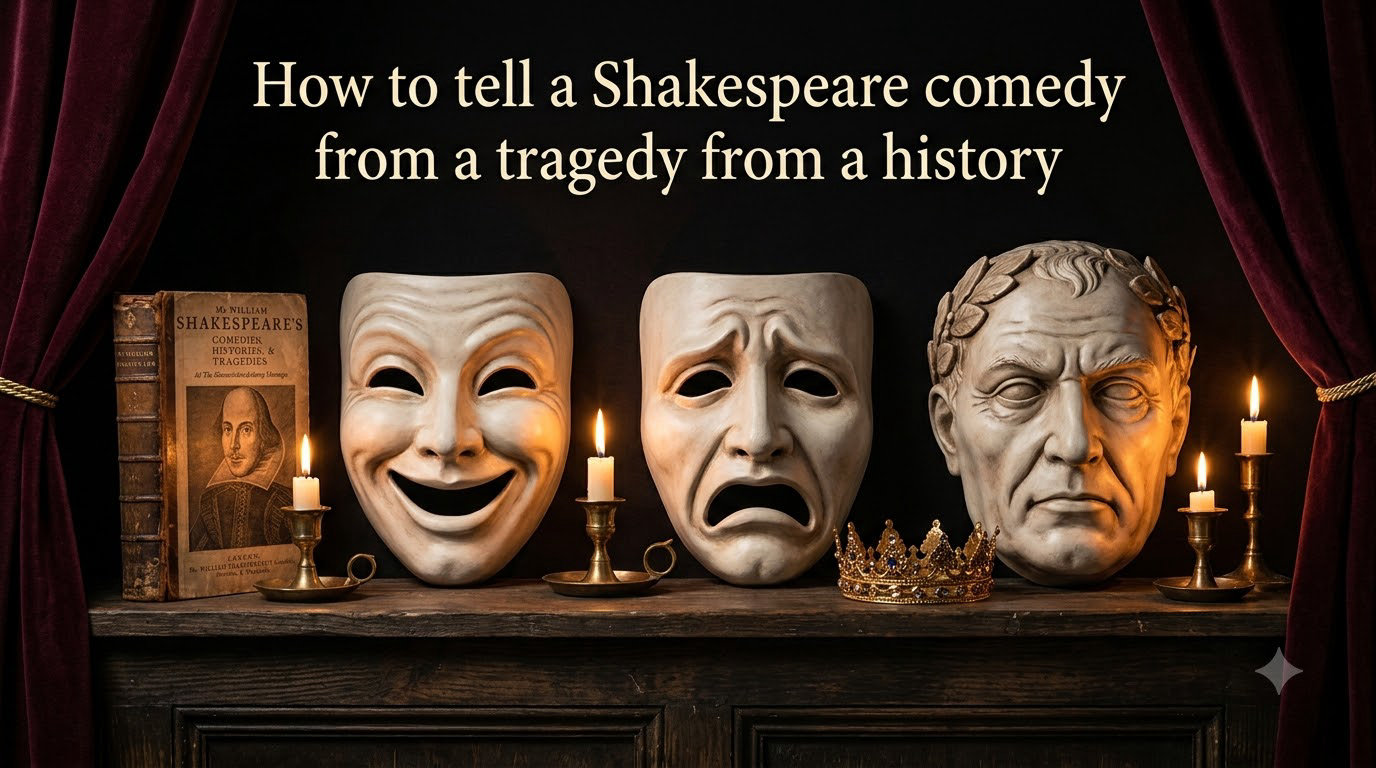
If you have ever picked up a Shakespeare play and wondered whether you are holding a comedy, a tragedy, or a history, you are not alone. Readers and students have asked this question for centuries, and the answer is more practical than you might think. Once you know the signature patterns of each genre, you can classify almost any Shakespeare play within minutes.
Shakespeare wrote roughly 38 to 39 plays across his career, and his colleagues sorted them into three main categories in the First Folio of 1623. Those categories are comedies, tragedies, and histories, and they remain the standard framework used in classrooms and theaters today. Understanding the Shakespeare comedy tragedy history classification system gives you a roadmap for what to expect in tone, structure, and outcome before you even open the first page.
In this guide, I will walk you through how each genre works, what markers to look for, and how to handle the tricky plays that refuse to fit neatly into one box. By the end, you will have a practical system you can apply to any play in the canon.
Table of Contents
Where the Three Categories Come From: The First Folio of 1623
The comedy, tragedy, and history labels trace directly back to a single book published in 1623, seven years after Shakespeare’s death. That book is the First Folio, compiled by two of Shakespeare’s fellow actors, John Heminges and Henry Condell. They gathered 36 of his plays into one large volume and organized them under three headings: Comedies, Histories, and Tragedies.
This was not a casual decision. Heminges and Condell were working within the literary conventions of their time, which drew on classical ideas about drama going back to Aristotle and the Roman playwrights. Renaissance critics believed that comedy and tragedy were fundamentally different art forms with different purposes. Comedy was meant to entertain and celebrate life, while tragedy was meant to instruct by showing the consequences of human failings.
The history category was somewhat unique to English Renaissance drama. Classical writers did not have a separate genre for historical plays. But English playwrights of the 1590s and early 1600s were deeply interested in their national past, and Shakespeare was the most ambitious of them all, covering centuries of English kings in interconnected cycles.
One important thing to understand is that Shakespeare himself never labeled his own plays this way. The genre categories were imposed after the fact by his editors. This is why some plays sit awkwardly on the boundaries, and why scholars still debate where certain works belong. The First Folio gave us a useful starting framework, but it was never meant to be the final word.
How to Identify a Shakespearean Comedy
A Shakespearean comedy is a play built around misunderstanding, romance, and social disruption that ultimately resolves into celebration and renewal. The defining feature is the ending: comedies end with marriage, reconciliation, or festivity, not death.
Here are the hallmarks you will find again and again across the comedies. If a play hits three or more of these, you are almost certainly reading a comedy.
Core Characteristics of Shakespeare’s Comedies
1. A happy ending built on marriage. Comedies resolve with weddings, betrothals, or reunions that restore social harmony. Think of the triple wedding at the end of A Midsummer Night’s Dream or the paired marriages closing As You Like It.
2. Mistaken identity and disguise. Characters frequently cross-dress, assume false names, or are confused for someone else. Viola disguises herself as a man in Twelfth Night, and the resulting chaos drives the entire plot.
3. Wordplay and verbal wit. Comedies are packed with puns, double meanings, and rapid-fire banter. The dialogue itself is often funnier than the situation, and lower-class characters like servants or clowns frequently deliver the sharpest lines.
4. Movement from disorder to order. Comedies typically begin with a disruption, like lovers quarreling, families feuding, or characters fleeing their homes. By the final act, the confusion clears and the social world returns to balance.
5. Young lovers facing obstacles. The central plot usually revolves around couples trying to get together despite external barriers, whether those are disapproving parents, rival suitors, or magical interference.
6. A pastoral or festive setting. Many comedies move characters out of the city and into forests, gardens, or country estates. Nature becomes a space where social rules loosen and transformation becomes possible.
The Full List of Shakespeare’s Comedies
The First Folio classified 14 plays as comedies, and modern scholars often expand this list to 17 by including later works that blend comedy with other elements. The core comedies are: The Tempest, The Two Gentlemen of Verona, The Merry Wives of Windsor, Measure for Measure, The Comedy of Errors, Much Ado About Nothing, Love’s Labour’s Lost, A Midsummer Night’s Dream, The Merchant of Venice, As You Like It, The Taming of the Shrew, All’s Well That Ends Well, Twelfth Night, and The Winter’s Tale.
Additional plays often grouped with the comedies include Pericles, Cymbeline, and The Two Noble Kinsmen, though these are sometimes classified separately as late romances because of their darker tones and more complex endings.
Comedy Identification Checklist
To quickly identify a comedy, ask yourself these questions: Does the play end with a wedding or celebration? Do characters use disguise or get mistaken for someone else? Is there a subplot involving servants or clowns providing humor? Do young lovers struggle against obstacles but eventually triumph? If you answered yes to most of these, you have a comedy on your hands.
How to Identify a Shakespearean Tragedy
A Shakespearean tragedy is a play that follows a person of high status from prosperity to destruction, driven by a fatal flaw that brings about their own downfall and the deaths of major characters. The defining feature is the ending: tragedies end in death, often multiple deaths, and they leave the audience with a sense of waste and sorrow.
Tragedies are where Shakespeare’s psychological depth reaches its fullest expression. These plays ask hard questions about ambition, jealousy, loyalty, and the limits of human self-knowledge.
Core Characteristics of Shakespeare’s Tragedies
1. A tragic hero of high rank. The protagonist is always someone of importance, a king, a general, a nobleman. Their fall matters because it affects entire nations, not just one family. Hamlet is a prince. Macbeth is a Scottish thane who becomes king. Othello is a celebrated military commander.
2. Hamartia, the tragic flaw. The hero possesses a specific weakness or error in judgment that sets the catastrophe in motion. This concept, borrowed from Aristotle, is called hamartia. Macbeth’s flaw is unchecked ambition. Othello’s is jealous insecurity. Lear’s is pride and a refusal to see the truth.
3. Hubris leading to a fall. Tragic heroes often display hubris, an overconfidence or pride that blinds them to danger. They believe they can control events or defy fate, and this overreach is precisely what destroys them.
4. Reversal of fortune, or peripeteia. At a key moment, the hero’s situation reverses dramatically. Everything that seemed to be going right suddenly collapses. Macbeth’s coronation gives way to paranoia, rebellion, and defeat.
5. Recognition, or anagnorisis. The hero comes to a devastating understanding of what they have done and who they really are. Othello realizes too late that Desdemona was faithful. Lear understands too late which daughter truly loved him.
6. Catharsis for the audience. The play builds toward an emotional release where the audience experiences pity and fear, then a kind of purging or cleansing. This is why tragedies can feel oddly uplifting despite their dark endings.
7. Death as the inevitable conclusion. The hero dies, and often so do many other characters. The stage is littered with bodies by the final scene. Order may be restored afterward, but it comes at a terrible cost.
The Four Great Tragedies
Scholars typically single out four works as Shakespeare’s greatest tragedies: Hamlet, Othello, King Lear, and Macbeth. These four are considered the peak of his tragic art because of their psychological complexity, philosophical depth, and dramatic power. Each explores a different facet of human destruction. Hamlet examines paralysis of will. Othello explores the corrosive power of jealousy. King Lear strips away every comfort to ask what makes us human. Macbeth charts the psychology of ambition turned murderous.
The Full List of Shakespeare’s Tragedies
The standard tragedies include: Titus Andronicus, Romeo and Juliet, Julius Caesar, Hamlet, Troilus and Cressida, Othello, King Lear, Macbeth, Timon of Athens, Antony and Cleopatra, and Coriolanus. The last three are sometimes called the Roman tragedies because they are set in ancient Rome, though they follow the same tragic structure as the English-set plays.
Note that Troilus and Cressida is one of the most debated plays in the canon. It appeared in the First Folio among the tragedies, but some scholars argue it belongs with the histories or even stands alone as a genre-defying work.
Tragedy Identification Checklist
To identify a tragedy, ask: Does the protagonist hold a position of power? Do they have a personal flaw that drives their downfall? Does the play end with the death of the main character? Is there a moment where the hero realizes their mistake too late? Does the audience feel a mix of pity and fear? Multiple yes answers mean you are reading a tragedy.
How to Identify a Shakespearean History Play
A Shakespearean history is a play based on the lives and reigns of real English monarchs, drawn primarily from historical chronicles and concerned with questions of power, legitimacy, and national identity. The defining feature is the subject matter: histories deal with actual kings and actual political events from English history.
Shakespeare wrote his history plays during a period when England was intensely interested in its own past. The recent defeat of the Spanish Armada in 1588 had fueled a wave of patriotic feeling, and audiences were hungry for stories about English kings, civil wars, and the forging of the nation.
Core Characteristics of Shakespeare’s Histories
1. Based on real English monarchs. The central characters are kings, queens, and nobles who actually lived. Shakespeare drew heavily from Raphael Holinshed’s Chronicles and Edward Hall’s The Union of the Two Noble and Illustrate Families of Lancaster and York. These were the standard history books of Shakespeare’s day.
2. Political themes. Histories explore what makes a good or bad ruler, the legitimacy of succession, the consequences of civil war, and the relationship between personal character and national fate. The fall of Richard II is framed as a national catastrophe that triggers decades of conflict.
3. Interconnected story arcs. Many history plays form sequences. The two main tetralogies cover the Wars of the Roses across multiple plays. The first tetralogy includes the three Henry VI plays and Richard III. The second tetralogy includes Richard II, the two Henry IV plays, and Henry V.
4. A mixture of tones. Histories blend tragic elements with comic relief. A history play can contain the death of a king and also scenes with comic characters like Falstaff. This tonal range is one reason histories can be hard to pin down.
5. The question of legitimacy. Nearly every history play wrestles with who has the right to rule. Richard II is deposed. Henry IV seized the crown by force. Henry V must prove himself worthy of a throne his father won through usurpation.
The Full List of Shakespeare’s History Plays
The First Folio classified 10 plays as histories: King John, Richard II, Henry IV Part 1, Henry IV Part 2, Henry V, Henry VI Part 1, Henry VI Part 2, Henry VI Part 3, Richard III, and Henry VIII. Some scholars also discuss Edward III as a possible history play with partial Shakespearean authorship, though it was not included in the First Folio.
A persistent question is why plays like Julius Caesar and Antony and Cleopatra are classified as tragedies rather than histories, even though they are also based on real historical figures. The answer is that the First Folio reserved the history label specifically for English history. Plays about Roman or other ancient figures were grouped with tragedies, regardless of their historical basis.
The Overlap Between Histories and Tragedies
This is where many readers get tripped up. Plays like Richard III and Richard II function as both history and tragedy. Both are based on real kings, satisfying the history criterion. But both also follow a tragic arc: a flawed ruler loses everything and dies. Richard III opens with one of the most famous villain soliloquies in all of English literature and tracks the rise and spectacular fall of a hunchbacked tyrant. It reads like a tragedy from start to finish.
The practical distinction is that histories are primarily concerned with national politics and the chain of English governance, while tragedies focus more intensely on the inner life and personal destruction of the protagonist. When a play does both, the First Folio’s classification is a reasonable default, but you should recognize the overlap.
History Identification Checklist
To identify a history, ask: Is the central character a real English king or noble? Is the plot drawn from documented English history? Does the play explore themes of political legitimacy and succession? Is the play part of a larger sequence about English monarchs? If most answers are yes, you are dealing with a history.
A Practical Guide to Telling the Genres Apart
The fastest way to tell a Shakespeare comedy from a tragedy from a history is to look at the ending, the protagonist’s fate, and the source material. These three signals will classify the vast majority of plays correctly. I use this approach myself whenever I encounter a play I am less familiar with.
Side-by-Side Genre Comparison
Here is how the three genres stack up against each other on the key questions.
Ending: Comedies end with marriage or celebration. Tragedies end with the death of the protagonist. Histories end with a change of ruler or the resolution of a political conflict, which may or may not involve death.
Protagonist: Comedies feature young lovers or clever servants. Tragedies center on a noble figure brought down by a personal flaw. Histories focus on English kings and the political figures around them.
Tone: Comedies are light, witty, and festive. Tragedies are dark, intense, and philosophically heavy. Histories are mixed, combining political seriousness with moments of humor and pageantry.
Structure: Comedies move from disorder to restored order. Tragedies move from order to destruction. Histories follow the arc of a reign or a dynastic conflict across multiple plays.
Source: Comedies draw on Italian novellas, classical Roman comedy, and folk traditions. Tragedies draw on classical models and earlier revenge narratives. Histories draw on English chronicles like Holinshed’s.
The Classification Decision Tree
When you need to classify a play, work through these questions in order. The first one that gives you a clear answer will usually settle the genre.
Step 1: Does the play end with weddings, reconciliations, or a festive celebration? If yes, it is almost certainly a comedy. This is the single most reliable signal across the entire canon.
Step 2: Does the protagonist die at the end as a direct result of their own decisions? If yes, and the character is a noble figure with a recognizable flaw, you are looking at a tragedy. The self-caused downfall is what separates tragedy from mere sad endings.
Step 3: Is the play about a real English monarch and drawn from historical chronicles? If yes, it is a history. The English specificity matters. Roman figures like Julius Caesar go into tragedy, not history, under the First Folio system.
Step 4: Does the play combine elements from multiple categories in a way that resists simple labeling? If yes, you may be dealing with a problem play, a late romance, or a work like Troilus and Cressida that scholars debate to this day. These require a more nuanced discussion.
Quick Reference for Tricky Plays
Some plays are notoriously hard to classify. Romeo and Juliet is technically a tragedy, but it feels like a love story, and some of its conventions echo comedy before the fatal turn. The Merchant of Venice is a comedy, but its treatment of Shylock and the trial scene carry a darkness that makes the happy ending feel uneasy. Richard III sits in the history section but operates as a textbook tragedy. Measure for Measure ends with a forced marriage that many readers find more disturbing than comic. These edge cases are not failures of the system but evidence of Shakespeare’s refusal to be boxed in by genre.
Problem Plays, Late Romances, and Plays That Defy Classification
Not every Shakespeare play fits cleanly into the comedy, tragedy, or history framework. Scholars have identified two additional categories to handle the plays that resist easy labeling: the problem plays and the late romances.
The Problem Plays
The term problem play was coined in the late nineteenth century by the critic F. S. Boas to describe three works that share an unsettling tone and resist easy genre classification: Measure for Measure, Troilus and Cressida, and All’s Well That Ends Well. These plays have the structure of comedy but the moral and emotional texture of tragedy.
In Measure for Measure, a deputy abuses his power to coerce a novice nun, and the resolution depends on a forced marriage that many modern audiences find troubling rather than joyful. In Troilus and Cressida, Shakespeare strips the heroism from the Trojan War, presenting a world of cynicism, betrayal, and disillusionment. In All’s Well That Ends Well, the heroine wins her husband through deception, and the audience is left wondering whether the marriage is a triumph or a sentence.
What makes these plays problem plays is not that they are bad. It is that they ask us to sit with discomfort. They refuse to deliver the clean emotional payoff that comedy or tragedy promises, and that refusal is precisely what makes them so fascinating to modern readers and directors.
The Late Romances
Shakespeare’s final plays are often grouped together as the late romances. These include Pericles, Cymbeline, The Winter’s Tale, and The Tempest. Some scholars add The Two Noble Kinsmen to this group as well.
The romances share a distinctive pattern. They begin with a family torn apart by jealousy, accusation, or shipwreck. They pass through years of suffering and separation. Then they resolve with a miraculous reunion, often involving the apparent return of someone believed dead. The tone is darker and more reflective than the early comedies, but the endings are genuinely redemptive.
The First Folio placed most of these plays among the comedies, but modern criticism recognizes them as a distinct group. They blend tragic suffering with comic resolution in a way that earns them their own category. The Winter’s Tale, for example, contains one of the most devastating scenes of jealousy and death in all of Shakespeare, followed by one of the most moving reconciliation scenes ever written. Calling it simply a comedy feels inadequate.
Tragicomedy as a Concept
The term tragicomedy captures the spirit of these genre-defying works. A tragicomedy blends the serious stakes of tragedy with the redemptive possibilities of comedy. The late romances are Shakespeare’s most fully realized tragicomedies. But traces of tragicomic structure appear throughout his career, which is part of why rigid genre labels can only take you so far with Shakespeare.
FAQs
What is the difference between a Shakespearean comedy and tragedy?
A Shakespearean comedy ends with marriage, reconciliation, or celebration and features mistaken identity, wordplay, and young lovers overcoming obstacles. A Shakespearean tragedy ends with the death of the protagonist, who is a noble figure destroyed by a personal flaw or error in judgment known as hamartia. Comedies move from disorder to restored order, while tragedies move from order to destruction.
What is an example of a tragicomedy by Shakespeare?
The best examples of Shakespearean tragicomedy are his late romances, particularly The Winter’s Tale and The Tempest. The Winter’s Tale begins with tragic jealousy and death but ends with a miraculous reunion. The Tempest opens with betrayal and exile but resolves through forgiveness and restoration. These plays blend serious suffering with redemptive endings in a way that fits neither pure comedy nor pure tragedy.
Is Macbeth a comedy, tragedy, or history?
Macbeth is a tragedy. It is one of Shakespeare’s four great tragedies alongside Hamlet, Othello, and King Lear. Macbeth follows a Scottish nobleman whose unchecked ambition, his tragic flaw, leads him to murder King Duncan and descend into tyranny and madness. The play ends with Macbeth’s death, the classic ending of a Shakespearean tragedy.
What makes a Shakespearean tragedy a tragedy?
A Shakespearean tragedy requires several elements: a protagonist of high social rank, a tragic flaw called hamartia that drives their downfall, a reversal of fortune, a moment of recognition where the hero understands their error, and a conclusion involving the death of major characters. The play should produce catharsis, a purging of pity and fear in the audience.
How are Shakespeare’s tragedies different from his comedies?
Shakespeare’s tragedies focus on a noble protagonist’s destruction and end in death, while his comedies focus on young lovers overcoming obstacles and end in marriage. Tragedies explore ambition, jealousy, and fatal errors in a dark, intense tone. Comedies explore romance, wit, and social confusion in a light, festive tone. The structural movement is opposite: tragedies go from order to chaos, comedies from chaos to order.
What are the four major tragedies of Shakespeare?
The four major tragedies of Shakespeare are Hamlet (around 1600), Othello (around 1603), King Lear (around 1605), and Macbeth (around 1606). These four are considered the peak of Shakespeare’s tragic art because of their psychological depth, philosophical complexity, and dramatic power. Each explores a different destructive force: paralyzed will, jealousy, pride, and ambition.
Why are Shakespeare’s plays divided into three categories?
Shakespeare’s plays are divided into comedies, histories, and tragedies because his fellow actors John Heminges and Henry Condell organized them that way in the First Folio of 1623. They followed Renaissance literary conventions that distinguished comedy from tragedy based on classical models. The history category was unique to English Renaissance drama and reflected the period’s fascination with national origins and royal succession.
What makes a play a Shakespearean history?
A Shakespearean history is based on the life of a real English monarch and is drawn from historical chronicles such as Holinshed’s Chronicles. History plays explore political legitimacy, succession, and the consequences of civil war. They are grouped in interconnected cycles covering the Wars of the Roses. Plays about Roman or other non-English historical figures are classified as tragedies, not histories.
Conclusion: Putting It All Together
Telling a Shakespeare comedy from a tragedy from a history comes down to three signals: the ending, the protagonist’s fate, and the source material. Weddings mean comedy. Death of a flawed noble means tragedy. A real English king drawn from the chronicles means history. When a play blends these signals, you have encountered one of Shakespeare’s more ambitious works, and that complexity is part of what makes his canon endlessly rewarding to explore.
I encourage you to try this classification system yourself the next time you pick up a Shakespeare play. Read with an eye for the structural patterns described here, and you will find that even the most genre-defying works become easier to understand once you know what conventions Shakespeare is working with, bending, or breaking. The Shakespeare comedy tragedy history framework is a starting point, not a cage, and Shakespeare’s greatest genius may be how often he refused to stay inside the lines.