
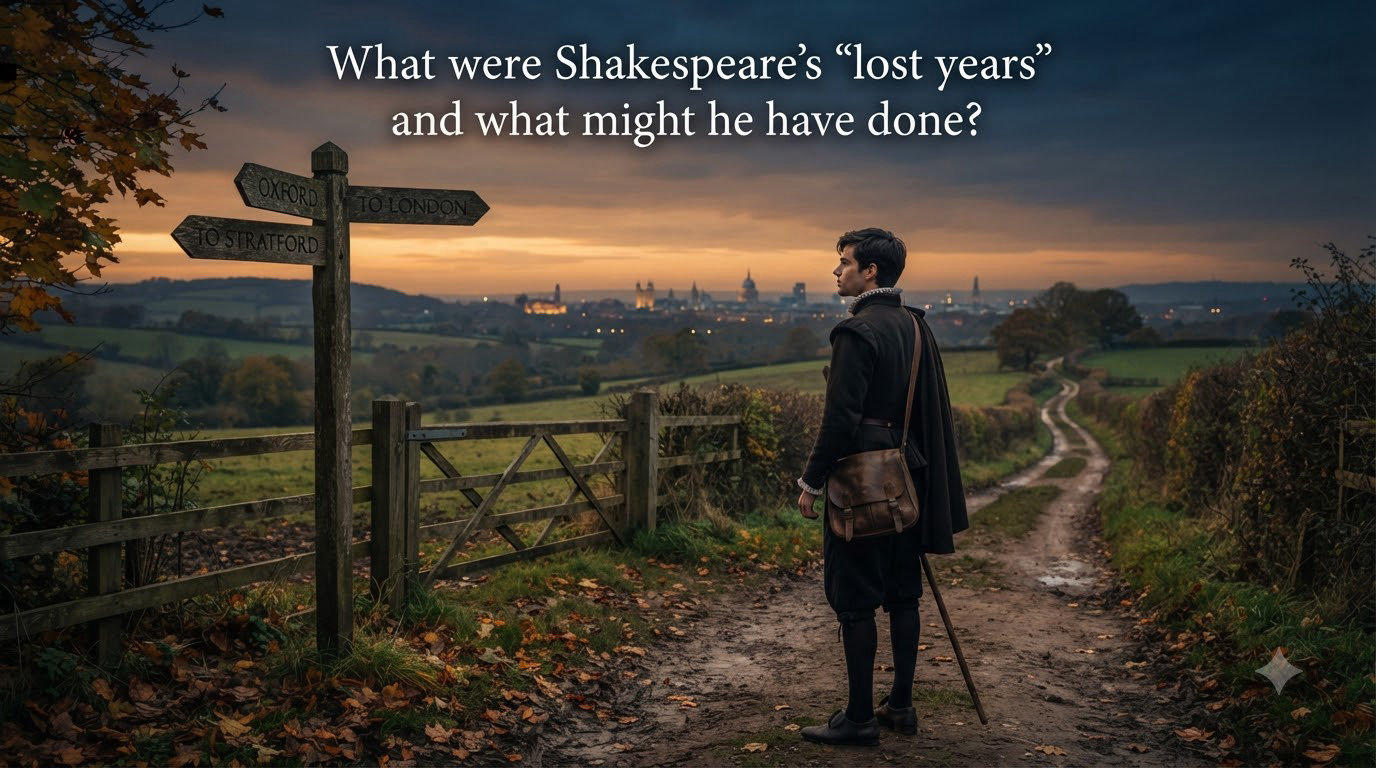
Shakespeare’s lost years refer to the period between 1585 and 1592 when no documentary records trace William Shakespeare’s activities, spanning from the baptism of his twins Hamnet and Judith in Stratford-upon-Avon to his emergence as a working playwright on the London theatre scene. For roughly seven years, the man who would become the most famous writer in the English language vanished from the historical record, leaving scholars and biographers to piece together his story from rumour, speculation, and a handful of late sources.
I find this gap fascinating because it sits at the heart of how Shakespeare became Shakespeare. Whatever he did in those seven years helped him develop the extraordinary range of knowledge that later filled his plays with insights into law, warfare, courtly life, Italy, and human nature. Understanding the lost years of Shakespeare is, in many ways, the key to understanding how a glover’s son from a small Warwickshire market town became the supreme poet of the English language.
In this guide, I will walk you through what we know, what we think we know, and what we will probably never know about Shakespeare’s lost years. I will cover the leading theories, the historical context of Elizabethan England during that period, and the moment Shakespeare reappears in the documentary record in 1592. I will also address the famous stories about deer poaching and teaching school, and explain why those stories might still matter.
Table of Contents
What Years Are Considered Shakespeare’s Lost Years?
The lost years of William Shakespeare cover 1585 to 1592, roughly seven years that bookend his life between two firmly documented events. The starting point is the baptism of his twins Hamnet and Judith at Holy Trinity Church in Stratford-upon-Avon on 2 February 1585. The endpoint is his emergence as a London playwright by 1592, when the writer Robert Greene attacked him as an “upstart crow” in the pamphlet Groats-Worth of Wit.
Between those two anchors, there are no surviving letters, business documents, parish records, court appearances, or guild memberships that mention Shakespeare by name. For a man who would become the most influential writer in the English-speaking world, this silence is striking. Biographers usually divide the lost years into three phases: 1585-1587 (immediately after the twins’ birth), 1587-1589 (the period of greatest speculation), and 1589-1592 (when he may have been moving toward London).
What makes the dates tricky is that historians disagree about exactly when Shakespeare left Stratford. Some scholars argue he stayed close to home until 1591. Others suggest he was already working in the London theatre by 1588. The 1592 endpoint is the only part most experts agree on, because Greene’s hostile reference tells us Shakespeare was already established enough to threaten established playwrights by that year.
Why Are These Years Called Shakespeare’s ‘Lost Years’?
Shakespeare’s lost years are called “lost” because historians have found almost no documentary evidence from this period that mentions William Shakespeare of Stratford. No letters survive. No property transactions are recorded. No court cases bear his name. No apprenticeship records list him. For seven crucial years, the documentary trail simply stops.
The reason for this gap is partly social. Shakespeare was the son of a glover and whittawer, John Shakespeare, who had fallen on hard times by the mid-1580s. The family had stopped paying tithes, lost their coat of arms application, and slipped into a kind of middling obscurity. Records of ordinary townspeople in late sixteenth-century England were sparse compared with those of gentry, clergy, and major merchants. If Shakespeare was working as an itinerant labourer, actor’s assistant, or country schoolmaster, he would have left little paper behind.
Elizabethan record-keeping practices also explain the silence. Parish registers tracked baptisms, marriages, and burials but rarely people’s daily movements. Tax records focused on the wealthier households. Guild records covered only those who completed formal apprenticeships, which Shakespeare apparently never did in any documented trade. The earliest substantial records of his life in London begin around 1592-1594, when he was already established enough to attract notice from rival writers.
I think this absence tells us something important about class in Elizabethan England. The lives of commoners were often invisible to the historical record unless they committed crimes, joined institutions, or accumulated property. Shakespeare was, in the 1580s, simply a young husband and father in a struggling family. There was no reason for anyone to write about him.
England in 1585-1592: The World Shakespeare Inherited
To understand Shakespeare’s lost years, you have to understand what was happening in England while he was missing from the record. The years 1585 to 1592 were among the most turbulent of Elizabeth I’s reign, and they shaped the world that Shakespeare would later write about.
In 1585, England entered the Anglo-Spanish War by sending troops to the Netherlands to support Dutch rebels against Spain. From 1587 onward, the country prepared feverishly for the Spanish Armada, which finally arrived in 1588. The Armada’s defeat unleashed a surge of patriotic feeling across England, and travelling players frequently performed patriotic plays to capitalise on the mood. A young man interested in the theatre could hardly have avoided the excitement.
Between 1589 and 1591, England faced harvest failures, recurring plague outbreaks, and economic depression. Stratford-upon-Avon itself suffered badly. The town council repeatedly petitioned the government for relief. Families like Shakespeare’s, already struggling, were pushed further into poverty. Some historians think the worsening conditions may have driven young William to seek work elsewhere, possibly in London.
The theatre scene was also changing rapidly. In the late 1580s, playing companies began performing in purpose-built playhouses rather than inn yards and great halls. The Theatre opened in 1576, the Curtain in 1577, and the Rose in 1587. By 1592, the stage was becoming a serious profession, capable of supporting full-time writers and actors. Shakespeare appears to have arrived at exactly the moment the London theatre was professionalising into an industry.
What Did Shakespeare Do During His Lost Years? The Major Theories
Biographers have proposed several theories about what Shakespeare was doing between 1585 and 1592. None can be proved. None can be disproved. Taken together, they form a portrait of a young man of unusual curiosity and ambition, trying to find his place in a difficult world.
The Deer Poaching Story and Sir Thomas Lucy
The most famous story about Shakespeare’s lost years is the deer poaching tale. According to a tradition recorded by Nicholas Rowe in 1709, young Shakespeare poached deer from the park of Sir Thomas Lucy at Charlecote, near Stratford. When caught, he was reportedly punished and wrote a satirical ballad about Sir Thomas, which so angered the local magistrate that Shakespeare was forced to flee the town and seek work in London.
This story has the ring of folk legend. Sir Thomas Lucy was a real person, an active prosecutor of Catholic recusants and a notable local magistrate. The ballad supposedly mocking him has not survived. Critics point out that the story contains many typical features of origin myths about famous writers: youthful transgression, persecution by a powerful local figure, and a heroic flight that explains later greatness.
Even so, the deer poaching story has not been dismissed entirely. It appears in multiple seventeenth-century sources and may reflect a genuine incident. It also fits the historical context. Stratford had forests and deer parks nearby, and poaching was common enough that landowners like Sir Thomas prosecuted it vigorously. If Shakespeare was involved in any trouble that drove him from Stratford, it may well have involved game rather than religion or crime.
John Aubrey’s Schoolmaster Account
The most widely repeated theory about Shakespeare’s lost years is that he worked as a country schoolmaster. This idea comes from a brief note written by the antiquary John Aubrey in the 1680s, who claimed that Shakespeare had been “in his younger years a schoolmaster in the country.” Aubrey was writing nearly a century after the events, but his notes were based on older local traditions.
The schoolmaster theory fits what we know about Shakespeare’s education. He attended the Stratford grammar school, where he would have studied Latin grammar, classical literature, and rhetoric. Schoolmasters in Elizabethan England were often young men who had completed their own education but not yet established themselves in another profession. It was a respectable, if poorly paid, occupation.
What makes the theory attractive is that it explains Shakespeare’s later mastery of Latin texts, classical mythology, and historical examples in his plays. A man who taught school for a few years would have refreshed and deepened his classical knowledge through daily work. It also explains his familiarity with logic, rhetoric, and moral philosophy, all of which were part of the grammar school curriculum.
Soldier, Lawyer’s Clerk, and Travelling Player Theories
Several other theories have circulated about Shakespeare’s lost years, each with some evidence behind it. Some scholars have suggested Shakespeare served as a soldier in the Low Countries during the Anglo-Spanish War. The 1585-1592 period coincided exactly with English military campaigns in the Netherlands, and Shakespeare’s later plays show surprising knowledge of military life, fortifications, and soldierly slang.
Others have proposed that Shakespeare worked as a lawyer’s clerk in Stratford or Warwick. This would explain his later fluency with legal terminology, courtroom procedure, and the rhythms of legal argument that pervade his plays. Shakespeare used the word “voucher” more than 100 times, “indenture” more than any other writer of his era, and “sinew” in legal contexts dozens of times. Only a man who had spent time in legal offices would absorb that vocabulary.
Perhaps the most plausible theory is that Shakespeare spent some of his lost years with travelling players. In the 1580s, companies of actors regularly toured the English provinces, stopping at Stratford and other market towns. A young man with literary ambitions might well have joined such a company, learned the basics of acting, and gradually worked his way toward London. By 1592, he was apparently a member of a company good enough to provoke Robert Greene’s jealous attack.
How Shakespeare Emerged on the London Theatre Scene in 1592
Shakespeare reappears in the documentary record in 1592, when the playwright Robert Greene published Groats-Worth of Wit. In this pamphlet, Greene warned his fellow university-educated writers about an “upstart crow, beautified with our feathers, that with his tiger’s heart wrapped in a player’s hide supposes he is as well able to bombast out a blank verse as the best of you.” The line “O tiger’s heart wrapped in a woman’s hide” was a deliberate parody of a line from Shakespeare’s Henry VI, Part 3.
Greene’s attack is hugely important. It proves that by 1592 Shakespeare had already established himself as an actor and playwright in London, good enough to be seen as a threat to established writers. It also shows he had begun writing his history plays, since Henry VI was almost certainly performed in 1591 or early 1592. The pamphlet was entered in the Stationers’ Register on 20 September 1592.
By 1593, Shakespeare had published his poem Venus and Adonis, and by 1594 he was a founding member of the Lord Chamberlain’s Men, the most important playing company in London. From that point on, the documentary record becomes dense and continuous. We know what he wrote, when it was performed, what he earned, and where he lived. The lost years were over for good.
Do Shakespeare’s Lost Years Show Up in His Plays?
Whatever Shakespeare did during his lost years left traces in his work. The plays he wrote from the 1590s onward draw on an astonishing range of knowledge that he could not have acquired from books alone. He knew Italian city life intimately enough to set Romeo and Juliet, The Merchant of Venice, and The Taming of the Shrew in Verona and Venice. He understood military camps, naval battles, and the details of soldiery in ways that suggest firsthand observation.
The legal fluency of Shakespeare’s plays is particularly striking. The Merchant of Venice revolves around a bond dispute and a court scene. Measure for Measure is built around English common law and the uses of royal prerogative. Hamlet features a court scene that reflects genuine procedure. If Shakespeare had worked as a lawyer’s clerk during his lost years, his plays would be exactly what we would expect them to look like.
I find the Italian settings especially intriguing. Some scholars have speculated that Shakespeare travelled to Italy during his lost years, possibly fleeing religious persecution or simply as a young adventurer. Others argue he learned about Italy from English travellers’ accounts and Italian dictionaries. The truth may be a combination. Either way, the lost years produced a man whose curiosity about the world fed directly into the imaginative universe of his plays.
Frequently Asked Questions About Shakespeare’s Lost Years
What did Shakespeare do from 1585 to 1592?
Shakespeare’s activities between 1585 and 1592 are undocumented. Scholars believe he likely worked as a country schoolmaster, helped with his father’s business, may have poached deer from Sir Thomas Lucy’s park, and possibly joined a travelling theatre company before arriving in London by 1592.
What years are considered the lost years of Shakespeare?
Shakespeare’s lost years refer to the period from 1585 to 1592, beginning with the baptism of his twins Hamnet and Judith and ending with his emergence as a playwright in London.
Why are the years between 1585 to 1592 called the lost years?
They are called lost years because historians have found almost no documentary records from this period mentioning William Shakespeare. No letters, court records, business documents, or apprenticeship papers survive from these seven years.
Why did Shakespeare disappear for 7 years?
Shakespeare likely did not deliberately disappear. As a commoner from a struggling family in Stratford-upon-Avon, he left few traces in the records that historians depend on. Ordinary people of his class were rarely documented unless they committed crimes or joined institutions.
What are the theories about Shakespeare’s lost years?
The main theories include: Shakespeare worked as a country schoolmaster (John Aubrey’s account), fled Stratford after poaching deer from Sir Thomas Lucy’s estate, served as a soldier in the Low Countries, worked as a lawyer’s clerk, helped with his father’s glove-making business, or joined a travelling theatre company on its way to London.
What did Shakespeare do in his lost years?
The most widely accepted theory is that Shakespeare combined several activities during his lost years: teaching school, helping his father, and gradually moving toward the theatre through connections with travelling players before settling in London by 1592.
What was Shakespeare doing in 1592?
By 1592, Shakespeare was established in London as both an actor and a playwright. Robert Greene’s pamphlet Groats-Worth of Wit attacked him as an upstart crow, proving Shakespeare was already a recognised figure on the London stage.
What happened in Shakespeare’s life in 1585?
In 1585, Shakespeare’s twins Hamnet and Judith were baptised at Holy Trinity Church in Stratford-upon-Avon on 2 February. This baptism is the last firm documentary evidence we have of Shakespeare until his appearance in London seven years later.
Why Shakespeare’s Lost Years Still Matter
Shakespeare’s lost years between 1585 and 1592 remind us that even the most famous figures in history were once young, ordinary, and undocumented. Whatever William Shakespeare did in those seven years, whether he taught school, poached deer, served as a clerk, or joined a touring company, he emerged as a writer whose range and depth still astonish us four centuries later.
The lost years of Shakespeare matter because they shaped the man behind the plays. If you want to understand how the glove-maker’s son from Stratford became the supreme poet of the English language, you have to start here, in the silence between the baptismal record of 1585 and the hostile pamphlet of 1592. That silence is not empty. It is full of possibilities that we may never fully resolve.