
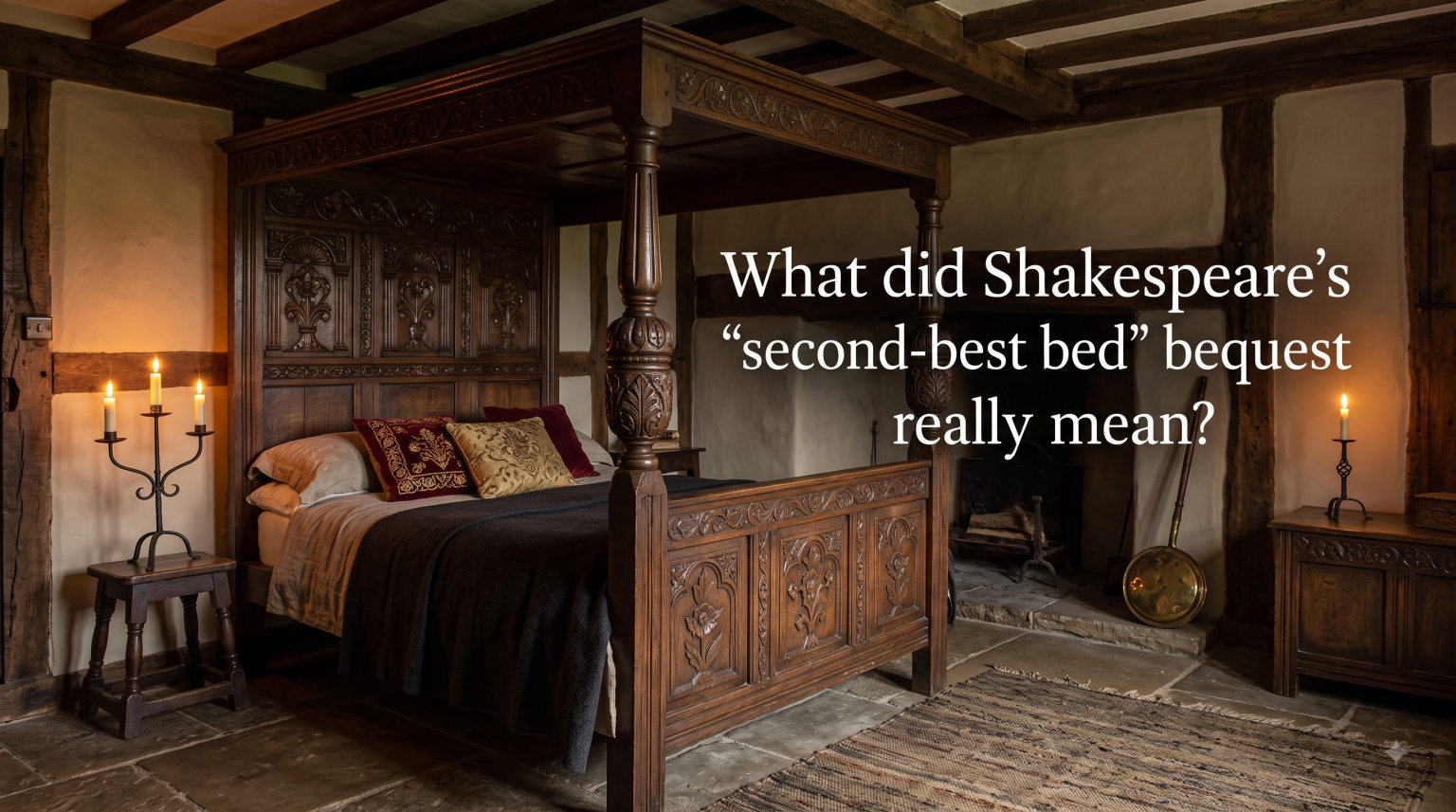
When William Shakespeare sat down to revise his Last Will and Testament in March 1616, he added a single, short sentence that has tormented literary detectives ever since. In his own handwriting, the playwright left his wife Anne Hathaway “my second best bed with the furniture.” That line, often quoted as evidence of a cold marriage, is almost certainly the opposite of a slight. In Elizabethan England, the “second-best bed” was the one the couple actually slept in. The “best bed” was reserved for guests.
I have spent weeks reading through the Shakespeare Birthplace Trust archive, the OUP academic blog, and the BBC’s coverage of the National Archives scientific study. What I found surprised me. The famous bequest is less a clue to a failed marriage than a window into how Tudor families slept, inherited, and protected widows. Here is what the Shakespeare second-best bed bequest really meant.
Table of Contents
The Exact Wording of Shakespeare’s “Second-Best Bed” Bequest
Shakespeare’s will survives as a four-page document, three of which are written in the scrivener Thomas Whittington’s hand. The famous bequest appears in a passage added in March 1616, just weeks before Shakespeare’s death on 23 April 1616. The wording, transcribed from the original held at the National Archives, reads:
“I gyve unto my wief my second best bed with the furniture.”
That single sentence, sitting among bequests of property, silver bowls, and cash sums to his daughters Susanna and Judith, has generated more academic argument than any other clause in the document. The phrase “second best bed with the furniture” tells us two things immediately. First, Shakespeare owned multiple beds. Second, “furniture” in Elizabethan English did not mean tables and chairs.
What “Furniture” Meant in Elizabethan England
In Elizabethan usage, “furniture” referred specifically to the soft furnishings of a bed. That included the curtains that hung from the tester (the wooden canopy frame), the coverlet (the decorative top blanket), the blankets, sheets, and sometimes the featherbed and bolster itself. A complete set of bed furniture could be worth more than a common laborer’s annual wages. The Shakespeare Birthplace Trust notes that when Shakespeare wrote “furniture,” he was not leaving Anne a bare wooden frame. He was leaving her the entire outfit of the marital bed.
Why “Second-Best” Almost Certainly Meant the Marital Bed
The single most important fact for understanding the Shakespeare second-best bed bequest is this. In Tudor households, the “best bed” was not where the family slept. It was a status symbol kept in the best parlour or guest chamber, displayed to visitors as proof of the household’s prosperity. The bed the husband and wife actually shared was, by long custom, the second-best in the house.
This convention is so well established that Shakespeare himself wrote it into Romeo and Juliet. When the Capulet servant instructs the nurse to “go fetch the best bed, the best bed in all of Padua,” he is referring to the guest chamber, not the family sleeping quarters. English families kept their best bed downstairs or in a dedicated guest room, the way some households still keep a “good china” cabinet today. The bed Anne and Will slept on at New Place in Stratford-upon-Avon was almost certainly the second-best bed.
Beds as Heirlooms Worth Protecting
Elizabethan beds were not casual furniture. A well-made oak bed with carved headboard, tester frame, curtains, and featherbed could cost the equivalent of a small cottage. They were passed down through generations like jewellery. When Shakespeare wrote “second-best bed with the furniture,” he was leaving Anne something materially valuable, not symbolically shabby.
The 230-Year Transcription Error
For more than two centuries, scholars thought Shakespeare had left Anne a much stranger item. An early transcript of the will recorded the phrase as “my brown best bed,” which made no sense at all. The mistake came from misreading the original secretary hand, in which the long-s character in “second” can resemble the letters “br.”
The correction came in 1790, when the Shakespeare scholar Edmond Malone examined the original probate copy at Doctors’ Commons and confirmed the wording was “second best bed,” not “brown best bed.” Yet the older reading still circulates in popular references, and some confusion persists. Paleographers (specialists in old handwriting) have since confirmed that the document clearly reads “second best” when properly interpreted.
What Anne Hathaway Was Legally Entitled To Under Dower Law
To understand why the bed bequest was emotionally generous rather than legally stingy, you have to understand dower law. Under English common law in Shakespeare’s time, a widow was automatically entitled to one-third of her husband’s real estate for the rest of her life. This was her “dower right,” and it could not be overridden by the will.
Anne Hathaway was therefore already legally entitled to one-third of New Place, the largest house in Stratford-upon-Avon, plus a lifetime interest in a portion of Shakespeare’s other property. The daughters Susanna and Judith inherited the estate outright in the will, but Anne had a guaranteed legal claim regardless. So when Shakespeare added the bed bequest on top of her dower rights, he was giving her something personal and movable, something she could keep in her own household management.
Coverture and Married Women’s Property
There is a related legal concept called coverture. Under coverture, a married woman’s property, wages, and inheritance legally belonged to her husband during the marriage. Anne could not independently own land in her own name. Anything Shakespeare gave her directly through the will was a way of restoring personal property to her control. The bed was Anne’s to do with as she pleased, and importantly, it was hers alone, not part of the estate Susanna would inherit.
Other Bequests in Shakespeare’s Will
The bed to Anne is the famous bequest, but it is one line in a much larger document. To get a fair picture, you have to look at what everyone else received. Susanna Hall, Shakespeare’s elder daughter, got New Place and the bulk of the estate. Judith, his younger daughter, received 150 pounds (a substantial sum, payable in instalments), all his silver bowls, and the lease to the Blackfriars Gatehouse.
Shakespeare’s sister Joan got the cottage at Stratford that Anne Hathaway had grown up in, plus 20 pounds and all his wearing apparel. Various small sums went to friends, business associates, and the poor of Stratford. Three actors from the King’s Men, Richard Burbage, John Heminges, and Augustine Phillips, received 26 shillings 8 pence each to buy mourning rings. Compared with this, the bed to Anne is not unusually small. It is part of a careful, detailed family settlement.
The Hamnet Connection Theory
One of the most compelling interpretations of the second-best bed bequest links it to the death of Shakespeare’s only son, Hamnet, in 1596. Hamnet died at age 11, during a plague outbreak in Stratford. The theory, advanced by scholars including Stephen Greenblatt and explored in the OUP blog, suggests that the 1616 bed bequest carries the weight of two decades of grief. Anne and Will had lost their son together. The bed they had shared as a family was the bed in which Hamnet had likely been conceived and born.
I find this interpretation moving but not provable. What is provable is that Shakespeare added the bequest in March 1616, the last month of his life, when he knew he was dying. The fact that he thought of Anne’s bed, of the place where they had slept together through the years, including the years of mourning, suggests the bequest was personal rather than dismissive. He left her the most intimate piece of furniture they owned.
The National Archives Scientific Analysis
In 2015, the National Archives, in partnership with the British Library, conducted a multi-spectral imaging study of Shakespeare’s will. Using infrared and ultraviolet photography, conservators revealed ink layers, corrections, and even text that had been erased and written over. The study confirmed three key findings.
First, three of the four pages were drafted in January 1616, with the famous bed bequest added later. Second, the ink used on the March 1616 insertions differs chemically from the rest of the document, suggesting Shakespeare dictated the additions to a different scribe, possibly during a final visit. Third, a previously obscured passage was detected, revealing additional small bequests.
The National Archives confirmed that the “second best bed” wording is original to the March 1616 insertion and was not a later error or copyist mistake. This scientific analysis is the strongest modern evidence we have for understanding how the will was actually written and revised.
Other Interpretations Still Worth Considering
Not every Shakespeare scholar accepts the marital bed interpretation. A minority argue that the bequest was a deliberate slight, that Shakespeare, having already provided Anne with dower rights and household income, was expressing displeasure with his wife by leaving her only the household bed. Some have even suggested the bequest was a coded message to the legal executors.
These readings are intellectually possible but contextually weak. Elizabethan wills were public legal documents, read aloud at probate and witnessed by neighbours. Leaving a deliberate insult to your widow in such a document would have been socially scandalous, harming the family’s standing in Stratford. The most economical reading remains the cultural one. The second-best bed was the marital bed, and Shakespeare left Anne the most personal thing he could.
Why the Bequest Still Fascinates Us Today
The Shakespeare second-best bed bequest endures as a mystery because it asks us to translate a private gesture across four centuries. Shakespeare and Anne Hathaway married in 1582, raised three children, spent time apart while Will worked in London, and returned to Stratford together for his final years. The bed they slept on was the physical centre of that long marriage.
What I take from the evidence is that the bequest was not a slight. It was an act of intimacy. Shakespeare left his wife the bed where they had shared their lives, including the grief of losing Hamnet. The famous line is not the coldness of a great writer. It is the tenderness of a dying husband.
Frequently Asked Questions
What did Shakespeare mean by second-best bed?
In Elizabethan England, the ‘best bed’ was reserved for guests as a display of wealth. The ‘second-best bed’ was the marital bed the couple actually slept in, which is what Shakespeare left Anne Hathaway.
Why did Shakespeare only leave his wife a bed?
Anne Hathaway was already legally entitled to one-third of Shakespeare’s estate under dower law. The bed was a personal addition on top of her dower rights, given as a movable item she could keep in her own name despite coverture law.
What was dower law in Elizabethan England?
Dower law gave a widow automatic lifetime rights to one-third of her husband’s real estate. It could not be overridden by his will, meaning Anne Hathaway was legally guaranteed a portion of New Place regardless of what Shakespeare wrote.
Who got Shakespeare’s best bed?
The best bed went with New Place to his elder daughter Susanna Hall as part of the main estate. It was likely kept as a guest bed in the best parlour, following the Elizabethan convention of reserving the best bed for visitors.
When did Shakespeare die and write his will?
Shakespeare died on 23 April 1616. His will was drafted in January 1616, with the famous ‘second best bed’ bequest added in March 1616 during a final revision shortly before his death.
Shakespeare’s “second-best bed” bequest to Anne Hathaway remains one of the most quoted lines in English literary history, and one of the most misunderstood. In Elizabethan context, the line tells us that the second-best bed was the marital bed, that “furniture” meant the entire soft-furnishing outfit of that bed, and that Anne was already protected by dower law against any inheritance slight. The bequest, added in March 1616, was a personal and intimate gesture from a dying husband to the wife who had shared his life, his home, and his grief. The line is not cold. It is the warmest thing in the entire will.