
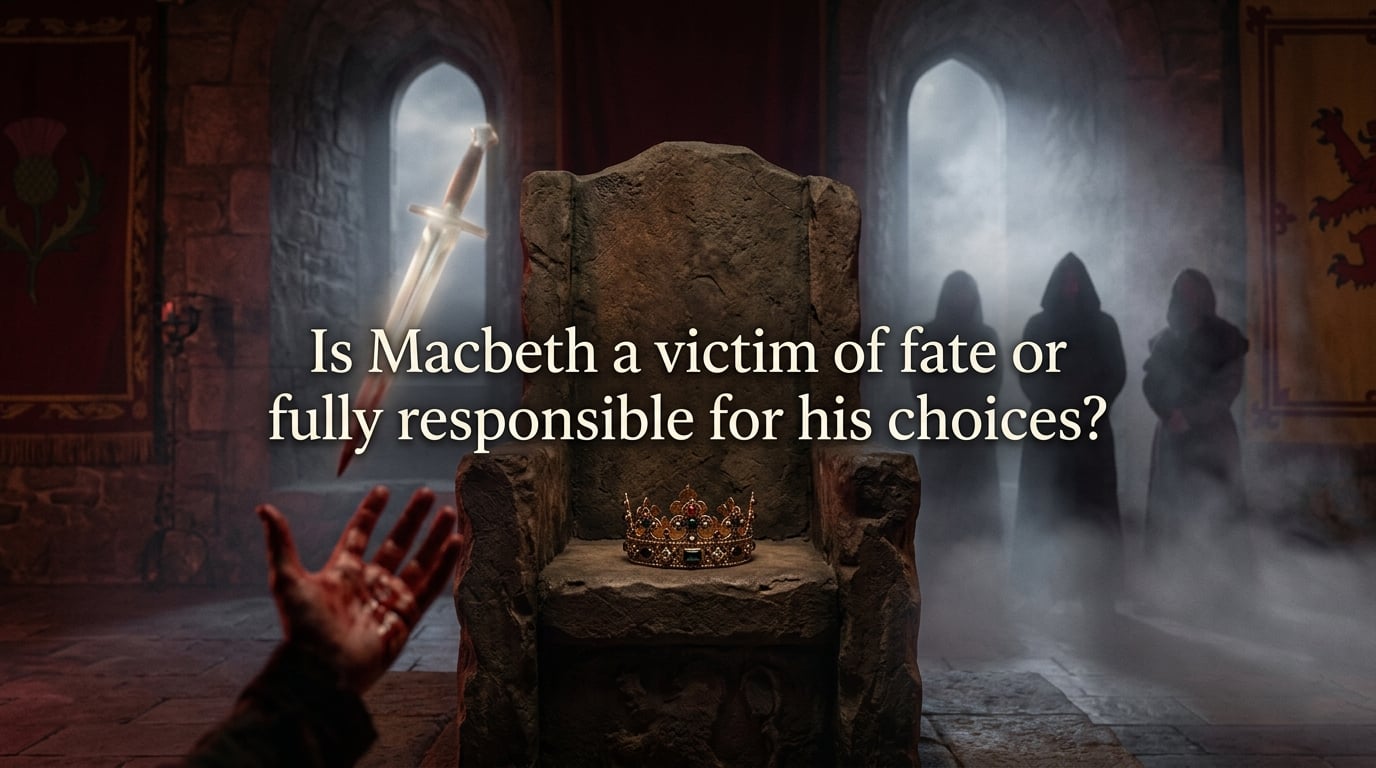
Few questions in literary study spark as much debate as whether Macbeth is a victim of fate or fully responsible for his choices. The answer matters because it shapes how we read every murder, every soliloquy, and every moment of guilt in Shakespeare’s tragedy. Students, scholars, and readers have argued both sides for centuries.
Some see the witches as agents of destiny who sealed Macbeth’s fate before the play even began. Others argue that Macbeth’s own ambition and deliberate decisions drove him to ruin. In our analysis of the play’s key scenes, quotes, and historical context, we have found that the truth lies in a more nuanced middle ground.
Shakespeare deliberately constructs Macbeth so that supernatural influence and personal agency operate simultaneously. Understanding how these forces interact is essential to writing a strong Macbeth essay or simply appreciating the depth of the tragedy. Let us examine the evidence on both sides.
Table of Contents
Is Macbeth a Victim of Fate or Fully Responsible for His Choices? The Thesis
Macbeth is not a victim of fate in the strict sense, but neither is he solely responsible in a vacuum. Shakespeare presents a character who receives powerful external provocation from the witches and from Lady Macbeth, yet consistently makes the final choice to act on his own dark desires. The prophecies create the conditions for temptation, but Macbeth supplies the ambition that turns temptation into murder.
This balanced reading is supported by the play’s structure. Every time Macbeth faces a decision, he deliberates, weighs consequences, and then chooses. His soliloquies reveal a man wrestling with his conscience, not a puppet moved by invisible strings. The guilt that consumes him afterward is itself evidence that he knew what he was doing was wrong.
The most compelling argument for shared responsibility comes from comparing Macbeth with Banquo. Both men hear the same prophecies, yet only Macbeth commits murder. This contrast proves that the prophecies were not commands. They were catalysts that revealed what was already inside each man.
The Witches’ Prophecies and External Influence on Macbeth’s Fate
The strongest case for Macbeth as a victim of fate rests on the witches’ prophecies. When the three Weird Sisters greet Macbeth as “King hereafter,” they introduce an idea that had not yet entered his mind in a concrete form. The supernatural timing is striking: the prophecy arrives the very moment Macbeth proves his valor in battle, making kingship seem both possible and destined.
The witches do not simply predict, they plant. Their opening line, “Fair is foul, and foul is fair,” establishes that they exist to invert moral categories and destabilize perception. By telling Macbeth what he could become rather than what he must do, they weaponize his own latent desires. This is manipulation dressed as prophecy.
However, the prophecies never instruct Macbeth to kill anyone. He himself recognizes this immediately after hearing them, saying, “If chance will have me king, why, chance may crown me / Without my stir.” This is the voice of a man who initially considers letting fate take its course. The fact that he abandons this position proves that fate alone was not enough to make him act.
The second set of prophecies, delivered later in the play, functions differently. The apparitions telling Macbeth to fear “none of woman born” and that he is safe until “Birnam Wood” comes to Dunsinane give him false confidence. These prophecies do not cause his downfall; they delay his reckoning by making him feel invincible. Macbeth chooses to trust them, which is itself a decision.
Macbeth’s Vaulting Ambition and Internal Conflict
If the witches provide the spark, Macbeth’s ambition is the fuel. Shakespeare makes this explicit in one of the play’s most famous passages. In Act 1, Scene 7, Macbeth admits he has “no spur / To prick the sides of my intent, but only / Vaulting ambition, which o’erleaps itself / And falls on the other.” He names the force driving him, and it is not fate, it is his own desire.
This soliloquy is critical evidence of free will. Macbeth acknowledges that Duncan has been a good king, that he is a guest under his roof, and that murder violates every bond of loyalty and hospitality. He lays out every moral reason not to kill Duncan. Then he proceeds to do it anyway. A man trapped by fate would not need to argue himself into action.
Even before the murder, Macbeth’s inner conflict is visible. He hallucinates a dagger before him, asking, “Art thou not, fatal vision, sensible / To feeling as to sight?” The dagger is not real, it is a projection of Macbeth’s own tortured mind. It reveals a man whose conscience is fighting against what his ambition wants. Fate does not produce guilt; choice does.
His plea, “Stars, hide your fires; / Let not light see my black and deep desires,” is perhaps the most damning evidence of agency. Macbeth does not want the moral universe to witness what he plans to do. He is making a conscious decision to act in darkness, fully aware of the evil involved.
Fate vs Fatalism: Understanding the Difference
One of the biggest sources of confusion in this debate is the difference between fate and fatalism. This distinction matters enormously for interpreting Macbeth correctly, yet many readers conflate the two concepts.
Fate suggests that events are predetermined and inevitable, that no action by the individual can change the outcome. Fatalism, by contrast, is the psychological state of believing one’s actions do not matter because the outcome is already fixed. Macbeth’s tragedy is not that fate controls him, it is that he adopts a fatalistic mindset that lets him justify terrible actions.
Once Macbeth believes the witches’ prophecies guarantee his success, he stops weighing moral consequences. He tells himself that because the future is “written,” his choices are merely the playing out of destiny. This is fatalism as a coping mechanism. Shakespeare shows us a man who uses the idea of fate to silence his own conscience. The tragedy is that the fate was never real; only Macbeth’s belief in it was.
Banquo vs Macbeth: How Two Men Respond to the Same Prophecy
The single strongest argument that Macbeth exercises free will is Banquo. Both men hear the identical prophecies from the same witches at the same moment. Yet their responses could not be more different.
Banquo hears that his descendants will be kings, a prophecy just as tempting as Macbeth’s. But Banquo is suspicious. He warns Macbeth that “the instruments of darkness tell us truths, / Win us with honest trifles, to betray’s / In deepest consequence.” Banquo sees the prophecies as potentially deceptive rather than as guarantees. He does not rush to murder anyone to make them come true.
Macbeth, by contrast, immediately begins plotting. The difference is not in what they heard but in who they were when they heard it. Macbeth already harbored ambition; the prophecy gave him permission to act on it. Banquo’s restraint proves that the prophecy contained no coercive power. It was a seed that only took root in soil already prepared for it.
Shakespeare includes Banquo specifically to make this point visible. The two characters serve as a controlled experiment in the play’s moral universe. Same stimulus, different response, different outcome. That is the essence of free will.
Lady Macbeth’s Influence and the Question of Agency
Lady Macbeth deserves scrutiny because she actively pushes Macbeth toward murder. After reading his letter about the prophecies, she declares she will “pour my spirits in thine ear” and chastise “all that impedes thee from the golden round.” She questions his manhood, tells him he is too full of “the milk of human kindness,” and provides the practical plan for killing Duncan.
This manipulation is real and powerful. Macbeth is clearly swayed by his wife’s words, and without her pressure, he might have hesitated longer. But influence is not the same as coercion. Macbeth could have refused. He had already identified every reason not to proceed in his own soliloquy.
Furthermore, Lady Macbeth’s influence diminishes sharply after Duncan’s murder. By Act 3, Macbeth orchestrates Banquo’s assassination without consulting her at all, saying, “Be innocent of the knowledge, dearest chuck.” From this point forward, every killing is Macbeth’s own initiative. Lady Macbeth cannot be blamed for the slaughter of Macduff’s family or the reign of terror that follows. Those choices belong to Macbeth alone.
The fact that Lady Macbeth herself descends into guilt and madness reinforces the play’s moral framework. Her famous “Out, damned spot!” scene shows a conscience that cannot be silenced. Both Macbeths know what they have done, and that knowledge is proof of responsibility.
The Progression of Murders as Evidence of Free Will
The pattern of Macbeth’s violence tells the clearest story about agency. The first murder, that of Duncan, involves enormous deliberation, hesitation, and external pressure. Macbeth nearly backs out. Lady Macbeth must push him. The decision is agonizing.
The second murder, that of Banquo, is different. Macbeth plans it alone, hires the killers himself, and acts out of paranoia rather than necessity. He tells his wife nothing. He is already becoming the kind of man who kills to maintain power.
The third wave of violence, the massacre of Macduff’s wife and children, is pure tyranny. Macbeth orders it impulsively after learning that Macduff has fled to England. He admits, “I am in blood / Stepped in so far, that, should I wade no more, / Returning were as tedious as go o’er.” He has passed the point of moral return, and he knows it.
This escalation is the opposite of a man following a predetermined script. Each murder requires less justification than the last. Macbeth is learning to kill, adapting, and hardening. That kind of psychological progression can only happen when a person is making choices, not when fate is simply unfolding.
Jacobean Beliefs About Fate, Witchcraft, and Free Will
To fully understand the question, we need to consider the world in which Shakespeare wrote. King James I, who sat on the English throne when Macbeth was first performed around 1606, was deeply invested in witchcraft. He had even authored a treatise called Demonology in 1597 that argued witches were real agents of the devil.
Shakespeare’s inclusion of the witches was not accidental. For Jacobean audiences, the supernatural was a genuine concern, and witchcraft was punishable by death. The witches in Macbeth would have been seen as genuinely dangerous spiritual forces, not mere theatrical devices. This makes the question of their influence more than academic for the original audience.
However, the dominant theological framework of the era still emphasized free will and moral accountability. The Church of England taught that humans possessed agency and would be judged for their choices. Shakespeare reflects this tension: the witches have real power to tempt, but they cannot force a soul to sin. The play ultimately sides with the idea that Macbeth damns himself through his own decisions, which aligns with both the moral theology and the theatrical traditions of the time.
FAQs
How is Macbeth a victim of fate?
Macbeth can be seen as a victim of fate because the witches’ prophecies introduce the idea of kingship at a moment when he is vulnerable and ambitious. The supernatural timing and accuracy of the predictions create the impression that events are predetermined. The second set of prophecies gives Macbeth false confidence that shapes his later actions. However, the prophecies never command him to kill, and his initial instinct was to let chance take its course.
Is Macbeth entirely responsible for his downfall?
Macbeth bears primary responsibility for his downfall because every murder is his conscious decision. His soliloquies show him weighing moral consequences and choosing violence anyway. The escalation from Duncan to Banquo to Macduff’s family demonstrates increasing autonomy, not decreasing control. While Lady Macbeth and the witches influenced him, influence is not coercion, and Macbeth alone committed each act.
Is Macbeth a victim of his own character or circumstances?
Macbeth is primarily a victim of his own character. His vaulting ambition, as he himself calls it, is the internal force that turns prophecy into action. The circumstances, including the witches and Lady Macbeth, function as catalysts that reveal what was already inside him. Banquo faced the same circumstances but did not murder, proving that character determined the outcome.
How is Macbeth presented as a victim?
Shakespeare presents Macbeth as a victim in the limited sense that external forces exploit his weaknesses. The witches deliberately target him with prophecies designed to corrupt, and Lady Macbeth manipulates his emotions to push him toward murder. His hallucinations and guilt also make him appear psychologically tormented. But Shakespeare structures the play so that Macbeth always retains the power to choose, making him a tragic figure rather than a helpless one.
Conclusion: The Balanced Verdict on Macbeth’s Responsibility
The question of whether Macbeth is a victim of fate or fully responsible for his choices does not have a simple answer, and that is precisely Shakespeare’s point. The playwright constructs a tragedy in which supernatural suggestion, wifely manipulation, and personal ambition all converge to produce catastrophe. Removing any one of these elements changes the outcome.
But the weight of evidence tilts toward responsibility. Macbeth deliberates, chooses, and acts with full knowledge of the evil he commits. His progression from reluctant murderer to tyrant shows a man who is learning to choose darkness more freely with each decision. The Banquo comparison demolishes the argument that fate was inescapable, because Banquo heard the same prophecy and walked a different path.
For students writing about Macbeth fate vs free will, the strongest thesis acknowledges both sides but argues that Shakespeare ultimately assigns moral responsibility to the individual. The witches create conditions, but Macbeth creates the crimes. His final recognition that life is “a tale told by an idiot, full of sound and fury, signifying nothing” is the despair of a man who knows he chose his own destruction.
If you are developing your own analysis, focus on specific quotes and the Banquo contrast for the most persuasive arguments. The richest essays explore how Shakespeare uses the tension between fate and free will not to resolve it neatly, but to expose the terrifying ease with which human beings talk themselves into evil.