
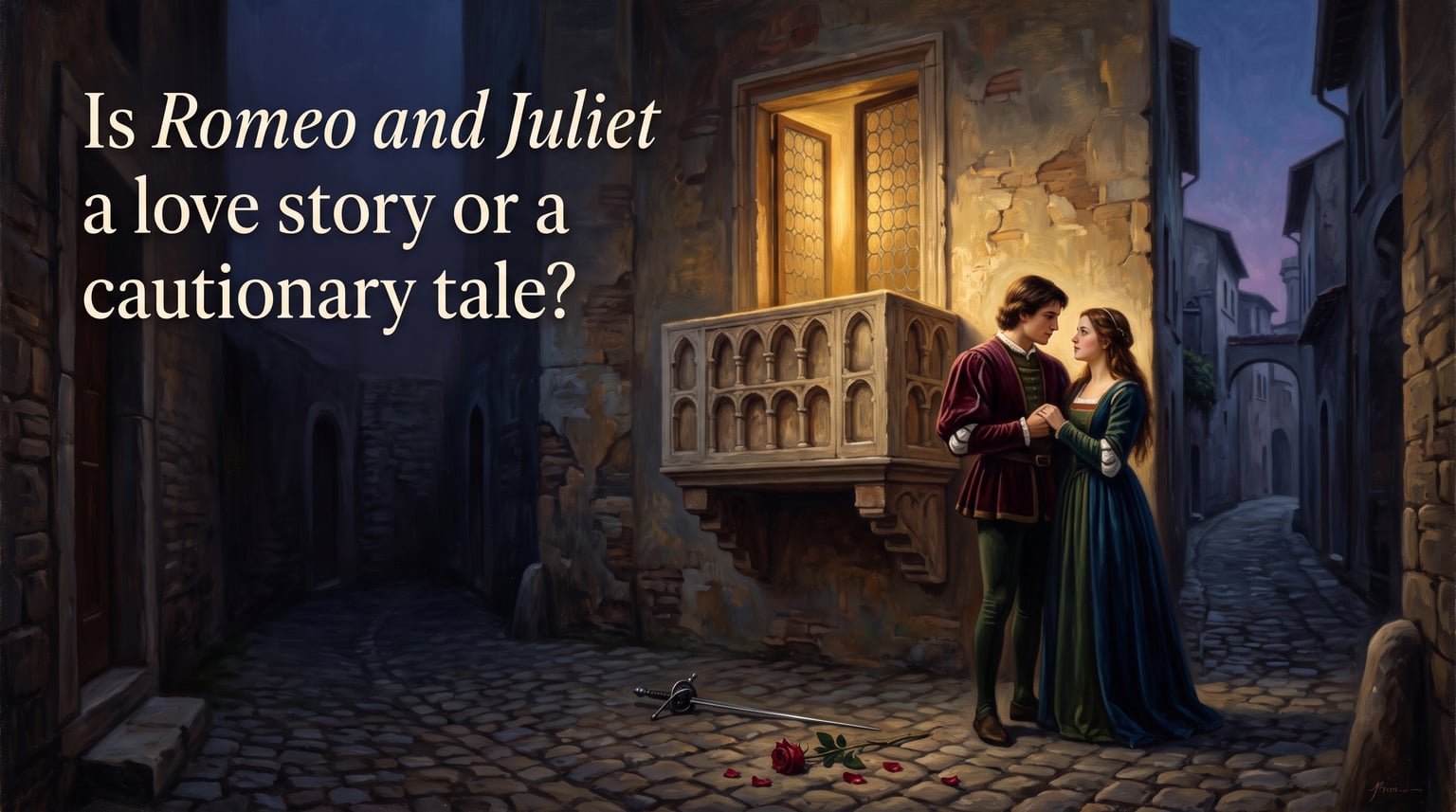
When I first read Romeo and Juliet in high school, I thought it was the most romantic story ever written. Years later, after teaching the play to hundreds of students and revisiting the text with fresh eyes, I realized Shakespeare had given us something far more complicated than a simple love story.
The question of whether Romeo and Juliet is a love story or a cautionary tale has divided readers, scholars, and audiences for over four centuries. The honest answer is that it is both, and that duality is precisely what makes Shakespeare’s most performed play so enduringly powerful. We can read it as a celebration of love triumphant over hatred, or as a stark warning about what happens when passion overrides reason. Both readings are correct, and both are incomplete without the other.
In this analysis, I’ll walk through the strongest arguments on each side, examine what Shakespeare actually put on the page, and share why I think the play works precisely because it refuses to choose between romance and warning. Whether you’re writing an essay, preparing for a class discussion, or simply trying to understand this play better, you’ll find the textual evidence and historical context you need right here.
Table of Contents
Romeo and Juliet Functions as Both a Love Story and a Cautionary Tale
Shakespeare wrote a tragedy that lives in the tension between two truths. On one side stands the genuine, passionate love between two young people whose affection for each other feels real, deep, and worth dying for. On the other side stands the brutal reality that their choices, made in haste and driven by emotion rather than wisdom, destroy six lives and leave two families devastated.
The play does not pick a winner. Instead, it invites us to hold both interpretations simultaneously, which is why the debate continues to generate fresh essays, classroom discussions, and Reddit threads even now. Shakespeare gives us the poetry of love AND the prophecy of doom in the same lines. He gives us the sweetness of the balcony scene AND Friar Laurence’s warning that “Wisely and slow, they stumble that run fast.”
When our team looked at how the play gets taught across different grade levels, we found something striking: younger students almost always read it as a romance, while older students and teachers tend to emphasize the cautionary elements. This shift mirrors Shakespeare’s own careful balance. The play rewards both readings, and perhaps demands them.
The Case for a Love Story Interpretation
The strongest argument for reading Romeo and Juliet as a love story comes from the text itself. Shakespeare wrote some of the most beautiful love poetry in the English language for these two characters, and he made their connection feel authentic, mutual, and transformative.
Star-Crossed Lovers and the Power of Fate
From the prologue, Shakespeare frames the lovers as “star-crossed” – a phrase that suggests their love was written in the heavens before they ever met. This is not the language of warning. This is the language of destiny, of souls destined to find each other against impossible odds.
The idea that some loves are fated has resonated with audiences across every generation since the play premiered. Romeo and Juliet feel like two halves of the same whole, drawn together by forces beyond their control or their families’ hatred. When Juliet declares “My bounty is as boundless as the sea, / My love as deep,” she is not speaking the language of teenage infatuation. She is speaking the language of total devotion.
Poetic Beauty and Romantic Language
No one writes accidental poetry. Shakespeare’s choice to give Romeo and Juliet some of his most exquisite verse tells us something important. When Romeo stands beneath Juliet’s window and whispers “But, soft! What light through yonder window breaks? / It is the east, and Juliet is the sun,” he is not being ironic. Shakespeare wants us to feel the genuine awe of first love.
I have watched students visibly moved by this scene, even students who pride themselves on cynicism. The balcony exchange captures something universal about the experience of seeing someone and feeling your world rearrange. That emotional truth is not a cautionary device. It is the play’s emotional center.
Defiance of Social Barriers
Love stories often work because the lovers must overcome obstacles. Romeo and Juliet face one of the oldest and most dangerous obstacles in human society: a blood feud between their families. Their willingness to risk everything for each other – their reputations, their safety, their lives – is the essence of romantic heroism.
When Juliet says “My only love sprung from my only hate,” she names the tragedy and the triumph at once. She loves the son of her father’s enemy. That she chooses love over loyalty to family hatred is, from one perspective, the most courageous act in the play.
Genuine Passion and Self-Sacrifice
The lovers die for each other. Romeo kills himself believing Juliet is dead. Juliet wakes to find him dead and stabs herself rather than live without him. Whether we call this romantic or foolish, it represents a depth of feeling that cannot be dismissed as superficial attraction. The Folger Shakespeare Library’s modern perspective notes that the play affirms “the power of love over hate,” and that affirmation lives in these final acts.
For readers who have loved deeply and lost, the deaths feel less like a warning and more like a tribute. Shakespeare seems to be saying: this is what love looks like when nothing else matters. Whether that is beautiful or terrible depends on how you read the play.
The Case for a Cautionary Tale Interpretation
The strongest argument against the love story reading comes from a simple, devastating observation: the relationship lasts three days. From the Capulet ball where they meet to the tomb where they die, Romeo and Juliet know each other for approximately 72 hours. Hardly any literary scholar, and certainly no honest reader, can call three days the foundation for genuine love.
The Three-Day Relationship Problem
Our team compared the play’s timeline to real relationship research and found something striking. Modern psychology suggests that the infatuation phase of romantic attraction typically lasts longer than three days, yet we routinely call this feeling “love.” Shakespeare knew this. He wrote Romeo as a character who leaps from one obsession to another with terrifying speed.
Before meeting Juliet, Romeo was “in love” with Rosaline, a woman who never appears on stage and who he has never spoken to directly. He mopes, writes poetry, and declares himself heartsick over a woman whose only sin is refusing to return his affection. Then he sees Juliet and forgets Rosaline entirely. This is not the behavior of a deep romantic. This is the behavior of someone ruled by impulse.
Romeo’s Prior Infatuation with Rosaline
The Rosaline subplot is Shakespeare’s quiet joke at his own character’s expense, and it is devastating to the love story interpretation. Romeo’s “love” for Rosaline was identical in form to his “love” for Juliet: passionate, all-consuming, and based almost entirely on projection. If Romeo could love Rosaline that intensely without ever speaking to her, what does that say about the depth of his feelings for Juliet?
For readers paying attention, this detail undercuts the entire romance. Romeo is not a man who has finally found his soulmate. He is a young man who falls in love with the idea of being in love, and the object of that love changes based on proximity and convenience.
Impulsive Decisions and Their Consequences
Every major decision in the play is made in haste, and every one of them backfires catastrophically. Romeo and Juliet marry after knowing each other for less than 24 hours. Romeo kills Tybalt in a moment of rage after Mercutio’s death. Friar Laurence devises the sleeping potion plan as a desperate last-minute scheme. Juliet rushes to the tomb rather than wait or seek help.
When we map the tragedy to the decisions that caused it, we see a clear pattern: emotional decisions made without counsel, consideration, or wisdom lead to ruin. This is the structure of a cautionary tale, not a love story.
Friar Laurence’s Explicit Warnings
Friar Laurence, the closest thing the play has to a wise voice, explicitly warns the lovers about their own behavior. He tells Romeo that “Wisely and slow, they stumble that run fast” – a line that essentially predicts the entire tragedy. He also cautions that “These violent delights have violent ends” – another prophecy that comes true with horrifying precision.
Shakespeare does not bury the warning. He puts it in the mouth of the play’s moral authority and lets the audience watch the lovers ignore it. This is the architecture of a cautionary tale. The wise elder speaks, the young ignore, and disaster follows.
Key Textual Evidence Shakespeare Provides
One of the most compelling things about the play is how carefully Shakespeare embedded evidence for both interpretations. He was not careless. He was a master craftsman who wanted us to feel both the beauty and the danger of what his characters were doing.
The Chorus Prologue’s Dual Meaning
The opening prologue tells us the lovers will die and that their death will “bury their parents’ strife.” This is a hopeful ending described as a tragic event, or a tragic event that produces a hopeful ending. The audience knows from line one that no happy future awaits these characters, which colors every romantic scene with dramatic irony.
When we watch the balcony scene knowing they have four days to live, we cannot experience it as pure romance. The beauty is real, but so is the doom. Shakespeare built this tension into the structure of the play itself.
The Lovers’ Foreshadowed Doom
Throughout the play, characters repeatedly predict bad endings. Romeo has a dream that “some consequence, yet hanging in the stars, / Shall bitterly begin his fearful date.” Juliet feels uneasy about the sleeping potion plan. Even the lovers themselves seem to know, on some level, that they are rushing toward destruction.
These moments serve a dual purpose. They warn the audience that disaster approaches, and they make the romance feel both more precious and more reckless. Every kiss carries the shadow of its own ending.
Friar Laurence as Moral Voice
Friar Laurence functions as the play’s chorus of caution. His warnings, his fears, and his failed plan all point to a single lesson: impulsive action, even when motivated by love, destroys what it tries to save. His final speech, “Unhappy fortune,” lays out the full cost of the lovers’ choices and the adults who failed to guide them.
I find the Friar one of Shakespeare’s most revealing creations. He is not a villain. He genuinely wants to help. But he helps in exactly the wrong way, by enabling secret plans rather than encouraging open communication. His failure is the cautionary tale’s argument made flesh.
Character Motivations and Psychological Depth
What makes the play work on a deeper level is that the characters feel real. Romeo and Juliet are not allegorical figures. They are recognizable young people making choices that millions of readers and audience members have made or witnessed. Understanding their psychology helps us understand the play’s dual nature.
Romeo’s Romantic Idealism vs. Impulsiveness
Romeo is a study in contradictions. He speaks some of the play’s most beautiful poetry and makes some of its worst decisions. He is genuinely tender with Juliet and genuinely murderous toward Tybalt. He is loyal to Mercutio and disloyal to the law. He is, in short, a teenager with the emotional regulation of a teenager.
From the love story perspective, this makes him a passionate romantic hero. From the cautionary perspective, this makes him a cautionary example. Both readings are psychologically accurate. Young love really can feel that overwhelming. Young people really do make catastrophic decisions in the grip of strong emotions.
Juliet’s Agency and Defiance
Juliet is often overlooked in casual discussions of the play, but she is arguably its most impressive character. She is 13 years old, betrothed against her will, and expected to submit to her father’s choice. Instead, she defies him, marries in secret, and ultimately chooses death over a life without autonomy.
Whether we read this as romantic courage or tragic rebellion depends on our lens. What we cannot deny is that Juliet acts with more agency than any other character in the play. She makes the hardest choices and pays the highest price.
Friar Laurence’s Misguided Wisdom
The Friar is the play’s most complex adult figure. He believes he can outsmart fate by orchestrating secret plans. He believes the lovers’ union will end the feud. He believes his good intentions will save everyone. Every belief proves catastrophically wrong.
In many ways, the Friar is the cautionary tale’s central figure. He represents the adult failure to guide young people honestly. He enables rather than confronts. He schemes rather than communicates. His fate – surviving to tell the story – is part of Shakespeare’s point. The wise man who chose poorly must live with the consequences of his poor choices.
Historical Context and Modern Relevance
To fully understand the play, we need to remember that Shakespeare wrote it around 1595, in a culture very different from our own. Renaissance Verona, as Shakespeare imagined it, was a society where family honor mattered more than individual desire and where young people had little say in their own marriages.
Renaissance Marriage Customs and Family Feuds
Marriage in Shakespeare’s England was rarely a matter of personal choice. It was a family alliance, an economic arrangement, a political strategy. Juliet’s arranged marriage to Paris would have seemed entirely normal to Shakespeare’s original audience. Her refusal would have seemed shocking, even scandalous.
This context makes the love story more courageous and the cautionary tale more tragic. Romeo and Juliet are not just fighting their parents. They are fighting an entire social order. The fact that they cannot win that fight may be the deepest warning of all.
Petrarchan Love Conventions
Shakespeare was working within the Petrarchan tradition, a style of love poetry that idealized women as distant, unattainable figures. Romeo’s opening speeches about Rosaline follow this convention precisely. His shift to genuine, mutual love with Juliet represents a departure from the tradition.
Some scholars argue that Shakespeare was critiquing Petrarchan love as much as he was celebrating romantic love. Romeo’s ability to forget Rosaline the moment he sees Juliet suggests that the entire tradition of worshipful, distant love was, in Shakespeare’s view, more performance than feeling.
Why This Debate Still Matters Today
I think this debate persists because the play speaks to something real in modern life. We still see young people making decisions in the grip of strong emotions. We still see families torn apart by long-running feuds. We still see love celebrated as worth any sacrifice and criticized as a poor basis for major life choices.
The Reddit discussions we examined showed readers wrestling with exactly these questions. Some argued passionately that the play is a warning against rushing into relationships. Others defended the lovers as tragic heroes whose only crime was loving in a world that refused to let them. Both readings felt true to the people making them.
That is the genius of the play. It does not resolve the tension. It gives us the tools to feel both the romance and the warning, and it leaves us to decide which weighs heavier for ourselves.
FAQ: Common Questions About Romeo and Juliet’s Meaning
Is Romeo and Juliet considered a love story?
Yes, Romeo and Juliet is considered one of the most celebrated love stories in Western literature. Shakespeare wrote some of his most beautiful poetry for these characters, and their willingness to die for each other has inspired audiences for over 400 years. The Folger Shakespeare Library describes the play as affirming the power of love over hate, and the lovers remain archetypes of romantic devotion across cultures.
How is Romeo and Juliet a cautionary tale?
Romeo and Juliet functions as a cautionary tale through its portrayal of impulsive decisions and their consequences. The relationship lasts only three days. Romeo was infatuated with another woman immediately before. Friar Laurence explicitly warns that they stumble that run fast. Every major decision is made in haste, and every one backfires. Six people die because two teenagers refused to seek wise counsel or communicate openly with their families.
What type of tale are Romeo and Juliet?
Romeo and Juliet is classified as a tragedy in the Shakespearean sense, but it contains elements of multiple genres. It works as a romantic tragedy, a cautionary tale about youth and impulse, and a commentary on the destructive nature of family feuds. Most modern scholars read it as deliberately hybrid – a play that wants us to feel both the beauty of love and the danger of acting on passion alone.
Why do people say Romeo and Juliet is not a love story?
Critics and readers often argue the play is not a true love story because the relationship lasts only three days, because Romeo transferred his affections from Rosaline to Juliet almost instantly, and because the lovers make catastrophic decisions based on emotion rather than reason. They point to Friar Laurence’s warnings and the six deaths that result from the lovers’ secrecy as evidence that Shakespeare intended warning rather than celebration.
What is the moral lesson of Romeo and Juliet?
The moral lesson is multifaceted and has been debated for centuries. Common interpretations include: hatred between families destroys the young people caught in the crossfire, impulsive decisions made in the grip of passion lead to tragedy, and love without wisdom can be as destructive as hate. Many readers also find a hopeful message: that even in death, the lovers’ sacrifice can heal wounds and end cycles of violence.
Conclusion: A Love Story That Is Also a Warning
After years of teaching this play and reading every interpretation I can find, I have landed on a position I hold with some conviction. Romeo and Juliet is a love story that knows it is a cautionary tale. Shakespeare wrote a romance and embedded its critique inside it. He gave us the beauty of young love and the brutal arithmetic of what that love cost.
The play does not force us to choose. It lets us hold both truths: that Romeo and Juliet’s love was real, and that their choices were reckless. That their defiance was brave, and that their secrecy was fatal. That their deaths were tragic, and that their tragedy might teach future generations to love more wisely.
If you are reading this play for the first time, I encourage you to sit with both interpretations. Notice how the balcony scene makes your heart race and how Friar Laurence’s warnings make you uneasy. Notice how Romeo’s poetry moves you and how his impulsiveness frustrates you. That tension is not a flaw in the play. It is the play.
Shakespeare understood something that four centuries of readers and audiences have confirmed. Love is worth dying for, and love without wisdom is worth dying from. Both can be true at once. Both, I think, are exactly what he meant us to see.