
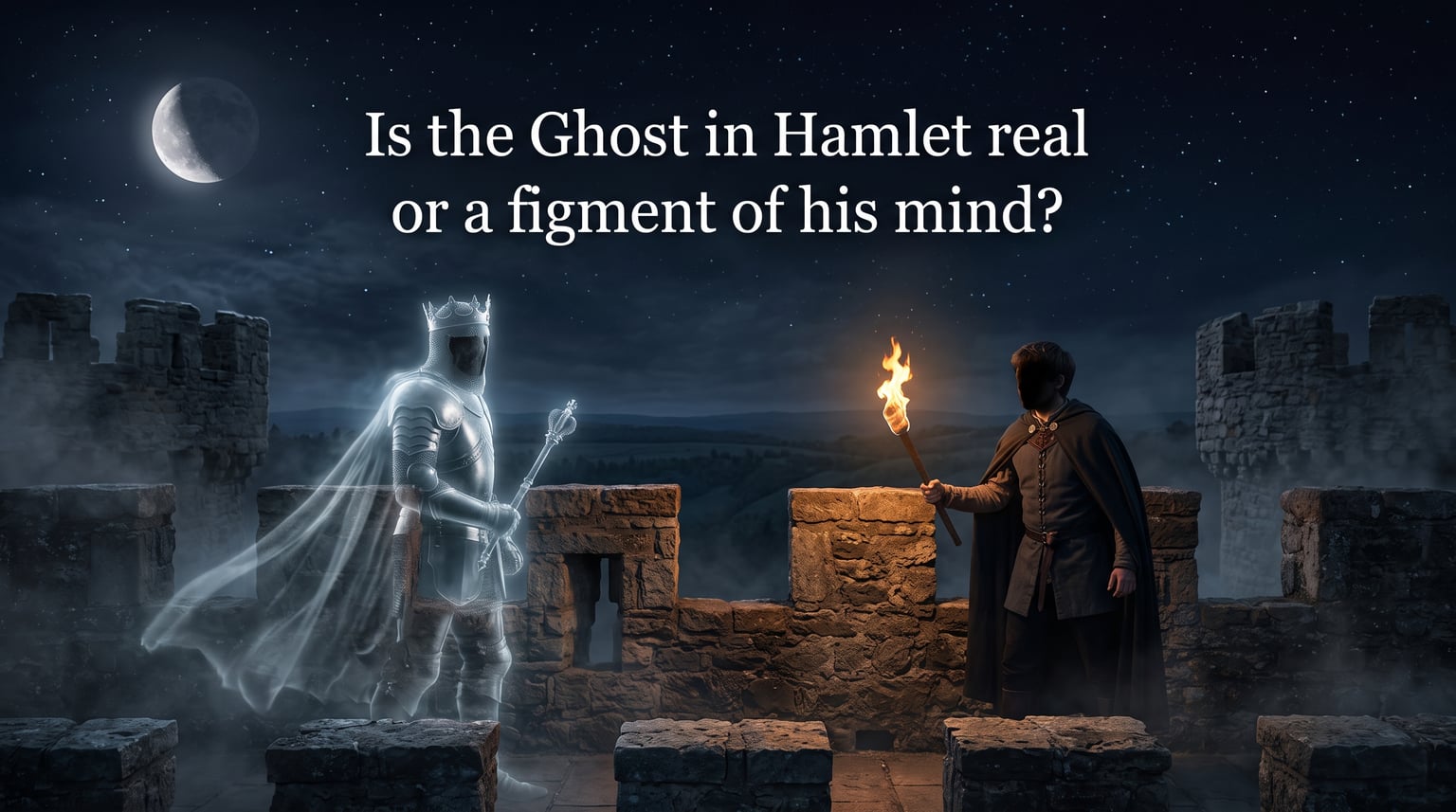
The Ghost in Hamlet is one of the most debated figures in all of English literature. Is he the genuine spirit of the murdered King Hamlet, returned from beyond to demand justice? Or is he a projection of a grieving son’s fractured psyche, born from trauma and rage?
Scholars have argued this question for over four centuries. The answer Shakespeare intended matters less than the brilliance of the ambiguity itself. The play gives us evidence for both readings, and that tension is exactly what makes Hamlet endure as perhaps the greatest work in the English language.
In this guide, I will walk you through every appearance the Ghost makes, break down the major scholarly interpretations, and explore the religious and historical context that shaped how Shakespeare’s original audience would have understood a ghost on stage. Whether you are writing an essay, preparing for a class discussion, or simply curious about one of literature’s great questions, this analysis gives you the tools to form your own opinion.
The two camps are clear. On one side, scholars like J. Dover Wilson argue the Ghost is a genuine supernatural entity, witnessed by multiple characters and rooted in Catholic tradition. On the other, W.W. Greg and others contend the Ghost is a psychological construct, a symptom of Hamlet’s deteriorating mental state. Modern scholars like Stephen Greenblatt have added a third dimension, reading the Ghost through the lens of Reformation-era religious anxiety.
What makes this question endlessly fascinating is that Shakespeare refuses to resolve it. Let us examine why.
Table of Contents
The Ghost’s Four Appearances in Hamlet
The Ghost in Hamlet appears in four distinct scenes across the play, and each appearance adds a new layer to the central mystery. Understanding who sees the Ghost, when, and under what circumstances is essential to forming any interpretation.
Act 1, Scene 1: The Sentinels See the Ghost
The play opens on the battlements of Elsinore castle. Three men, Marcellus, Bernardo, and Horatio, encounter the Ghost independently of Hamlet. This is the strongest evidence for the “real ghost” camp.
Horatio, a scholar and a skeptic, initially dismisses the sighting but is forced to acknowledge what he sees. The Ghost appears in full armor, matching the appearance of the dead King Hamlet. Horatio interprets the apparition as an omen, connecting it to the political tensions between Denmark and Norway.
The cock crows at dawn, and the Ghost vanishes. This detail matters. In Elizabethan folklore, supernatural beings were believed to retreat at daybreak, a convention that lends the Ghost credibility as an authentic supernatural entity.
Act 1, Scene 4: The Ghost Beckons Hamlet
When the Ghost appears again, Hamlet is present. The Ghost beckons him away from his companions. Horatio and Marcellus try to restrain Hamlet, fearing the Ghost might “draw you into madness” or lead him to a cliff’s edge.
Hamlet breaks free and follows. This scene establishes the Ghost’s pull over Hamlet while raising the first hint of danger. Is the Ghost trustworthy, or could he be a malevolent force luring Hamlet toward destruction?
Act 1, Scene 5: The Revelation
In the play’s most famous ghost scene, the Ghost speaks directly to Hamlet. He reveals that he is the spirit of King Hamlet, doomed to walk the night and suffer in flames by day until his sins are purged.
He claims that Claudius murdered him by pouring poison into his ear while he slept. The Ghost demands revenge: “Revenge his foul and most unnatural murder.” He also instructs Hamlet not to harm Gertrude, leaving her to her own conscience and heaven.
This scene gives us the most substantial text about the Ghost’s nature. His description of suffering, his denial of last rites, and his claim of purgatorial torment all point toward Catholic theology of Purgatory.
Act 3, Scene 4: The Closet Scene
The Ghost’s final appearance is the most ambiguous. In Gertrude’s bedchamber, Hamlet sees the Ghost, but Gertrude does not. She tells Hamlet: “This is the very coinage of your brain,” suggesting he is hallucinating.
The Ghost reminds Hamlet of his mission, noting that Hamlet has nearly forgotten his purpose. But Gertrude’s inability to see the Ghost is the strongest evidence for the psychological interpretation. If the Ghost were real, why would he be invisible to some characters?
This single scene has launched a thousand scholarly essays. It is the crux of the entire debate over whether the Ghost in Hamlet is real or a figment of his mind.
The Scholarly Debate: Real Spirit or Psychological Projection?
The debate over whether the Ghost in Hamlet is real or imagined has defined Hamlet criticism for generations. Two scholars in particular shaped the modern conversation, and their arguments remain the starting point for any serious analysis.
The core tension comes down to a single question: did Shakespeare write a ghost story about supernatural revenge, or did he write a psychological drama about a young man’s mental breakdown? Both interpretations are supported by textual evidence.
The Ghost is seen by multiple witnesses in Act 1, which supports a supernatural reading. But the Ghost appears only to Hamlet in Act 3, which supports a psychological one. Shakespeare gives us enough evidence for either conclusion and not enough to settle the matter definitively.
This ambiguity is not a flaw. It is the defining feature of the play’s genius. Every production, every essay, every classroom discussion re-litigates this question because Shakespeare built the tension into the text itself.
The religious context of Elizabethan England adds another dimension. Shakespeare wrote Hamlet at the turn of the 17th century, a time when the Protestant Reformation had fundamentally changed how people thought about ghosts. The old Catholic belief in Purgatory, where souls could return to seek prayers and justice, had been officially abolished. But cultural memory and popular belief lingered.
This created a perfect dramatic situation. Shakespeare’s audience was genuinely uncertain about what to make of a ghost. Were they souls from Purgatory? Were they demons in disguise? Were they psychological projections? The play never tells us, and that uncertainty mirrors the cultural moment in which it was written.
W.W. Greg’s Interpretation: The Ghost as Figment of Imagination
W.W. Greg, writing in the early 20th century, offered one of the most influential readings of the Ghost as a psychological phenomenon. His argument: the Ghost is a figment of Hamlet’s overwrought imagination, a projection born from grief, rage, and political ambition.
Greg pointed to several textual clues. First, the Ghost’s appearances become progressively more private. In Act 1, Scene 1, multiple characters see the Ghost. But by Act 3, Scene 4, only Hamlet perceives it. Greg argued this progression reflects Hamlet’s descent into genuine madness, not the feigned “antic disposition” he claims to perform.
The closet scene is Greg’s strongest evidence. Gertrude cannot see the Ghost and explicitly tells Hamlet his mind is fabricating what it sees. She says: “This is the very coinage of your brain. This bodiless creation ecstasy is very cunning in.” For Greg, this was Shakespeare telling us the Ghost exists only in Hamlet’s head.
Greg also questioned the reliability of the Act 1 sightings. He suggested that the sentinels and Horatio were primed to see something on the battlements. Fear, expectation, and the darkness of night created conditions ripe for a collective hallucination.
Greg noted as well that the Ghost’s demands align suspiciously well with what Hamlet already wants. Hamlet resents Claudius, grieves his father deeply, and is suspicious of his uncle’s rapid rise to power. The Ghost tells Hamlet exactly what he wants to hear: that Claudius is a murderer and that Hamlet should kill him.
For Greg, the Ghost is the externalization of Hamlet’s own desires, dressed in supernatural clothing.
J. Dover Wilson’s Interpretation: Supernatural Reality
J. Dover Wilson, writing in “What Happens in Hamlet” in 1935, mounted the most thorough defense of the Ghost as a genuine supernatural entity. His argument directly countered Greg’s psychological reading and remains central to the “real ghost” interpretation.
Wilson’s first point: the multiple witnesses in Act 1, Scene 1 cannot be dismissed. Horatio is explicitly described as a scholar and a skeptic. He does not believe in ghosts until he sees one with his own eyes. Three independent witnesses, including a rationalist, seeing the same apparition in full armor is powerful evidence against a purely psychological explanation.
Wilson also analyzed the daylight vanishing. The Ghost retreats at the cock’s crow, a traditional boundary between the supernatural and natural worlds. This detail aligns with centuries of ghost lore, giving the Ghost behavioral consistency with authentic supernatural beings in Elizabethan belief.
The closet scene, which Greg saw as proof of hallucination, Wilson read differently. He argued that the Ghost intentionally appears only to Hamlet in Act 3 to avoid confronting Gertrude directly, since he had instructed Hamlet to leave her judgment to heaven. The Ghost’s selective visibility was a deliberate choice, not evidence of unreality.
Wilson also emphasized the Ghost’s knowledge. The Ghost reveals specific details about the murder that Hamlet could not have known. The method of poisoning, poured into the ear during sleep, is confirmed later when the play-within-a-play catches Claudius’s guilty reaction. The Ghost’s information proves accurate, which is hard to explain if the Ghost is merely a projection.
For Wilson, the play is a revenge tragedy with a genuine ghost. Hamlet’s delay is the psychological drama, not the Ghost’s existence.
Stephen Greenblatt and the Purgatory Question
Stephen Greenblatt, one of the most influential Shakespeare scholars of the late 20th and early 21st centuries, reframed the Ghost debate entirely in his book “Hamlet in Purgatory,” published in 2001.
Greenblatt argued that the Ghost cannot be understood outside the religious upheaval of the Reformation. For centuries, Catholic doctrine held that souls in Purgatory could return to earth to seek prayers, masses, and acts of justice from the living. The Ghost in Hamlet behaves exactly like a soul from Purgatory: he describes suffering, he was denied last rites, and he demands specific action from his son.
But here is the complication. By the time Shakespeare wrote Hamlet, the Anglican Church had officially abolished Purgatory. Protestant theology held that the dead went directly to heaven or hell. No middle ground existed. Therefore, any ghost that claimed to come from Purgatory was, by Protestant logic, either a hallucination or a demon impersonating the dead.
Greenblatt’s insight: Shakespeare exploits this religious fault line deliberately. The Ghost speaks the language of Catholic Purgatory in a Protestant world. He is simultaneously believable and suspect, and that is precisely the point. The ambiguity is not an accident but a calculated dramatic strategy rooted in a culture that had lost its consensus about what happened after death.
Religious Context: Catholic Purgatory vs Protestant Skepticism
To understand the Ghost in Hamlet, you need to understand the religious world Shakespeare inhabited. The England of 1600 was a country in spiritual crisis, and the Ghost reflects that crisis perfectly.
Catholic tradition taught that most souls went to Purgatory after death, a state of purification where sins were burned away over time. These souls could communicate with the living, typically seeking prayers and masses to speed their journey to heaven. A ghost from Purgatory was a familiar and accepted concept in pre-Reformation England.
The Protestant Reformation changed everything. Under Edward VI and Elizabeth I, the Church of England officially rejected Purgatory as an unbiblical invention. The dead went to heaven or hell, full stop. Any apparition claiming to be a departed soul was either a deception of the mind or a trick of the devil.
Shakespeare’s audience lived between these two worlds. Many people, especially older generations, still privately believed in something like Purgatory even though it was no longer official doctrine. The cultural memory of Catholic ghost beliefs remained powerful.
The Ghost in Hamlet speaks the language of Catholic Purgatory. He describes flames, denied last rites, and a mission of justice from beyond the grave. But in a Protestant framework, those same words mark him as suspect. This dual reading is not a contradiction but the foundation of the play’s power.
Why Can’t Gertrude See the Ghost?
The closet scene in Act 3, Scene 4 is the single most contested passage in the entire debate. Hamlet sees the Ghost. Gertrude does not. She concludes her son has lost his mind.
This scene works powerfully for both interpretations. For the psychological camp, Gertrude’s testimony is definitive proof. A real entity should be visible to everyone in the room. Her inability to see it confirms that the Ghost exists only in Hamlet’s imagination.
For the supernatural camp, the explanation is more nuanced. The Ghost may choose to appear selectively. In Act 1, Scene 5, the Ghost explicitly instructed Hamlet: “Taint not thy mind, nor let thy soul contrive against thy mother aught.” The Ghost’s decision to remain invisible to Gertrude could be an act of mercy, sparing her from the full horror of her first husband’s accusation.
Shakespeare leaves the question beautifully unresolved. Gertrude’s line, “This is the very coinage of your brain,” works as both diagnosis and dramatic irony. We in the audience know something she does not, because we saw the Ghost with our own eyes in Act 1.
Horatio’s Role as Rational Witness
Horatio is the Ghost’s most important witness, and his presence shapes the entire debate. He is introduced as a scholar from Wittenberg, a rationalist who initially dismisses the sentinels’ ghost story as fantasy.
When the Ghost appears to Horatio in Act 1, Scene 1, his conversion is complete. He sees the armored figure with his own eyes, speaks to it, and fails to get a response. His skepticism collapses in the face of direct experience.
Horatio’s testimony matters because he is not emotionally invested. Unlike Hamlet, who is grieving, angry, and desperate for an explanation, Horatio has no reason to hallucinate. His sighting lends the Ghost an objective reality that a purely psychological reading struggles to explain.
The question “Is Horatio a figment of Hamlet’s imagination?” arises from some radical readings, but the text does not support this. Horatio survives the play, delivers the final speech, and lives to tell Hamlet’s story. He is Shakespeare’s anchor of rationality in a play saturated with uncertainty.
Is the Ghost a Demon? The Protestant Fear
A third interpretation, less discussed but deeply rooted in the play’s religious context, holds that the Ghost is a demon disguised as King Hamlet. This reading draws from Protestant theology, which taught that apparitions of the dead were not souls from Purgatory but agents of the devil.
Several textual details support this reading. The Ghost appears at night and flees at dawn, behavior associated with demonic entities in folklore. He demands an act of bloody revenge, which contradicts Christian teachings about leaving vengeance to God.
Hamlet himself entertains this possibility. After meeting the Ghost, he does not immediately act. Instead, he stages the play-within-the-play specifically to test whether the Ghost is “an honest ghost” or a devil exploiting his melancholy. He says: “The spirit that I have seen may be the devil, and the devil hath power to assume a pleasing shape.”
This is one of the play’s most brilliant strokes. Hamlet doubts the Ghost, and Shakespeare encourages us to doubt it too. If the Ghost is a demon, then everything Hamlet does in its name becomes morally horrifying. The play never confirms or denies this reading, which is exactly why it continues to disturb.
The Revenge Motif and the Ghost’s Demands
The Ghost’s primary function in the play is to set the revenge plot in motion. His demands are specific: Hamlet must kill Claudius but spare Gertrude. He must remember, and he must act.
This demand places Hamlet at the center of a revenge tragedy, a popular genre in Elizabethan theater. Plays like Thomas Kyd’s “The Spanish Tragedy” established conventions that Shakespeare both followed and subverted. The ghost demanding revenge was a stock element of the genre, and Shakespeare’s original audience would have recognized it immediately.
But Shakespeare complicates the formula. In typical revenge tragedies, the hero acts swiftly. Hamlet does not. His delay, his philosophical agonizing, and his self-doubt transform the genre from action spectacle into something far more interior and modern.
The Ghost’s demand for revenge also raises ethical questions that fuel the entire play. Does the Ghost have legitimate authority to command murder? If the Ghost is real, is Hamlet morally obligated to obey? If the Ghost is a demon, is Claudius actually guilty?
The play-within-a-play is Hamlet’s attempt to answer these questions independently rather than taking the Ghost’s word on faith. He needs external confirmation that Claudius is guilty before he can act on the Ghost’s command. This is Hamlet treating the supernatural with suspicion, testing the spirit before trusting it.
The revenge motif cannot be separated from the question of the Ghost’s reality. Everything Hamlet does depends on whether the Ghost told the truth. And Shakespeare never gives us a clear answer.
Historical Sources: From Saxo Grammaticus to Shakespeare
Shakespeare did not invent the story of Hamlet. The tale has deep roots in medieval Scandinavian folklore, and understanding these sources illuminates how Shakespeare transformed the material.
The earliest known version comes from Saxo Grammaticus, a 12th-century Danish historian who recorded the legend of Amleth in his “Gesta Danorum.” In this version, a young prince feigns madness to avenge his father’s murder by his uncle. There is no ghost. The father’s spirit never appears.
The story was retold in the 16th century by the French writer Francois de Belleforest, who added moral and psychological dimensions. An earlier, now-lost play known as the “Ur-Hamlet,” performed in the late 1580s or early 1590s, is believed to have introduced the ghost to the story.
Shakespeare’s decision to center a ghost was a deliberate artistic choice. He took a story about political revenge and psychological survival and added a supernatural catalyst that demands interpretation. The Ghost is Shakespeare’s invention within this framework, and the ambiguity he creates is Shakespeare’s gift to every reader and audience that follows.
FAQs
Was the ghost in Hamlet real?
The play never confirms whether the Ghost is real. Shakespeare provides evidence for both readings: multiple witnesses see the Ghost in Act 1, supporting a supernatural entity, but Gertrude cannot see it in Act 3, supporting a psychological projection. Scholars remain divided, with J. Dover Wilson arguing for a real ghost and W.W. Greg arguing for a figment of Hamlet’s imagination.
Is the ghost a hallucination in Hamlet?
Some scholars, particularly W.W. Greg, argue the Ghost is a hallucination born from Hamlet’s grief and rage. The strongest evidence is Act 3, Scene 4, where Gertrude cannot see the Ghost and calls it the very coinage of your brain. However, the multiple witnesses in Act 1 complicate this reading, since Horatio and the sentinels see the Ghost before Hamlet does.
Is Horatio a figment of Hamlet’s imagination?
No. Horatio is a real character in the play, not a projection of Hamlet’s mind. He survives the final scene, delivers the closing lines, and lives to tell Hamlet’s story. He serves as a rational witness whose independent sighting of the Ghost in Act 1 lends credibility to the supernatural interpretation.
What does the ghost represent in Hamlet?
The Ghost represents multiple things simultaneously: Hamlet’s unresolved grief, the demand for justice, the Catholic concept of Purgatory, and the Protestant fear of demonic deception. He functions as the catalyst for the revenge plot, the source of the play’s central ambiguity, and a mirror reflecting the religious anxieties of Shakespeare’s audience.
Conclusion: Is the Ghost in Hamlet Real or a Figment of His Mind?
The question of whether the Ghost in Hamlet is real or a figment of his mind has no single answer, and that is exactly the point. Shakespeare designed the Ghost to resist definitive interpretation, giving evidence for a genuine supernatural entity, a psychological projection, and a demonic deception all at once.
The genius of the play lies in this deliberate ambiguity. The Ghost is whatever each reader, each audience, and each age needs him to be. That is why Hamlet remains alive in a way few works of literature ever achieve, and why the question still matters.