
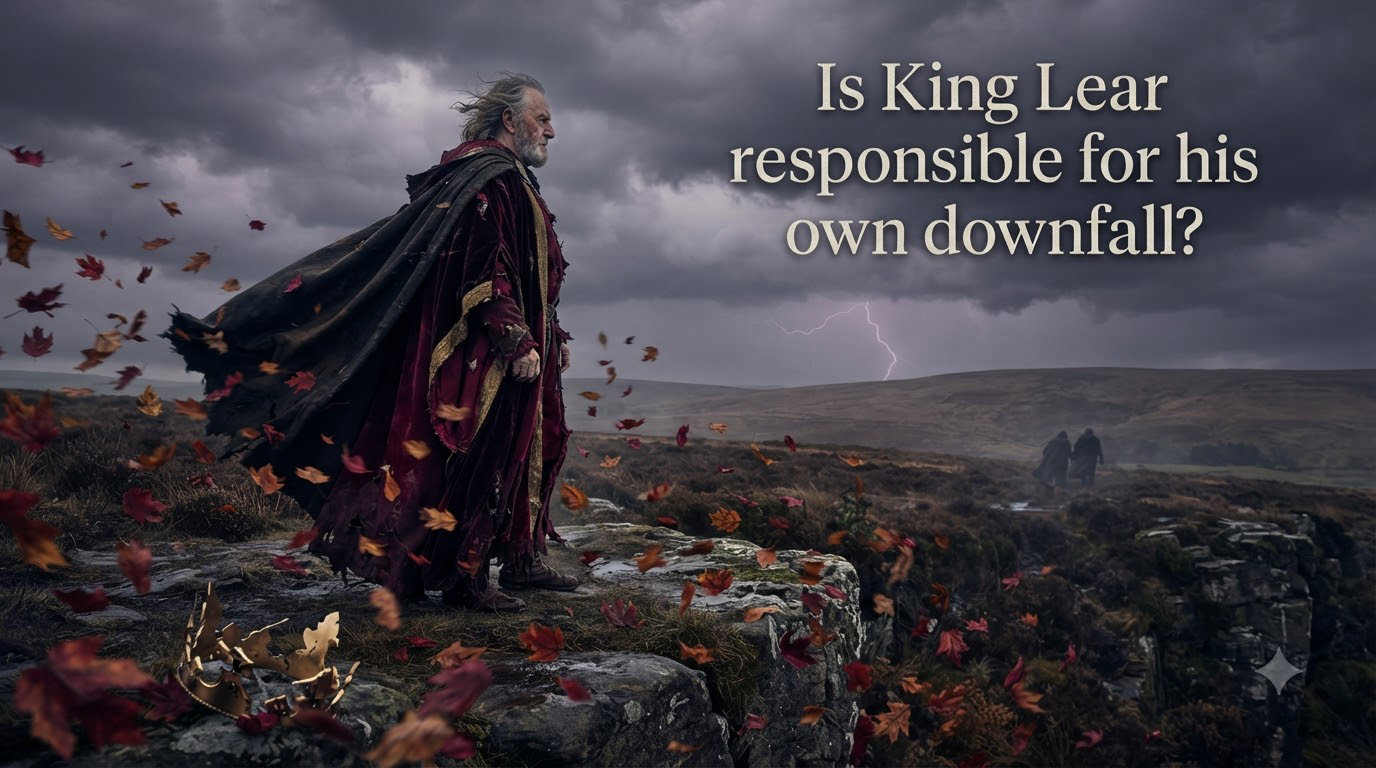
Yes, King Lear is responsible for his own downfall. His tragic flaws, principally hubris, a craving for flattery, and an inability to see beyond appearances, set in motion every catastrophe that befalls him. No character in Shakespeare’s tragedy manipulates Lear into dividing his kingdom, banishing his most loyal daughter, or exiling his best advisor. Each of these decisions originates from Lear himself, making the question of whether King Lear is responsible for his own downfall one with a clear answer rooted in the play’s opening scene.
What makes this Shakespearean tragedy so compelling is not that Lear is a villain, but that a fundamentally sympathetic man engineers his own ruin. The playwright constructs a careful chain of causation: Lear’s pride demands a love test, the love test requires flattery, and flattery rewards deceit while punishing honesty. By the time Lear recognizes his errors, the damage is irreversible. This analysis examines the specific decisions, flaws, and moral failings that make Lear the architect of his own catastrophe, drawing on textual evidence and the play’s deeper moral philosophy.
Table of Contents
The Fatal Division: Lear’s Love Test
The downfall begins with a single, catastrophic decision. In Act 1, Scene 1, Lear announces he will divide his kingdom among his three daughters based on a public competition: “Which of you shall we say doth love us most?” (1.1.49). This love test is not a harmless game. It is the mechanism through which Lear transfers political power while demanding personal validation.
The test itself reveals Lear’s fundamental misunderstanding of love and power. A king who truly understood filial duty would not need to auction his kingdom for compliments. Cordelia, his youngest and most honest daughter, refuses to participate in the performance. Her simple reply, “Nothing, my lord” (1.1.86), enrages Lear not because it is disrespectful, but because it denies him the flattery he craves.
Lear’s response to Cordelia’s honesty is to disinherit her entirely. He declares, “Here I disclaim all my paternal care, / Propinquity and property of blood” (1.1.113-114). This single impulsive act accomplishes three things simultaneously. It removes Lear’s only truly loving daughter from the line of succession. It rewards Goneril and Regan, whose speeches are calculated performances designed to secure power. And it signals to the court that honesty is punished while deception is rewarded.
The division of the kingdom is therefore not merely a political mistake. It is the moral and psychological error from which everything else flows. Lear hands his authority to the two daughters most willing to deceive him, while banishing the one who loves him genuinely. The entire tragedy is pre-loaded into this opening decision.
Pride as Tragic Flaw: The Hamartia of Hubris
In Aristotelian terms, Lear possesses a clear hamartia, or tragic flaw. His hamartia is hubris, an excessive pride that blinds him to his own limitations and the true nature of those around him. A tragic hero, in classical theory, is a figure of nobility whose downfall results not from pure villainy but from a specific, identifiable character defect. Lear fits this definition precisely.
Lear’s pride manifests most visibly in his need to be publicly adored. He has ruled for decades as an absolute monarch, and he expects that deference to continue even after surrendering power. When Goneril and Regan flatter him with increasingly absurd declarations of love, Lear does not question their sincerity. He accepts their performances because they feed his ego. His pride simply cannot entertain the possibility that his daughters might be deceiving him.
This pride also makes Lear unable to accept counsel. When Kent, his most loyal nobleman, objects to the disinheritance of Cordelia, Lear banishes him too. “Out of my sight!” (1.1.156) he rages, and when Kent delays, Lear escalates: “Five days we do allot thee for provision” (1.1.171). A ruler capable of self-reflection would at least pause when his most trusted advisor challenges a decision. Lear’s pride allows no such pause.
The crucial point is that this hubris is not imposed on Lear from outside. No one forces him to stage the love test, no one demands he disinherit Cordelia, and no one compels him to banish Kent. His pride generates each of these decisions from within. This is what makes Lear, in the fullest sense, responsible for his own downfall.
Blindness and Lack of Self-Awareness
Shakespeare weaves the metaphor of blindness throughout King Lear, and it applies to the title character most of all. Lear’s central deficiency is not physical blindness but a profound lack of self-awareness. He cannot see his daughters for who they truly are, cannot see his own weaknesses, and cannot see that his actions have consequences.
This blindness to reality is most stark in Lear’s valuation of appearances over substance. Goneril and Regan deliver elaborate, theatrical speeches declaring their love. Goneril claims Cordelia is worth “no less than the eyes-tongue-less, / Dowered with our faces, and with our hands” (1.1.131-132). These statements are so exaggerated they border on parody. Yet Lear, blinded by his need for validation, accepts them completely.
Cordelia, by contrast, offers honest love that she describes as bound by duty: she loves her father “According to my bond, no more nor less” (1.1.92). Lear is incapable of recognizing this as genuine. His self-absorption is so total that he can only interpret love through the lens of public declaration and excessive praise.
The irony of Lear’s blindness becomes literal later in the play through the Gloucester subplot. Gloucester, who is metaphorically blind to his son Edgar’s loyalty, has his eyes physically gouged out by Cornwall. After losing his sight, Gloucester famously observes, “I stumbled when I saw” (4.1.19-20), meaning he was actually more blind when he had his eyes. Lear undergoes a parallel journey. His self-awareness only develops after he has lost everything, including his sanity.
Impulsive Decisions and Rash Judgment
Beyond pride and blindness, Lear’s impulsivity accelerates his downfall dramatically. He does not deliberate, consult, or reflect. He reacts, and his reactions are volcanic. Every major decision in the first two acts is made in a state of fury, and each one proves disastrous.
The banishment of Cordelia is the first and most consequential example. Cordelia’s refusal to flatter him produces an immediate, disproportionate reaction. Lear does not ask why his favorite daughter has responded this way. He does not consider whether she might be speaking honestly. He simply explodes, cursing her and stripping her of her dowry and inheritance.
Kent’s intervention should have been a warning sign. A seasoned nobleman who has served Lear faithfully for years is willing to risk banishment to correct the king’s judgment. Lear’s response is to banish Kent as well, warning him that “thy banished trunk be found / In our dominions” will mean death (1.1.178-179). This is not measured governance. It is rage substituting for reason.
This pattern repeats when Goneril reduces Lear’s retinue of knights. Rather than negotiating or reflecting on why his daughter feels overwhelmed by his entourage, Lear curses her with devastating fury. He prays that she might bear a child “that she may feel / How sharper than a serpent’s tooth it is / To have a thankless child” (1.1.286-288). The curse is vivid and violent, and it accomplishes nothing except to deepen the rupture with his daughter.
Each impulsive decision narrows Lear’s options and isolates him further. By the time he storms out of Goneril’s house, he has alienated every person who genuinely cared about him. The rashness is entirely his own, and it is entirely responsible for the speed and completeness of his isolation.
The Daughters’ Betrayal: Shared Responsibility?
One counterargument deserves serious attention. Goneril and Regan are genuinely cruel. They strip Lear of his knights, deny him shelter, and drive him into the storm. Their betrayal is real, deliberate, and monstrous. Does their villainy reduce Lear’s share of the blame?
The answer the play itself offers is no. Goneril and Regan can only betray Lear because Lear handed them the power to do so. They did not seize the kingdom by force. Lear gave it to them willingly, based on a contest of flattery that he designed himself. Their treachery is enabled by, and made possible through, his catastrophic misjudgment.
Furthermore, Lear had every opportunity to recognize their true nature. Kent warned him. Cordelia’s honesty, though rejected, was available as evidence. The Fool mocks the king relentlessly, pointing out the absurdity of giving away power and expecting to keep respect. Lear ignored every signal because his pride refused to process them.
Shakespeare is careful to assign blame proportionally. Goneril and Regan are villains who bear responsibility for their own cruelty. But Lear’s downfall, specifically, is the result of decisions he made before their betrayal even began. He created the conditions for his own destruction, and no amount of filial ingratitude can undo that fundamental fact.
The Fool’s Mirror: Truth-Telling and Warnings
The Fool is one of Shakespeare’s most underrated characters in this tragedy, and his role highlights Lear’s responsibility with devastating clarity. Throughout the first half of the play, the Fool functions as Lear’s conscience, holding up a mirror to the king’s folly through riddles, songs, and bitter jokes.
The Fool tells Lear directly that he was a fool to give away his crown. “Thou shouldst not have been old till thou hadst been wise” (1.5.39-40), he tells the king, crystallizing the entire tragedy in a single line. Lear divided his kingdom while still foolish, and his age brought no wisdom to accompany the transfer of power.
What is striking is that Lear listens to the Fool but does not act on his wisdom. He finds the Fool’s barbs amusing and sometimes painful, but he never reverses course. This is a crucial detail. The Fool offers Lear every opportunity to recognize his mistake and seek to correct it. Lear’s refusal to do so confirms that his downfall results from his own choices, not from ignorance of the truth.
The Fool disappears from the play after Act 3, and his absence is telling. By that point, Lear has begun to gain genuine self-awareness through suffering. The Fool’s job, which was to reflect Lear’s folly back at him, is no longer needed. The tragedy is that Lear only becomes capable of hearing the truth after it is too late to act on it.
Lear’s Transformation: Too Little, Too Late?
One of the most debated questions among readers and scholars is whether Lear actually changes. The answer matters enormously for the question of responsibility, because a character who genuinely transforms and gains wisdom is one who earns some measure of redemption, even if the transformation comes too late.
The storm scene in Act 3 marks the turning point. Stripped of power, shelter, and dignity, Lear wanders the heath and begins to see the world differently. For the first time, he recognizes the suffering of others. “O, I have ta’en / Too little care of this!” (3.4.32-33), he says of the poor and naked wretches of his kingdom. This is a king who ruled for decades without ever considering the plight of his poorest subjects.
By Act 4, Lear’s self-awareness has deepened profoundly. In his reunion with Cordelia, he acknowledges his failings with striking humility: “I am a very foolish fond old man, / Fourscore and upward” (4.7.60-61), and asks, “Pray you now, forget and forgive. I am old and foolish” (4.7.84). This is not the raving tyrant of Act 1. This is a man who has been broken open by suffering and has finally seen himself clearly.
But this transformation, however genuine, cannot undo what has been set in motion. Lear gains wisdom, but the kingdom has already been divided. Cordelia has been banished and now returns only to die. The daughters Lear empowered are at war with each other. Lear’s newfound self-knowledge is real and moving, but it arrives after the consequences of his earlier decisions have become irreversible. This is the defining cruelty of the tragedy: Lear becomes wise precisely when wisdom can no longer save him.
The Gloucester Parallel: A Double Tragedy
Shakespeare reinforces the theme of personal responsibility through the Gloucester subplot. Gloucester, like Lear, makes a catastrophic error in judgment based on appearances. He believes his illegitimate son Edmund’s lies about his legitimate son Edgar, and he banishes the loyal child while embracing the treacherous one.
The parallel is exact and deliberate. Both Lear and Gloucester are deceived by flattery, both reject their loyal children, and both suffer devastating consequences. The doubling of this pattern across two storylines makes Shakespeare’s point unmistakable: these are not isolated mistakes. They represent a universal human tendency to prefer comfortable lies over difficult truths.
Gloucester’s fate also mirrors Lear’s in its irony. His physical blinding by Cornwall makes him metaphorically clear-sighted for the first time. Like Lear, Gloucester only sees the truth after losing the ability to see. The subplot confirms that the play’s moral is not about one man’s weakness, but about a fundamental error in judgment that can afflict anyone who values appearance over reality.
Moral Philosophy: Does Lear Deserve Sympathy?
The deepest question the play raises is moral rather than literary. Does Lear deserve our sympathy, or is he simply reaping what he sowed? This question matters because it sits at the heart of how we interpret the play’s meaning and what we take from it as readers.
Shakespeare’s answer is deliberately complex. Lear is guilty of the sins that destroy him. His pride, impulsivity, and blindness are not excused by his age, his position, or the cruelty of his daughters. He is, in the fullest sense, responsible for his own downfall. The play never allows him to shift the blame, and Lear himself ultimately does not try to.
Yet Shakespeare also insists that we feel for Lear deeply. The suffering he endures on the heath, his descent into madness, and his heartbreak over Cordelia are depicted with enormous compassion. The play suggests that responsibility and sympathy are not mutually exclusive. A person can be fully responsible for their downfall and still be worthy of pity. This is what makes King Lear one of the most morally sophisticated works in all of English literature.
From a modern psychological perspective, Lear’s behavior reflects patterns that are painfully recognizable. The need for validation, the inability to accept criticism, the tendency to lash out when threatened, and the slow, painful acquisition of self-knowledge through loss are all deeply human traits. Shakespeare was writing about psychological realities that modern readers recognize in themselves, which is why the play continues to resonate centuries after it was first performed.
FAQs
What was the tragic flaw of King Lear?
King Lear’s tragic flaw, or hamartia, is hubris: an excessive pride that demands flattery and blinds him to the true nature of those around him. This pride causes him to stage a love test, banish his honest daughter Cordelia, and hand his kingdom to deceitful daughters, setting his entire downfall in motion.
How does Lear’s decision to divide his kingdom lead to his downfall?
By dividing his kingdom through a love test based on flattery, Lear rewards Goneril and Regan’s dishonesty while punishing Cordelia’s sincerity. He surrenders political power to daughters who only value authority, not filial duty. Once powerless, Lear has no leverage when they strip away his knights, his dignity, and finally his shelter, driving him into madness.
Who betrayed King Lear in the story?
Goneril and Regan, Lear’s two eldest daughters, betray him after receiving his kingdom. They reduce his retinue of knights, deny him shelter, and refuse to house him during the storm. However, their betrayal was only possible because Lear empowered them through his own misjudgment in the love test.
What is the main weakness of King Lear?
Lear’s main weakness is his lack of self-awareness. He values appearances over reality, cannot distinguish genuine love from flattery, and refuses to accept counsel from those who see clearly. This blindness to truth, both moral and psychological, is the root cause of every catastrophic decision he makes.
Is King Lear a tragic hero?
Yes, King Lear is a classic tragic hero. He is a figure of great nobility whose downfall results from a specific, identifiable flaw rather than external villainy alone. His journey follows the Aristotelian arc of hamartia (tragic flaw), peripeteia (reversal of fortune), and anagnorisis (recognition), culminating in genuine self-knowledge that arrives too late to prevent catastrophe.
Conclusion
The evidence from Shakespeare’s text is unambiguous. King Lear is responsible for his own downfall because every catastrophe in the play traces back to decisions he made freely and independently. His hubris demanded a love test. His impulsivity banished Cordelia and Kent. His blindness to reality empowered Goneril and Regan. No external force compelled any of these choices.
What elevates the play beyond a simple cautionary tale is the depth and sincerity of Lear’s eventual transformation. He gains genuine wisdom, recognizes his failings, and achieves a hard-won self-awareness that makes him one of literature’s most fully realized tragic heroes. The play’s genius lies in showing us that responsibility and compassion can coexist: Lear fully deserves his fate, and he fully deserves our tears.
Understanding whether King Lear is responsible for his own downfall reveals Shakespeare’s deepest moral insight. The greatest tragedies are not those inflicted upon us by others, but those we build with our own hands, brick by brick, through the flaws we refuse to see. That is why Lear’s story has echoed through the centuries, and why it will continue to challenge and move readers for generations to come.