
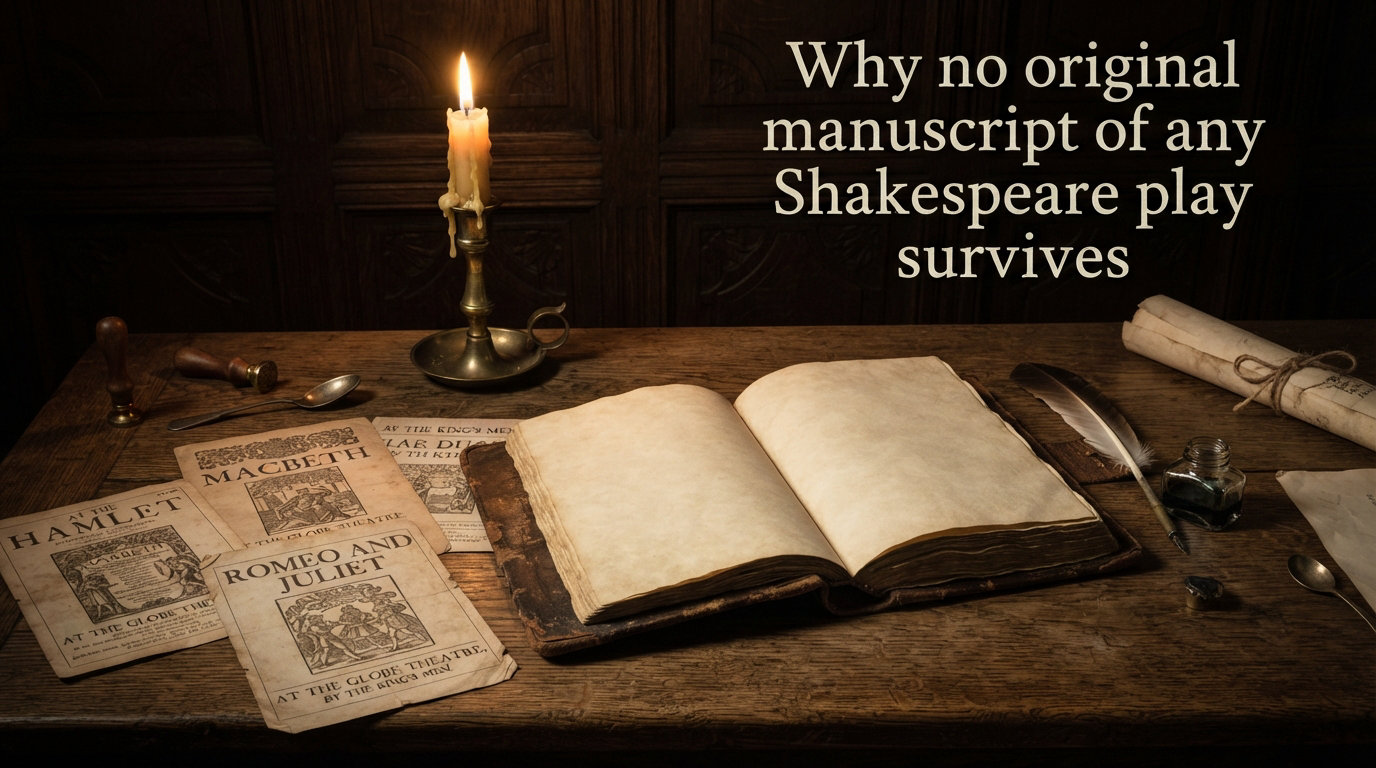
No original manuscript of any Shakespeare play survives to this day. The simple reason is that Elizabethan paper was too valuable to keep idle in a drawer. Once a play had been performed, copied out, or printed, the original handwritten paper was routinely recycled for domestic and commercial uses. Shakespeare’s plays survived only because his fellow actors, John Heminge and Henry Condell, gathered them together and published them in the First Folio of 1623, seven years after his death.
I have spent years tracing the paper trail of the Elizabethan stage, and the absence of Shakespeare manuscripts remains one of the most striking facts in literary history. In this guide, I will walk you through every reason why those manuscripts disappeared, what tiny fragments have come close to being Shakespeare in his own hand, and how the works we now treasure even exist at all.
Table of Contents
Why No Original Manuscript of Any Shakespeare Play Survives
The short answer is paper economics. In late 16th and early 17th century England, rag paper was a manufactured commodity, and it cost real money. When a play had served its purpose at the playhouse, the page was liable to be sold by weight to a grocer, a stationer, or a passing scrap dealer. Linen merchants, cooks, and bakers all bought used paper for wrapping, lining pie dishes, and other domestic tasks.
Shakespeare was also a working playwright, not a literary icon during his lifetime. Playwrights were considered craftsmen, on par with shoemakers or tailors. Their scripts were working documents, not artistic relics. Nobody imagined that future generations would treat a scribbled playhouse draft as a national treasure.
There is also a confirming negative. Shakespeare’s signature appears six times in surviving legal documents, and the British Library, the Folger Shakespeare Library, and scholars worldwide have authenticated every known example of his handwriting. Apart from a handful of pages from the play The Booke of Sir Thomas More, no theatrical manuscript has ever been attributed to him with confidence.
Paper Was Too Valuable to Waste in Elizabethan England
Paper in Shakespeare’s England was made from linen rags, boiled, pulped, and pressed into sheets by hand. Each sheet cost a laborer roughly a day’s wages for a small quantity. For a playhouse script of, say, 30 or 40 pages, the paper alone was a small investment. It made no sense to leave it in a chest when the sheets could be sold or reused.
Stationers, the booksellers and publishers of the era, kept close accounts of paper stocks. When a manuscript was no longer useful, the sheets would be returned to the paper chain. I find this especially telling. The same physical paper might have served as a playhouse prompt book, then a court record, then a baker’s wrapper, and finally a piece of household lining.
BBC Future’s reporting on the search for Shakespeare’s lost play makes this vivid. In 1828, a London auctioneer named Heber bought a bundle of old manuscripts from a country estate. The papers turned out to be Elizabethan plays, including a probable early Hamlet. They had survived because they had been pressed into service as the lining of pie dishes in a kitchen cupboard. Moist pastry had preserved them for centuries.
The cook story is more than a curiosity. It is a perfect illustration of how Shakespeare manuscripts disappeared. Anything truly valuable would have been reused before it ever had the chance to be considered historically precious. There is also the question of fires. Wooden London burned repeatedly, and most of the city was destroyed in the Great Fire of 1666. Playhouse archives, stationers’ warehouses, and even private libraries went up in flames.
Plays Were Treated as Ephemeral Entertainment
I think the single most important reason Shakespeare manuscripts vanished is cultural. In Tudor and Stuart England, plays were popular entertainment. A successful run might last a few weeks, after which the scripts were gathering dust. Nobody in 1605 imagined that Hamlet would one day be studied in schools on every continent.
The Elizabethan literary world simply did not value the playwright’s working draft. A finished printed book carried some prestige, but a manuscript was a transient thing. Even authors like Ben Jonson, who fought hard for recognition as a literary figure, kept few of their own drafts. The manuscripts of Shakespeare, Marlowe, Kyd, Greene, and most of Shakespeare’s contemporaries are all gone.
This explains why official records have survived far better than literary ones. Government documents, court proceedings, parish registers, and legal contracts were written on paper that needed to be kept for accountability. Plays had no such archival value. The Lord Chamberlain’s Men, Shakespeare’s playing company, treated their scripts as business assets, not heirlooms.
Even Shakespeare’s personal papers reflect this attitude. He left a will, property deeds, mortgage documents, and a handful of business letters. None of those survive either. The only evidence of his handwriting we have with certainty is his signature on six legal documents, plus a possible contribution to Sir Thomas More.
Understanding Shakespeare’s Manuscripts: Foul Papers, Fair Copies, and Prompt Books
To understand what we have lost, it helps to know what kinds of manuscripts existed in the Elizabethan playhouse. Scholars generally recognize three main types of pre-printing documents.
Foul papers were the playwright’s working draft. They were covered in revisions, deletions, marginal notes, and stage directions. The name foul refers to the messy state of the pages. If any of Shakespeare’s foul papers had survived, they would be the most precious literary documents in the English language. None have come down to us.
Fair copies were clean transcripts of the foul papers, often made by a professional scribe. They were prepared for the acting company or, in some cases, for submission to the Master of the Revels for censorship review. A fair copy would be cleaner, but it would still be a handwritten document, and so subject to the same paper recycling pressure.
Prompt books were the playhouse’s working copy, used by the book-keeper (or prompter) during rehearsals and performances. They typically included stage directions, actor cues, music cues, and notes on props. A prompt book could be modified by the prompters over many years, with new cuts or additions. None of Shakespeare’s prompt books survive.
Finally, there were scribal transcripts prepared for the printing house. When a publisher wanted to print a play, they would obtain a manuscript from the playhouse and have a scribe prepare a transcript for the compositors to set in type. Shakespeare’s plays were printed in single-play editions called quartos during his lifetime, and very few of those manuscripts survive either. The most famous example is the manuscript of Sir Thomas More, which I’ll come to in a moment.
How the First Folio Saved Shakespeare’s Plays
Without the First Folio of 1623, we would have lost roughly half of Shakespeare’s plays forever. That single book preserved 36 plays, including Macbeth, The Tempest, Julius Caesar, and Twelfth Night, none of which had been printed in quarto form during Shakespeare’s lifetime.
John Heminge and Henry Condell, Shakespeare’s fellow actors and business partners in the Lord Chamberlain’s Men (later the King’s Men), compiled the First Folio. They had access to the playhouse’s working manuscripts, both foul papers and prompt books, and they used them as the basis for the printed text. Their preface famously declared that they had collected his scattered works “as an assistant to the truth” and that other printed texts were “stolen and surreptitious.”
The First Folio also explains why we still have Shakespeare at all. Within a few years of publication, the folio was a rare book. Today, around 230 copies are known to survive, scattered across libraries and private collections. The Folger Shakespeare Library in Washington, DC holds 82 copies, by far the largest collection. The fact that the Folger’s founder, Henry Clay Folger, dedicated his life to amassing them shows how desperate the world was to preserve even the printed versions.
I want to underline something important. The First Folio is not a transcript of Shakespeare’s manuscripts. It is a printed book derived from them. The handwriting, the revisions, the deletions, the stage directions, the actor names, all of that was lost in the transition from manuscript to print. The First Folio preserves the words, but not the work that produced them.
Shakespeare’s Signature: The Only Certain Evidence of His Handwriting
It is striking, and a little sad, that the only thing we can confidently say Shakespeare wrote in his own hand is his name. Six signatures survive, all attached to legal documents. Three are on the parchments of his will, dated 1616. Others appear on property deeds, a mortgage, and a deposition in the Bellott v. Mountjoy lawsuit.
Scholars have studied those signatures carefully. They show a man who could write clearly enough for business purposes, but with no flourish and no literary ambition. The signatures are not beautiful, but they are consistent. The British Library and the National Archives in Kew have authenticated them. Beyond these six marks, no manuscript in Shakespeare’s hand has ever been conclusively identified.
This is the standard truth that every Shakespeare scholar repeats. There is no surviving letter, diary, notebook, or playhouse draft written by William Shakespeare. Not a single example of his literary handwriting. The plays have come down to us transcribed by other hands, set in type by anonymous compositors, and printed by stationers whose names we often know but whose motives varied.
The Sir Thomas More Exception
There is one partial exception to the rule that no Shakespeare manuscripts survive. The manuscript of The Booke of Sir Thomas More, held at the British Library, contains three pages of additions in a hand that scholars have long debated as possibly Shakespeare’s. The play is about the life of Sir Thomas More, written by Anthony Munday and revised by several other playwrights, including (some scholars argue) Shakespeare.
The pages in question, mostly working on More’s speech to the rioters in Act 2, have been analyzed by paleographers for over a century. Some scholars have argued that the handwriting matches Shakespeare’s known signatures, and that the language, especially a passage about “the quality of mercy,” shows Shakespeare’s distinctive style. The British Library has placed the manuscript online, so you can study it yourself.
It is important to be honest about how speculative this is. Most Shakespeare scholars, including the editors of the modern Norton and Arden editions, treat the Sir Thomas More attribution as possible but not certain. Even if those three pages are Shakespeare’s, they amount to roughly 148 lines of text, a tiny fragment compared to the 36 surviving plays. The exception proves the rule: there is essentially no Shakespeare manuscript tradition in the way that we have them for Chaucer, for example, or for other contemporary writers.
Lost Plays: What Else Disappeared
The lack of Shakespeare manuscripts is even more painful when we consider what we have lost altogether. Scholarly tradition lists two plays that have vanished entirely from the canon: Love’s Labour’s Won, mentioned by contemporaries as a sequel to Love’s Labour’s Lost, and Cardenio, a lost play based on a story from Don Quixote, attributed to Shakespeare and John Fletcher in 1613.
Beyond these, there are passing references to other works, possibly by Shakespeare, that have not survived. A play called Henry II is mentioned in Henslowe’s papers, and some scholars believe Shakespeare may have had a hand in Edward III and The Two Noble Kinsmen. The more we search the archives, the more we realize how much of the Elizabethan stage has been lost.
The BBC’s 420-year search for these lost plays has produced occasional flashes of hope. In 2023, scholars digitized and reanalyzed thousands of manuscripts from the Henslowe archive at Dulwich College. They confirmed that some anonymous plays of the 1590s may have been lost simply because no stationer thought them worth printing. The search continues, and I have to admit that the cook story still gives me hope that a manuscript somewhere is yet to be uncovered.
FAQ: Common Questions About Shakespeare Manuscripts
Do any of Shakespeare’s manuscripts survive?
No original manuscript of any Shakespeare play survives. The only certain evidence of his handwriting is six signatures on legal documents, plus a debated three-page addition to the manuscript of Sir Thomas More.
Did all of Shakespeare’s plays survive?
Most of Shakespeare’s plays survive, but two known works are lost: Love’s Labour’s Won and Cardenio. Eighteen plays would have been lost entirely if not for the First Folio of 1623, which preserved them in print for the first time.
Are there any original copies of Shakespeare’s plays?
No original playhouse manuscripts exist. The earliest texts we have are printed quartos from the 1590s onward, and the First Folio of 1623, which was compiled by Shakespeare’s fellow actors John Heminge and Henry Condell from playhouse scripts.
What are Shakespeare’s foul papers?
Foul papers were the playwright’s working drafts, full of revisions, deletions, and marginal notes. We have no surviving foul papers of Shakespeare, only the printed quartos and the First Folio, which preserve the text but not the messy original work.
What is Shakespeare’s only surviving play manuscript?
The Sir Thomas More manuscript at the British Library contains three pages that may be in Shakespeare’s hand. The attribution is debated, but if true, it is the only surviving example of Shakespeare writing for the stage.
Why was paper valuable in Elizabethan England?
Paper was made from linen rags and cost roughly a day’s wages per small quantity. Once a play had been used, the sheets were sold to stationers, bakers, and households for wrapping, lining pie dishes, and other domestic tasks.
Who inherited most of Shakespeare’s money?
Shakespeare left the bulk of his estate to his daughter Susanna and her husband, Dr. John Hall. He famously left his wife Anne only his second-best bed, a small bequest that has intrigued scholars for centuries.
What did Mark Twain say about Shakespeare?
Mark Twain was famously skeptical about Shakespeare’s authorship, once writing that the plays showed ‘the loosest-composite hand’ and wondered how one writer could produce works of such varied quality. Twain’s doubts fed later authorship conspiracy theories.
Conclusion
So why no original manuscript of any Shakespeare play survives? It comes down to three forces working together. First, Elizabethan paper was a commodity too valuable to leave idle. Second, plays were treated as ephemeral entertainment, not as works of art worthy of preservation. Third, the only large-scale rescue effort came after Shakespeare’s death, when Heminge and Condell published the First Folio in 1623 and froze the texts in print before the manuscripts could be lost completely.
It is one of the great ironies of literary history. The world’s most famous playwright left no drafts, no letters, no notebooks. Only six signatures testify that he ever picked up a pen. The plays survived because other people, actors, scribes, and printers, chose to keep them alive. The manuscripts are gone, but the words remain.
If you want to dig deeper, the British Library’s online collection includes the Sir Thomas More manuscript and digitized First Folios. The Folger Shakespeare Library in Washington, DC has the largest collection of First Folios anywhere in the world, and their digital resources are open to all. The story of Shakespeare’s lost manuscripts is, in the end, a reminder that culture is fragile, and that we owe a debt to every printer, every librarian, and yes, every cook who ever kept a piece of paper long enough for it to be read again.