
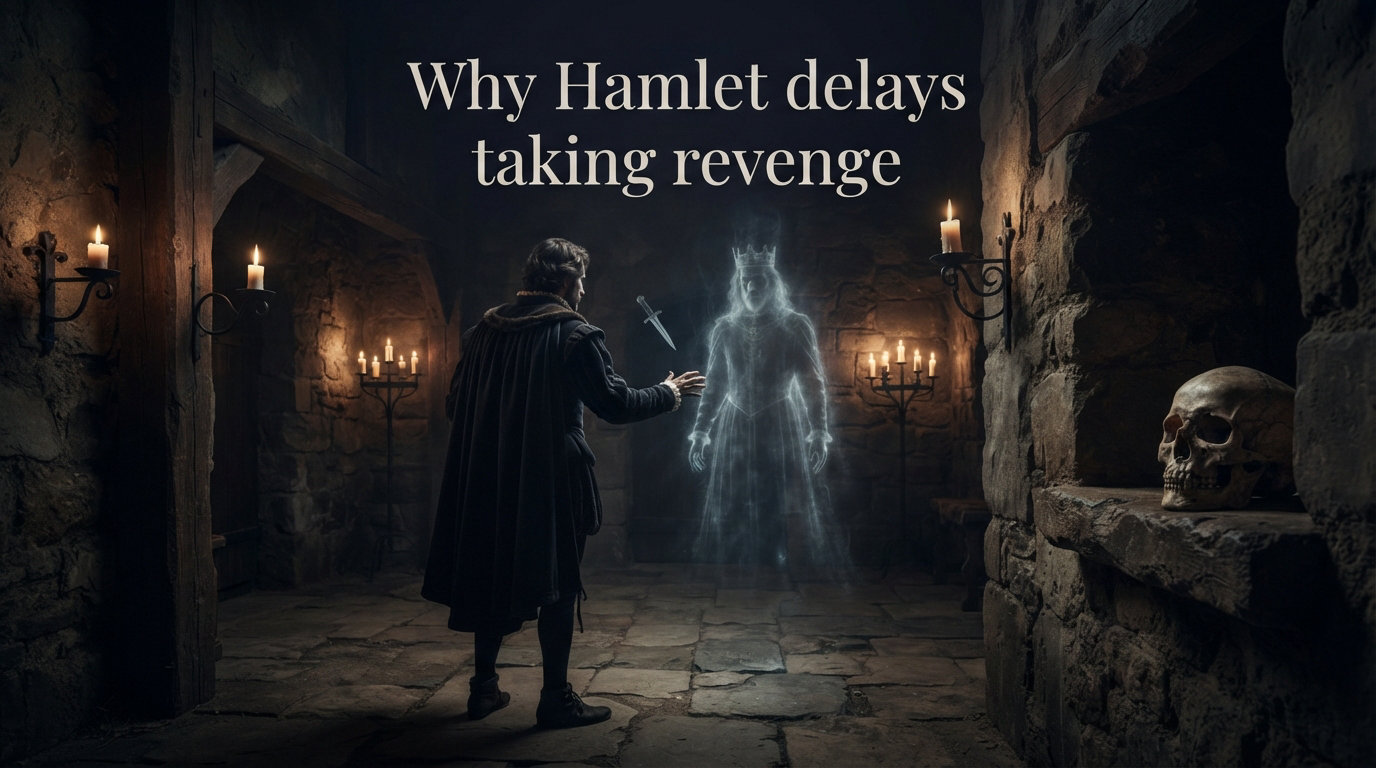
The question of why Hamlet delays taking revenge against his uncle Claudius has fascinated readers for over four hundred years. After the Ghost reveals that Claudius poured poison into King Hamlet’s ear while he slept, the prince has a victim, a murderer, and a direct command. Yet he waits through five acts of agonizing deliberation before he finally strikes.
Critics have called this the “Hamlet problem,” and it has generated more scholarly debate than almost any other question in English literature. Goethe blamed the prince’s sensitive nature. Coleridge pointed to an overactive mind.
Freud found an unconscious conflict rooted in desire. Still others argue the delay is purely dramatic, a structural necessity that gives Shakespeare room to explore moral territory no swift revenge could ever reach. Every great theory illuminates part of the play, and none captures the whole.
In this analysis, I walk through the major critical approaches, examine the textual evidence, and explain what Shakespeare achieves through the delay that a more decisive hero never could. Whether you are writing a literature essay, preparing for a seminar, or simply frustrated by a prince who refuses to act, this guide will help you understand why Hamlet’s procrastination is not a flaw but the play’s deepest design.
Table of Contents
Why Hamlet Delays Taking Revenge: The Central Problem Explained
Hamlet’s delay is not a single failure but a layered conflict involving moral doubt, intellectual paralysis, psychological disturbance, and theatrical strategy. Each time he moves toward action, something inside him or outside him pulls him back.
After the Ghost’s command in Act 1 Scene 5, Hamlet swears he will “sweep to my revenge” with the speed of thought. He even adopts an “antic disposition,” a performance of madness, as part of his plan. Yet by Act 2, he is berating himself for doing nothing while a travelling actor can summon real tears for a fictional character named Hecuba.
The play itself draws constant attention to the problem. Hamlet calls himself a “rogue and peasant slave” for his inaction. He asks, “Am I a coward?” He wonders why he cannot act when lesser men, players and soldiers, throw themselves into causes far less just than his own.
This self-awareness matters enormously. Shakespeare is not hiding the delay from us or apologizing for it. He makes Hamlet accuse himself of inaction over and over, in some of the most famous soliloquies in the English language.
The delay is not a plot hole. It is the play’s central subject, the thing the audience is meant to wrestle with from the first scene to the last. The reason Hamlet delays taking revenge has puzzled readers precisely because the character is intelligent enough to recognize his own paralysis.
A stupid hero would simply fail. Hamlet sees his failure, names it, analyzes it, and still cannot overcome it. That is what makes the delay tragic rather than merely frustrating.
Five Major Theories That Explain Hamlet’s Procrastination
Scholars have proposed five major theories to explain Hamlet’s delay. These are Goethe’s delicate-hero theory, Coleridge’s burden of thought, Bradley’s melancholic depression, Freud’s unconscious Oedipal conflict, and the moral-conscience interpretation. Each captures part of the truth, and together they form a complete picture of one of literature’s most complex minds.
Goethe: Hamlet Is Too Sensitive for the Task
Goethe, writing in Wilhelm Meister’s Apprenticeship in 1796, famously compared Hamlet to a precious vase planted with a noble flower. The prince, he argued, is a beautiful soul asked to perform a brutal deed for which he has no natural capacity.
For Goethe, the Ghost’s command places an oak tree inside a delicate vase. The roots expand and the vase shatters. Hamlet is not lazy, cowardly, or stupid; he is simply not built for revenge.
This theory explains Hamlet’s tenderness, his love of theatre, his poetic language, and his genuine grief for his father. But it can make him seem too soft, almost a passive victim rather than the play’s most powerful intelligence. Goethe’s Hamlet is sympathetic but ultimately fragile, crushed by a task too heavy for his nature.
Coleridge: Thinking Paralyzes Action
Samuel Taylor Coleridge offered one of the most influential accounts of the delay. He argued that Hamlet suffers from an imbalance between thought and action, that his intellect is so active it smothers every impulse before it can become a deed.
In Coleridge’s reading, action is normally the result and issue of thought. But in Hamlet, the balance is disturbed. His brain overworks every situation until the original impulse to kill Claudius drowns in a flood of counter-motives, qualifications, and second thoughts.
He thinks himself out of acting. This reading fits the soliloquies with striking precision. Hamlet never simply decides; he deliberates, qualifies, questions, and reconsiders until the moment for action has passed.
Coleridge’s theory remains one of the most popular explanations among modern readers because it matches what we actually see on the page. It also resonates with anyone who has ever overthought a decision until the opportunity disappeared. That universal experience is part of what keeps Coleridge’s interpretation alive and persuasive.
A.C. Bradley: Melancholia and Moral Paralysis
A.C. Bradley, in his landmark Shakespearean Tragedy published in 1904, grounded the delay in Hamlet’s mental state. After his father’s sudden death and his mother’s hasty remarriage to his uncle, the prince sinks into a deep melancholy that Bradley compared to what we now call clinical depression.
Bradley’s Hamlet is not merely thoughtful. He is emotionally shattered. His melancholia brings lethargy, disgust with the world, obsessive brooding, and an inability to sustain effort. He cannot act because he cannot fully engage with life itself.
Everything seems “weary, stale, flat, and unprofitable” to him. This theory explains the opening soliloquy, “O that this too too solid flesh would melt,” and the suicidal longing that runs through the play. It also explains his sudden cruelty toward Ophelia and his mother, the bitterness of a depressed mind lashing out at those closest to him.
For Bradley, the delay is not philosophical but pathological, rooted in a damaged psyche rather than an overactive one. The prince’s melancholy precedes the Ghost’s command, which means the revenge mission inherits a mind already in crisis.
Freud and the Oedipus Complex
Sigmund Freud offered a radical reinterpretation in The Interpretation of Dreams and later writings. He suggested that Hamlet hesitates because Claudius has done exactly what Hamlet himself unconsciously wished to do: kill his father and possess his mother.
According to Freud, Hamlet’s disgust at Gertrude’s remarriage is not simple moral outrage but repressed desire. He cannot punish Claudius without confronting his own guilty wishes. The man he must kill embodies his deepest hidden impulse, and so his conscience, his unconscious mind, paralyzes his sword hand.
Ernest Jones developed this into a full psychoanalytic reading in 1910, arguing that Hamlet’s delay is a textbook case of neurosis rooted in an unresolved Oedipal fixation. While many scholars now find this reading reductive, it remains one of the most provocative theories ever offered.
It forces us to ask whether Hamlet’s rage at his mother is really about morality at all, or about something darker and more personal. Even readers who reject the full Freudian framework find that it illuminates the intensity of Hamlet’s fixation on Gertrude’s sex life.
The Moral Conscience Interpretation
Perhaps the deepest theory holds that Hamlet delays because his conscience tells him revenge is morally wrong. This reading emphasizes that private vengeance was condemned by Elizabethan Christianity, and that Hamlet, a student of theology at Wittenberg, feels the wrongness of murder in his very bones.
Kenneth Chan, one of the most detailed modern analysts of the play, argues that Shakespeare uses the delay to make his audience experience why revenge is a moral disaster. By watching Hamlet’s transformation along what Chan calls “this terrible path of vengeance,” we feel the spiritual desecration that revenge inflicts on the avenger himself.
On this view, the delay is not weakness at all. It is Hamlet’s soul resisting corruption. Shakespeare’s genius is to dramatize a moral argument instead of simply stating it, making us feel through Hamlet’s suffering that vengeance destroys the one who wields it.
The conscience reading ties together the other theories because it explains why a thoughtful, melancholy, sensitive man cannot do what a brutal world demands of him. The delay becomes the visible evidence of a moral nature under impossible pressure.
The Soliloquies as Evidence: What Hamlet Says About His Own Delay
Hamlet’s soliloquies are the primary textual evidence for why he delays. They show a prince acutely aware of his own inaction and tormented by it. Shakespeare gives us direct access to Hamlet’s mind through seven major soliloquies, each revealing a different layer of the conflict that paralyzes him.
“O that this too too solid flesh would melt” (Act 1, Scene 2) comes before Hamlet even meets the Ghost. Here he is already in crisis, suicidal, disgusted by his mother’s remarriage, and wearied by the world. Bradley read this as proof of pre-existing melancholy; the delay begins before the revenge mission does, which means the mission inherits a mind already damaged.
“O all you host of heaven!” (Act 1, Scene 5) arrives immediately after the Ghost’s command. Hamlet vows swift action: “I’ll wipe away all trivial fond records… and thy commandment all alone shall live within the book and volume of my brain.” But his very next instinct is to put on madness and stall, and that contradiction defines him from the start.
“O what a rogue and peasant slave am I!” (Act 2, Scene 2) is the great self-accusation. Hamlet compares himself unfavorably to a player who can weep for Hecuba, a fictional queen he has never met. “Am I a coward?” he asks himself before resolving to test Claudius with a play, the Mousetrap.
This is another delay dressed up as strategy. Testing is not acting, and Hamlet knows it. But the plan gives him something to do instead of killing his uncle, and so it buys him time.
“To be, or not to be” (Act 3, Scene 1) is the most famous soliloquy in the language, and it is not about revenge at all. It is about whether existence itself is worth enduring. This is the philosophical Hamlet, so absorbed in the largest questions that the specific task of killing Claudius fades into abstraction.
“‘Tis now the very witching time of night” (Act 3, Scene 2) follows the Mousetrap, which has confirmed Claudius’s guilt. Hamlet briefly turns savage, ready to “drink hot blood” and do bitter business. But in the very next scene, the prayer scene, he hesitates again, and the surge of resolve collapses instantly.
“How all occasions do inform against me” (Act 4, Scene 4) comes as Hamlet watches Fortinbras lead an army of twenty thousand men to die for a worthless patch of ground. He is shamed into renewed resolve: “O, from this time forth, my thoughts be bloody, or be nothing worth.” Yet the killing does not come until Act 5, and even then it is prompted by external events rather than his own initiative.
The pattern is unmistakable. Each soliloquy ends with a vow to act, and each is followed by more delay.
Shakespeare is not writing an indecisive man by accident but charting the rhythm of a conscience at war with a command it cannot fully accept. The soliloquies are where we hear that war fought in real time.
The Prayer Scene: The Moment Hamlet Chooses Not to Act
The prayer scene in Act 3 Scene 3 is the single clearest moment where Hamlet could kill Claudius and chooses not to. Finding his uncle alone and kneeling, apparently at prayer, Hamlet draws his sword, raises it, and then sheathes it without striking.
His stated reason is theological. If he kills Claudius while the king is praying, he will send his soul to heaven. That would be “hire and salary, not revenge.” Hamlet wants Claudius damned, not saved.
So he decides to wait for a moment when the king is “drunk asleep, or in his rage, or in the incestuous pleasure of his bed,” so that his soul may be “as damned and black as hell.” This is not a man too weak to act. This is a man who wants more than death; he wants damnation.
This scene matters enormously because it shows the delay is deliberate. Hamlet has the weapon, the opportunity, the justification, and the will in that moment. He makes a conscious, reasoned decision to wait, choosing cruelty over mercy.
Critics debate whether Hamlet’s reasoning is sincere or an excuse. After all, Claudius admits immediately afterward that his prayers are hollow: “My words fly up, my thoughts remain below. Words without thoughts never to heaven go.” Had Hamlet struck, Claudius would not have been saved, but he did not know this.
Either way, the prayer scene reveals that the reason why Hamlet delays taking revenge is, at least in part, a conscious choice. The very ambition for perfect, complete revenge keeps him from acting at all. The desire for a better revenge produces a worse one, or none.
The Ghost’s Ambiguous Authority: Can Hamlet Trust the Spirit?
The Ghost’s command is the foundation of Hamlet’s mission, yet its moral and supernatural authority is far from certain, and Hamlet knows it. The prince never fully trusts that the spirit is what it claims to be, and this uncertainty gives him a genuine, rational reason to hesitate.
In Elizabethan belief, ghosts were deeply ambiguous creatures. A spirit might be a tormented soul returning from Purgatory to demand justice. But it might equally be a demon in disguise, or even the devil himself assuming a pleasing shape to tempt the living into sin.
Protestant England had officially rejected the doctrine of Purgatory, which made every ghost suspect by default. Hamlet himself voices this fear explicitly in Act 2 Scene 2: “The spirit that I have seen may be the devil, and the devil hath power to assume a pleasing shape.” This is the prince articulating the exact theological danger of acting on a ghost’s word.
This ambiguity matters enormously for the delay. If the Ghost is truthful, killing Claudius is righteous justice. If it is a demon tempting him to murder an innocent man, then acting would damn Hamlet’s own soul forever.
The prince cannot know for certain. So the Mousetrap play becomes his attempt to verify the Ghost’s story through independent evidence before he risks his salvation on a spirit’s word. Even after the play seems to confirm Claudius’s guilt, doubt lingers.
Hamlet has tested his uncle’s conscience, but he has not tested the Ghost’s nature. He can prove Claudius is guilty, but he cannot prove the Ghost is honest. The uncertainty gives him a standing, rational reason to pause, not from weakness but from care with his immortal soul.
This reading reframes the entire delay. Hamlet is responsibly gathering evidence before committing an irreversible act of violence on the basis of a possibly demonic apparition. The Ghost’s ambiguity is not a side issue; it is the engine of the play’s deepest moral tension, and no competitor analysis covers it thoroughly enough.
Hamlet Versus Laertes: Contemplation Against Impulse
Shakespeare deliberately contrasts Hamlet’s delay with Laertes’ immediate, impulsive rage. The contrast shows that swift revenge is not the virtue the play endorses. Laertes acts exactly as Hamlet does not, and it destroys him just as completely.
When Laertes learns that Hamlet has killed his father Polonius, he storms the palace with a mob, ready to cut the prince’s throat on the spot. He cares nothing for proof, conscience, or consequence. “To hell, allegiance! Vows, to the blackest devil!” he cries, swearing that nothing in the world would stop his revenge.
Laertes gets precisely what Hamlet spends the play refusing to do. He takes revenge quickly and decisively, without philosophy, without hesitation, without moral scruple. And it kills him.
He conspires with Claudius to poison his sword and murder Hamlet in a rigged fencing match, and his own poisoned blade cuts him down. He dies confessing, “the king’s to blame,” having been manipulated by the very man he believed he was serving. The lesson is unmistakable.
Shakespeare is not praising Laertes for acting fast; he is showing that impulsive revenge is just as destructive as delayed revenge, perhaps more so. Hamlet’s hesitation looks weak beside Laertes’ fury, but Hamlet survives longer and dies with more self-understanding. Laertes dies a dupe, the tool of the man who killed his father.
Fortinbras provides a third model entirely. He is the political man of action who seizes power without revenge drama, fighting for territory rather than personal vendetta. He enters Elsinore at the end to inherit Denmark, and Shakespeare suggests that cold political ambition, however unheroic, is saner than the blood-feud that consumes both Hamlet and Laertes.
Elizabethan Revenge Tragedy: The Convention Hamlet Subverts
Hamlet was written within the Elizabethan revenge tragedy tradition, a popular genre in which a hero is duty-bound to avenge a murdered relative. Shakespeare uses the conventions of the genre to subvert it from the inside out.
Thomas Kyd’s The Spanish Tragedy, written around 1587, established the template that audiences expected. A ghost demands revenge. The hero feigns madness to disguise his intentions. A play-within-a-play exposes the villain, and bodies pile up on the stage.
Shakespeare gives his audience the formula and then breaks it open. His hero questions whether the ghost is real or demonic. He worries about damnation. He jokes, philosophizes, and stages a play-within-a-play that is more about the nature of theatre itself than about catching a king.
He turns the revenge tragedy into a tragedy about the impossibility of clean revenge. This matters directly for the delay, because Hamlet’s procrastination is not an accident of character but Shakespeare’s way of testing the genre to its breaking point. What happens when the avenger actually thinks about what he is doing?
The answer is the most psychologically complex play ever written. The Elizabethan audience also knew something modern readers often forget: private revenge was officially condemned by both church and state. The Church of England taught that vengeance belonged to God alone and to the lawful authorities, not to individuals.
A man who killed his uncle in private vengeance was committing a sin and a crime, no matter how justified he felt. A hero who hesitates to kill in private vengeance would have resonated powerfully with an audience taught that such killing damned the soul.
Hamlet’s delay is not just psychology but theology. Shakespeare knew his audience would feel the wrongness of revenge even as the conventions of the genre demanded it. That tension is what gives the play its extraordinary moral weight, and it is something few modern analyses explain adequately.
Modern Psychology and Hamlet’s Delay: Beyond Freud
Modern psychology offers explanations for Hamlet’s delay that go well beyond Freud’s Oedipal theory. These frameworks help contemporary readers connect with a four-hundred-year-old character in surprisingly direct and personal ways, addressing a gap that no competitor analysis covers.
Today’s clinicians might recognize in Hamlet clear symptoms of clinical depression. The lethargy, the intrusive rumination, the suicidal ideation, and the loss of pleasure in the world all map onto modern diagnostic categories for major depressive disorder. Bradley’s melancholia theory, once dismissed as old-fashioned, now looks remarkably close to current clinical understanding.
Cognitive psychology adds another layer. Hamlet’s soliloquies display classic catastrophizing and rumination, the repetitive, unproductive overthinking that paralyzes people facing difficult moral decisions. He cannot kill Claudius because he cannot stop generating reasons, counter-reasons, worst-case scenarios, and alternative interpretations of every event.
There is also the question of moral injury. Soldiers, doctors, first responders, and others who face impossible ethical choices often describe exactly the kind of paralysis Hamlet displays. It is the sense that any available action will violate a deeply held value.
Hamlet knows revenge is commanded by his dead father, but he also knows it is murder. That double bind is a recognized source of psychological collapse in real people today, which makes Hamlet’s delay feel startlingly current rather than merely literary.
Even the familiar modern experience of procrastination connects directly. We delay not from laziness but from anxiety about doing the wrong thing, from perfectionism, and from fear of irreversible consequences. Hamlet’s delay, read through this lens, becomes deeply recognizable rather than alien.
He is the patron saint of everyone who has ever known what they should do and still could not bring themselves to do it. This is why the play has never gone stale, because Shakespeare built the delay from observation of how human beings actually struggle. The result still matches what we see in ourselves.
Shakespeare’s Dramatic Purpose: Why the Delay Is the Point
Shakespeare’s dramatic purpose in the delay is to transform a revenge story into a meditation on moral action. He makes audiences feel rather than merely hear why vengeance corrupts the avenger. The delay is not an obstacle to the play’s meaning; it is the play’s meaning.
A Hamlet who killed Claudius in Act 2 would be a satisfying but forgettable revenge hero. We would cheer his justice and move on. Instead, Shakespeare stretches the quest across five acts, forcing us to live inside the mind of a brilliant, sympathetic man being destroyed by the very mission he has accepted.
Every soliloquy deepens the portrait. We watch Hamlet’s language deteriorate, his relationships collapse, and his moral clarity dissolve into cruelty. By the time he finally kills Claudius in Act 5, he has become someone capable of arranging the deaths of his former friends Rosencrantz and Guildenstern without a flicker of remorse.
The revenge has changed him, and not for the better. This is Shakespeare’s deepest genius: he does not lecture us that revenge is wrong, he dramatizes it. He makes us spend five acts with a man being eaten alive by hatred, until we understand from the inside how the desire for vengeance poisons the soul that harbors it.
The argument is not spoken but lived. Without the delay, Hamlet would be just another blood-and-ghosts thriller in the Kyd tradition. With it, the play becomes one of literature’s deepest arguments against the very revenge it appears to demand.
Even in 2026, audiences leave productions of Hamlet unsettled, not by the violence on stage, but by the recognition that Hamlet’s corruption began the moment he accepted the Ghost’s command. The delay is where the tragedy lives, and it is where we recognize ourselves.
FAQs
What are the reasons for Hamlet’s delay in taking revenge?
Hamlet’s delay stems from multiple overlapping causes: his moral objection to private murder, his need to verify the Ghost’s honesty before risking his soul, his melancholic depression, his overactive intellect that paralyzes action through rumination, and his desire in the prayer scene to damn Claudius rather than simply kill him. Most critics agree that no single theory explains the entire delay; Shakespeare layers them deliberately to create a character too complex for any one answer.
Why does Hamlet hesitate to take action?
Hamlet hesitates because his conscience and his intelligence resist the violent act demanded of him. He cannot be certain the Ghost is truthful rather than a demonic temptation, he cannot reconcile private murder with his Christian belief that vengeance belongs to God, and his melancholic mental state drains his will to act. His hesitation is presented throughout the play as moral sensitivity and intellectual caution rather than simple cowardice.
Why is Hamlet obsessed with revenge?
Hamlet becomes obsessed with revenge because his father’s ghost commands it, because Claudius has stolen both the throne and Hamlet’s mother, and because the play’s genre of Elizabethan revenge tragedy makes revenge the prince’s defining duty. His obsession is the engine of the entire plot and the source of his psychological unraveling as the play progresses.
How does Hamlet view the concept of revenge by the end of the play?
By Act 5, Hamlet speaks of a divinity that shapes our ends and accepts that the readiness is all. He no longer frames his mission as personal vengeance but as a fulfillment of providence. His final killing of Claudius happens only after the king’s guilt is public and Gertrude lies dead, making it a response to open murder rather than the private revenge the Ghost originally demanded.
Is Hamlet’s delay cowardice or thoughtfulness?
Both interpretations have strong support. Coleridge and Bradley saw a thoughtful, melancholy mind unable to act. Some modern readers and forum discussers see selfishness or even cowardice. The richest reading holds that Hamlet’s delay is a deliberate mix of genuine moral scruple, psychological paralysis, theological caution, and theatrical strategy, all of which are Shakespeare’s design rather than a single character flaw.
Why doesn’t Hamlet just kill Claudius immediately?
The clearest textual answer comes from the prayer scene in Act 3 Scene 3, where Hamlet explicitly chooses to wait so that Claudius will die damned rather than saved. More broadly, Hamlet cannot be sure the Ghost is not a demon tempting him to murder, and he cannot square revenge with his Christian conscience. The play suggests that immediate action would have been spiritually and dramatically far less complex.
Understanding Why Hamlet Delays Taking Revenge
The reason why Hamlet delays taking revenge is that Shakespeare designed him as a character whose every strength makes simple violence impossible. His intelligence, his conscience, and his moral imagination all resist the act demanded of him. The delay is what transforms a standard revenge plot into one of the greatest tragedies ever written.
No single theory solves the Hamlet problem, and that is precisely the point. Goethe’s delicate hero, Coleridge’s over-thinker, Bradley’s melancholic, Freud’s conflicted son, and the conscience-driven Christian each illuminate a facet of the prince. Taken together, they reveal a character too complex for any one explanation, which is why scholars are still arguing about him after four centuries.
The delay is also Shakespeare’s craft. By stretching the revenge across five acts, he turns a formulaic genre into a study of how the desire for vengeance corrodes the human soul. Hamlet’s procrastination is not a dramatic accident that needs excusing; it is the play’s central subject, its deepest source of power, and its lasting moral argument.
If you take one thing from this analysis, let it be this. Hamlet’s delay is not a flaw that Shakespeare failed to fix; it is the mechanism through which the play teaches us that revenge, even righteous revenge, destroys the one who pursues it. The prince who cannot act is more tragic, and more recognizably human, than any hero who could.
For students and readers in 2026 and beyond, the question of why Hamlet delays taking revenge remains fertile ground. Every age reinvents the prince in its own image: the Victorian melancholic, the Freudian neurotic, the existential modern hero searching for meaning. The delay endures because it speaks to something every human being recognizes, the gap between knowing what we should do and finding the will to actually do it.