
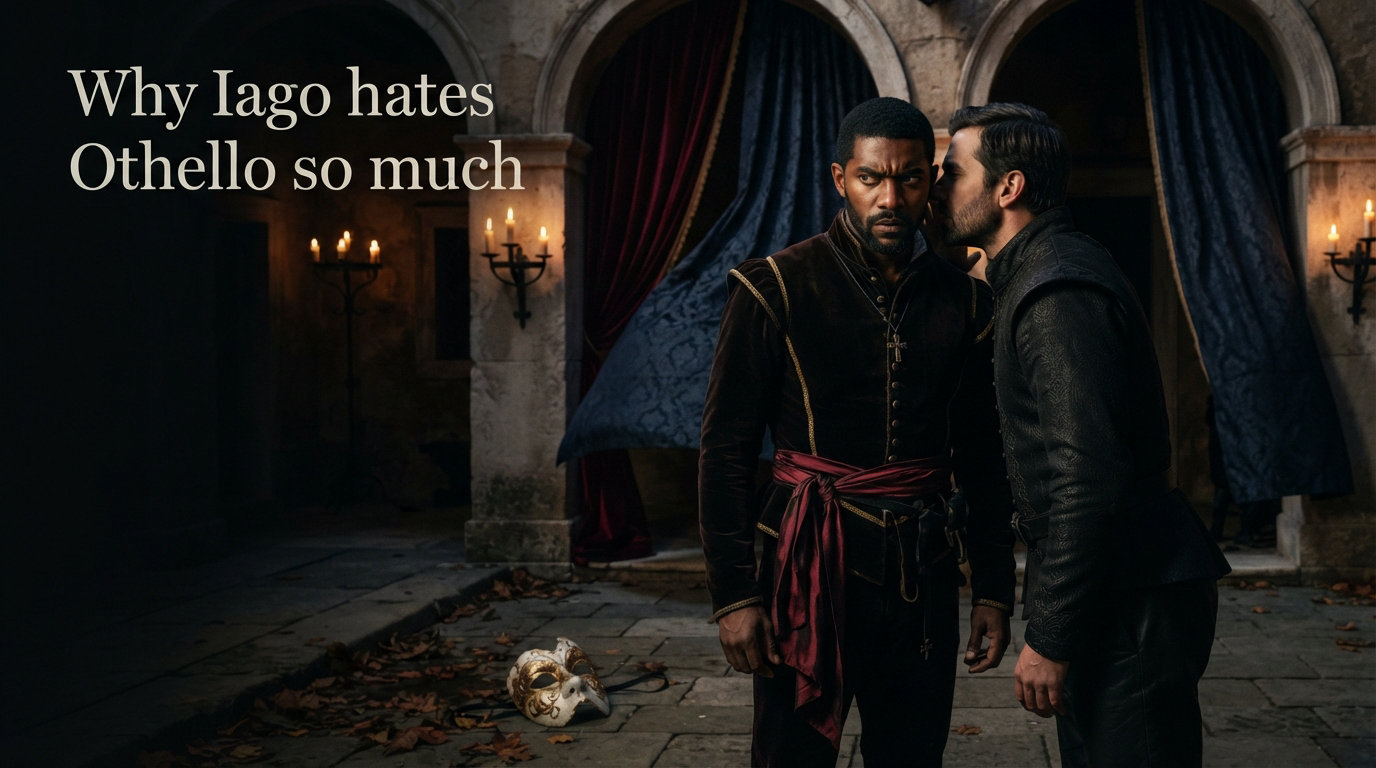
I have spent the last month rereading Othello cover to cover, scribbling notes in the margins, and arguing with every literary critic I respect. The question why Iago hates Othello so much is one I have been asking for years. It is also the question that has divided Shakespeare scholars for more than four centuries.
No single answer is satisfying on its own. That is exactly what makes this question so enduring, and so frustrating. In this guide, I will walk you through the four major theories of Iago’s hatred, the textual evidence behind each, and the scholarly debates that keep the mystery alive in 2026.
Table of Contents
Why Iago Hates Othello So Much: The Central Question
Iago hates Othello for a tangle of stated and unspoken reasons: a promotion he was denied, a suspicion he could not prove, racial prejudice he could not hide, and a deep psychological need to control other people. No single motive fully explains the devastation he causes.
Shakespeare wrote Iago as a villain whose motivation is famously slippery. The Romantic critic Samuel Taylor Coleridge coined the term “motiveless malignity” to describe the feeling that Iago seems to act without a clear cause. I disagree with that reading, but I understand why so many readers reach for it.
What the play actually gives us is a series of overlapping motives. Iago himself offers different reasons to different audiences. Roderigo gets the jealousy line. The audience gets the soliloquies. Each reveals a different layer of hatred.
In the sections that follow, I will break down each motivation in order, starting with the grievance Iago names most loudly: the promotion he wanted and did not get.
The Promotion Grievance That Started Iago’s Revenge
Iago’s stated reason for hating Othello is that Othello passed him over for the lieutenant’s position and gave it to Michael Cassio. Iago considers himself a more experienced soldier, and the promotion feels like a professional insult.
In Act 1, Scene 1, Iago tells Roderigo, “I follow him to serve my turn upon him.” The line is compact and bitter. He is not pledging loyalty. He is admitting that he plans to use his service to Othello as cover for revenge.
He repeats the professional grievance in Act 1, Scene 3, when he tells Roderigo that Cassio “never set a squadron in the field” and lacks real combat experience. Iago, by contrast, has fought in Rhodes and Aleppo. He sees the promotion as theft.
Earlier in the same scene, Iago adds another complaint: “I have no great devotion to the deed, and ’twere damnation to think so base a thought. It were enough to be sold as a slave for it, but O vain boast! Who can control his fate?” The bitterness here is real, but Iago also frames himself as a philosopher of resentment. The wound to his pride is genuine, and his reaction is unrepentant.
When Iago learns that Othello has chosen Cassio, the professional grievance becomes the engine of the entire plot. Every deception he engineers later, the drunken brawl, the lost position, the fractured marriage, all stem from this first unfairness.
The Professional Insult in Military Terms
Understanding the promotion scandal also requires understanding Venetian military hierarchy. A lieutenant was a trusted second-in-command, not just a job title. Choosing a Florentine courtier over a battle-tested ensign was a public humiliation.
Iago’s complaint is not just envy. It is the language of a man who believes his experience has been dismissed. That wound quietly powers every soliloquy he delivers for the rest of the play.
The Cuckolding Suspicion Against Othello
Iago also claims he hates Othello because he suspects Othello has slept with his wife, Emilia. He refers to this as the “office and profit” of his revenge, a phrase that appears early in Act 1, Scene 3.
“And it is thought abroad that ‘twixt my sheets he has done my office,” Iago says in the same scene. The rumor is unconfirmed. Emilia never confirms it. Othello never confirms it. The suspicion exists only inside Iago’s head.
Even if we take the suspicion at face value, the response is wildly disproportionate. Sleeping with a man’s wife, even a general, does not usually lead to the murder of a wife, the ruin of a marriage, and the destruction of a military commander. Iago knows this. The audience knows this. The disproportion is the point.
Modern readers often point out that the cuckolding motive serves Iago better as a public excuse than as a private truth. It gives him a reason to Roderigo for why he wants to act. It is, in fact, plausible cover for office jealousy. The suspicion that “he has done my office” is a phrase that also applies to the lieutenant position. The word “office” means both sexual acts and a professional role. Iago piles both meanings into one sentence.
Either way, the cuckolding suspicion is what Iago admits aloud. It is also the motive that Iago narrator of his own revenge, more than the promotion grievance, keeps returning to when he talks to Roderigo.
Racial Prejudice and Iago’s Resentment of Othello
Racial prejudice is arguably the deepest layer of Iago’s hatred of Othello. Othello is a Moor, a North African, working as a general in the Venetian military. Iago is a Venetian, and he reminds the audience of Othello’s race every chance he gets.
In Act 1, Scene 1, Iago wakes Brabantio with the line, “Even now, now, very now, an old black ram is tupping your white ewe.” The word “ram” is the first racial insult. It is also the calling card of the entire play. Every slur Iago uses, “Barbary horse,” “thick-lips,” refers to Othello’s body and his color.
Later in Act 1, Scene 3, Iago says Othello is “of a free and open nature, that thinks men honest that but seem to be so, and will as tenderly be led by th’ nose as asses are.” The stereotype is not just about race. It is also about perceived naïveté. Iago positions himself as the knowing European and Othello as the trusting outsider.
The racial prejudice in the play is not subtle. It is loud, persistent, and almost always delivered to white Venetians whom Iago wants to recruit. Iago uses racial slurs when other motives would be quieter. That pattern matters.
Cultural context is important here. In Shakespeare’s London, race was a live issue. Queen Elizabeth I had recently issued an order to expel “blackamoors” from the realm. Audiences recognized the language of resentment. Modern productions often amplify the racial dimension, sometimes shifting the play’s center of gravity toward race-based reading.
It is also worth noting that Iago is the only major character who uses racial slurs to describe Othello. Other characters occasionally mention his color, but Iago weaponizes it. His hatred is, in part, racial hatred, and that truth is written into the play from the first scene.
Psychological Theories: Psychopath or Motiveless Malignity?
Coleridge’s phrase “motiveless malignity” is the most famous answer to the question of why Iago hates Othello so much. Coleridge argued that Iago’s stated motives were pretexts, and the real driver was a deep-seated love of evil for its own sake.
That reading has real force. Iago’s actions are wildly disproportionate to his grievances. Even if we accept every motive he names, the murder of Desdemona, the suicide of Othello, and the destruction of his own career all exceed the stakes. Something else has to be doing the work.
A.C. Bradley, in Shakespearean Tragedy, wrestled with the same problem. Bradley argued that Iago’s stated motives were real but that Iago was a criminal driven by the sheer pleasure of destruction. He saw Iago as profoundly amoral and possibly unable to feel genuine emotion.
Modern readers often reach for clinical language. Iago is described as a psychopath, a narcissist, or a Machiavellian manipulator. Each label captures something real. None captures everything.
The psychological gap is what gives the play its lingering power. Iago is not a normal wronged man. He is also not a cartoon villain. He is a person whose motives are real but whose reactions are catastrophic. The disproportion is the lead character of the play.
The Homosexual Love Theory About Iago
One controversial theory is that Iago’s hatred of Othello is rooted in repressed homosexual desire. The theory suggests that Iago loves Othello, cannot act on that love, and resents him for promoting a man Iago considers unworthy and for marrying a white Venetian woman.
SparkNotes and other study guides include this theory. Some readers find it compelling. Others find it anachronistic, reading modern psychology onto a Jacobean character. I think the theory is worth holding lightly, but I do not think it has to be the central answer. Shakespeare’s Iago can be read without it. The theory works best as a complement to the promotion grievance.
What the gay love theory does well is explain Iago’s fascination with Othello’s marriages. He watches Othello’s bedding scenes with an intensity that goes beyond professional jealousy. He also refuses to ever mention a lover of his own. Something is unsaid, and that something might be desire.
Even if you reject the theory in full, the question it raises is useful. Why does Iago fixate on Othello’s marriage so much? The answer is not obvious. Something in the obsession outlives the stated motives.
How Iago’s ‘Honest’ Reputation Fuels His Hate
Iago’s reputation as “honest Iago” is partly how he gets away with everything, and partly why he hates Othello. He is trusted in a way that his honesty does not deserve, and he knows that his reputation among everyone, Othello, Desdemona, Cassio, is not matched by his self-image.
In Act 2, Scene 3, Othello calls Iago “a man he is of honesty and trust.” The label becomes the weapon. Iago uses his reputation to advance, and he also resents the fact that he has to maintain it. The “honest” reputation is the identity he performs, but the inner man is something else.
Hatred, in Iago’s case, is the result of a contradiction that he cannot resolve. He is overqualified, under-rewarded, and universally praised in a way that feels hollow. His hatred is the only outlet for the gap between who he is and how he is treated.
Why Iago’s Hatred Endures in Shakespeare Studies
The mystery of Iago’s hatred endures because the play is honest about what it cannot tell us. Iago is the only major character who never has a true soliloquy in which he tells the audience what he really feels. Every other confession is shaped for an audience he wants to manipulate.
That is the genius of the play. Shakespeare’s Iago cannot be reduced to a single motive, because the text itself refuses to let any one motive be his final word. Iago’s hatred is plural, layered, and ultimately resistant to summary.
FAQ: Common Questions About Iago’s Hatred for Othello
What is the real reason Iago hates Othello?
Iago hates Othello for a combination of reasons, including being passed over for the lieutenant’s promotion, suspecting Othello of sleeping with his wife Emilia, harboring racial prejudice against the Moor, and being driven by a deep psychological need for control. Most scholars agree that no single motive fully explains his actions.
Who is the true villain in Othello?
Iago is the true villain of Othello. He engineers the downfall of Othello, Desdemona, Cassio, and ultimately himself through deception, manipulation, and calculated innuendo. Without Iago’s interference, none of the play’s central tragedies would occur.
Was Iago in love with Othello?
Some scholars theorize that Iago had repressed romantic feelings for Othello, which fueled his hatred. The theory is supported by Iago’s obsessive focus on Othello’s marriage and his inability to name a lover of his own. The theory is debated and not universally accepted, but it offers a useful complement to his stated grievances.
Why is Iago so deeply resentful of Othello?
Iago’s resentment of Othello comes from multiple sources: a denied promotion, a suspicion of cuckolding, racial prejudice against Othello as a Moor, and the broader humiliation of being publicly called ‘honest’ while feeling underappreciated. The mixture of professional, personal, and racial grievances compounds into a destructive force.
Why does Iago really hate Othello?
Iago’s hatred is layered and partly opaque. His stated motives are professional jealousy and cuckolding suspicion, but critics have also pointed to racial prejudice, repressed desire, and what Coleridge called ‘motiveless malignity’ as deeper drivers. The inability to pin Iago down to a single reason is part of the play’s enduring power.
Is Iago racist in Othello?
Yes, Iago expresses racial prejudice against Othello throughout the play. He uses slurs such as ‘old black ram,’ ‘Barbary horse,’ and ‘thick-lips’ to describe Othello, and he weaponizes Othello’s race when recruiting allies like Brabantio. This racial hatred is one of the strongest undercurrents of the play and is most visible in Act 1.
Conclusion: Why Iago Hates Othello So Much, and Why That Question Still Matters
So why does Iago hate Othello so much? My honest answer is that no single motive is sufficient. The promotion grievance is real. The cuckolding suspicion is real. The racial prejudice is real. The psychological hunger for control is real. None of them alone explains the death of Desdemona.
What makes Iago so dangerous is that he is a man who has chosen, consciously, to act on every grievance he has, even when the actions are wildly disproportionate. He is the closest thing Shakespeare ever wrote to a villain who hates because hatred is what he has decided to do.
If you are writing an essay on why Iago hates Othello so much, my advice is to stop looking for the one answer and start looking for the chain. Promotion grievance, suspicion, racial resentment, and the gap between being praised as honest and feeling ignored. Each is a step. The full chain is what makes him terrifying.
For more Shakespeare analysis, browse our library of breakdown essays on the tragedies and histories. Each play hides a similar mystery, and each one rewards the same careful reading. The texts are difficult. The language is old. The questions are worth sitting with.
Read the play again. Watch a good production. Then ask yourself which motive you believe most. I have changed my mind three times in the last month. You might too.