
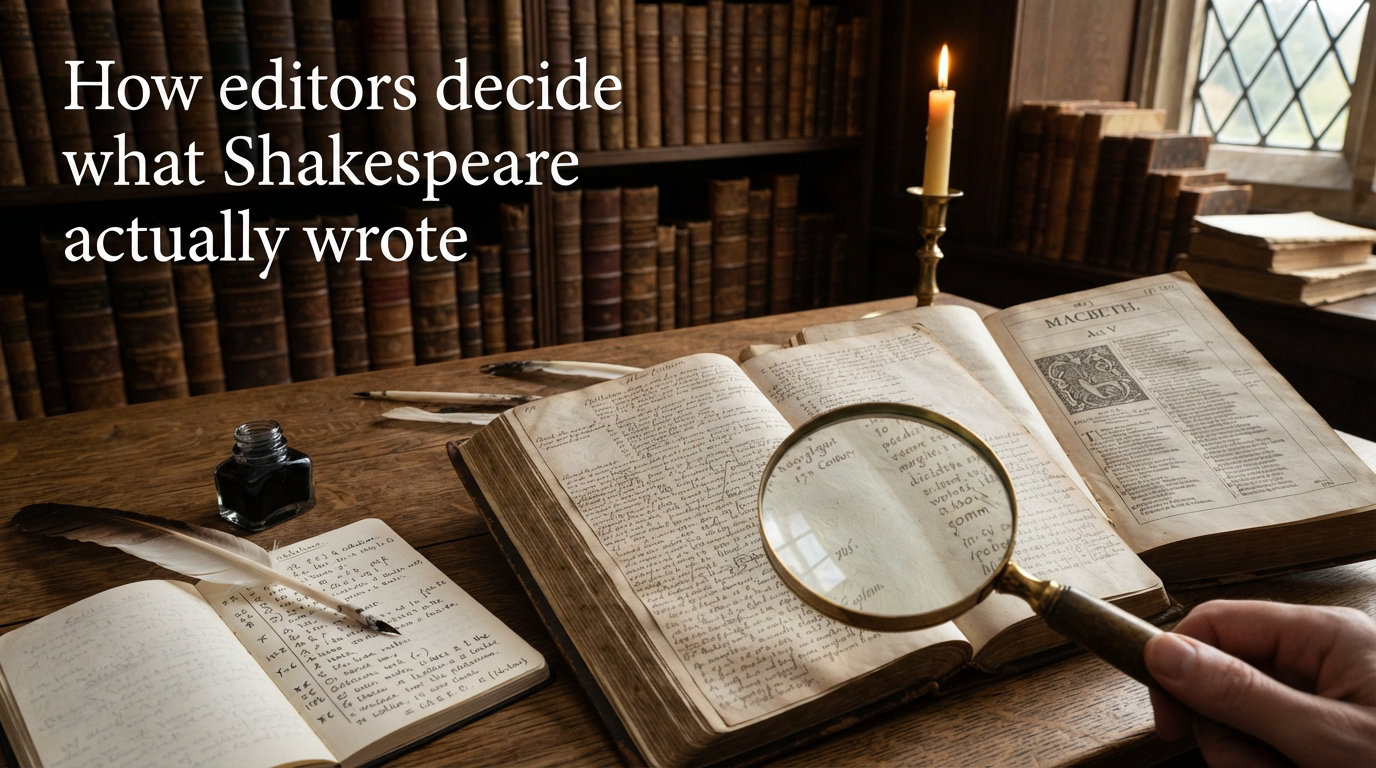
Not a single page of Shakespeare’s own handwriting survives for any of his plays. No autograph manuscript, no foul papers, no working draft has ever been recovered. Every line of Shakespeare you have ever read comes to you through a chain of copyists, printers, editors, and scholars who each made decisions about what the text should say.
That chain is what we want to unpack here. Understanding how editors decide what Shakespeare actually wrote means tracing a path from the Elizabethan playhouse to the printed book on your shelf. It involves handwritten manuscripts that no longer exist, printed texts full of contradictions, and centuries of scholarly argument over single words.
If you have ever wondered why your copy of Hamlet says something slightly different from a friend’s, or why actors sometimes debate whether a particular line is really Shakespeare’s, the answer lies in textual criticism. This is the academic discipline that reconstructs texts from surviving evidence and tries to get as close as possible to what the author originally wrote.
The challenge is enormous. Shakespeare wrote for a theatre company, not for the page, and the manuscripts he handed to his actors were never meant to survive. What we have instead are printed texts of varying quality, produced years or decades after the fact, each carrying its own errors and mysteries.
Editors must sort through this evidence and make judgment calls that affect how every reader and performer encounters these plays. In this guide, we walk through the entire process: the surviving sources, the methods scholars use, the history of the editorial tradition, and specific case studies that show real editorial dilemmas in action. By the end, you will understand exactly how the words you read in any modern edition got there, and why intelligent editors sometimes disagree about them.
Table of Contents
How Editors Decide What Shakespeare Actually Wrote: The Core Challenge
The fundamental problem is that Shakespeare left behind no authorial manuscripts for his plays. Not one page of a play in his own hand has survived the four centuries since his death in 1616. This means editors cannot simply consult the original document to settle a question about what Shakespeare wrote.
Instead, they must work with copies of copies. Shakespeare wrote his plays in what scholars call “foul papers,” rough working drafts that he handed to his theatre company, the King’s Men. Scribes then produced “fair copies” or transcripts for various purposes, and those transcripts eventually made their way to printers.
At each stage, the text could change, sometimes subtly and sometimes drastically. Think of it like a game of telephone played across decades, with the added complication that the people passing the message along were professionals with their own agendas. Printers needed copy that was easy to set in type.
Actors needed scripts that worked on stage. Booksellers wanted texts they could sell. None of these priorities guaranteed fidelity to what Shakespeare originally put on paper.
This is why the question of authenticity is not a simple one. When editors face two different printed versions of a speech, with different wording, they cannot just pick the one that sounds better. They have to reconstruct the history of how each version came to exist, weigh the evidence for each, and make a reasoned argument for which reading is more likely to reflect Shakespeare’s own words.
The answer is never obvious, and it is never final. Every editorial decision is provisional, open to challenge, and subject to revision when new evidence or better arguments emerge. That is the nature of working with a textual record that is incomplete and often contradictory.
What Is Textual Criticism and Why Does It Matter for Shakespeare?
Textual criticism is the scholarly discipline of analyzing manuscript and printed evidence to reconstruct a text as close as possible to what the author originally wrote. It is sometimes called “lower criticism” because it deals with the physical evidence of texts, as opposed to “higher criticism,” which interprets meaning. For Shakespeare, textual criticism is the foundation of every edition you can buy or read today.
The process involves comparing all surviving versions of a text, identifying where they differ, and using logical and historical reasoning to determine which readings are most likely authentic. A “reading” in this context simply means a specific way a word, phrase, or line appears in a particular source. When two sources give different readings of the same passage, editors call the difference a “variant.”
Textual criticism matters for Shakespeare more than for almost any other English author because the evidential situation is so tangled. Some plays survive in multiple printed versions that differ in hundreds of places. Others survive in only one version, leaving editors with no comparison point at all.
The famous tragedies King Lear and Hamlet each exist in substantially different early printed texts, and editors must decide how to handle the differences. The stakes are real. When an editor chooses one reading over another, that choice determines what millions of students read, what actors perform on stage, and what scholars analyze for meaning.
A single editorial decision can change our understanding of a character’s motivation, a play’s thematic emphasis, or even its plot. Getting it wrong means passing on a corrupted text and building interpretation on a foundation that Shakespeare never intended.
That said, “wrong” and “right” are not always clear categories here. Textual criticism deals in probabilities, not certainties. A good editor presents the evidence transparently, explains the reasoning behind each decision, and acknowledges where uncertainty remains.
The goal is not to produce a perfect text, because that may be unrecoverable. The goal is to produce the most defensible text possible, given what survives. Every edition is an argument, not a verdict.
The Evidence: Folios, Quartos, and What Editors Actually Work With
Editors of Shakespeare work with two main categories of early printed sources: quartos and folios. Understanding the difference between them is essential to understanding the editorial challenge, because the quality and origin of these sources varies enormously from play to play.
The First Folio of 1623
The most important single source for Shakespeare’s text is the First Folio, published in 1623 by his fellow actors John Heminges and Henry Condell. This large-format book collected thirty-six of Shakespeare’s plays and was the first printed edition to include many of them, including Macbeth, The Tempest, Julius Caesar, and Twelfth Night. Without the First Folio, we would have lost roughly half of Shakespeare’s plays entirely.
Heminges and Condell claimed in their preface that they were publishing the plays from Shakespeare’s own papers. Modern scholars take this claim with a grain of salt. Some Folio texts do appear to derive from authorial manuscripts or good theatrical transcripts, but others show signs of having been copied from printed quartos or reconstructed from actors’ memories.
The Folio is indispensable, but it is not a time machine back to Shakespeare’s desk. Editors treat it as the best available source for many plays while recognizing that it carries its own layer of editorial and compositorial intervention. Each Folio text must be evaluated on its own merits.
Quarto Editions
Quartos were smaller, cheaper pamphlet-format editions of individual plays, printed during Shakespeare’s lifetime and shortly after his death. Some plays, like Hamlet and King Lear, appeared in multiple quarto editions, sometimes with substantially different texts. Editors classify quartos as “good” or “bad” based on how close they seem to an authorial original.
Good quartos are those that appear to have been printed from Shakespeare’s foul papers or from a careful transcript. They tend to have fuller, more coherent texts with distinctive authorial features. Bad quartos, by contrast, are often shorter, garbled, and full of errors that suggest they were reconstructed from memory by actors or spectators.
The so-called “bad quarto” of Hamlet (Q1, printed in 1603) is about half the length of the version most readers know and contains famously different readings of major soliloquies. The “To be or not to be” speech appears in a radically different form, which has led some scholars to argue it represents an early draft while others see it as a garbled memorial reconstruction.
The existence of both good and bad quartos creates a constant editorial dilemma. When a quarto reading differs from the Folio, which should an editor trust? The answer depends on the specific play, the specific variant, and the editor’s theory about where each source came from.
Prompt Books and Theatre Documents
Beyond quartos and folios, editors sometimes draw on theatrical documents like prompt books, which were working copies used by stage managers to keep productions running smoothly. Prompt books often contain stage directions, cuts, and annotations that reflect how a play was actually performed. While these documents are rarely the basis for the main text of an edition, they can illuminate staging questions and help editors understand theatrical conventions that shaped the text.
Very few Shakespearean prompt books survive, but the ones that do offer a window into the gap between what Shakespeare wrote and what audiences actually saw. Editors use this evidence cautiously, aware that theatrical cuts and additions may reflect the needs of a particular production rather than Shakespeare’s authorial intentions. Still, prompt books can settle questions about entrances, exits, and staging that printed texts leave ambiguous.
The Three Stages of Textual Scholarship: Recension, Examination, and Emendation
Classical textual criticism breaks the editor’s work into three stages: recension, examination, and emendation. These stages provide a systematic framework for moving from raw evidence to a finished text. While Shakespeare editors do not always follow these steps in a rigid sequence, understanding them clarifies what textual criticism actually involves.
Recension: Reconstructing the Earliest Text
Recension is the process of analyzing all surviving copies of a text to reconstruct the line of transmission and identify the earliest recoverable version. In classical and biblical textual criticism, this often involves building a “stemma,” which is a family tree of manuscripts showing how they relate to one another. The goal is to figure out which copies descended from which, so you can work back toward the original.
For Shakespeare, recension is complicated by the fact that we are dealing with printed texts, not manuscripts, and the relationships between quartos and folios are often unclear. Some plays have a clean line of descent from quarto to later quarto to Folio. Others have tangled relationships that defy easy classification.
In cases where a play survives in only one source, recension is impossible, because there is nothing to compare. The editor must simply take the surviving text as given and work with its limitations. This is the situation for many of the plays that appear only in the First Folio.
Examination: Determining the Authenticity of Variants
Examination is the stage where editors evaluate specific variant readings to determine which is most likely authentic. This involves asking questions about each variant: Does one reading make more sense grammatically? Does one fit better with Shakespeare’s known habits of language and meter? Does one reflect what a scribe or compositor might have mistakenly introduced?
The principle of lectio difficilior potior, or “the more difficult reading is to be preferred,” often applies here. The logic is that scribes and copyists tend to simplify difficult language, so the harder reading is more likely to be original. If one version of a line is smooth and easy and another is strange and challenging, the strange one may be closer to what Shakespeare actually wrote.
Editors also consider transcriptional probability, which asks how likely it is that a particular error or change could have occurred during copying or typesetting. A reading that can be explained as a plausible compositor error is less likely to be original than one that cannot be easily explained away.
Emendation: Correcting Errors
Emendation is the most controversial stage, because it involves the editor actively changing the text to correct perceived errors. When all surviving sources clearly contain a mistake, whether a broken meter, an impossible grammar, or a nonsensical stage direction, the editor may propose an emendation, which is a conjectural correction not found in any source.
Good emendation is conservative. The editor should change the text only when the evidence demands it, should explain exactly why the change is necessary, and should record the original reading in notes so readers can judge for themselves.
Reckless emendation, where editors rewrite Shakespeare to suit their own preferences, is the cardinal sin of textual criticism. Some of the most heated debates in Shakespeare scholarship have been about whether a particular emendation is justified or whether the editor has overstepped. The best editors leave a clear trail of reasoning that allows other scholars to evaluate their decisions.
Types of Errors in Manuscript and Print Transmission
Understanding the types of errors that crept into texts during transmission helps editors identify and correct them. These errors fall into several recognizable categories, each with its own causes and characteristics. Recognizing the pattern of an error is often the first step toward fixing it.
Scribal and Copyist Errors
When texts were copied by hand, certain types of mistakes recurred so often that scholars have given them names. Dittography is the accidental repetition of a letter, word, or phrase, where a copyist’s eye skips back and writes something twice. The opposite problem, haplography, occurs when a copyist’s eye skips forward over similar-looking text, causing words or lines to be omitted entirely.
These errors are especially common when the original contains repeated words or similar line endings. A scribe copying a passage where the same word appears at the end of consecutive lines might easily skip the second occurrence. Editors learn to look for these patterns when a text seems to be missing something or to contain an unexpected repetition.
Hearing Errors
Some texts were produced by dictation, where one person read aloud while another wrote. This process introduced hearing errors, where words that sound similar were confused. In early modern English, where spelling was not standardized and pronunciation was shifting, such errors could be subtle and hard to detect.
An editor comparing two versions of a passage might find that one has a word that sounds almost identical to the other’s word but changes the meaning of the line. Recognizing these errors requires knowledge of early modern phonology and an understanding of which words could plausibly have been confused in the period.
Compositor Errors in the Printing House
Once a text reached the printing house, a new set of errors became possible. The compositors who set type from manuscript copy had to decipher handwriting, interpret abbreviations, and fit text into the physical constraints of the page. They sometimes misread letters, transposed words, or silently regularized spelling and punctuation to match house style.
Studies of early modern printing houses have shown that individual compositors had identifiable habits. Some regularly confused certain letterforms, while others tended to expand contractions in particular ways. Editors who can identify which compositor set which pages can sometimes predict what kinds of errors to expect, which helps them evaluate variant readings.
Substantive vs. Accidental Changes
Textual scholars distinguish between substantive changes, which affect the meaning of the words, and accidental changes, which affect only spelling, punctuation, or formatting. Substantive changes are the more serious concern, because they alter what the text says. Accidental changes are generally less consequential, though punctuation can sometimes shift the meaning of a sentence significantly.
Most modern editors regularize accidentals like spelling and punctuation according to contemporary conventions, while preserving substantive readings from the source text. This approach, known as “copy-text editing,” uses one source as the base text and adopts substantive readings from other sources only when there is clear reason to do so. The choice of copy-text is itself a major editorial decision that can shape the finished edition.
The Shakespeare Editorial Tradition: From Rowe to the Arden Fourth Series
The history of Shakespeare editing stretches back over three centuries, and each generation of editors has brought different assumptions and methods to the task. Understanding this history helps explain why modern editions look the way they do, and why editorial standards have evolved.
The Eighteenth Century: Rowe, Pope, and Johnson
Nicholas Rowe produced the first formally edited edition of Shakespeare’s works in 1709. Rowe modernized spelling and punctuation, added stage directions, and divided the plays into acts and scenes in a consistent way. His edition set the template for how Shakespeare would be presented to readers for the next century.
Alexander Pope followed in 1725 with an edition that took a more interventionist approach, cutting passages he considered unworthy of Shakespeare and moving them to the bottom of the page. Pope’s editorial philosophy assumed that Shakespeare’s genius could be separated from the supposed corruptions of actors and printers, and that the editor’s job was to restore that genius through taste and judgment.
Samuel Johnson’s 1765 edition offered a more conservative approach. Johnson was skeptical of editors who reshaped the text to suit their own aesthetic preferences, and he argued for preserving readings even when they seemed imperfect. His preface remains one of the most thoughtful statements about the limits of editorial intervention.
The Nineteenth and Twentieth Centuries
The nineteenth century saw the rise of more systematic editorial methods, driven in part by the work of scholars like Edmund Malone, who brought rigorous historical research to bear on questions of dating, sources, and textual transmission. The creation of the Cambridge Shakespeare in the 1860s represented a new level of scholarly thoroughness, with detailed collations of variant readings.
The twentieth century brought a revolution in editorial thinking. A. W. Pollard’s work on distinguishing “good” and “bad” quartos, R. B. McKerrow’s development of copy-text theory, and W. W. Greg’s foundational work on editorial method transformed how editors approached Shakespeare. The New Bibliography, as this movement was called, applied scientific principles to the study of early printed texts and established many of the methods still in use today.
Modern Editions Compared: Arden, Oxford, Cambridge, and Riverside
Today, several major scholarly editions of Shakespeare compete for the attention of students, scholars, and general readers. Each has its own editorial philosophy and strengths, and serious students of Shakespeare often consult more than one.
The Arden Shakespeare, now in its Fourth Series, is known for its detailed introductions, extensive commentary, and willingness to present complex textual situations in full. Arden editors typically provide a long introduction discussing the textual history of the play, a freshly edited text, and extensive notes explaining editorial decisions. The Fourth Series, which began appearing in the early 2020s, has been particularly attentive to questions about which source text to use as the basis for each play.
The Oxford Shakespeare, edited by Gary Taylor, Stanley Wells, and others in 1986, took a radical approach to King Lear by printing the quarto and Folio versions as two separate plays, arguing that they represent distinct works rather than variants of the same play. This decision sparked enormous debate and has influenced how subsequent editions handle the Lear problem.
The Cambridge Shakespeare and the Riverside Shakespeare round out the major reference editions. Cambridge is valued for its scholarly precision and detailed textual apparatus. Riverside, edited by G. Blakemore Evans, has long been a favorite for classroom use because of its comprehensive annotations and accessible format.
Editorial Case Studies: The Tempest, King Lear, and Macbeth
Abstract descriptions of editorial method are useful, but nothing illustrates the process better than specific examples. These three case studies show how real editorial decisions get made, what evidence they rest on, and why they sometimes remain controversial.
The Tempest: The Speech Prefix Controversy
In the Folio text of The Tempest, certain speeches are assigned to characters using abbreviated labels called speech prefixes. In one famous passage, a speech directed at Miranda appears to be assigned to Prospero, but some scholars have argued that it more properly belongs to Miranda herself. The debate turns on whether the speech prefix in the Folio reflects Shakespeare’s intention or a copyist’s error.
Editors of the Arden Fourth Series have grappled with this problem directly. If the speech is Miranda’s, it changes our understanding of her character, giving her an agency and intelligence that the more passive reading denies her. The editorial decision is not just about textual accuracy but about how we interpret the play’s gender dynamics.
This is a perfect example of how apparently technical textual questions have profound interpretive consequences. A decision about a two-letter abbreviation in a printed book can reshape how actors approach a role and how audiences understand a play’s power relationships.
King Lear: Two Plays or One?
King Lear survives in two substantially different early texts. The quarto version, printed in 1608, is about 300 lines shorter than the Folio text and lacks several passages that the Folio includes, most notably the mock trial scene in Act 4. The Folio, in turn, omits about 100 lines that appear in the quarto.
The two texts differ in hundreds of individual readings as well. For centuries, editors conflated the two versions, combining what they considered the best readings from each into a single hybrid text. This practice assumed that the quarto and Folio both descended from a single lost original and that combining them could approximate that original more closely than either could alone.
The Oxford Shakespeare challenged this assumption in 1986 by printing the quarto and Folio versions as two separate plays, titling them The History of King Lear and The Tragedy of King Lear. The editors argued that the differences between the texts reflect Shakespeare’s own revision of the play, meaning each version is a complete, intentional work rather than a corrupted copy of the other.
This “two-text” theory has become the dominant view among Shakespeare scholars. Most modern editions now present the versions separately or at least acknowledge their independence. The Lear controversy fundamentally changed how editors think about the relationship between variant texts of the same play.
Macbeth: Weird Sisters or Wayward Sisters?
The First Folio text of Macbeth refers to the three witches as the “Weird Sisters.” But some scholars have argued that the word “weird” may be a misreading of “wayward,” which would subtly change the nature of these characters. “Weird” implies fate or destiny, connecting the sisters to the mythological Fates of classical legend. “Wayward,” by contrast, suggests willfulness, unpredictability, and capricious malice.
The textual evidence is complicated because both words existed in early modern English and could have been confused by a compositor. Editors must weigh the palaeographical evidence, which letters might have been misread, against the interpretive question of which reading makes more dramatic sense. Most editions keep “weird,” but the debate illustrates how a single word can open up entirely different readings of a play’s meaning.
Modern Digital Approaches to Shakespeare Texts
The digital revolution has transformed Shakespeare textual scholarship in ways that earlier editors could not have imagined. Computational tools now allow scholars to collate variant readings across dozens of sources in seconds, a task that once took months of painstaking manual comparison. Digital databases like the Shakespeare Quartos Archive and the Internet Shakespeare Editions make high-resolution images of early texts freely available to scholars and students worldwide.
The New Oxford Shakespeare, published in 2016, made headlines by using computational stylometry to argue for collaborative authorship in plays traditionally attributed solely to Shakespeare. Statistical analysis of vocabulary, meter, and linguistic patterns suggested that Christopher Marlowe co-wrote parts of the Henry VI plays and that other collaborators contributed to several works in the canon. These computational methods raise new questions about what we mean by “what Shakespeare wrote,” since some passages may be collaborative rather than solo work.
Digital editing also enables new forms of publication. Some projects now publish editions that present multiple versions of a play side by side, allowing readers to see exactly where quarto and Folio texts differ without having to consult a separate critical apparatus. Open-access editions challenge the dominance of traditional academic publishers, making scholarly editions available to readers who cannot afford expensive print volumes.
How Editorial Choices Shape Performance and Interpretation
Every editorial decision ripples outward into how Shakespeare is performed and understood. When an editor chooses the Folio King Lear over the quarto, actors perform a different play. When an editor assigns a speech to Miranda rather than Prospero, a director stages a different scene.
The choices made at the level of textual scholarship ultimately shape the experience of every audience and every reader. This is why textual criticism, despite its reputation as a dry and technical field, is one of the most consequential branches of literary scholarship.
The text is the foundation. Everything else, performance, interpretation, criticism, rests on top of it. When the foundation shifts, everything above it shifts too.
FAQs
How do scholars compare different copies of a Shakespeare text?
Scholars use a process called collation, which involves placing all surviving versions of a text side by side and recording every difference, no matter how small. Modern digital tools allow this comparison to happen quickly and accurately, but the underlying method has not changed: identify every variant reading, classify the type of difference, and use historical and logical reasoning to determine which version is most likely closest to what Shakespeare originally wrote.
How does textual criticism maintain accuracy in Shakespeare editions?
Textual criticism maintains accuracy by applying a systematic, three-stage process: recension (reconstructing the line of transmission from surviving evidence), examination (evaluating each variant reading for authenticity), and emendation (correcting clear errors while preserving authorial intent). Good editors also document every decision in footnotes and commentary, so readers can see exactly what was changed and why.
What kinds of errors can happen when Shakespeare texts were copied and printed?
Common errors include dittography (accidental repetition of text), haplography (accidental omission when the eye skips similar-looking lines), hearing errors from dictation, and compositor errors in the printing house where type was set from handwritten copy. Substantive errors change the meaning of words, while accidental errors affect only spelling, punctuation, or formatting.
How do experts decide which version of a Shakespeare play is closest to the original?
Experts weigh several factors: the quality and likely origin of each source (authorial manuscript versus theatrical transcript versus reconstructed text), the nature of specific variant readings (whether they reflect authorial intent or copyist error), and principles like lectio difficilior potior, which prefers the more difficult reading as more likely original. No single factor is decisive; editors build cumulative arguments from multiple types of evidence.
Why are there different versions of Shakespeare plays?
Different versions exist because plays were printed at different times from different source materials. Some quartos were printed from Shakespeare working drafts, others from theatrical transcripts, and still others from memory reconstructions by actors. The First Folio of 1623 drew on yet another set of sources. When these printed texts differ, it is because they descend from different points in the transmission chain, each carrying its own history of copying, revision, and error.
Conclusion
Understanding how editors decide what Shakespeare actually wrote reveals that the text of Shakespeare is not a fixed, settled thing. It is the product of centuries of scholarly labor, built on fragmentary evidence and shaped by judgments that reasonable people can disagree about. Every modern edition represents a series of choices, and those choices matter.
The methods of textual criticism, recension, examination, and emendation, give editors a framework for making those choices responsibly. The surviving sources, from the First Folio to the quartos to the theatre documents, provide the raw evidence.
The editorial tradition, from Rowe in 1709 to the Arden Fourth Series being published today, shows how standards and assumptions have evolved. And the case studies, from King Lear to Macbeth, demonstrate that even the best-informed decisions can remain open to debate.
The next time you open a Shakespeare play, remember that someone made a decision about every word on that page. They may have gotten it right, or they may have gotten it wrong, but they did not guess. They built an argument from evidence, and they left a record of their reasoning for you to examine.
That is what textual criticism does, and that is how we keep reaching for what Shakespeare actually wrote, even when his own hand is nowhere to be found. The work is never finished, but that is exactly what makes it a living discipline rather than a closed book.