
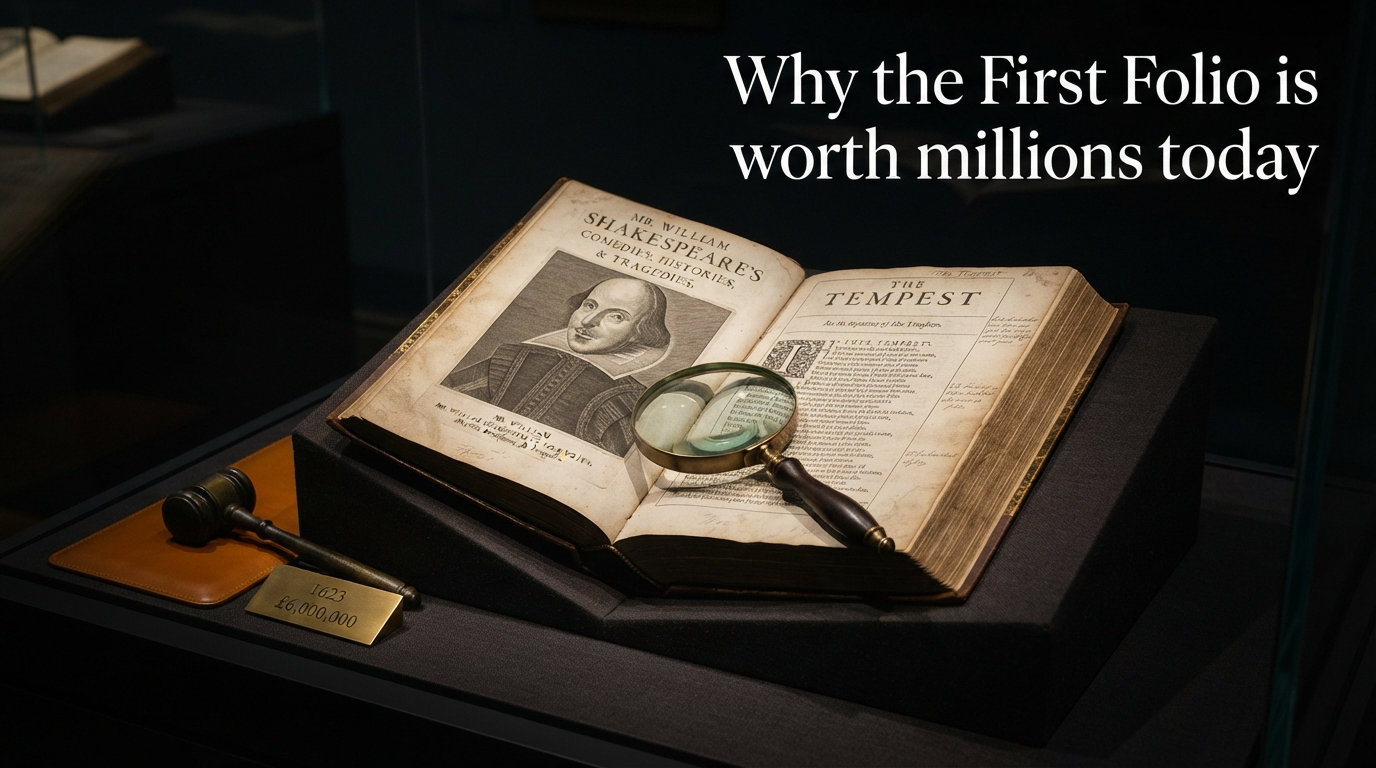
When a single book sells for nearly $10 million at auction, people take notice. That is exactly what happened in October 2020 when a complete copy of Shakespeare’s First Folio fetched a record-breaking price at Christie’s in New York. The First Folio is worth millions today because it sits at the intersection of extreme scarcity, irreplaceable literary content, and cultural significance that no other book in the English language can match.
I have spent years studying rare book markets and Shakespearean publishing history, and the First Folio stands apart from every other literary artifact. It is not just expensive because it is old. It commands astronomical prices because without it, nearly half of Shakespeare’s plays would have vanished from history entirely.
In this guide, I will break down exactly why the First Folio is worth millions today. We will cover the historical context behind its creation in 1623, the startling math of how few copies survive, the specific plays it saved from extinction, and the auction records that continue to climb. Whether you are a rare book enthusiast, a Shakespeare scholar, or simply curious about what makes this book so phenomenally valuable, you will find clear answers here.
Table of Contents
What Is the First Folio? Historical Context
The First Folio is the common name for “Mr. William Shakespeares Comedies, Histories, and Tragedies,” the first collected edition of Shakespeare’s plays. It was printed in 1623, seven years after his death, by a publishing syndicate led by Edward Blount, William Jaggard, and his son Isaac Jaggard. The formal title page, featuring the famous Martin Droeshout engraving of Shakespeare, immediately signaled that this was a work of major importance.
The word “folio” refers to the physical format of the book. In early printing, a folio was created by folding a large sheet of paper once, producing two leaves or four pages. This was the largest and most expensive format available, typically reserved for important religious, legal, or scholarly works. Plays were normally printed in quarto format, smaller and cheaper booklets that were considered disposable entertainment.
Printing a playwright’s collected works in the prestigious folio format was virtually unheard of in 1623. Ben Jonson had done it with his own works in 1616, but that was a self-published vanity project. The decision to print Shakespeare in folio was a bold statement that his plays deserved to be treated as serious literature, not throwaway pamphlets. That decision shaped how the English-speaking world would read and regard Shakespeare for the next four centuries.
The book contained 36 plays, running to approximately 900 pages. It was a massive undertaking, one of the largest publishing projects of its era in England. The surviving copies of this single printing are what we now call the First Folio, and they are the most sought-after books in the world of rare book collecting.
Why the First Folio Was Created
The First Folio exists because of two men: John Heminges and Henry Condell. They were Shakespeare’s fellow actors, shareholders in the King’s Men theatre company, and close friends who had performed in his plays for years. After Shakespeare died in 1616, they took it upon themselves to gather his plays and publish them in a collected, authoritative edition.
In their dedication to the reader, Heminges and Condell wrote that they were publishing the plays “only to keep the memory of so worthy a friend and fellow alive as was our Shakespeare.” This was not a commercial venture in the modern sense. It was an act of literary preservation driven by personal loyalty and respect.
They had a practical problem to solve. About half of Shakespeare’s plays had never been published in his lifetime. Of those that had appeared in print, many existed only in unreliable “bad quartos,” cheap editions full of errors, garbled text, and lines that bore little resemblance to what Shakespeare actually wrote. Heminges and Condell wanted to correct this by assembling the best available texts.
They drew from multiple sources to compile the Folio. Some plays came from theatrical prompt books, others from the authors’ own working manuscripts (called “foul papers”), and still others from existing quartos that they considered reliable. Their editorial work produced what scholars still regard as the most important single source for Shakespeare’s text.
Richard Burbage, the leading actor of the King’s Men and the first to play Hamlet, Lear, and Othello, had died in 1619. Without the institutional memory of the theatre company, the plays could easily have been lost. Heminges and Condell recognized this risk and acted before it was too late. Their decision is the reason we still have Shakespeare’s complete works today.
The Print Run and Survival: 750 Printed, 235 Remain
The original print run of the First Folio was approximately 750 copies. This was a substantial number for a major publishing project in 17th-century England, but it was still a limited edition by any standard. Each copy was sold for about one pound, roughly equivalent to $150 to $200 in 2026 dollars.
That original price tag feels almost absurd when you consider what these same copies sell for now. But the low price reflects a grim reality. Books in the 1600s were not treated as preservation artifacts. They were used, read, spilled on, rebound, shelved in damp rooms, and eventually discarded when they fell apart.
Of those 750 original copies, scholars have identified 235 known surviving copies as of 2026. The Folger Shakespeare Library in Washington, D.C. holds the largest collection, with 82 copies. The rest are distributed among institutions and private collectors around the world. Some copies remain unaccounted for and may exist in attics, estate collections, or private libraries that have never been cataloged.
The survival rate of roughly 31 percent is actually remarkable for a book of this age. Most printed works from the 1620s have completely vanished. But even 235 surviving copies does not mean 235 are available for purchase. The overwhelming majority belong to institutions like the British Library, the Bodleian Library at Oxford, and university collections that will never sell them.
This means the actual number of First Folios that could ever come to auction is extremely small. When one does appear, the competition among collectors is fierce. That scarcity drives the value, and it is one of the core reasons the First Folio is worth millions.
The 18 Plays That Only Survived in the First Folio
Here is the fact that truly explains the First Folio’s importance. Eighteen of Shakespeare’s plays exist in print today only because they were included in the 1623 collection. Without the First Folio, they would have been lost forever.
The list of plays preserved only in the Folio reads like a roll call of Shakespeare’s greatest works. Macbeth, The Tempest, Twelfth Night, As You Like It, Julius Caesar, Antony and Cleopatra, The Winter’s Tale, Coriolanus, All’s Well That Ends Well, The Taming of the Shrew, Measure for Measure, The Comedy of Errors, King John, Henry VI Part 1, Henry VIII, The Two Gentlemen of Verona, Timon of Athens, and The Two Noble Kinsmen. All of these would simply not exist in written form without the Folio.
Think about that for a moment. No Macbeth. No Tempest. No Twelfth Night. These are among the most performed and studied plays in the history of English literature. The loss of any single one would be considered a cultural catastrophe. The Folio saved all eighteen.
The other eighteen plays in the Folio had been previously printed in quarto editions. But even for those plays, the Folio texts are often superior. Heminges and Condell had access to theatrical manuscripts and corrected versions that the quarto publishers never saw. For plays like Hamlet and King Lear, the Folio text differs significantly from the quarto versions, and scholars continue to debate which represents Shakespeare’s final intentions.
This textual authority gives the First Folio a dual value. It is both the sole surviving source for eighteen plays and a competing textual witness for the other eighteen. No other single book in English literature carries this kind of weight.
Why the First Folio Is Worth Millions: Value Factors
When people ask why the First Folio is worth millions, the answer comes down to three converging factors that no other book can replicate. Understanding these factors explains why prices keep climbing rather than stabilizing.
The first factor is scarcity. With only 235 known copies and the vast majority locked in institutional collections, the supply of First Folios that could ever reach the open market is vanishingly small. A complete, original copy might appear at auction once every few years. That level of scarcity creates intense competition whenever a copy does surface.
The second factor is irreplaceable content. This is not just a rare book. It is the sole surviving source for eighteen of Shakespeare’s plays. No other book carries this responsibility. If every copy of the Gutenberg Bible were destroyed, the text survives in countless reproductions. If every First Folio were destroyed, Macbeth and The Tempest would vanish from the historical record. That irreplaceability gives the book a value beyond any conventional rare book metric.
The third factor is cultural significance. Shakespeare is the most studied, performed, and quoted author in the English language. The First Folio is the foundational document of his literary legacy. Sotheby’s has called it “without question the most significant publication in the history of English literature.” That significance draws interest not just from rare book collectors but from museums, universities, and national libraries with enormous acquisition budgets.
These three factors reinforce each other. Scarcity creates demand, irreplaceability justifies extraordinary prices, and cultural significance ensures that the pool of motivated buyers keeps growing. As wealth concentrates and institutional budgets expand, the price ceiling for a First Folio keeps rising.
There is also an investment dimension. Unlike stocks or real estate, a First Folio is a tangible cultural artifact that cannot be duplicated or mass-produced. Its value has appreciated steadily over decades, making it attractive to collectors who see rare books as an alternative asset class. The combination of passion-driven collecting and investment logic is a powerful price driver.
Record Auction Prices: The $10 Million Sale
The most famous recent sale of a First Folio took place in October 2020 at Christie’s in New York. A complete and original copy, known as the Mills College copy, sold for $9.98 million including buyer’s premium. At the time, it was the most expensive work of literature ever sold at auction.
That sale shattered the previous record of $6.1 million, set in 2001 when a copy owned by Dr. Williams’s Library was sold at Christie’s in London to Sir Paul Getty. The jump from $6.1 million to nearly $10 million in less than twenty years illustrates the accelerating value of these books.
The price history tells a clear story of appreciation. In 1623, a First Folio cost about one pound. By the late 19th century, copies were selling for a few hundred dollars. The first million-dollar sale came in the late 1980s. By 2026, the record stands at nearly $10 million, and experts believe the next major sale could push higher.
Not every copy sells for eight figures, of course. Prices vary enormously based on condition, completeness, and provenance. A damaged or incomplete copy might sell for a few hundred thousand dollars, while a pristine copy with distinguished ownership history commands millions. But even the lower end of the First Folio market represents values that place it firmly in the category of books worth millions.
The 2020 Christie’s sale was particularly notable because the copy was in excellent condition and had a clean provenance. It had been held by Mills College in Oakland, California, for decades. The buyer was Stephan Loewentheil, a rare book dealer who described the First Folio as “the greatest book in the English language.” That sale confirmed that the market for exceptional copies remains strong even in uncertain economic times.
Condition Grades and Their Impact on Value
One of the most misunderstood aspects of First Folio valuation is how dramatically condition affects price. Two copies of the same 1623 printing can differ in value by millions of dollars based on their physical state.
Condition is evaluated across several dimensions. The most important factor is completeness. A complete copy with all 452 leaves, including the title page with the Droeshout portrait, is worth vastly more than a copy missing even a few pages. Collectors use detailed collation reports to verify that every single leaf is present and original.
Another major factor is whether the binding and pages are original or have been restored. An unrecorded copy that has never been washed, rebound, or repaired is extremely rare and commands a premium. Copies that have been heavily restored, with washed pages or modern facsimile replacements, sell for significantly less.
The quality of the leaves matters too. Foxing (brown spots), water damage, ink burns, and trimmed margins all reduce value. Some copies have survived in remarkably fresh condition because they were stored carefully from the beginning. Others show centuries of wear and use.
Provenance, the documented chain of ownership, adds another layer. A copy that can be traced back to a famous historical owner or a distinguished library carries a premium. The Mills College copy sold for nearly $10 million in part because its provenance was clean and well documented.
For anyone trying to understand why some copies sell for $500,000 and others for $10 million, the answer almost always lies in these condition factors. The same 750-copy print run produced books that have aged very differently over 400 years, and the market reflects those differences with precision.
Forgeries, Theft, and Authentication
With values this high, the First Folio has attracted its share of fraud. Authentication is a serious concern in the rare book world, and the Folio has been at the center of several remarkable cases.
The most famous forgery case involved John wise, a Cuban-born forger who created a convincing fake First Folio that was displayed at the Folger Shakespeare Library in the 1990s. The forgery was eventually detected through microscopic analysis of the paper and ink. The case became a landmark in rare book authentication and highlighted how sophisticated modern forgeries have become.
Theft has also plagued the First Folio. In 1998, a stolen copy surfaced at the Folger Shakespeare Library when a man named Raymond Scott brought it in for appraisal, claiming he had found it in Cuba. The library’s staff immediately recognized it as a copy stolen from Durham University in England in 1998. Scott was arrested, convicted, and sentenced to prison. The book had been badly damaged during its time outside proper storage, with pages torn and water-damaged.
Authentication of a genuine First Folio involves multiple steps. Experts examine the paper composition using beta-radiography to identify the specific laid paper used by the Jaggard printing shop. They check watermarks, typeface characteristics, and binding materials. Collation against known copies reveals whether any leaves have been replaced with facsimiles.
The Folger Shakespeare Library maintains the most comprehensive records of known First Folio copies, including detailed descriptions of each copy’s condition and provenance. This database helps authenticate copies and track their movements over time. Any copy that cannot be matched to the known records raises immediate suspicion.
Famous Copies and Notable Owners
Among the 235 known surviving copies, several stand out for their history and ownership. These copies carry stories that add to their mystique and value.
The Bodleian Library at Oxford University acquired a First Folio in 1623, the year it was published. It was the first copy deposited at the library under the agreement that the stationers’ company would send a copy of every major publication. The Bodleian eventually sold its first copy in the 1660s when the Third Folio was published and they wanted to make space, a decision that would be unthinkable today. They later acquired another copy in the 20th century.
The Folger Shakespeare Library’s collection of 82 copies is the largest in the world. Henry Clay Folger, the library’s founder, spent decades and a fortune acquiring copies. His obsessive collecting helped preserve many copies that might otherwise have been lost or damaged. The library continues to be the primary center for First Folio scholarship and conservation.
The copy that set the $9.98 million record in 2020 had been at Mills College since the 1960s. Its distinguished institutional provenance and excellent condition made it one of the most desirable copies to appear at auction in decades.
Private collectors like Stephan Loewentheil, Sir Paul Getty, and others have played major roles in the Folio market. Their willingness to pay record prices has helped establish the First Folio as the most valuable book in English literature. Each major sale sets a new benchmark that influences the valuation of all surviving copies.
How to See a First Folio in Person
You do not need millions of dollars to experience a First Folio. Many institutions around the world make their copies accessible to the public, and digital technology has opened up unprecedented access.
The Folger Shakespeare Library in Washington, D.C. regularly displays First Folios and offers public viewing opportunities. The library also runs traveling exhibition programs that bring First Folios to venues across the United States. If you are in the D.C. area, this is the easiest way to see one in person.
The British Library in London holds multiple copies and displays them as part of its permanent literary treasures exhibition. The Bodleian Library at Oxford, the Meisei University in Tokyo, and numerous other institutions also have copies that can be viewed by arrangement or during public exhibitions.
For those who cannot visit in person, digital facsimiles have revolutionized access. The Folger Shakespeare Library offers high-resolution digital scans of its copies online. The Bodleian Library’s First Folio project has digitized its copy in extraordinary detail, allowing anyone with an internet connection to examine every page.
The Shakespeare Quartos Archive and other digital projects provide side-by-side comparisons of quarto and folio texts, making it possible to study the textual differences that scholars have debated for centuries. These resources have made First Folio scholarship accessible to students and enthusiasts worldwide, even if owning an original remains out of reach.
If you have inherited an old Shakespeare book and wonder whether it might be valuable, the key distinction is between original 1623 copies and the many reprints and facsimiles that followed. A true First Folio from 1623 is exceptionally rare, but later printings from the 17th, 18th, and 19th centuries have far more modest values. Professional appraisal through a reputable auction house like Christie’s or Sotheby’s is the only reliable way to authenticate any copy.
FAQs
How much is the First Folio worth today?
A complete, original First Folio in excellent condition can sell for $10 million or more at auction. The record sale was $9.98 million in October 2020 at Christie’s. Prices vary based on condition, completeness, and provenance, with lesser copies selling for several hundred thousand dollars.
How many copies of the First Folio survive today?
Scholars have identified 235 known surviving copies of the original 750-copy print run. The Folger Shakespeare Library holds 82 of these, the largest single collection. The rest are distributed among institutions and private collectors worldwide.
What makes a First Folio valuable?
The First Folio is valuable because of three converging factors: extreme scarcity (only 235 copies survive), irreplaceable content (18 plays exist only in this book), and unmatched cultural significance as the foundational document of Shakespeare’s literary legacy.
Why are Folio Society books so expensive?
Folio Society books are expensive because they are high-quality collector editions with premium bindings, archival paper, and limited print runs. They have no connection to the original 1623 First Folio and are not rare book investments. The Folio Society is a modern publisher creating new collector editions, not a seller of historical Shakespeare folios.
Conclusion
The First Folio is worth millions today because it is unlike any other book in existence. Only 235 copies survive from a print run of 750, and the vast majority are permanently held in institutional collections. It contains the only surviving text of eighteen plays, including Macbeth and The Tempest. And it represents the foundational moment when Shakespeare’s works were preserved for posterity by the friends who knew him best.
Understanding why the First Folio is worth millions means understanding that its value cannot be measured by rarity alone. It is the combination of scarcity, irreplaceability, and cultural magnitude that makes each surviving copy a treasure. As record auction prices continue to climb and the supply of copies available for sale dwindles further, the First Folio’s position as the most valuable book in English literature seems secure for generations to come.
If you want to experience this extraordinary book for yourself, start with the digital facsimiles available through the Folger Shakespeare Library and the Bodleian Library. Then, if you have the chance, visit a copy in person at one of the institutions that display them publicly. Standing in front of a genuine 1623 First Folio is an experience that puts the millions into perspective.