
Imagine a world without Macbeth. No witches circling a cauldron, no “Out, damned spot,” no tale told by an idiot full of sound and fury. Imagine The Tempest never existing, with no Prospero, no Ariel, no Caliban. Imagine Julius Caesar vanishing from the stage entirely, leaving us without “Friends, Romans, countrymen.”
That world nearly happened. When William Shakespeare died on April 23, 1616, roughly half of his plays existed only in handwritten manuscripts that no one bothered to preserve. If not for two of his closest friends, those plays would have rotted away within a generation.
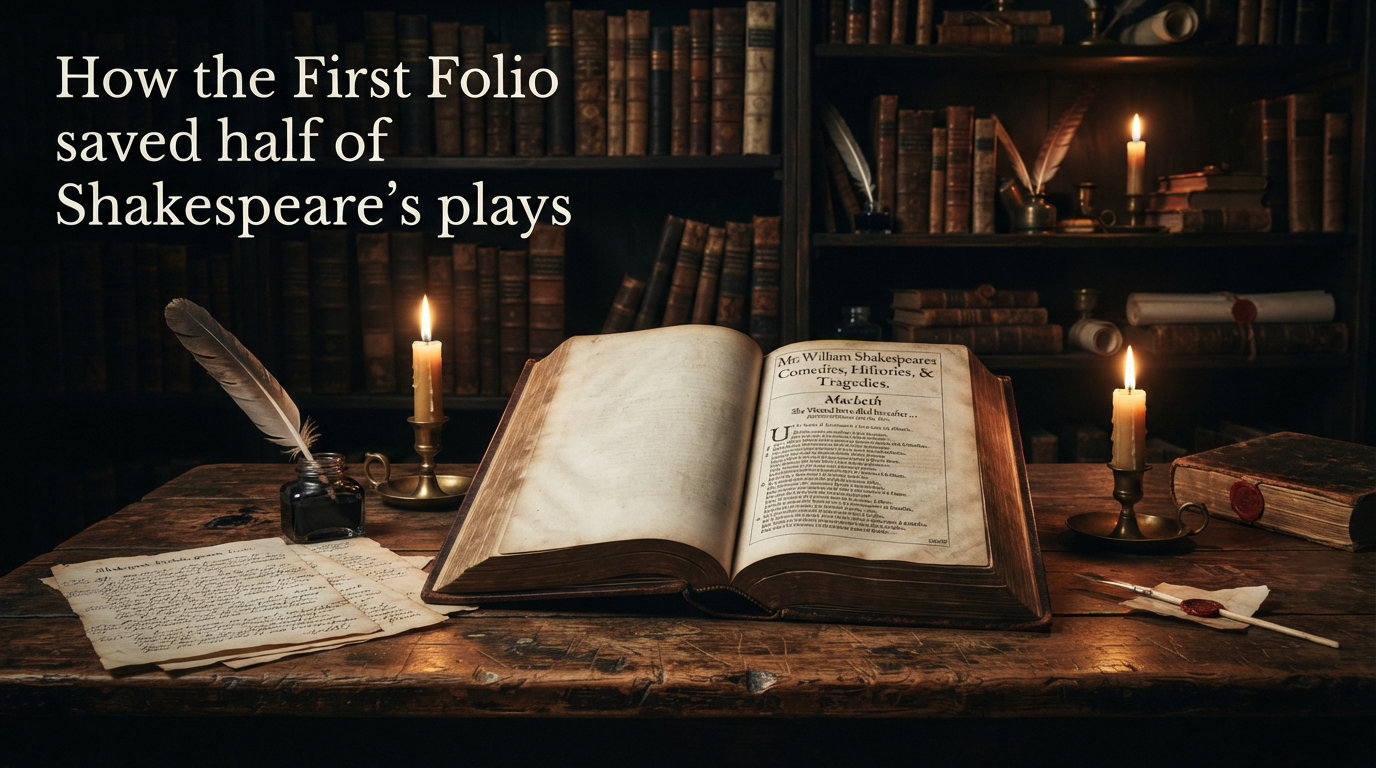
Understanding how the First Folio saved half of Shakespeare’s plays means looking at a single book printed in 1623. It was called Mr. William Shakespeare’s Comedies, Histories & Tragedies, and it preserved 18 plays that had never appeared in print before. Without it, the plays that define Shakespeare for us today would simply not exist.
This is the story of that book, the actors who made it, the plays it rescued, and why it remains one of the most important publications in the English language.
Table of Contents
What Is the First Folio?
The First Folio is a large-format book published in 1623 that collected 36 of Shakespeare’s plays into a single volume. It was the first time anyone had gathered his dramatic works together in one place, and it was printed seven years after his death.
The book’s formal title is Mr. William Shakespeare’s Comedies, Histories & Tragedies. Scholars and collectors simply call it the First Folio, because it was the first edition printed in folio format and because three more folio editions followed in 1632, 1663, and 1685.
Physically, the First Folio is a substantial object. It runs roughly 900 pages and weighs close to five pounds. The pages measure about 12 by 15 inches when opened, making it a book you hold on a table, not one you carry in a pocket.
It was also groundbreaking for another reason. The First Folio was the first collection of plays by a single English playwright ever published in folio format. In the printing culture of early 17th-century England, folios were reserved for important works like Bibles, law books, and classical texts. Putting plays in a folio was a statement that Shakespeare’s work deserved the same respect.
That decision was not accidental. The people who assembled the book wanted the world to treat Shakespeare as a serious literary figure, not just as an entertainer who wrote scripts for a theater company.
Who Created the First Folio: The Actors Who Saved a Legacy
John Heminge and Henry Condell created the First Folio. They were not publishers or scholars. They were actors, Shakespeare’s colleagues and personal friends, and members of the same theater company he wrote for, the King’s Men.
Heminge had known Shakespeare since at least the early 1590s. He was a senior actor, a shareholder in the Globe Theatre, and the company’s business manager. He appeared in the original productions of many Shakespeare plays. Condell joined the company in the late 1590s and became a leading actor alongside Shakespeare himself.
Both men were listed among the “principal comedians” in the First Folio’s cast of actors. They were in the room when these plays were first performed. When Shakespeare died in 1616, they were named in his will as colleagues empowered to buy mourning rings, a sign of genuine friendship.
After Shakespeare’s death, Heminge and Condell took on an enormous task. They gathered his plays, organized them, and worked with printer William Jaggard and publisher Edward Blount to produce the collected edition. This was not a quick project. It required years of work, significant financial investment, and access to manuscript copies of plays that existed nowhere else.
In their dedication letter to the Earls of Pembroke and Montgomery, Heminge and Condell wrote directly to the reader. They said they had collected the plays “only to keep the memory of so worthy a friend and fellow alive as was our Shakespeare.” They described the previous published versions as “stolen and surreptitious copies” and offered these texts as the authentic versions.
That personal motivation matters. These were not editors working for a publishing house. They were grieving friends who wanted the world to remember the man they had shared a stage with for decades.
Without their decision to act, the manuscripts Shakespeare left behind would have been scattered, discarded, or lost. Actors and theater companies did not typically preserve old play scripts. The fact that two of Shakespeare’s closest colleagues decided to save his work is the reason we have it at all.
The 18 Plays the First Folio Saved from Oblivion
Eighteen of the 36 plays in the First Folio had never been printed before. If Heminge and Condell had not included them, they would have been lost forever, because the original manuscripts no longer exist. Here is how the First Folio saved Shakespeare’s plays from disappearing entirely.
During Shakespeare’s lifetime, about half of his plays were published individually as small pamphlets called quartos. These were cheap, disposable editions aimed at readers who wanted to follow along with a popular play. Publishers printed them because they sold well.
But 18 plays were never published as quartos. Their scripts stayed with the King’s Men as working manuscripts, used for rehearsals and performances. When Shakespeare died, those manuscripts sat in the company’s storage. Without the First Folio, they would have eventually been thrown out, reused as scrap paper, or simply deteriorated beyond use.
Here are the 18 plays that existed only in manuscript until the First Folio preserved them:
The Tragedies:
Macbeth
Julius Caesar
Antony and Cleopatra
Coriolanus
Timon of Athens
King Lear (in a substantially different and longer version than the quarto)
The Comedies:
The Tempest
Twelfth Night
As You Like It
The Winter’s Tale
Measure for Measure
The Comedy of Errors
The Taming of the Shrew
The Two Gentlemen of Verona
All’s Well That Ends Well
Cymbeline
The Histories:
King John
Henry VI, Part 1
Henry VIII
Look at that list carefully. Macbeth, the play that gave us “Double, double, toil and trouble” and Lady Macbeth’s sleepwalking scene, survives only because of the First Folio. The Tempest, often called Shakespeare’s farewell to the stage, exists only because Heminge and Condell put it in print.
Julius Caesar, the source of “Et tu, Brute?” and the model for every political assassination scene in Western drama, was never published during Shakespeare’s lifetime. Neither was Twelfth Night, the romantic comedy that gives us Malvolio, Sir Toby Belch, and one of the most beloved cross-dressing plots in English literature.
As You Like It with its “All the world’s a stage” speech. The Winter’s Tale with its famous stage direction “Exit, pursued by a bear.” The Comedy of Errors, Shakespeare’s earliest farce. All of them would be gone.
Even King Lear deserves special mention. A quarto version of King Lear was published in 1608, but the First Folio version is substantially different. It contains about 300 lines not in the quarto and omits about 100 lines that the quarto includes. The Folio text of King Lear is what most modern editions are based on, and without it, we would have a different and arguably lesser version of the play.
This is what makes the First Folio not just important but essential. Eighteen plays completely, plus a superior text of King Lear, all depend on this single book. That is half of Shakespeare’s dramatic output.
Folio vs Quarto: Why the Format Changed Everything
The difference between folio and quarto format was not just about paper size. It determined how seriously the world took Shakespeare as a writer, and it shaped how his plays have survived.
A quarto was made by taking a single sheet of paper and folding it twice to create four leaves, or eight pages. The result was a small pamphlet, roughly the size of a modern paperback. Quartos were cheap to produce, cheap to buy, and treated as disposable entertainment.
Many Shakespeare plays were printed as quartos during his lifetime. Some of these were “good quartos” printed from clean manuscripts, but others were “bad quartos” reconstructed from memory by actors or audience members. The bad quartos were full of errors, missing lines, and garbled text. They were the bootleg recordings of their day.
A folio was something completely different. You took a large sheet of paper and folded it just once, creating two leaves, or four pages. The result was a much larger book, more expensive to produce, and built to last. Folios were reserved for works of lasting significance: Bibles, legal codes, histories, and the collected works of major authors.
By publishing Shakespeare’s plays in folio, Heminge and Condell were making a bold claim. They were saying that these plays belonged in the same category as the Bible and the classics of ancient literature. They were asserting that Shakespeare was not just a popular playwright but a literary figure whose work would endure.
Ben Jonson, Shakespeare’s rival and friend, had published his own collected works in folio format in 1616, the year Shakespeare died. Jonson’s folio was controversial at the time because many people thought plays did not deserve that level of treatment. Heminge and Condell followed Jonson’s example, but for a writer whose reputation far outlasted Jonson’s.
The folio format also meant physical survival. Large, well-bound books were kept on shelves, protected from moisture and wear. Small pamphlets were read, passed around, and eventually discarded. The decision to print in folio is a major reason the plays survived the centuries.
How the First Folio Was Organized
The First Folio divided Shakespeare’s plays into three categories: Comedies, Histories, and Tragedies. This simple organizational structure shaped how we think about Shakespeare’s work to this day, even though modern scholars recognize that several plays do not fit neatly into any of these buckets.
The Comedies section contained 14 plays, opening with The Tempest and closing with The Winter’s Tale. The Histories section contained 10 plays, beginning with King John and ending with Henry VIII. The Tragedies section contained 12 plays, starting with Troilus and Cressida (which was a late and problematic addition) and ending with Cymbeline.
The categorization was not always accurate by modern standards. The Winter’s Tale and Cymbeline are listed as comedies and tragedies respectively, but modern scholars often classify them as romances. Measure for Measure is technically a comedy but deals with dark themes that make it feel closer to tragedy.
But the structure gave the book a narrative shape. Readers could approach Shakespeare’s work systematically, moving from the lighter plays through the English histories and ending with the great tragedies. It turned a random collection of scripts into a curated body of work.
The book’s front matter was also significant. It opened with a title page featuring the famous Droeshout portrait of Shakespeare, an engraving created by Martin Droeshout. It was one of only two images of Shakespeare considered authentic by people who knew him.
Ben Jonson contributed a dedicatory poem praising the portrait, writing that the engraver had caught Shakespeare’s likeness well even though he could never capture the writer’s “wit.” Jonson’s longer poem, “To the Memory of My Beloved, the Author, Mr. William Shakespeare,” called Shakespeare the “Sweet Swan of Avon” and declared he was “not of an age, but for all time.”
That phrase turned out to be prophetic. The First Folio also included a list of the principal actors in Shakespeare’s plays, providing an invaluable record of the King’s Men’s company. Heminge and Condell’s dedicatory letter to the Earls of Pembroke and Montgomery and their address “To the Great Variety of Readers” rounded out the front matter, making the case for why these plays deserved to be collected and preserved.
How Many First Folios Survive Today
Approximately 750 copies of the First Folio were printed in 1623. Today, about 235 copies are known to survive. That survival rate is remarkable for a 400-year-old book, and it speaks to how highly the First Folio was valued from the very beginning.
The Folger Shakespeare Library in Washington, D.C. holds the largest collection, with 82 copies. The British Library, the University of Oxford’s Bodleian Library, and other major institutions hold significant numbers as well. Private collectors own a smaller but important share.
New copies still turn up occasionally. In 2016, a previously unrecorded First Folio was discovered in the library of a stately home on the Scottish island of Bute. It had been sitting on a shelf for over a hundred years, unrecognized. This was the 234th known copy at the time, and it generated worldwide news coverage.
Each surviving copy is slightly different from the others. Corrections were made during the print run, meaning that errors in early copies were fixed in later ones. Some copies include Troilus and Cressida and others do not, because the play was added late and a prologue was printed but the play itself was almost dropped over a rights dispute.
The monetary value of a First Folio has risen dramatically over the centuries. When it was first published in 1623, a copy cost about one pound, roughly a week’s wages for a skilled worker. Today, a First Folio in good condition can sell for millions of dollars.
In 2001, a copy formerly owned by Dr. Williams’s Library sold at Christie’s for over 6 million dollars. In 2020, Mills College sold its copy at auction for nearly 10 million dollars. These prices reflect the book’s status as the single most important work in English literary history.
Why the First Folio Still Matters in 2026
The First Folio is not just a museum piece. Every modern edition of Shakespeare, whether it is a paperback you buy at a bookstore or a script used by a professional theater company, ultimately traces its text back to the First Folio for many plays.
For the 18 plays that appeared only in the First Folio, it is the sole source. There is no alternative text to compare it against. Editors of modern Shakespeare editions work from the Folio text, correcting obvious printer errors and making judgment calls about ambiguous passages, but they cannot cross-reference an earlier edition because one does not exist.
Even for the plays that were previously published as quartos, the First Folio often provides a better or more complete text. Scholars compare the quarto and Folio versions of plays like Hamlet and King Lear, weighing which version is closer to what Shakespeare actually wrote and intended.
The First Folio also matters for the theater. The Royal Shakespeare Company, the Globe Theatre in London, and countless other companies worldwide perform from texts that are rooted in the First Folio. When an actor delivers the line “Is this a dagger which I see before me?” in Macbeth, those words exist because Heminge and Condell put them in a book 400 years ago.
In 2026, digital initiatives have made the First Folio more accessible than ever. The Folger Shakespeare Library has digitized its copies and made them freely available online. Anyone with an internet connection can now read the exact text that rolled off William Jaggard’s press in 1623, page by page.
That accessibility matters because it democratizes a book that was once available only to wealthy collectors and elite institutions. The plays Shakespeare wrote belong to everyone, and the First Folio is the reason we still have them to share.
FAQs
What role did the First Folio play in preserving Shakespeare’s works?
The First Folio preserved 18 of Shakespeare’s 36 plays that had never been printed before, including Macbeth, The Tempest, Julius Caesar, and Twelfth Night. Without it, those plays would have been lost forever because the original manuscripts no longer exist. It is the sole surviving source for approximately half of Shakespeare’s dramatic output.
What plays are missing from the First Folio?
The First Folio contains 36 plays but omits Pericles and The Two Noble Kinsmen, which modern scholars consider at least partially written by Shakespeare. It also does not include the narrative poems Venus and Adonis and The Rape of Lucrece, or the sonnets, because it was specifically a collection of plays. Two lost plays, Cardenio and Love’s Labour’s Won, are not included either.
How were Shakespeare’s folios divided?
The First Folio divided Shakespeare’s plays into three categories: Comedies (14 plays), Histories (10 plays), and Tragedies (12 plays). This structure was created by the editors John Heminge and Henry Condell and has shaped how readers and scholars organize Shakespeare’s work ever since, even though some plays like The Winter’s Tale and Cymbeline do not fit neatly into these categories.
What is the First Folio of Shakespeare’s plays?
The First Folio is a 900-page book published in 1623 titled Mr. William Shakespeare’s Comedies, Histories u0026amp; Tragedies. It was the first collected edition of Shakespeare’s plays, printed seven years after his death by his fellow actors John Heminge and Henry Condell. It contains 36 plays and is considered the most important book in English literature.
Who created the First Folio?
John Heminge and Henry Condell created the First Folio. They were fellow actors in the King’s Men, Shakespeare’s theater company, and personal friends of Shakespeare. They gathered the plays, organized them, and worked with printer William Jaggard and publisher Edward Blount to produce the collection. They did it to honor Shakespeare’s memory and preserve his work for future readers.
How many copies of the First Folio survive today?
Approximately 235 copies of the First Folio survive today out of about 750 originally printed. The Folger Shakespeare Library in Washington, D.C. owns 82 copies, the largest single collection. New copies are still occasionally discovered, with the most recent significant find occurring in 2016 at a stately home in Scotland. Surviving copies have sold at auction for up to 10 million dollars.
Conclusion
When John Heminge and Henry Condell sat down to collect their friend’s plays and send them to the printer, they could not have known they were creating one of the most influential books in history. They were simply trying to keep Shakespeare’s memory alive, as they said themselves.
But that act of friendship saved half of Shakespeare’s plays from oblivion. Without the First Folio, Macbeth, The Tempest, Julius Caesar, Twelfth Night, As You Like It, and thirteen other plays would have vanished along with the manuscripts they were written on. The words you read, the performances you watch, and the phrases that have entered everyday English all depend on a single book printed in 1623.
How the First Folio saved half of Shakespeare’s plays is ultimately a story about two actors who refused to let their friend’s work disappear. We owe them more than we can calculate.