
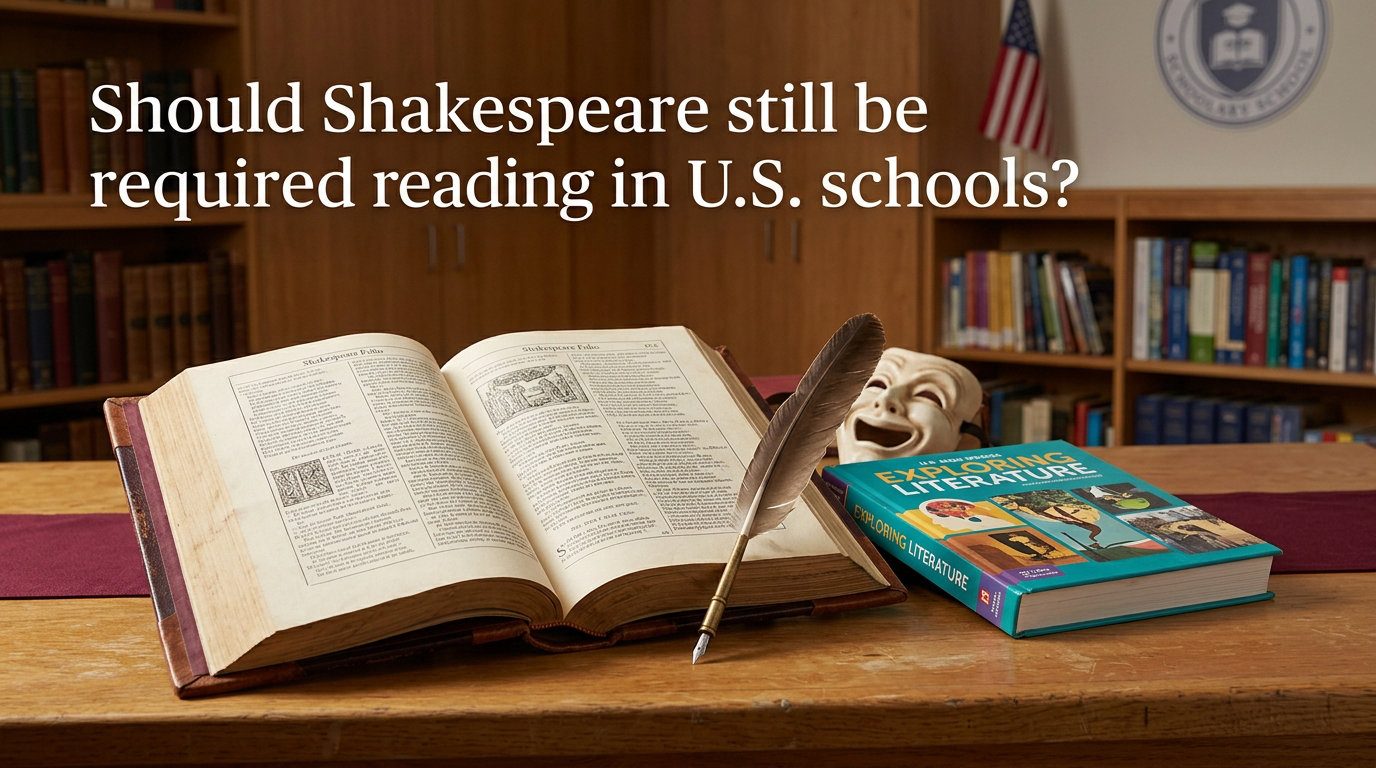
I still remember my sophomore English class, hunched over a dog-eared copy of Romeo and Juliet, underlining every third word with a pencil because the teacher told us to look for “patterns.” I hated it. Then I watched our class perform the balcony scene, and something clicked. Twenty years later, as a writer and curriculum volunteer, I am still not sure whether that experience taught me to love literature or simply to survive it. The question of whether Shakespeare should still be required reading in U.S. schools is one I take seriously.
Walk into almost any American high school in 2026 and you will find Shakespeare on the syllabus. Walk into a faculty meeting and you will find someone arguing about him. The debate is loud, sincere, and far from settled. I have spent the last few months reading the strongest arguments on both sides, talking with teachers, and rereading the plays I once dreaded. This article is my honest attempt to answer the question: should Shakespeare still be required reading in U.S. schools?
I will not give you a tidy verdict. Instead, I will give you the historical context, the strongest pro arguments, the strongest rethink arguments, and some practical ways forward. By the end, you will have what you need to make your own call, whether you are a parent, a teacher, a student, or a concerned citizen who cares about the future of American education.
What I have found, after all this research, is that the question is less about Shakespeare himself and more about what we want our schools to do. Do we want them to preserve a shared cultural inheritance, or to reflect the diversity of the students inside them? Do we want them to teach a single body of great works, or to teach students how to think critically about any text they encounter? Those are real questions, and the Shakespeare debate is the loudest place they get argued out loud.
Table of Contents
How Shakespeare Became Required Reading in American Schools
Yes, Shakespeare is still required reading in most U.S. high schools, and the reason goes back nearly two centuries. Understanding that history is the first step toward answering whether it still makes sense in 2026.
In the early 1800s, American educators borrowed the British literary canon to build cultural credibility for the new nation. Shakespeare’s plays were already seen as the pinnacle of English literature, and they offered a shared body of texts that colleges could test on. Noah Webster, the dictionary guy, was one of the loudest voices arguing that American schools should teach Shakespeare alongside the Bible to form a literate, moral citizenry. By the late 19th century, high schools across the country adopted him as a centerpiece of the English curriculum, in part because reading Shakespeare signaled that a student had received a “serious” education.
The practice survived the 20th century largely untouched. The 1983 report A Nation at Risk reinforced a back-to-basics approach, and Shakespeare became shorthand for rigor. School boards pointed to the plays to prove that their English language arts programs were not soft. AP English Literature, founded in 1953, has listed Shakespeare as required reading from its inception. By the time Common Core arrived in 2010, the assumption that Shakespeare would be taught was so baked into American education that nobody thought to challenge it.
Then, in 2010, the Common Core State Standards did something unusual. Among the dozens of authors a student might encounter, Shakespeare was the only one named by name. The standards cite his “complex texts” as a benchmark for college readiness, and that single citation has shaped English language arts classrooms in 41 states ever since. Schools that adopt Common Core are essentially required to teach Shakespeare, even if the standards do not say it in so many words.
Today, surveys consistently show that Shakespeare remains the most commonly taught author in American high school English classes. Roughly 90% of high school students encounter at least one Shakespeare play before graduation, most often Romeo and Juliet or Hamlet. Plays are sometimes taught in high school English classes as a unit specifically tied to Common Core reading standards. AP English Literature, taken by nearly 400,000 students each year, lists Shakespeare as the only author named in the curriculum framework.
So the question is not whether Shakespeare is still taught. He is. The question is whether the reasons that put him on the syllabus in 1830 still hold up in 2026.
The Common Core Connection
Parents and teachers who raise the “still required” objection often miss how directly the requirement is written. The Common Core standards for grades 9 through 10 specify that students should be able to analyze how an author develops themes, uses literary devices, and structures complex arguments. Many districts choose Shakespeare because the plays are in the public domain, dense enough to meet the rigor bar, and widely supported by existing teaching materials, lesson plans, and assessments.
That is a practical answer, not a moral one. Whether it is the right answer is the heart of the debate.
What the Common Core Actually Says
The Common Core appendix on text complexity puts Shakespeare in the same band as The Federalist Papers and Ulysses, all of which are flagged as “appropriately complex” for grades 11 and 12. School districts often latch onto Shakespeare because they already have a decade of lesson plans that fit the bill. Replacing him with a contemporary author would mean rebuilding the curriculum from scratch, and most districts do not have the budget or the time.
That is why the debate tends to stall out in practice. Even teachers who want to bring in more diverse voices face an institutional inertia that keeps the same five plays cycling through the same grades.
Why Shakespeare Still Belongs in the Classroom
Shakespeare belongs in the classroom because few other authors give students the same combination of language complexity, thematic depth, and cultural literacy in a single package. The strongest arguments in his favor are not about tradition. They are about what he teaches.
I have taught Shakespeare to teenagers, and I have watched them wrestle with language that does not give up easily. That is the point. Reading Hamlet is hard, and that difficulty is part of the value. When a student finally cracks a line like “brevity is the soul of wit,” they have done real intellectual work. That work builds the kind of close-reading muscles that show up in college essays, in legal reasoning, and in any job that requires careful interpretation of complicated texts.
Beyond the skills, Shakespeare’s themes remain stubbornly current. Ambition, jealousy, power, betrayal, love, grief, forgiveness, and identity are not 17th-century concerns. They are the building blocks of every novel, film, and TV show produced this year. A student who has read Macbeth understands the arc of a modern political thriller. A student who has read The Merchant of Venice has a frame for conversations about justice and prejudice they will have for the rest of their lives. A student who has read King Lear has a vocabulary for parent-child conflict that no parenting book can match.
Performance is another argument. Shakespeare’s plays were written to be acted, not read silently. Schools that stage even a small scene give students a chance to embody characters, hear the iambic pentameter out loud, and feel the rhythm of the language. Many teachers I have spoken with say that the day a student performs Shakespeare is the day a student stops fearing him. The Folger Shakespeare Library in Washington, D.C. has run a national competition for student performances since 1983, and the energy at those events is something you will not get from a textbook.
Cultural capital is harder to measure but impossible to ignore. Phrases like “wild goose chase,” “break the ice,” “heart of gold,” “foregone conclusion,” “sleep with one eye open,” and “all that glitters is not gold” all come from Shakespeare. So do the plots of The Lion King, She’s the Man, 10 Things I Hate About You, and a hundred other modern adaptations. Students who have read Shakespeare walk into college seminars, movies, political speeches, and ordinary conversations with a shared reference that the rest of the world assumes.
The plays also teach empathy in a way that few other texts can. Othello asks what happens when jealousy is allowed to win. Twelfth Night asks what happens when gender roles are bent. Measure for Measure asks what happens when power is unchecked. Reading these plays carefully is a workout in seeing the world from someone else’s perspective. That is a skill that translates directly into better friendships, better workplaces, and better citizenship.
Finally, the plays reward rereading. A 16-year-old reading Hamlet will see a different play at 25 and a different one at 50. Few texts in the curriculum offer that kind of return on investment. The lines that seem like nothing in tenth grade become loaded with meaning after the loss of a parent, a betrayal by a friend, or a brush with political corruption. Shakespeare grows with you.
And the data, while thin, is broadly positive. Studies from the Royal Shakespeare Company and American universities have shown that students who engage with Shakespeare through performance show measurable gains in confidence, vocabulary, and group collaboration. Pulling him out of the curriculum would mean losing the most thoroughly tested complex text in American education.
Why Schools Are Rethinking the Shakespeare Requirement
Schools are rethinking Shakespeare because the reasons he was placed at the center of the curriculum were never neutral, and because the content of the plays themselves does not always serve modern students. The strongest arguments against the requirement are about whose stories get told, and how.
The colonial origins of the Shakespeare requirement are real. In the 19th century, English literature was used as a tool to assimilate immigrants and to elevate “high culture” over oral, vernacular, and non-Western traditions. Shakespeare was chosen not just because he was good, but because he was English, white, and male, the same profile as the gatekeepers of the era. Scholar Ayanna Thompson has argued that the way Shakespeare is taught in American schools often erases the complex racial history of early modern England, including the role of Black actors in Shakespeare’s original companies and the Moorish presence in many of his plays.
This is not a fringe argument. In 2016, students at Yale University petitioned to remove the Shakespeare requirement from the English major, citing the need to “decolonize” the curriculum. Similar conversations have happened at Columbia, Cornell, and dozens of other schools. The criticisms are not that Shakespeare is bad. They are that he is a single voice doing the work of many, and that the effort to make him the centerpiece of an English education has come at the cost of voices that are equally complex and far more relevant to the students sitting in the classroom.
The content of the plays can also be a problem when it is taught without context. The Merchant of Venice contains antisemitic tropes that, read carelessly, can reinforce harmful stereotypes. Othello turns race into a tragedy that has been stripped of its full complexity by generations of white directors. The Taming of the Shrew treats a woman as a project to be conquered. The Tempest has been read for centuries as a colonial fantasy, and that reading is not wrong. Henry V glorifies military violence in ways that no modern curriculum would accept in a contemporary novel.
None of these plays need to be banned. Most English teachers do a careful job with them. But when the entire literary curriculum leans on these texts year after year, students who do not see themselves in the classroom lose out. A 2020 survey by the National Education Association found that fewer than 30% of high school students reported feeling represented in their required reading. That is a problem with the curriculum, not with the students.
Students themselves are often the loudest critics. On Reddit, TikTok, and in classroom surveys, Shakespeare is consistently among the most disliked required reading. The language is hard, the plots feel distant, and the assignments can feel like a chore. If the goal of required reading is to build lifelong readers, Shakespeare as commonly taught may be doing the opposite. A 2022 survey by the Center for Fiction found that students who read books they chose for themselves were nearly three times more likely to read outside of school than those who only read assigned texts.
Representation is the deepest issue. The current canon is overwhelmingly white, male, and European. There are extraordinary writers, particularly writers of color, women, and queer writers, who have produced work that is just as complex, just as literary, and far more relevant to the lived experience of today’s students. Toni Morrison, James Baldwin, Sandra Cisneros, Jhumpa Lahiri, Ocean Vuong, Claudia Rankine, and dozens of others deserve a seat at the table. Right now, the seat is taken. When the curriculum devotes 12 weeks of a semester to Hamlet, that is 12 weeks in which a student never meets a single author who looks like them or speaks from their experience.
There is also a labor question. Teaching Shakespeare well is hard. It takes time, training, and a tolerance for chaos in the classroom. Many teachers are not given the privilege of working with the material. When a teacher is handed a Shakespeare unit and told to get through it in three weeks, the result is a bored class and a teacher who feels like a failure. The hardest critics of the Shakespeare requirement are often the teachers who love him most.
Modern Approaches and Alternatives to the Old Shakespeare Curriculum
The best answer to the Shakespeare debate is not to ban the plays or to enforce them. It is to teach them better, and to teach them alongside other voices. Here are the practical approaches that teachers and parents are using right now.
Performance-based teaching is the single most effective method. Schools that stage even a 20-minute scene of a Shakespeare play see engagement spike. Students who once complained about the language suddenly need to understand it, because they have to say it out loud. Across the country, programs like the Shakespeare in Schools project and the Folger Library’s performance workshops have shown that active engagement, not silent reading, is what makes the plays land. The most successful Shakespeare units I have observed are the ones where students are on their feet, not slumped over a desk.
Pair Shakespeare with diverse voices. There is no rule that says Hamlet and Macbeth cannot be taught alongside Beloved or The House on Mango Street. Many districts now build whole units around themes, like power, identity, or injustice, and let the canon be one resource among many. This is not a downgrade. It is a richer curriculum. A student who reads Macbeth alongside Antigone and The Parable of the Sower gets a more complete picture of how different cultures tell the same stories.
Use modern adaptations. The 1996 Romeo + Juliet, the 2018 Macbeth with Frances McDormand, and Slings & Arrows, the Canadian TV series about a Shakespeare festival, all give students a way in. Watching a film clip before reading the original text can dissolve the fear factor and give students a visual scaffold for the language. There are also excellent graphic novel versions of the plays, including the No Fear Shakespeare series, that help reluctant readers get past the unfamiliar vocabulary.
Teach the problem on purpose. None of the plays is perfect, and pretending otherwise is bad teaching. When a high school class reads The Merchant of Venice, the best teachers do not skip the antisemitism. They slow down, hold up the history, and ask why Shakespeare wrote the play the way he did. Critical thinking is exactly what Shakespeare is supposed to teach. A teacher who flinches from the hard parts is not protecting students. They are missing the most valuable lesson the play has to offer.
Reasonable curricular balance is the goal. Most educators I have spoken with do not want to remove Shakespeare. They want to stop making him the only thing. A 12th-grade English class of 30 students where 28 weeks of the year are spent on one dead white man is not a curriculum. It is a monument. A smarter approach is to teach one Shakespeare play a year, well, alongside contemporary voices that students can see themselves in.
For parents who want to push back, the conversation is simple. Ask your child’s school what other voices are on the syllabus. Ask how many female authors, how many authors of color, how many contemporary writers. If the answer is “mostly Shakespeare,” that is a conversation worth having. School board meetings are open to the public, and curriculum decisions are decisions the public gets to weigh in on.
For students, the practical advice is to give Shakespeare one more honest try, this time with a good teacher, a modern adaptation, and a willingness to read the play out loud. The plays were meant to be heard, not skimmed. The students who end up loving Shakespeare are almost always the ones who got to perform him, not just read him.
For teachers, the lesson is that the choice is not “Shakespeare or no Shakespeare.” The choice is “Shakespeare alone, or Shakespeare alongside.” The most successful curricula I have seen do both, and they do not apologize for either.
Frequently Asked Questions About Shakespeare in U.S. Schools
Do they still read Shakespeare in high school?
Yes. As of 2026, roughly 90% of American high school students encounter at least one Shakespeare play before graduation, most commonly Romeo and Juliet or Macbeth. The Common Core State Standards list Shakespeare as the only required author by name, which keeps him anchored in most English language arts curricula across 41 states.
Why is reading Shakespeare still relevant?
Reading Shakespeare is still relevant because his plays build close-reading skills, expose students to universal themes like ambition and betrayal, and provide the cultural capital needed to understand modern literature, film, and political life. The language is hard, but that difficulty is what develops the habits of careful interpretation that students use in college and beyond. Shakespeare also rewards rereading, growing more meaningful with age and experience.
Why is Shakespeare not relevant today?
Some educators argue Shakespeare is not relevant today because his plays contain outdated and sometimes harmful content, including antisemitism in The Merchant of Venice, racism in Othello, and misogyny in The Taming of the Shrew. Critics also point to the colonial origins of the requirement and the lack of representation of women and authors of color in the broader canon. These concerns do not require banning Shakespeare, but they do ask schools to stop making him the only option.
Is Shakespeare taught in American schools?
Yes. Shakespeare is taught in American schools from middle school through college, with the heaviest concentration in grades 9 and 11. Most districts require at least one play per year, and AP English Literature courses typically feature multiple Shakespeare works. The teaching is not uniform, however, and many districts are now supplementing or replacing the traditional Shakespeare units with more diverse voices such as Toni Morrison, James Baldwin, and contemporary poets of color.
Where Do We Go From Here?
So, should Shakespeare still be required reading in U.S. schools? My honest answer is yes, but not the way he has been taught for most of the last century. The plays are worth reading. The cultural capital is real. The training in close reading is genuine. None of that goes away.
What should change is the assumption that Shakespeare is the only author who can do this work. The question of whether Shakespeare should still be required reading in U.S. schools is really a question about the wider curriculum. It is about whether we will keep lifting up the same dead white men year after year, or whether we will trust our students with a richer, more representative body of literature, with Shakespeare as one voice among many.
If you are a teacher, consider teaching one Shakespeare play a year, taught well, paired with voices your students don’t yet know. If you are a parent, ask what else is on the syllabus. If you are a student, give Shakespeare one more honest try, then write what you really think. The conversation is not ending. It is finally getting better.
What I want, in the end, is for Shakespeare to be taught in a way that lives up to the plays. That means teaching them with joy, with rigor, with honesty about what they say, and with a clear-eyed acknowledgment that there are other voices just as worthy of a teenager’s attention. If we can do that, the debate fades into the background and the books do what they were always meant to do. Change how we see the world, and how we see one another.