
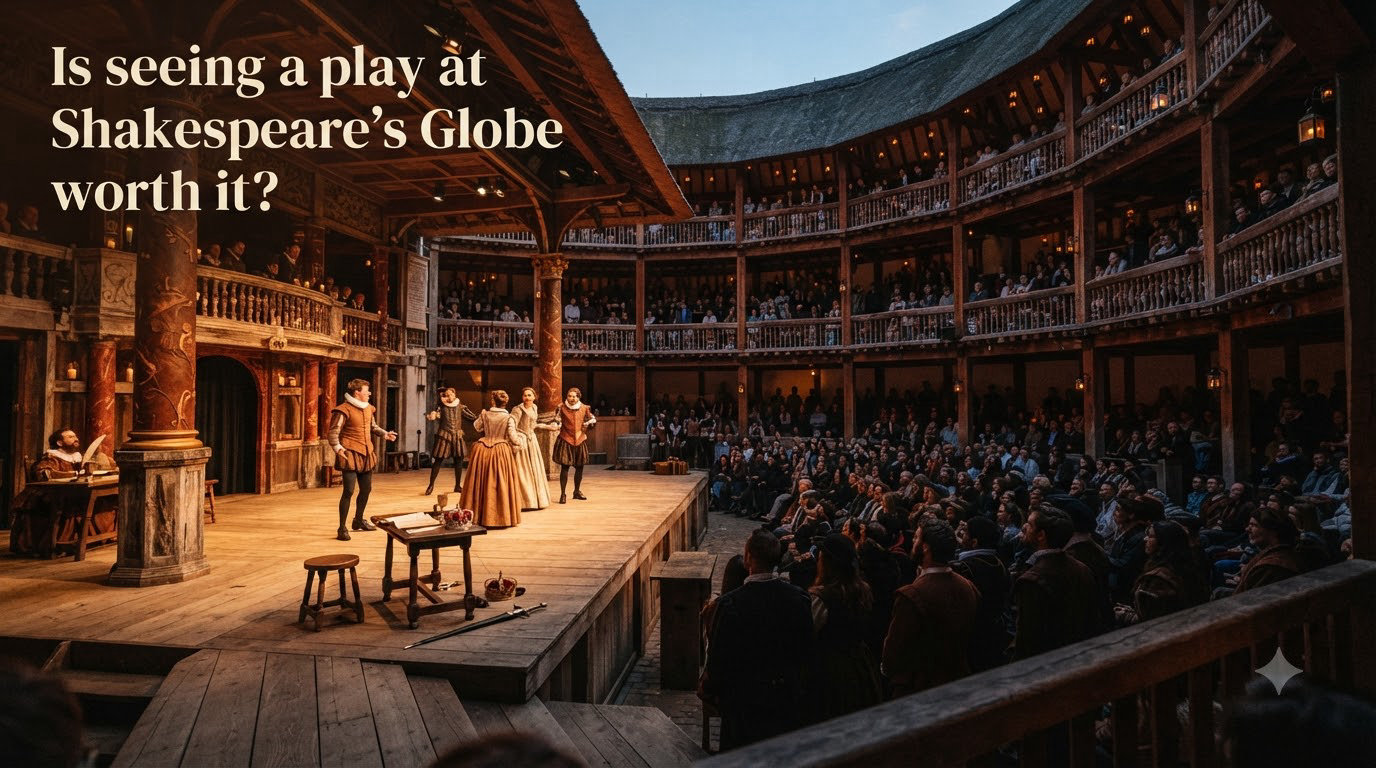
Yes, seeing a play at Shakespeare’s Globe is absolutely worth it, especially if you grab a £5 groundling standing ticket. You get to watch Shakespeare performed in an open-air, oak-and-thatch reconstruction of the original 1599 playhouse, surrounded by the buzz of a live Elizabethan-style audience. No other theatre in London, or arguably the world, offers this level of historical immersion.
Now, whether it is worth it for you depends on a few things. Can you stand for three hours? Do you enjoy Shakespeare, or are you just curious? Are you visiting in summer or braving a chilly autumn evening? I have attended multiple performances at the Globe, stood in the yard as a groundling, and sat in the galleries, so I can walk you through exactly what to expect.
This guide covers the full experience, from ticket options and seating to weather prep, accessibility, and how the Globe stacks up against a glossy West End show. By the end, you will know whether seeing a play at Shakespeare’s Globe is worth it for your trip.
Table of Contents
What Is the Shakespeare’s Globe Experience?
Seeing a play at Shakespeare’s Globe is a full sensory experience unlike anything else on the London theatre scene. The venue is an open-air, icosagon-shaped playhouse built from green oak, lime plaster, and a hand-thatched roof, faithfully recreating the theatre where Shakespeare’s own company first staged his plays around 1599.
The biggest difference from a normal theatre? You can stand. Roughly 700 “groundlings” pay a few pounds to stand in the yard right in front of the stage, just as working-class audiences did 400 years ago. Another 800 to 900 audience members sit on wooden benches in the three covered gallery tiers that wrap around the yard.
Because the Globe is open-air, performances happen in daylight or early evening light during the summer season. There is no darkened auditorium, no elaborate lighting rigs, and no amplified sound. Actors rely on natural acoustics, projection, and direct interaction with the crowd.
That last point is what makes the experience special. Groundlings lean on the stage edge, actors make eye contact, and audience reactions shape the energy of the performance. I have seen performers break character to acknowledge a laughing groundling or riff on a plane flying overhead. You are not just watching a play. You are part of it.
One thing to understand going in: production quality varies. Some seasons feature inventive, critically acclaimed stagings, while others lean experimental in ways that divide audiences. Forum discussions on Reddit and TripAdvisor consistently note that even a mediocre production feels memorable simply because the setting is so extraordinary.
A Brief History of Shakespeare’s Globe
The original Globe Theatre was built in 1599 by Shakespeare’s playing company, the Lord Chamberlain’s Men, on the south bank of the Thames in Bankside. It became the primary venue for most of Shakespeare’s greatest works, including Hamlet, Othello, and King Lear.
In 1613, a theatrical cannon fired during a performance of Henry VIII ignited the thatched roof, and the theatre burned to the ground in under an hour. It was rebuilt the following year with a tiled roof, then demolished in 1644 by Puritans who closed all theatres.
The building you visit today is not the original site (that sits about 750 feet away, beneath a modern apartment block). It is a meticulous reconstruction spearheaded by American actor and director Sam Wanamaker, who spent decades campaigning, fundraising, and researching every detail of the build.
Construction used traditional materials and methods wherever possible: green oak frames joined with wooden pegs, lime plaster mixed with goat hair, and even the first thatched roof permitted on a London building since the Great Fire of 1666. The reconstruction opened in 1997, nearly 50 years after Wanamaker first visited London and was dismayed to find only a plaque marking the original Globe’s location.
Knowing this history adds depth to the experience. When you stand in the yard or sit on those gallery benches, you are participating in a living reconstruction of theatrical history, not a theme park imitation.
Ticket Options: Standing vs Seated at the Globe
The biggest decision you will make is whether to stand as a groundling or pay for a gallery seat. This choice affects your budget, your view, and your physical comfort, so let me break it down.
Groundling Standing Tickets
Standing in the yard is the cheapest and most authentic option, and it is what most budget travelers and first-timers go for. You are in the thick of the action, feet from the stage, leaning against the wooden railing or shuffling around for the best angle.
Groundling tickets typically start at £5, though prices have crept up in recent seasons. That is one of the best entertainment bargains in London. The catch? You are on your feet for roughly 2.5 to 3 hours with no breaks. Comfortable shoes are non-negotiable.
The best standing spot, according to frequent visitors on travel forums, is along the back wall of the yard near the entrance. You get a head-height vantage over the crowd, a surface to lean against, and a quick exit if needed. The worst spot is directly front-center, where taller groundlings behind you may block your view.
I have stood as a groundling twice, and both times the physical demand was real but manageable. The energy of the crowd and proximity to the actors more than made up for tired legs. If you have any knee, back, or stamina concerns, consider a seated ticket instead.
Gallery Seated Tickets
Gallery seats put you on wooden benches in one of three tiered levels surrounding the yard. You get a back rest, a view from above, and shelter from rain under the gallery roof. Prices range from roughly £25 to over £60 depending on the tier and view quality.
Lower gallery seats (the first tier) offer the closest seated views and feel intimate. Middle gallery seats provide the best overall sight lines, balancing proximity with a full stage picture. Upper gallery seats are cheapest but can feel distant, and some have partially obstructed views from the pillars supporting the roof.
You can rent cushions for a small fee, which I strongly recommend. Those oak benches get hard after two hours. Some visitors also bring their own seat cushions.
If budget is not a concern, aim for the middle gallery, center section. That is the sweet spot for comfort and view quality.
The Globe vs West End Theatre: How Do They Compare?
This is one of the most common questions on travel forums, and the answer depends on what kind of theatre experience you want. The Globe and a West End show offer fundamentally different things.
A West End production gives you polished, professional theatre with state-of-the-art lighting, sound design, climate control, and comfortable seating. Shows like The Lion King or Les Miserables are spectacles built for modern audiences. Tickets typically run £30 to £150, and the experience is reliably high-quality.
The Globe trades polish for authenticity. You are trading plush seats and air conditioning for wooden benches, open sky, and a raw, immediate connection between actors and audience. The Globe is about the space and the history as much as the play itself.
If you want guaranteed production quality and comfort, choose the West End. If you want a one-of-a-kind, historically immersive experience you cannot get anywhere else, choose the Globe. Honestly, if you have time for both, do both. They complement rather than compete with each other.
For budget travelers, the Globe is hard to beat. A £5 groundling ticket delivers a world-class cultural experience for less than the cost of a pint in central London. You will not find standing-room West End tickets at that price.
Pros and Cons: Is Shakespeare’s Globe Worth It?
Let me lay out the honest pros and cons so you can decide based on your own situation.
The Pros
Unmatched historical atmosphere. Watching Shakespeare in a space designed to replicate the original playhouse is an experience no West End venue can replicate. The oak beams, thatched roof, and open yard transport you.
Incredible value for groundlings. At £5 for a standing ticket, it is one of the most affordable cultural experiences in London. Few world-class theatre venues offer anything close.
Immersive, interactive performances. Actors engage directly with groundlings, natural light creates unique staging opportunities, and the crowd energy is electric. You feel connected to the performance in a way a darkened theatre cannot match.
Stunning South Bank location. The Globe sits on the Thames embankment steps from Tate Modern, Borough Market, and Millennium Bridge. You can build an entire day around the area.
The Cons
Physical demands of standing. Three hours on your feet is tough. If you have mobility issues, joint pain, or low stamina, groundling tickets are a poor choice unless you are prepared for the strain.
Weather exposure. The yard is completely open to the sky. Rain, wind, cold, and sun all affect the experience. A beautiful summer evening is magical. A cold, drizzly October night is a test of endurance.
Variable production quality. Some productions are brilliant. Others are experimental, overlong, or simply not to everyone’s taste. Unlike a long-running West End hit, you cannot always count on a crowd-pleasing show.
Seated tickets can be pricey. Once you move beyond groundling prices, gallery seats climb quickly. For the cost of a mid-tier gallery seat, you could see a well-reviewed West End production in comfort.
No latecomer admission. If you arrive after the performance begins, you will not be seated (or allowed into the yard) until the interval. Plan your travel time accordingly.
Practical Tips for Your Visit
Weather and the Rain Policy
Performances at the Globe run rain or shine. There are no refunds or exchanges for bad weather. If you are a groundling, you will get wet, so bring a raincoat (not an umbrella, as they obstruct views). Gallery seats are covered, so rain only affects your pre-show queue and walk home.
I always check the forecast before booking and prefer matinee performances on sunny afternoons. Evening shows in summer can still get chilly once the sun drops, so bring layers even in July.
What to Wear and Bring
Wear comfortable, weather-appropriate clothing and the most comfortable shoes you own. For groundlings, footwear is critical since you will be standing the entire time. Bring a water bottle, a light snack, and sunscreen for daytime performances.
If you have a gallery seat, bring or rent a cushion. The benches are unforgivingly hard. A light jacket or blanket is wise for evening shows, even in summer.
Accessibility at Shakespeare’s Globe
The Globe offers step-free access to the ground floor and designated accessible seating areas for wheelchair users and visitors with mobility needs. Assistive listening devices, captioned performances, audio-described shows, and relaxed performances are available on select dates throughout the season.
If standing is not an option for you, the Globe still works. Book an accessible or gallery seat and contact the box office in advance to discuss the best seating for your needs. They are genuinely helpful and accustomed to accommodating requests.
The Sam Wanamaker Playhouse: A Winter Alternative
Here is something many guides overlook. If you are visiting London between November and April when the open-air Globe is closed or limited, the Sam Wanamaker Playhouse offers performances year-round in a candlelit indoor theatre modeled on a Jacobean playhouse. It is intimate, warm, and visually stunning.
The Playhouse is a completely different experience from the open-air Globe but equally worthwhile. If your trip falls in the off-season, this is your answer to “Is seeing a play at Shakespeare’s Globe worth it?” because you can still get a historically authentic performance indoors.
Booking Tips
Book early, especially for popular productions and summer weekend dates. Groundling tickets sell out fast because of the price. Weekday and matinee performances have better availability and smaller crowds.
Check the Globe’s website for £5 groundling ticket releases, which sometimes open on the day of the performance. These are first-come, first-served and a great option for flexible travelers.
Allow Enough Time for Your Visit
Plan for the full performance duration plus arrival and departure. Most plays run 2.5 to 3 hours including an interval. Arrive 30 to 45 minutes early to collect tickets, find your spot, and soak in the atmosphere. The building itself is worth exploring before curtain.
If you want even more depth, the Globe offers guided tours of the theatre on non-performance days, taking you backstage and explaining the architecture, staging conventions, and history in detail.
FAQs
What are the best Shakespeare plays to see at the Globe?
The most crowd-pleasing plays at the Globe tend to be the comedies and histories. A Midsummer Night’s Dream, Much Ado About Nothing, Twelfth Night, and Henry V are frequent favorites because they play well to groundling energy and natural daylight. Tragedies like Macbeth and Romeo and Juliet also work beautifully in the open-air setting. Check the current season schedule and read recent production reviews before booking, since staging quality varies from year to year.
How long do you need at Shakespeare’s Globe?
Plan for about 3 to 4 hours total for a performance visit. The plays themselves typically run 2.5 to 3 hours including one interval. Arrive 30 to 45 minutes early to collect tickets, find your standing spot or seat, and explore the theatre. If you want to add a guided tour of the building, budget an additional hour.
Where is the best place to sit at Shakespeare’s Globe?
The middle gallery center section offers the best balance of view quality and comfort. Lower gallery seats are closest and most intimate but may require looking down at the stage. Upper gallery seats are cheapest but can feel distant and some have obstructed views from supporting pillars. For groundlings, the best standing position is along the back wall near the entrance, where you get height and a surface to lean against.
What happens if it rains at the Globe Theatre?
Performances run rain or shine with no refunds or exchanges for bad weather. Groundlings in the open yard will get wet, so bring a raincoat rather than an umbrella to avoid blocking views. Gallery seats are sheltered under the roof. The Globe recommends checking the forecast and dressing appropriately with layers, waterproofs, and comfortable shoes.
Is Shakespeare’s Globe worth seeing?
Yes, Shakespeare’s Globe is worth seeing for most visitors. A groundling standing ticket at around £5 is one of the best cultural values in London, and the open-air Elizabethan atmosphere cannot be replicated anywhere else. It is especially worthwhile for history lovers, literature fans, and budget travelers. If you cannot stand for long periods, book a gallery seat or visit the indoor Sam Wanamaker Playhouse during the off-season.
Final Verdict
Seeing a play at Shakespeare’s Globe is worth it for almost anyone visiting London with even a passing interest in theatre, history, or culture. A £5 groundling ticket delivers an authentic Elizabethan experience that no polished West End production can match. Yes, standing for three hours is demanding, the weather is unpredictable, and production quality varies. But the setting, the atmosphere, and the connection between actors and audience make it one of the most memorable nights out you can have in London. If standing is not feasible, grab a gallery seat or catch a candlelit show at the Sam Wanamaker Playhouse. Either way, go.