
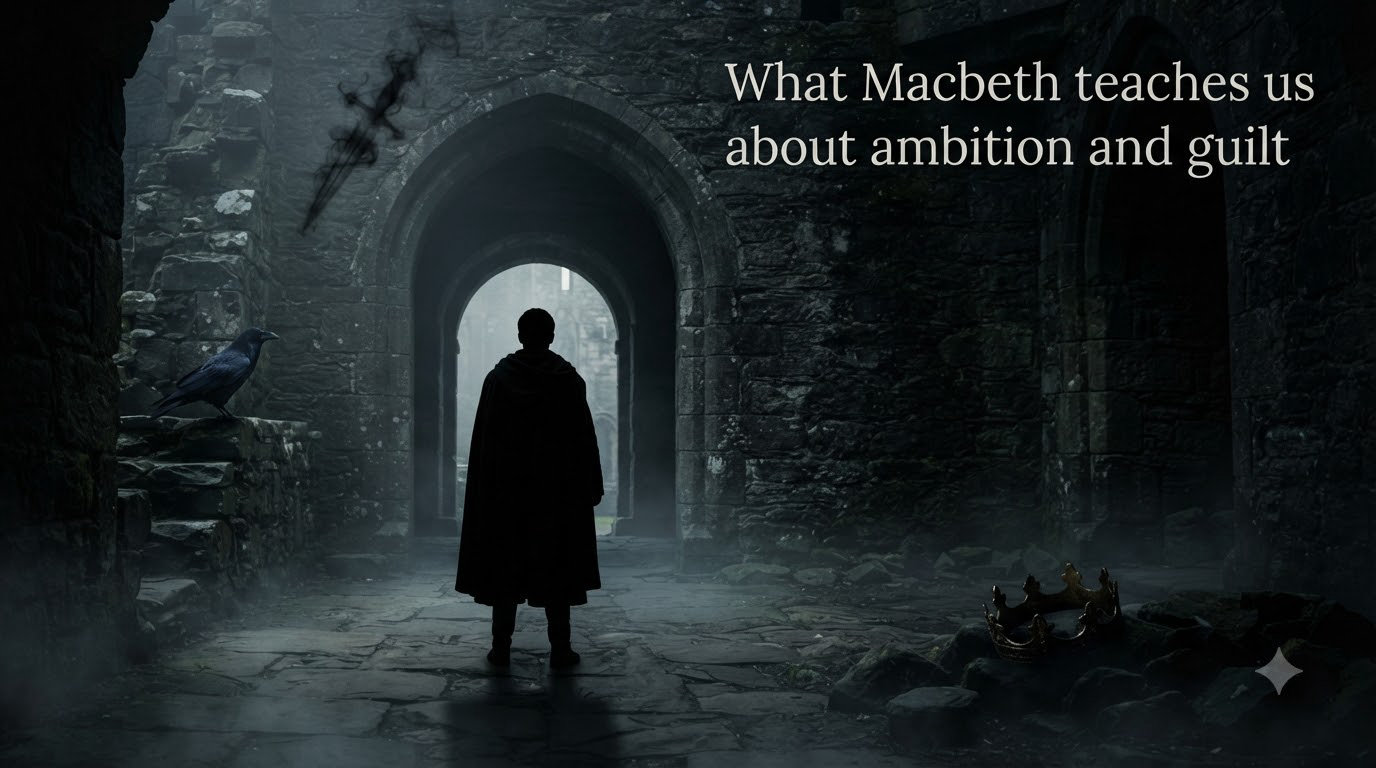
I have spent more than a decade teaching Shakespeare to students of all ages, and one play always sparks the most heated discussion: Macbeth. When readers ask what Macbeth teaches us about ambition and guilt, they often expect a simple moral about not wanting too much. The truth is far more interesting. The play shows us that ambition, when cut loose from moral restraint, does not just fail. It actively destroys the person who holds it, and guilt becomes the wreckage left behind.
In this guide, I will walk you through the lessons Shakespeare packed into his shortest tragedy. We will look at how unchecked ambition corrupts even good people, why guilt behaves like a relentless creditor, and how the play still speaks to anyone facing ethical pressure at work, in politics, or in their own lives. You will get direct quotes from the text, analysis you can use in essays, and questions perfect for a classroom or book club.
Table of Contents
What is the main lesson about ambition and guilt in Macbeth?
Macbeth teaches that unchecked ambition, when separated from moral constraints, corrupts the ambitious person and produces a guilt so relentless it destroys their mind, relationships, and power. The play argues that ambition needs conscience as a counterweight, and that guilt is the internal penalty for cutting that tie.
How does ambition link to guilt in Macbeth?
Ambition and guilt in Macbeth are not separate forces. They are cause and effect. The play argues that once ambition escapes moral constraint, guilt arrives almost immediately, and the two then feed each other in a fatal loop.
Macbeth begins the story as a respected warrior who already carries ambition inside him. He admits the thought of killing Duncan has been in his mind before the witches ever speak. When he finally acts on that thought, his conscience responds with such force that he hears a voice cry, “Macbeth shall sleep no more.” That single line tells us guilt has already moved in.
From this point, ambition drives him to cover up the crime, and guilt drives him to commit more crimes to silence the first one. Duncan’s murder leads to Banquo’s murder, which leads to the massacre of Macduff’s family, which leads to the end of his wife and his own death. Shakespeare builds a chain where every ambitious act produces a fresh wave of guilt, and every attempt to silence guilt requires a new ambitious act. This is the engine of the tragedy.
The Corrupting Power of Unchecked Ambition
Macbeth’s warning against unchecked ambition comes early in the play. Before he kills Duncan, Macbeth admits that his only motivation is “vaulting ambition, which o’erleaps itself and falls on the other.” That image is precise: ambition is a horse rider who jumps so high he tumbles over on the landing.
I have watched students arrive at this line with different reactions. Some see Macbeth as a villain who deserves his fate. Others see him as a warning about how quickly a loyal man can become a tyrant once he stops checking his desires. Shakespeare seems to side with the second view, because he spends the first act showing us a Macbeth who still hesitates, still reasons, still fears judgment in the afterlife.
The corruption is gradual and believable. It starts with a hesitation (“We will proceed no further in this business”). It moves through Lady Macbeth’s pressure and the witches’ nudging. It locks in the moment Macbeth decides he will not leave the future to chance. By Act 3, the same man who flinched at the idea of murder is sending hired killers to slaughter a father and his child. That is the path unchecked ambition carves through a soul.
The Relentlessness of Guilt in Macbeth
If ambition is the disease, guilt in Macbeth is the symptom that never goes into remission. Shakespeare presents guilt as something physical, public, and inescapable. It keeps Macbeth awake, makes him see blood on his hands, and turns his banquet into a hall of horrors where he rants at a ghost only he can see.
The most quoted image comes right after the murder. Holding the daggers, Macbeth whispers, “Will all great Neptune’s ocean wash this blood clean from my hand?” The answer, the play insists, is no. No amount of water, no amount of power, no amount of distance from Scotland can scrub the stain out. Blood becomes the visible sign of invisible guilt.
The relentlessness shows up in small details. Macbeth says he has murdered sleep itself. He cannot eat, cannot trust an old friend, cannot bless his own subjects. When Macduff’s family dies, Macbeth feels nothing. That absence of feeling is its own kind of punishment. The man who could once feel pity no longer can. By the final act, he is a hollow figure wading through a river of blood he made himself.
Lady Macbeth’s Role in the Ambitious Conspiracy
Lady Macbeth teaches us a second lesson about ambition and guilt: that encouraging someone else’s ambition does not protect you from the consequences. She is the architect of Duncan’s murder in many ways. She lays out the plan, steadies Macbeth’s nerves, and plants the daggers back in the sleeping guards.
Yet her guilt arrives faster and hits harder. Within a few scenes, she is sleepwalking, rubbing at imaginary blood, and repeating the line “Out, damned spot! Out, I say!” She knows that “a little water clears us of this deed,” but she also knows it is a lie. By the end, her conscience has destroyed her more completely than Macbeth’s destroys him.
The contrast matters. Lady Macbeth shows that guilt punishes the planner as much as the actor. She also shows that the people who push others toward ambitious crimes often pay a steeper psychological price. The ambitious conspiracy she championed becomes the trap that catches her first.
The Witches’ Prophecies as Catalyst for Ambition
The witches tell us something subtle about ambition in Macbeth. They do not plant ambition where none exists. They only confirm what is already growing. When they hail Macbeth as king, the desire they address is one he already carries. The prophecies are a mirror, not a seed.
This matters because it shifts some of the blame away from supernatural forces and onto Macbeth himself. His ambition is the cause, and the witches are the excuse he uses to act on it. In modern life, this lesson is easy to translate. People often blame circumstances, mentors, or pressure for choices they were already inclined to make. Macbeth shows that outer prompts only succeed when they meet an inner readiness.
Kingship vs Tyranny: A Lesson in Moral Leadership
Shakespeare sets Duncan and Macbeth against each other so we can see the difference between a king and a tyrant. Duncan is described as humble, generous, and trusting. Macbeth becomes isolated, paranoid, and brutal. The contrast is the play’s clearest lesson about how ambition should be governed.
Duncan rules with consent and gratitude. Macbeth rules through fear. Duncan’s death sends the realm into mourning. Macbeth’s death is met with relief. The play argues that legitimate power rests on the welfare of the people, while tyrannical power rests only on the ambition of the ruler.
This is one of the most modern lessons in Macbeth. Leaders today, in companies and governments alike, often slide from the first model into the second when they start prioritizing personal advancement over the people they serve. Shakespeare saw this pattern four hundred years ago and gave us a clear picture of where it ends.
Modern Lessons from Macbeth’s Ambition and Guilt
The lessons of Macbeth travel well beyond the stage. I have talked with readers who see Macbeth’s arc in the rise and fall of political figures, in corporate scandals, and in their own quieter struggles with temptation.
The first modern lesson is that ambition needs a conscience. Wanting to succeed is healthy. Cutting ethical corners to get there is what turns ambition into a poison. The second lesson is that guilt is not abstract. It shows up as anxiety, broken sleep, damaged relationships, and lost joy. The third lesson is that covering up one mistake usually creates a bigger one. Each act of concealment in Macbeth requires another murder, and that pattern repeats in real life when people falsify records to hide small frauds.
The fourth lesson is the hardest. Ambition that ignores morality does not just hurt the ambitious person. It hurts the people who trusted them. Macduff’s children did not choose Duncan’s murder, yet they died for it. In our own lives, the people who pay for someone else’s unchecked ambition are often the ones who had the least say in the decision.
Classroom Discussion Questions on Ambition and Guilt
If you are teaching Macbeth or running a book club, these questions work well for sparking conversation about ambition and guilt:
At what moment does Macbeth cross the line from thinking about murder to committing it? Could he have turned back?
Why does Lady Macbeth break under guilt faster than Macbeth does? What does that say about how guilt works?
Are the witches responsible for Macbeth’s choices, or are they only a reflection of his inner state?
What is the difference between Duncan’s kingship and Macbeth’s tyranny? Which matters more in a leader, success or integrity?
If Macbeth had succeeded and ruled securely, would his ambition still be a sin? Does outcome change moral judgment?
How does the play’s view of guilt compare with how guilt functions in modern psychology?
These questions are useful because they push readers past simple plot recall. They force engagement with the ethical questions Shakespeare built into the tragedy.
FAQ
What does the Macbeth play tell us about guilt?
The play tells us that guilt is a relentless, physically felt force that cannot be washed away, silenced, or outlived. It breaks sleep, twists perception, and ultimately destroys the people who try to ignore it.
What is the theme of ambition in Macbeth?
The central theme of ambition in Macbeth is that ambition left without moral limits corrupts the person who holds it. Ambition is treated as natural and even noble, but only when it is paired with conscience and restraint.
What is the context of guilt in Macbeth?
The context of guilt in Macbeth is moral and religious. Shakespeare writes the play for a Christian audience that believes murder is a grave sin, and he presents guilt as both a divine consequence and a human psychological reality. The play also reflects Renaissance ideas about conscience as an inner court that never stops judging.
Why does Lady Macbeth go insane in the play?
Lady Macbeth goes insane because her guilt over Duncan’s murder outweighs the strength that drove her to plan it. Her sleepwalking and compulsive hand-washing show her conscience punishing her for the crime she helped commit, and the mental strain is more than she can sustain.
How does Shakespeare present guilt in Macbeth?
Shakespeare presents guilt through physical imagery, broken sleep, hallucinations, and obsessive language. Characters hear voices, see blood that is not there, and repeat phrases like ‘Out, damned spot’ to show that guilt lives in the body, not just the mind.
How does ambition lead to downfall in Macbeth?
Ambition leads to downfall in Macbeth by pushing the protagonist past his moral limits, after which he must commit more crimes to protect his first crime. Each new act of violence weakens his hold on power and his grip on sanity until his enemies remove him.
Final Thoughts on Macbeth’s Lessons About Ambition and Guilt
Macbeth has survived four centuries because the lessons about ambition and guilt it teaches are still useful. The play reminds us that ambition is not the enemy by itself. Unchecked ambition is. It also reminds us that guilt is real, that it lives in our bodies, and that trying to silence it usually makes it louder.
Read the play once for the plot. Read it again for the language. Read it a third time and ask yourself where in your own life ambition and guilt are at work. You will find Shakespeare waiting there with hard-earned wisdom, ready to show you what the Scottish thane learned too late.