
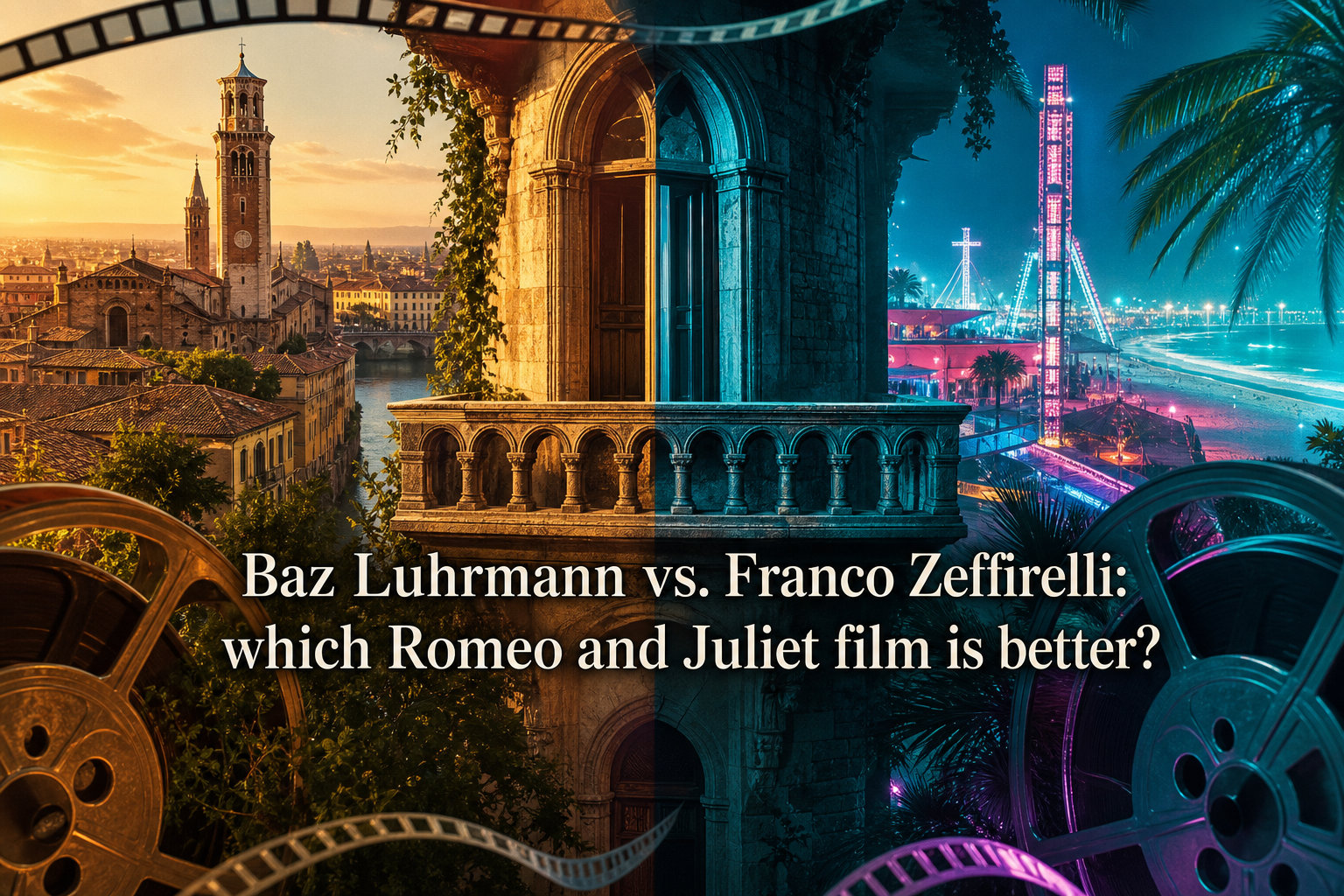
Shakespeare’s Romeo and Juliet has been adapted for the screen dozens of times, but two versions stand taller than the rest. Franco Zeffirelli’s 1968 classic and Baz Luhrmann’s 1996 reinvention split audiences down the middle in a debate that has only grown fiercer over the decades. One is a sun-drenched period piece that treats the text with reverence. The other is a neon-soaked fever dream that drags Verona into the MTV age.
If you have ever wondered which Romeo and Juliet film is actually better, you are not alone. Reddit threads, classroom debates, and film studies seminars revisit this question constantly. I have watched both films more times than I can count and spent hours poring over critical analyses, forum discussions, and behind-the-scenes material to bring you a definitive comparison.
The Baz Luhrmann vs Franco Zeffirelli Romeo and Juliet debate is not really about picking a winner. It is about understanding what each director set out to achieve and how well they delivered. Zeffirelli wanted you to feel like you were watching the play as Shakespeare’s original audience might have experienced it. Luhrmann wanted to make you feel the story’s emotional violence the way a teenager in the 1990s would feel it.
Both succeeded brilliantly. But they succeeded at very different things. In this breakdown, we will compare the two adaptations across cast, cinematography, fidelity to the text, music, key scenes, and cultural legacy. By the end, you will know exactly which version deserves your evening and why.
Table of Contents
Quick Verdict: Which Romeo and Juliet Film Is Better?
Here is the short answer: Zeffirelli’s 1968 film is the better Shakespeare adaptation, and Luhrmann’s 1996 film is the better cinematic experience. If you want the most faithful, emotionally grounded version of the play, watch Zeffirelli. If you want a visually explosive ride that captures the reckless energy of young love, watch Luhrmann.
Neither film is objectively superior. They have fundamentally different goals. Zeffirelli aimed for authenticity, casting actual teenagers and filming in Italian Renaissance locations. Luhrmann aimed for relevance, translating Shakespeare’s language into a hyper-kinetic modern world of guns, billboards, and pop music.
For students studying the play for the first time, Zeffirelli remains the gold standard. For viewers who want to feel why this story still matters to young people, Luhrmann delivers something Zeffirelli never could. The best answer is to watch both and decide for yourself.
Franco Zeffirelli’s Romeo and Juliet (1968): The Faithful Classic
Zeffirelli’s 1968 adaptation is widely regarded as the most faithful screen version of Romeo and Juliet ever made. Shot on location in Tuscany and Rome, it transports viewers directly into 15th-century Verona with painstaking period detail. Every costume, sword, and cobblestone feels authentic to the Renaissance era Shakespeare was writing about.
The casting was revolutionary for its time. Olivia Hussey was just 15 years old when she played Juliet, and Leonard Whiting was 17 as Romeo. Previous film versions had cast actors in their twenties or thirties. Zeffirelli’s decision to use actual teenagers gave the love story a raw vulnerability that adult actors simply could not fake. When Hussey’s Juliet defies her father, you see a real child pushing back against real authority.
Zeffirelli’s directorial vision was rooted in respect for the source material. He cut roughly half of Shakespeare’s text to fit a two-hour runtime, but he preserved the emotional arc and the most famous speeches intact. The original Elizabethan dialogue flows naturally from these young actors. You never feel like you are watching a museum piece. The language sounds alive and urgent.
The production values are extraordinary. Danilo Donati won an Academy Award for his costume design, and the film received three other Oscar nominations including Best Picture. Nino Rota’s orchestral score wraps the film in romantic melancholy, and the cinematography by Pasqualino De Santis captures the golden Italian light with painterly beauty. Every frame looks like a Renaissance fresco brought to life.
What makes Zeffirelli’s version endure is its emotional honesty. The balcony scene plays with genuine tenderness. The sword fights feel dangerous and messy. The final death scene in the candlelit tomb is devastating because you believe these are real children whose lives are being destroyed by adult stupidity. It is no wonder teachers have used this film in classrooms for over five decades.
Baz Luhrmann’s Romeo + Juliet (1996): The Bold Reinvention
Luhrmann’s 1996 film, officially titled William Shakespeare’s Romeo + Juliet, threw out every convention of period filmmaking. Instead of Renaissance Italy, we get Verona Beach, a fictional modern city where the Montagues and Capulets are rival business empires. Swords become guns branded with sword names. Horse-drawn carriages become convertibles and helicopters. The opening gas station shootout sets the tone immediately.
The casting was a cultural earthquake. Leonardo DiCaprio was 22 and on the cusp of global stardom when he played Romeo. Claire Danes, just 17, brought a quiet intelligence to Juliet that grounded the film’s chaos. Their chemistry is electric. The famous pool scene, where they first spot each other through a fish tank, remains one of the most iconic romantic moments in 1990s cinema.
Luhrmann’s approach was part of his self-described “Red Curtain Trilogy,” a style of filmmaking that prioritizes heightened emotion, theatrical exaggeration, and sensory overload. The editing is fast and aggressive, especially in the first act. Quick cuts, whip pans, and saturated colors bombard the viewer. Some critics found it exhausting. Others found it exhilarating. Either way, no one had ever seen Shakespeare filmed this way before.
The genius of Luhrmann’s concept is that he kept Shakespeare’s original dialogue. Characters speak in Elizabethan English while wielding handguns and watching television news. This juxtaposition could have been ridiculous, but it works because Luhrmann commits to it completely. The language takes on new life when spoken in a world of convertibles, Hawaiian shirts, and neon crosses.
The soundtrack became as famous as the film itself. Radiohead, Garbage, The Cardigans, and Des’ree contributed songs that captured the angsty, romantic mood of the story. The music was not background decoration. It was a character in its own right, translating Shakespeare’s poetry into a language 1990s teenagers already understood. The film grossed over $147 million worldwide and launched DiCaprio into the stratosphere.
Head-to-Head: Key Differences Between the Two Adaptations
Visual Style and Cinematography
The visual gap between these two films could not be wider. Zeffirelli’s camera moves with classical restraint, using wide shots to establish the Tuscan landscape and intimate close-ups to capture emotional truth. The lighting is natural and warm. The color palette is earthy and sun-baked. Every frame feels composed like a painting from the period.
Luhrmann’s camera never sits still. The opening sequence uses rapid-fire editing, freeze frames, and crashing zooms that feel like a music video on steroids. Colors are pushed to maximum saturation. Religious iconography collides with beach culture in every shot. Where Zeffirelli creates beauty through stillness, Luhrmann creates excitement through velocity.
Cast Performances and Chemistry
Hussey and Whiting bring an innocent, almost fragile chemistry to the 1968 film. They look like children discovering love for the first time, and that innocence makes the tragedy hit harder. Their performances are naturalistic and understated. You watch them fall in love quietly, through glances and whispered words.
DiCaprio and Danes bring fire and intensity to the 1996 film. Their connection is passionate and immediate, almost dangerously so. DiCaprio’s Romeo is a brooding romantic artist, while Danes’s Juliet is a sharp-witted young woman trapped by family expectations. Reports from the set suggest the two actors had genuine off-screen chemistry, though they were never romantically involved. That energy translates directly to the screen.
The supporting casts deserve mention too. Michael York’s Tybalt in Zeffirelli’s version is aristocratic and lethal. John Leguizamo’s Tybalt in Luhrmann’s version is a tattooed gangster with a Southern drawl. Both interpretations work within their respective worlds.
Fidelity to Shakespeare’s Text
Zeffirelli wins on fidelity by a wide margin. He cut the text substantially but preserved the structure, tone, and most of the famous passages. The balcony scene, the Queen Mab speech, and the final tomb scene follow the play closely. Characters behave and speak as Shakespeare intended. For anyone wanting to understand the play as written, this is the version to watch.
Luhrmann is more creatively liberal. He restructured scenes, added visual elements with no textual basis, and used setting to reinterpret meaning. ThePrince becomes a police chief. The apothecary becomes a drug dealer. The tomb scene takes place in a church surrounded by neon crosses and candles. Shakespeare’s words are mostly intact, but their context is radically transformed. This is adaptation as reinvention, not preservation.
Music, Score, and Atmosphere
Nino Rota’s score for the 1968 film is a masterpiece of classical film composition. Sweeping strings and gentle woodwinds create an atmosphere of romantic melancholy. The music supports the emotion without ever overwhelming it. When “A Time for Us” plays during the love scenes, it elevates the romance to operatic heights without feeling manipulative.
Luhrmann’s soundtrack is a curated mixtape of 1990s alternative and pop. Des’ree’s “Kissing You” plays during the fish tank scene and has become inseparable from that moment in cinema history. Radiohead’s “Talk Show Host” scores Romeo’s brooding. The music does not just accompany the film. For many viewers, the soundtrack was their gateway into the story itself. It made Shakespeare feel cool to a generation that had never connected with him before.
Mercutio: A Tale of Two Performances
No comparison of these films is complete without examining Mercutio, the character who steals every scene he is in. Most existing comparisons gloss over this, so let me give it the attention it deserves. Mercutio is the catalyst for the tragedy, and the two films handle him in radically different ways.
John McEnery’s Mercutio in Zeffirelli’s 1968 film is mercurial in the classical sense. He is witty, bitter, and dangerously intelligent. His Queen Mab speech starts as playful teasing and descends into something genuinely unsettling, as if Mercutio glimpses his own death in the fairy tales he spins. McEnery plays him as a man who uses humor as armor against a world he sees through too clearly. When he dies, cursing both houses, the moment is shocking because his vitality is so vivid up to that point.
Harold Perrineau’s Mercutio in Luhrmann’s 1996 film is a drag performer and a scene-stealer in every sense. Perrineau brings a theatrical, almost vengeful energy to the role. His Queen Mab speech becomes a drug-fueled rant at a party, delivered in glitter and a white sequined outfit. This Mercutio is queer-coded and glamorous, an outsider whose flamboyance masks deep pain. When he dies on the beach, shouting “a plague on both your houses” as a storm rolls in, it is one of the most powerful moments in the film.
Both performances are extraordinary, but they serve different purposes. McEnery’s Mercutio grounds the tragedy in psychological realism. Perrineau’s Mercutio explodes it into operatic spectacle. The debate over which Mercutio is better depends entirely on which version of the story you respond to more.
Scene-by-Scene Showdown: The Balcony Scene
The balcony scene is the most famous moment in the play, and both directors attack it differently. In Zeffirelli’s version, Romeo climbs a wall and finds Juliet on her balcony in a traditional setup. The scene plays with gentle humor and tender longing. The camera stays close on their faces, capturing every flicker of emotion. When they part, the physical distance between them feels heartbreaking because everything else in the scene has been so intimate.
Luhrmann throws out the balcony entirely. Instead, Romeo and Juliet meet again at a swimming pool, and their declarations of love happen while they are both partially submerged in water, whispering to avoid detection by guards and security cameras. The setting is intimate and surreal. The water creates a dreamlike quality that separates their love from the violent world surrounding them. The chemistry between DiCaprio and Danes in this scene is the beating heart of the entire film.
Zeffirelli’s balcony scene is more faithful to the text and more emotionally grounded. Luhrmann’s pool scene is more visually inventive and more passionately performed. Both are unforgettable, but they achieve their power through opposite methods.
Scene-by-Scene Showdown: The Death Scene
The final death scene is where both films reach their emotional peak, and the contrast between them reveals everything about each director’s philosophy. Zeffirelli stages the scene in a dark, candlelit tomb. The atmosphere is hushed and sacred. Romeo discovers what he believes is Juliet’s lifeless body, and the grief plays out in near silence. When Juliet wakes to find Romeo dead, Hussey’s scream is raw and primal. The restraint of the staging makes the emotion hit like a sledgehammer.
Luhrmann transforms the tomb into a church filled with hundreds of candles, neon crosses, and blue light. Sirens wail in the distance. Romeo takes poison just moments before Juliet’s hand twitches with returning life. Luhrmann adds a twist here that exists in no version of the play: Juliet reaches for Romeo as he realizes his mistake. Their fingertips almost touch before he dies. This single invented moment makes the tragedy almost unbearably cruel. Danes’s decision to use Romeo’s gun rather than his dagger for her own death is another modern touch that hits with brutal force.
Zeffirelli’s death scene earns its tears through quiet devastation. Luhrmann’s death scene earns its tears through operatic excess. Both work, but they will destroy you in different ways.
Critical Reception and Legacy
Zeffirelli’s 1968 film was a commercial and critical triumph. It earned over $38 million at the box office on a budget of roughly $850,000, making it one of the most profitable Shakespeare films ever made. It received four Academy Award nominations and won for Best Cinematography and Best Costume Design. Critics praised its fidelity, its casting, and its emotional power. Roger Ebert called it “a fine new film version” that captures the play’s essence. Over five decades later, it remains the version most frequently shown in schools.
Luhrmann’s 1996 film faced a more divided initial reception. Some critics dismissed it as style over substance. The Chicago Reader called it “a noisy, ugly mess.” But others recognized its ambition and power. It grossed over $147 million worldwide, proving that audiences connected with it even when critics wavered. Over time, critical opinion has shifted strongly in Luhrmann’s favor. The film is now studied in film courses as a masterclass in adaptation theory. Its visual language has influenced countless directors. The soundtrack went triple platinum.
Both films have left permanent marks on popular culture. Zeffirelli’s film is the version most people picture when they think of Romeo and Juliet. Luhrmann’s film is the version most younger viewers actually watch. The fact that both have endured for decades speaks to the strength of their respective visions.
Which Version Should You Watch First?
This is the question no existing comparison answers clearly, so here is a straightforward guide. Your first Romeo and Juliet film should depend on who you are and what you want from the experience.
If you are a student studying the play, watch Zeffirelli’s 1968 version first. It will give you the clearest understanding of the story, the characters, and the language as Shakespeare intended. You will see the setting, hear the dialogue in its proper context, and understand the plot beats without distraction. Once you know the play, you can appreciate what Luhrmann is doing with it.
If you are a film lover who has never connected with Shakespeare, watch Luhrmann’s 1996 version first. It will show you why this story still has power. The modern setting, the music, the visual energy, and DiCaprio’s star power make it accessible in a way no period piece can match. You might find yourself surprised by how much a 400-year-old play can move you.
If you are a Shakespeare purist, you may never fully accept Luhrmann’s version, but it is worth watching to understand how adaptation works at its most creative. If you are a teacher, Zeffirelli is your safest classroom choice, though showing clips from Luhrmann can spark powerful discussions about interpretation.
The ideal experience is watching both. Start with whichever fits your situation from the guide above, then watch the other. Seeing both films illuminates the play from two completely different angles and deepens your appreciation for Shakespeare’s genius in ways that watching either alone cannot.
FAQs
What are the main differences between the 1968 and 1996 Romeo and Juliet?
The 1968 Zeffirelli film is set in Renaissance Italy with period costumes, swords, and a classical orchestral score. The 1996 Luhrmann film is set in a fictional modern city called Verona Beach, with guns replacing swords, contemporary pop music, and MTV-style editing. Zeffirelli prioritizes fidelity to Shakespeare’s text, while Luhrmann reinvents the story’s visual world while keeping the original dialogue.
Which version of Romeo and Juliet is the most accurate?
Franco Zeffirelli’s 1968 film is widely considered the most faithful screen adaptation. It was shot on location in Italy, cast age-appropriate teenage actors, and preserves Shakespeare’s original dialogue in its proper historical context. While Zeffirelli cut roughly half the text for runtime, the remaining scenes follow the play’s structure and tone closely.
Why is the 1968 Romeo and Juliet considered the best?
The 1968 version is praised for casting actual teenagers as Romeo and Juliet, giving the love story an authenticity that adult actors cannot replicate. Its Renaissance settings, Nino Rota’s score, and Academy Award-winning costume design create a visually stunning and emotionally grounded experience. It remains the version most commonly used in classrooms worldwide.
Did Leonardo DiCaprio and Claire Danes get along on set?
Yes, Leonardo DiCaprio and Claire Danes developed a strong working relationship during filming. Reports from the production indicate they had genuine on-set chemistry, though they were never romantically involved. Both actors have spoken positively about each other in interviews, and their connection is widely credited as a key reason the 1996 film’s romance feels so convincing.
Which Romeo and Juliet film is better for students?
Zeffirelli’s 1968 version is better for students studying the play for the first time because it stays closest to Shakespeare’s original text, setting, and characterizations. It helps students understand the story as written before exploring creative reinterpretations. Luhrmann’s 1996 version can be a valuable supplement for discussing adaptation, but Zeffirelli is the stronger primary teaching tool.
Conclusion: Two Masterpieces, One Story
The Baz Luhrmann vs Franco Zeffirelli Romeo and Juliet debate does not have a single correct answer because these films are not trying to do the same thing. Zeffirelli gave us the definitive Shakespeare adaptation, faithful to the text, grounded in history, and emotionally devastating through restraint. Luhrmann gave us the definitive reinvention, faithful to the spirit, explosive in style, and emotionally devastating through excess.
Both films are essential viewing for anyone who cares about Shakespeare, cinema, or the art of storytelling. They represent two valid and brilliant approaches to the same material. Choosing between them says as much about you as it does about the films.
My recommendation is simple. Watch Zeffirelli to understand the play. Watch Luhrmann to feel it. Then watch both again and appreciate how two directors with opposite philosophies created two films that will outlast all of us.