
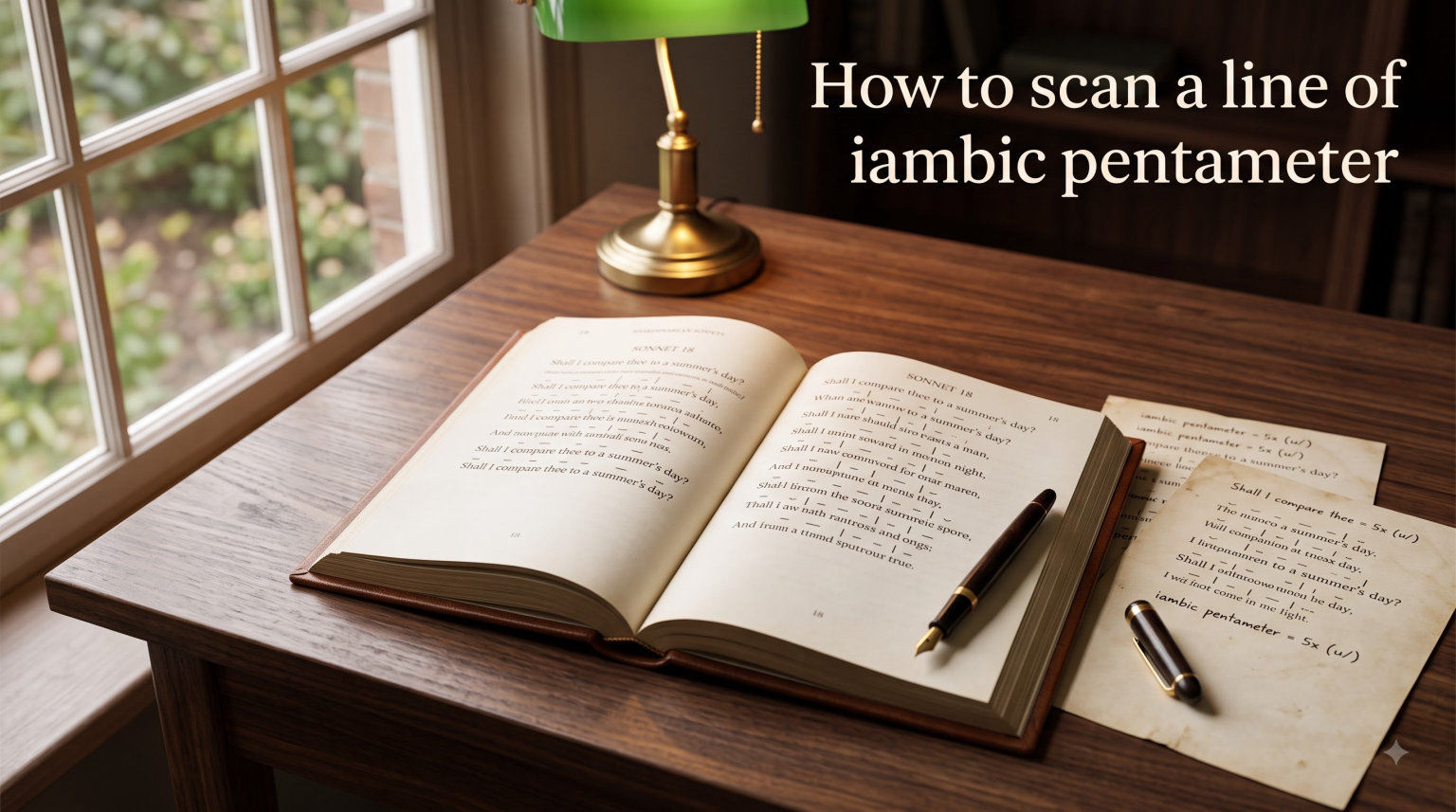
If you’ve ever opened a Shakespeare play and felt the rhythm thump beneath the words, you’ve felt iambic pentameter. It’s the heartbeat of English poetry. But turning that feeling into a marked-up line on the page? That’s called scansion, and it’s the skill that unlocks every sonnet, soliloquy, and stanza from the Elizabethan age to today.
In this guide, I’ll walk you through exactly how to scan a line of iambic pentameter using the same six-step process I teach in workshops. We’ll cover the symbols, the rules, a real Shakespeare example broken down word by word, and the common mistakes that trip up even confident students. By the end, you’ll be able to scan any line on your own.
Table of Contents
What is iambic pentameter and how do you identify it?
Iambic pentameter is a type of poetic meter built from five iambic feet per line, giving each line ten syllables arranged in an unstressed-stressed pattern. The classic way to hear it is da-DUM: a soft syllable followed by a loud one, repeated five times across the line.
That’s the whole definition in two sentences. Everything else is detail. The word “iambic” describes the foot (da-DUM). “Pentameter” tells you there are five of those feet (penta = five) per line. Put them together and you get ten syllables in a heartbeat rhythm.
Here’s the stress pattern in plain notation:
da-DUM da-DUM da-DUM da-DUM da-DUM
If a line reads smoothly when you speak it aloud and your ten syllables land in that alternating pattern, you’ve found iambic pentameter. Shakespeare wrote almost all of his plays in it. So did Spenser, Donne, and most of the canonical English poets through the 19th century.
Understanding poetic feet: the iamb
A poetic foot is the smallest repeating rhythm unit in a line of verse. The iamb is just two syllables: an unstressed one followed by a stressed one. That single pairing is the engine of iambic pentameter.
Other common feet you may run into:
Trochee (DUM-da) — a stressed syllable followed by an unstressed one. Think “garden” or “wonder.”
Anapest (da-da-DUM) — two unstressed syllables then a stressed one. Think “undertake.”
Dactyl (DUM-da-da) — a stressed syllable followed by two unstressed ones. Think “happily.”
For our purposes, focus on the iamb. When you scan a line, you’re checking whether those five two-syllable iambs fit naturally into the word flow.
Scansion notation: the symbols you need to know
Scansion uses three basic marks above your line of poetry. Print this reference card and keep it next to you while you practice:
/ (forward slash, or macron —) = stressed syllable
\ (back slash, or breve Ϯ) = unstressed syllable
x or no mark = a syllable you can’t determine, or that can go either way
You can stack these symbols into small feet to show the rhythm visually:
iamb: \ /
trochee: / \
anapest: \ \ /
dactyl: / \ \
A perfectly iambic line looks like five little pairs: \ / \ / \ / \ / \ /. Real Shakespeare lines often substitute one foot or add an unstressed extra syllable at the end. We’ll cover that next.
How to scan a line of iambic pentameter: 6 steps
This is the core method. Grab a pencil, find a sample line, and follow along.
Step 1: Write the line out clearly
Start by copying the line onto your paper with each word on its own line, leaving space above each word for scansion marks. Spacing makes the next five steps much easier.
Step 2: Count the syllables
Say the line out loud, slowly, and tap each syllable on your finger or the desk. A true iambic pentameter line has ten syllables. If you count eleven, the line may have a feminine ending (we’ll cover that in a moment). If you count nine, it’s likely trochaic or anapestic instead.
Step 3: Mark each syllable as stressed or unstressed
Now go back through and write a / over the stressed syllables and a \ over the unstressed ones. To find stress, listen for which syllable you’d naturally emphasize when speaking the word in isolation. Two-syllable words like “above,” “return,” and “today” put the stress on the second syllable. Words like “wonder,” “beauty,” and “apple” stress the first.
Step 4: Group the syllables into feet
Draw a small bracket underneath each pair of syllables to mark the foot boundaries. In a clean iambic line, you’ll have five pairs. In a real Shakespeare line, one foot may be inverted (a trochee, DUM-da), and the rest will still be iambs.
Step 5: Identify any substitutions or variations
Look for the typical Shakespearean variations: a trochaic substitution in the first foot (which gives a sense of energy and surprise), a feminine ending (an extra unstressed syllable at the end), or a pyrrhic substitution (two unstressed syllables in a row). Don’t panic if the pattern breaks in one place. Shakespeare breaks it on purpose.
Step 6: Compare your scansion to the rhythm of the spoken line
Read the line aloud again. Does your marked stress pattern match how you’d actually say it? If your marks feel “off” against the spoken rhythm, trust the speaking voice. That’s the strongest check you have.
A Shakespeare line scanned line by line
Let’s put the method to work. Take this famous line from Hamlet:
“To be, or not to be, that is the question.”
First, count syllables: to (1) be (2) or (3) not (4) to (5) be (6) that (7) is (8) the (9) ques–tion (10-11). Eleven syllables. That’s a feminine ending.
Now mark stress:
\ / \ / \ / \ / \ / \ / \
Mapping it word by word:
to (\) BE (/) — iamb
or (\) NOT (/) — iamb
to (\) BE (/) — iamb
that (\) IS (/) — iamb
the (\) QUES (/) — iamb
tion (\) — extra unstressed syllable, the feminine ending
Five iambic feet plus an extra unstressed syllable at the close. That’s textbook Shakespearean iambic pentameter with a feminine ending, and it gives the line its thoughtful, trailing-off feel before the next line begins.
Feminine endings and other variations
A feminine ending is an extra unstressed syllable tacked onto the end of an iambic pentameter line. It pushes the line to eleven syllables. Shakespeare used feminine endings to give a sense of continuation or breathlessness, especially in soliloquies where the speaker’s thoughts spill past the line break.
Other variations you may meet:
Masculine ending: the standard ten-syllable line ending on a stressed syllable.
Trochaic substitution: the first foot inverted to / \ (DUM-da). This often appears in the first foot of iambic lines to add weight to an opening word.
Pyrrhic foot: two unstressed syllables in a row, usually before an extra-strong stressed syllable.
Spondee: two stressed syllables in a row (DUM-DUM). Rare in English iambic pentameter, but it shows up for emphasis.
If you find a line that scans oddly, check whether it’s a feminine ending first. Half of the “wrong syllable counts” students report are really just that one extra unstressed tail.
Common mistakes students make when scanning
After teaching this for years, I’ve seen the same handful of mistakes trip people up. Avoid these and you’ll scan faster than you expect.
Forgetting to read aloud. Your ear catches stress patterns your eyes miss. Always read the line out loud at least twice before marking anything.
Treating every line as perfectly regular. Shakespeare breaks the pattern on purpose. One variant per line is normal. Two is still possible. Three means it’s probably a different meter.
Ignoring context. Some words change stress depending on how they’re used. “Record” is NOUN-cen-tral stress on the first syllable, but re-CORD the verb stress on the second. The sentence decides which pronunciation wins.
Counting multi-syllable words wrong. Slow down on words like “responsibility” (six syllables) and “inevitably” (five syllables). Get these right and your line count falls into place.
Refusing to scan backwards. If the start of the line is confusing, try scanning from the end. Stress patterns often reveal themselves when you approach from the strongest beats first.
Practice: try scanning these three lines yourself
Take a pencil and try each one. Don’t peek at the answers until you’ve worked through it on your own.
“Shall I compare thee to a summer’s day?” (Shakespeare, Sonnet 18)
“But, soft! what light through yonder window breaks?” (Shakespeare, Romeo and Juliet)
“The quality of mercy is not strained.” (Shakespeare, The Merchant of Venice)
For each, count the syllables, mark stressed and unstressed, and group into five feet. Check whether the line ends on a stressed or unstressed syllable. If you get stuck, scan backwards from the last foot first.
When you’ve finished, read each line aloud. Your marked scansion should match the natural speaking rhythm. If it doesn’t, your stress marks need adjusting.
FAQs
How do I know if my line is actually iambic pentameter?
Count the syllables first. If you have ten syllables and the stress falls in a da-DUM pattern across all five pairs, it’s iambic pentameter. Eleven syllables with an unstressed ending means you have a feminine ending, which is still iambic pentameter. Read the line aloud and trust your ear if your marks feel off.
How can I tell stressed from unstressed syllables?
Say the word in isolation and listen for which syllable feels louder and longer. In a sentence, content words (nouns, verbs, adjectives) usually take stress, while function words (the, of, and, to) usually stay unstressed. Multi-syllable words often have one clear stressed syllable. When in doubt, read the line aloud and tap the rhythm.
What are the scansion symbols for iambic pentameter?
The standard symbols are / for stressed syllables (sometimes written with a macron mark) and u005c for unstressed syllables (sometimes a breve). An iamb is the pair u005c /. A perfectly regular iambic pentameter line scans as u005c / u005c / u005c / u005c / u005c / u005c /. An x or no mark indicates a syllable that could go either way.
Can a word be stressed differently depending on context?
Yes. Many English words shift stress based on their part of speech. ‘Record’ as a noun stresses the first syllable (RE-cord); as a verb it stresses the second (re-CORD). ‘Contest,’ ‘present,’ ‘conduct,’ and ‘desert’ follow the same pattern. Always let the sentence decide which pronunciation is correct before you mark stress.
What is a feminine ending in iambic pentameter?
A feminine ending is an eleventh unstressed syllable added at the end of an otherwise normal iambic pentameter line. It pushes the line to eleven syllables and gives a sense of trailing off or continuation across the line break. Shakespeare used feminine endings frequently in his plays, especially in soliloquies.
What if my scansion doesn’t match the spoken rhythm?
Trust the spoken rhythm. Scansion is a tool, not a rule. If your marks conflict with how you’d naturally read the line, the marks are wrong. This often happens when you forget to account for context-dependent stress, miscount syllables in a long word, or try to force a line into perfect regularity when Shakespeare intentionally varied it.
Final thoughts
Knowing how to scan a line of iambic pentameter is one of those skills that keeps rewarding you. Once you can mark stress patterns, Shakespeare’s puns land harder, his jokes hit differently, and the music under his words becomes audible rather than mysterious. You’ll also start hearing the meter underneath modern songs, political speeches, and even movie dialogue. The rhythm is everywhere once you tune in.
Take the six steps from this guide, run them on the three practice lines, and don’t worry about getting every variant right on your first pass. Scansion is partly subjective. Honest readers sometimes disagree on which syllable carries the weight in a tricky line, and that’s fine. The goal is to feel the da-DUM, mark what you hear, and trust the line to teach you what it wants. That’s the whole art of scanning.
Updated for 2026 by the Byme Williamshakespeare team.