
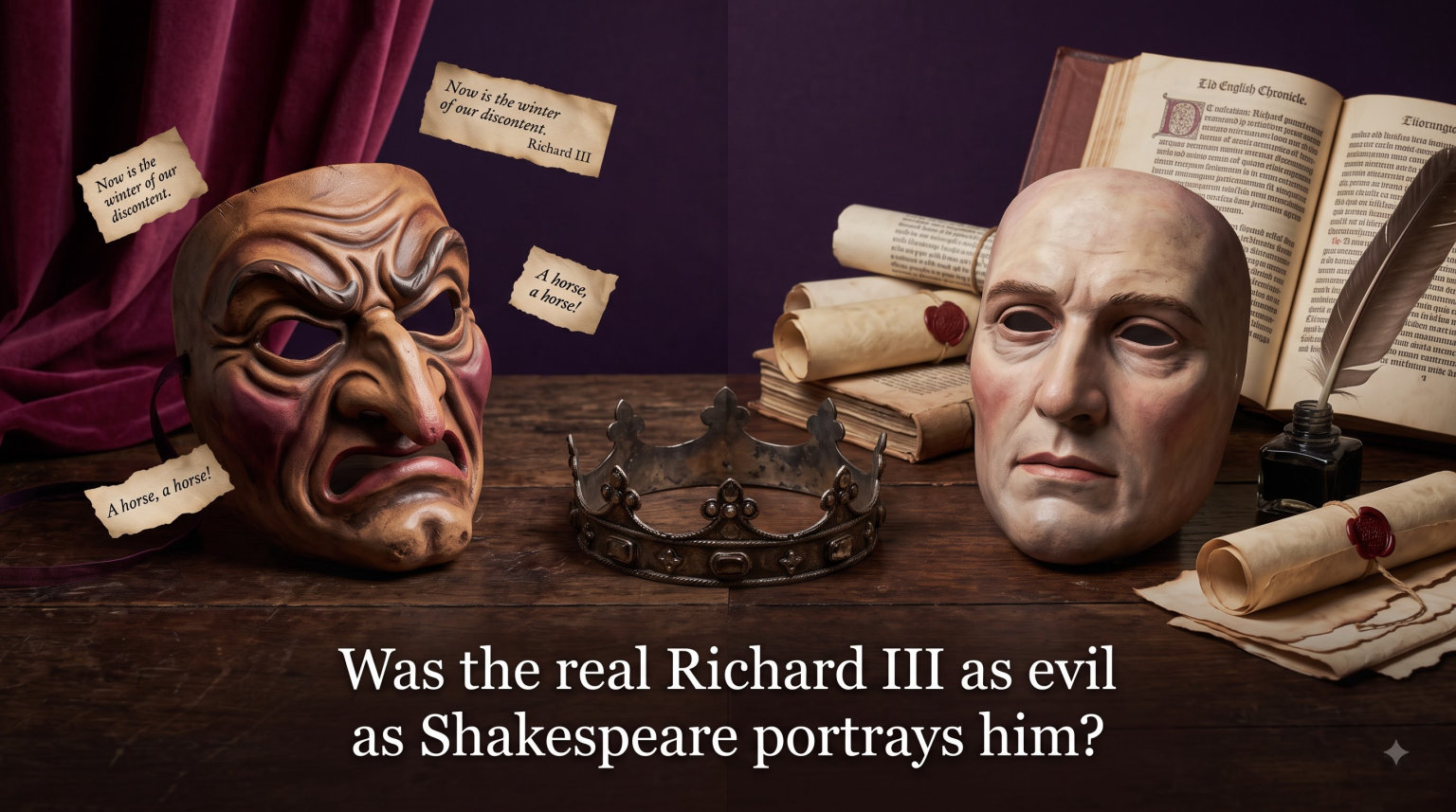
Richard III opens with one of the most famous soliloquies in all of English literature: “Now is the winter of our discontent.” In Shakespeare’s hands, the last Plantagenet king is a snarling, limping, scheming monster who murders his way to the throne and charms the audience while doing it.
But was the real Richard III as evil as Shakespeare portrays him? That question has fascinated historians, readers, and playgoers for over four hundred years. The short answer is no — but the full story is far more interesting than a simple yes or no.
Let me walk you through what Shakespeare invented, what Tudor politics demanded, and what modern archaeology finally revealed about a king who has been buried under layers of propaganda since 1485.
Table of Contents
Shakespeare’s Richard III: Literature’s Most Magnetic Villain
Shakespeare wrote Richard III around 1592, near the start of his career, and it remains one of the most performed history plays ever written. In it, Richard is a man who announces in the opening scene that he is “determined to prove a villain” — and then delivers on every promise. He orchestrates the deaths of his brother Clarence, his nephews the Princes in the Tower, his wife Anne, and anyone else standing between him and the crown.
What makes the portrayal so powerful is not the body count but the character’s direct relationship with the audience. Richard turns to us and confides his schemes, making us complicit in the plotting. He jokes about murder. He woos a grieving widow over her father-in-law’s coffin. This is dramatic genius, not historical record.
Academics frequently point out that the play functions as a tragedy of an overreacher — a Macbeth figure — rather than a documentary about a medieval king. Shakespeare was doing his job: entertaining an audience under a queen whose grandfather had overthrown the man on stage.
Shakespeare’s sources were Tudor chronicles written decades after Richard’s death, when it was politically convenient to paint him as a monster. The playwright took those sources and turned them into poetry so electrifying that nobody much cared whether they were true.
Was Richard III Really a Hunchback? The Physical Deformity Myth
“Deformed, unfinished, sent before my time into this breathing world, scarce half made up.” Shakespeare’s Richard describes himself as a misshapen creature, and for centuries audiences pictured a grotesque hunchback dragging a withered arm behind him.
Here is what the historical record and physical evidence actually show.
Richard III did have scoliosis — a sideways curvature of the spine. We know this for certain because his skeleton was found beneath a Leicester car park in 2012, and the spine tells the story plainly. The curvature would have made his right shoulder sit higher than his left. Contemporary accounts do describe one shoulder being raised, so there was a grain of truth beneath the exaggeration.
But scoliosis is not a hunchback. It would not have prevented him from riding into battle, wearing armour, or leading armies — all of which he demonstrably did. There is zero evidence for the withered arm, the dragging limp, or the full-body grotesquerie Shakespeare describes. Those details were dramatic inventions, drawing on a medieval belief that a twisted body revealed a twisted soul.
The Princes in the Tower: What We Actually Know
The single darkest charge against Richard III is the murder of his nephews, the Princes in the Tower. After Edward IV’s death in 1483, his sons — twelve-year-old Edward V and his younger brother Richard of Shrewsbury — were lodged in the Tower of London. They were never seen in public again after the summer of that year.
Richard had declared them illegitimate and taken the crown himself, so he had the clearest motive. He is the prime suspect, and most historians still lean toward his involvement or that of men acting on his orders. Shakespeare presents the murders as established fact, choreographed by a cackling uncle who hires a hitman and washes his hands of the details.
But here is the crucial point: there is no contemporary confession, no body found at the time, and no surviving evidence pinning the crime on Richard specifically. Other suspects exist. The Duke of Buckingham, who rebelled against Richard that same autumn, had access to the Tower. Henry Tudor — the man who overthrew Richard at Bosworth — never produced the boys alive to legitimise his own claim, which is deeply suspicious.
The historical record, unlike the play, presents an unsolved mystery rather than a closed case. Richard remains the likeliest culprit, but certainty is something neither Shakespeare nor modern historians can honestly supply.
Why Did Shakespeare Portray Richard III as Evil? Tudor Propaganda
To understand Shakespeare’s Richard III, you have to understand who was paying the bills. Shakespeare wrote under Queen Elizabeth I, granddaughter of Henry Tudor — the man who defeated and killed Richard III at the Battle of Bosworth in 1485 and founded the Tudor dynasty.
Henry VII’s claim to the throne was thin, built on a distant bloodline and won by force. He needed to justify that conquest by demonising the man he replaced. So the Tudor propaganda machine went to work. Sir Thomas More wrote a History of King Richard III that painted him as a deformed, scheming tyrant. The chroniclers Edward Hall and Raphael Holinshed drew on More and amplified the tale. Shakespeare, writing nearly a century later, simply dramatised what had already become the official Tudor version of history.
This was not unique to Richard. Medieval kings were routinely rewritten by their successors, and history was always written by the winners. But the difference here is that Shakespeare’s version was so theatrically brilliant that it survived long after the Tudors were gone. The propaganda became the myth, and the myth became what most people believe even now.
So why did Shakespeare not like Richard III? It was less personal dislike than professional necessity. His patron and his queen were Tudors, and vilifying the last Plantagenet king was both safe and lucrative. A playwright who wrote a sympathetic Richard would not have kept his commission for long.
The Real King Richard III: A Medieval Ruler, Not a Monster
Strip away the play and the propaganda, and what kind of king was Richard? The historical record paints a far more complicated figure: a capable administrator, a loyal brother for most of his life, and a man trusted enough by the citizens of York that they recorded his death at Bosworth with genuine grief.
Richard spent years governing the north of England on behalf of his brother Edward IV and earned a reputation for fairness and effective justice. As king, he introduced legal reforms aimed at protecting ordinary subjects from corrupt officials, including measures to ensure fair trials and the wider availability of bail. His parliament of 1484 passed statutes that historians describe as some of the most progressive of the entire fifteenth century.
He was no saint. He seized the throne in a coup, and he operated within the brutal logic of late medieval power politics, where nearly every nobleman had blood on his hands. But to collapse a real, flawed human being into a stage device is to trade understanding for spectacle.
The 2012 Discovery That Changed Everything
In September 2012, archaeologists excavating a council car park in Leicester found a skeleton buried in a hastily dug grave. The spine was curved with scoliosis. The skull bore the marks of battlefield trauma — several wounds to the head, consistent with being hacked down in the press of fighting at Bosworth. DNA testing later confirmed it beyond reasonable doubt: this was Richard III.
The discovery was a turning point in the long argument between Shakespeare’s Richard and the real one. For the first time in over five centuries, the physical reality of the man could be examined rather than merely imagined. The skeleton confirmed the scoliosis that had fuelled the deformity myths, but it also confirmed that those myths had been wildly exaggerated. Here was a man who had fought and died in armour, not slunk through palaces dragging a useless limb.
The Leicester skeleton did not prove Richard innocent or guilty of any specific crime. What it did was remind us that behind Shakespeare’s masterpiece lay a real person — buried, forgotten for centuries, and finally allowed to speak for himself through bone rather than ink.
So, Was the Real Richard III as Evil as Shakespeare Portrays Him?
No. The real Richard III was a medieval politician in a violent age — ambitious, ruthless when necessary, and certainly no innocent. He may well have been responsible for the deaths of his nephews, and that accusation alone is damning enough. But he was not the deformed, cackling, mass-murdering caricature of Shakespeare’s stage.
Shakespeare gave us one of literature’s greatest villains. He did not give us history, and he never intended to. The genius of the play is inseparable from its propaganda. Once you accept that, you can revel in the poetry and still ask the harder question: who was the man beneath the myth? Thanks to modern scholarship and a Leicester car park, we are closer to answering that in 2026 than at any point since 1485.
FAQs
Why did Shakespeare not like Richard III?
Shakespeare was writing under Queen Elizabeth I, whose grandfather Henry Tudor had defeated and killed Richard III at the Battle of Bosworth in 1485. Portraying Richard as a villain justified the Tudor dynasty’s claim to the throne, so Shakespeare drew on Tudor-friendly chronicles by Thomas More, Edward Hall, and Raphael Holinshed that had already spent decades demonising the deposed king.
How accurate was Shakespeare’s interpretation of Richard III?
Not very. Shakespeare’s Richard III is a theatrical villain built from Tudor propaganda rather than a historical portrait. His main sources were written decades after Richard’s death by writers with strong political motives, and the 2012 discovery of the king’s skeleton in Leicester disproved key claims such as the severe hunchback and the withered arm.
What disability did Richard the Third have?
Richard III had idiopathic scoliosis, a sideways curvature of the spine that likely developed in adolescence. It would have raised his right shoulder slightly higher than his left, but it did not cause a severe hunchback, a dragging limp, or a withered arm. His skeleton, discovered under a Leicester car park in 2012, confirmed the scoliosis and disproved the more dramatic deformities Shakespeare invented.
Was Richard III faithful to his wife?
There is no credible historical evidence that Richard III was unfaithful to his wife, Anne Neville, whom he married in 1472. They had one son, Edward of Middleham, who died in childhood. Unlike many noblemen of his era, Richard has no recorded mistresses or acknowledged illegitimate children — a detail that sits awkwardly alongside his reputation as a remorseless villain.