
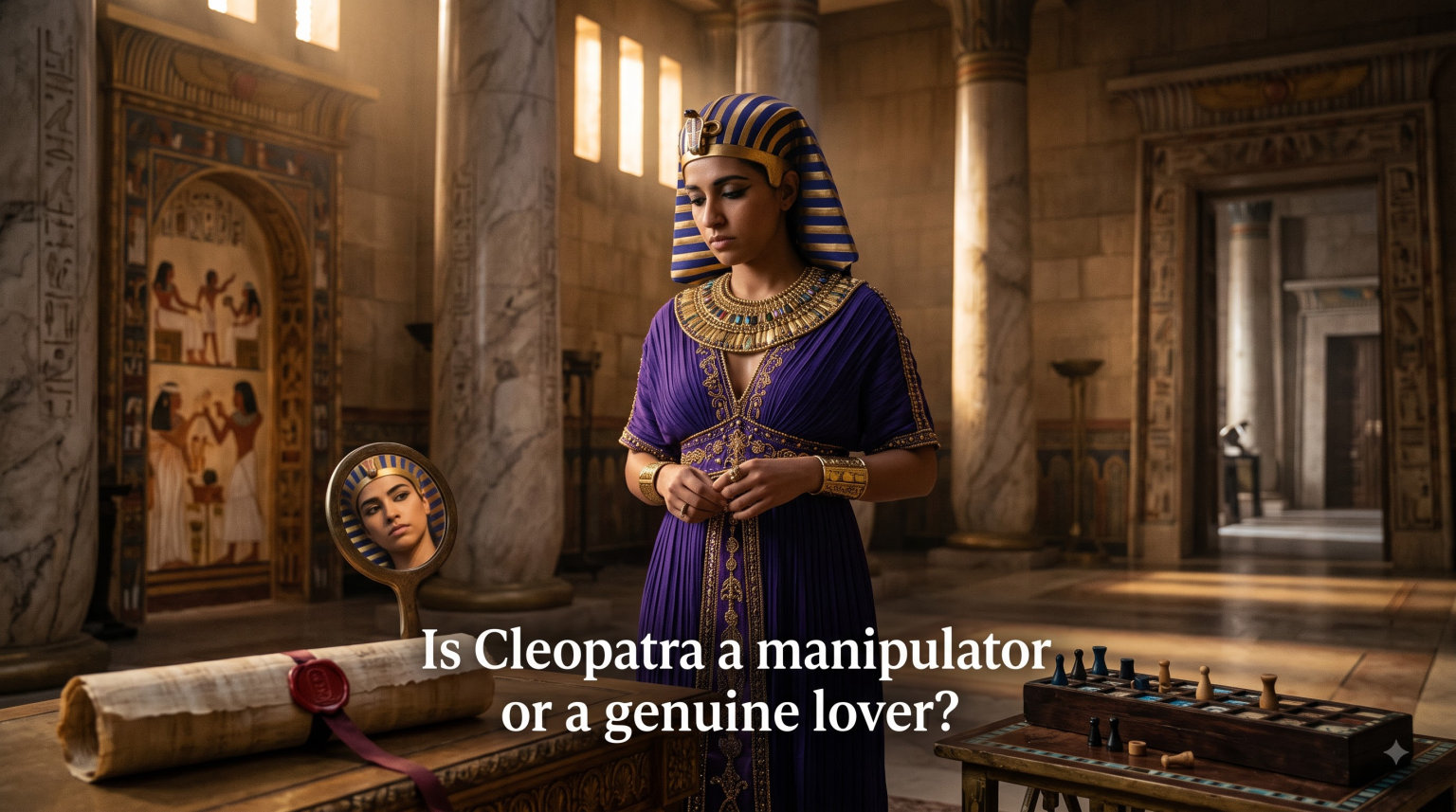
Cleopatra VII Philopator, the last active pharaoh of Ptolemaic Egypt, died more than two thousand years ago. Yet we still cannot agree on who she really was. Was Cleopatra a manipulator or a genuine lover? That single question has divided historians, poets, and readers for centuries.
I have spent months studying the ancient sources, modern scholarship, and forum debates surrounding this debate. What I have found is that the answer resists easy classification. The woman history remembers as a seductress was also a queen fighting for her kingdom’s very survival.
The problem begins with who told her story. Nearly every surviving account of Cleopatra was written by Romans, the people who conquered her. Octavian, who became Emperor Augustus, systematically portrayed Cleopatra as a foreign temptress who corrupted noble Roman men. This propaganda campaign shaped how the world sees her to this day.
Shakespeare himself drew on these Roman sources when writing Antony and Cleopatra in the early 1600s. His Cleopatra is brilliant, passionate, and larger than life. But even Shakespeare worked from a Roman-tinted version of events that had already been distorted by centuries of bias.
Even in 2026, historians continue to revisit this question with fresh eyes and newly analyzed evidence. In this guide, I will separate political calculation from genuine emotion by examining both of Cleopatra’s major relationships with Roman leaders. We will look at the evidence from multiple angles and weigh what the ancient sources actually say versus what later generations imagined.
The question of whether Cleopatra was a manipulator or a genuine lover demands that we look at the full picture, not just the version handed down by her enemies.
Table of Contents
Cleopatra’s World: Egypt on the Brink
To understand Cleopatra’s choices, we first need to understand the world she inherited. She was born around 69 BCE into the Ptolemaic dynasty, a Macedonian Greek family that had ruled Egypt since the death of Alexander the Great.
Her father, Ptolemy XII, had bankrupted the kingdom through mismanagement and lavish spending. He was briefly ousted from power and only regained his throne by paying enormous bribes to Roman politicians. Cleopatra watched her father grovel before Rome, and she learned from the experience.
Egypt was wealthy but politically vulnerable. Its grain supply fed much of the Mediterranean world, making it a tempting target for Rome’s expanding empire. By the time Cleopatra took the throne in 51 BCE alongside her younger brother Ptolemy XIII, Rome had already absorbed nearly the entire Hellenistic world.
Egypt was one of the last independent kingdoms standing. And it was barely holding on.
Cleopatra inherited a kingdom with enormous resources but a fragile political position. Her co-ruler Ptolemy XIII was only about ten years old, and his advisors quickly pushed Cleopatra aside and seized control of the government for themselves.
By 48 BCE, Cleopatra had been driven out of Alexandria entirely. She was in exile, raising a mercenary army, and fighting a civil war to reclaim her throne when Julius Caesar arrived in Egypt pursuing his rival Pompey the Great. This is where the famous story begins.
The key point is this: Cleopatra had no powerful allies left. Her own family had a long history of fratricide and court intrigue. She had already watched her father lose Cyprus to Rome. Every Ptolemaic ruler before her had been forced to deal with Rome’s growing power, and every one of them had eventually bowed to Roman demands.
When we ask whether Cleopatra was a manipulator or a genuine lover, we have to remember that she was operating under existential pressure. Egypt’s survival depended on securing a powerful Roman ally. Without one, her kingdom would be annexed, and her dynasty would end with her.
The Ptolemaic court also operated under cultural norms very different from those of Rome. Royal incest, sibling marriages, and court intrigue were standard practice among the Ptolemies. Cleopatra married both of her younger brothers, as was customary, though these marriages were political arrangements rather than romantic partnerships.
Forum discussions on Reddit communities like r/AskHistorians frequently highlight how little context most people have about Egypt’s vulnerability. Many assume Cleopatra was simply a powerful queen who chose to meddle in Roman politics for personal gain. In reality, she was a leader whose kingdom was living on borrowed time.
Every relationship she entered carried enormous political weight. Love and survival were deeply intertwined in Cleopatra’s world, and separating them is one of the hardest challenges in all of ancient history.
Caesar and Cleopatra: Seduction or Survival?
The relationship between Cleopatra and Julius Caesar began in 48 BCE under extraordinary circumstances. Caesar had arrived in Egypt with a modest military force, and Cleopatra desperately needed his help to reclaim her throne from her brother Ptolemy XIII.
The famous story, told by the Greek historian Plutarch, says Cleopatra had herself smuggled into Caesar’s private quarters rolled inside a carpet or bedsack. Whether this dramatic detail is literally true or later embellished, it captures something real about Cleopatra’s character. She was bold, resourceful, and willing to take enormous personal risks.
Caesar was 52 years old at the time. Cleopatra was about 21. The age gap of more than three decades is worth noting, as many forum users on r/AskHistorians have pointed out in discussions about power dynamics in the ancient world. This was not a relationship between equals in age or life experience.
Yet Cleopatra was already an experienced political leader who had ruled Egypt for three years before her exile. She was no naive young woman. She knew exactly what she was doing when she approached Caesar.
And something genuine seems to have developed between them. Caesar stayed in Egypt for months, far longer than his military objectives required. He and Cleopatra took a pleasure cruise down the Nile together, a trip that served no obvious political purpose and seemed designed purely for enjoyment.
During that Nile voyage, Caesar wrote about Egypt’s geography and culture with genuine fascination. He was clearly captivated by more than just Cleopatra’s political value.
Cleopatra gave birth to Caesar’s son, Ptolemy Caesar, nicknamed Caesarion or “Little Caesar,” in 47 BCE. Caesar acknowledged the child publicly, which was highly unusual for a married Roman patrician. He even had a golden statue of Caesarion placed in the Temple of Venus Genetrix in Rome, his own ancestral temple.
These are not the actions of a purely transactional relationship. If Cleopatra were simply manipulating Caesar, she would not have needed such visible signs of his affection to secure her position. And if Caesar were purely strategic, he would not have risked his reputation by publicly acknowledging an Egyptian child as his own.
However, we cannot ignore the political dimensions. Caesar restored Cleopatra to the throne, installed a Roman garrison in Alexandria, and secured Egypt’s loyalty to Rome. He desperately needed Egyptian grain and wealth to fund his ongoing civil wars back home.
Cleopatra needed Roman military backing to hold power against her many rivals within Egypt and across the Mediterranean. Their alliance served both their interests perfectly, and neither side pretended otherwise.
She visited Caesar in Rome from 46 to 44 BCE, staying at his villa across the Tiber River. Her presence in the capital caused enormous scandal among the Roman aristocracy. Many senators saw her as a dangerous foreign influence on Caesar’s decision-making.
Some ancient writers suggest Cleopatra believed Caesar would divorce his wife Calpurnia and marry her, making Caesarion his official Roman heir. Forum users on Reddit note that Cleopatra was reportedly willing to be submissive to Caesar, hoping for an official Roman marriage that would legitimize both her and her son.
If true, this suggests genuine emotional investment rather than pure calculation. A pure manipulator would have kept her feelings guarded and her options open.
Caesar’s assassination on the Ides of March in 44 BCE ended whatever future they might have built together. Cleopatra fled Rome with Caesarion and returned to Egypt to consolidate her power. She was 25 years old, a mother, grieving, and once again alone in a dangerous political world.
The relationship with Caesar defies simple categorization. It was both a political alliance and something that seems to have contained genuine mutual attachment. Perhaps the most honest reading is that Cleopatra loved Caesar while also recognizing what he represented for Egypt’s survival. Those two truths can coexist without canceling each other out.
Mark Antony and Cleopatra: Love That Changed the World
The relationship between Mark Antony and Cleopatra is even harder to classify as purely manipulative or purely romantic. It began differently from her affair with Caesar, with Antony summoning Cleopatra to Tarsus in 41 BCE to answer charges of supporting his political enemies.
Cleopatra’s arrival at Tarsus was theatrical genius. Plutarch describes her sailing up the river Cydnus in a gilded barge with purple sails, rowed by silver oars, dressed as Aphrodite reclining under a canopy of gold cloth. She surrounded herself with beautiful attendants dressed as Cupids and Graces, with the scent of incense drifting over the crowds on shore.
This entrance has been called the most famous seduction scene in history. But it was also a calculated political statement of enormous sophistication. By arriving as Aphrodite, Cleopatra presented herself as a divine queen meeting a Roman general on her own terms, in her own setting, according to her own script. It was power dressed as beauty.
Antony was instantly captivated. He accompanied Cleopatra back to Alexandria and spent the entire winter of 41 to 40 BCE in Egypt. Plutarch writes that Antony was completely bewitched, neglecting his military and political responsibilities to indulge in banquets, games, and pleasure with Cleopatra and her court.
But Plutarch, writing more than a century after these events, drew on sources hostile to Antony and his memory. The image of Antony as a man hopelessly enslaved to an exotic queen served Octavian’s propaganda purposes perfectly. We should read this portrayal with healthy skepticism.
What we know for certain is that the relationship produced three children: the twins Alexander Helios and Cleopatra Selene, born in 40 BCE, and Ptolemy Philadelphus, born around 36 BCE. Antony recognized all of them as his own.
Antony also made the famous “Donations of Alexandria” in 34 BCE, a public ceremony in which he granted vast territories to Cleopatra and her children. Alexander Helios was named king of Armenia and the territories beyond the Euphrates. Cleopatra Selene received Cyrenaica and Libya. Even Caesarion was declared the legitimate son of Julius Caesar, a direct challenge to Octavian’s own claim as Caesar’s heir.
This was a stunning political act. Antony was essentially carving up Roman-controlled territories and giving them to an Egyptian queen and her children. Octavian used this immediately to brand Antony as a man who had abandoned Rome for a foreign woman.
The question is whether Antony acted out of love or political strategy. Some historians argue that Antony needed Cleopatra’s wealth, grain, and military resources for his planned campaign against Parthia to the east. The territorial grants may have been a way to formalize their alliance and secure her ongoing financial support.
Cleopatra, for her part, contributed heavily to Antony’s military campaigns. She funded his navy, equipped his soldiers, and commanded her own Egyptian fleet personally. She was present at the disastrous Battle of Actium in 31 BCE, where Octavian’s forces under Agrippa shattered the combined Antony-Cleopatra fleet.
When Cleopatra’s ships withdrew from the battle, Antony followed her rather than continuing to fight. He abandoned his own fleet, his soldiers, and his military career in a single moment.
This moment is deeply revealing. Antony chose Cleopatra over everything he had built. Whether this was the act of a man consumed by love or a man who saw no other viable option, it sealed both their fates permanently.
Shakespeare captures this scene with devastating power in Antony and Cleopatra, writing that Antony “lifted up his eyes” to Cleopatra’s fleeing sails and followed, leaving his fleet to be destroyed. The image of a great Roman general undone by love for an Egyptian queen has resonated through four centuries of theater.
After Actium, Octavian pursued them relentlessly to Alexandria. When Antony received a false report that Cleopatra had killed herself, he fell on his own sword in despair. He was carried, still alive, to Cleopatra’s mausoleum and died in her arms.
Cleopatra, facing capture and the prospect of being paraded through Rome in Octavian’s triumph, chose death instead. According to tradition, she allowed a poisonous snake, an asp, to bite her. She was 39 years old.
Their deaths suggest deep emotional bonds that went far beyond political convenience. A pure manipulator would have negotiated surrender, bargained for her children’s safety, or simply fled. Instead, both Antony and Cleopatra chose to die rather than live without each other or endure public humiliation in Rome.
The Propaganda Machine: How Rome Rewrote Cleopatra’s Story
Here is where the question of manipulation versus love gets especially complicated. Most of what we know about Cleopatra comes from Roman sources, and those sources were written by the winning side.
Octavian launched one of history’s most effective propaganda campaigns against Cleopatra and Antony. He portrayed Cleopatra as a dangerous foreign seductress, an Egyptian witch who had enslaved a once-noble Roman general with dark arts and sexual wiles. The phrase Octavian used was that Antony had been “captured” by Cleopatra, using the same word Romans used for prisoners of war.
The key Latin term that defined this campaign was meretrix regina, meaning “prostitute queen” or “harlot queen.” This characterization appeared throughout Roman literature of the period and stuck to Cleopatra’s memory like tar.
Roman poets enthusiastically reinforced this image. Horace wrote an ode celebrating Cleopatra’s defeat, though he grudgingly admired her courage in the end. Propertius depicted her as a monstrous eastern tyrant. Virgil portrayed her in the Aeneid as a frenzied, drunken queen leading a mob of barking, Anubis-headed Egyptian gods against Roman virtue and civilization itself.
This characterization served a very specific political purpose. By framing the final war as a conflict against a dangerous foreign woman rather than a civil war against his fellow Roman Antony, Octavian avoided the stain of having fought against his own people. Cleopatra became the enemy, not Antony. Rome was at war with Egypt, not with itself.
The propaganda was so effective that it has shaped how Cleopatra has been perceived for over two thousand years. Even today, when people think of Cleopatra, they picture an exotic seductress lounging on a golden couch. As one forum user on r/AskHistorians memorably put it, the idea that Cleopatra seduced two powerful Roman men tells us far more about Roman anxieties about powerful women than it does about Cleopatra herself.
The sources we depend on for Cleopatra’s life all have serious limitations. Plutarch wrote around 75 CE, more than a century after her death. Suetonius wrote around 120 CE. Cassius Dio wrote around 200 CE. Appian wrote around 160 CE. None of them had access to Egyptian records, administrative documents, or Cleopatra’s own perspective.
They all relied on Roman accounts that had already been shaped and filtered through Octavian’s narrative. Egyptian sources, by contrast, tell a strikingly different story.
Temple inscriptions and administrative records from Cleopatra’s reign depict her as a legitimate and beloved pharaoh, a builder of temples, and a competent administrator who managed Egypt’s economy through difficult times. She was the first Ptolemaic ruler in three hundred years to learn the Egyptian language, which earned her genuine loyalty and devotion from her subjects.
The contrast is stark and deliberate. Roman sources reduce her to a seductress and a whore. Egyptian sources celebrate her as a wise, just, and beloved ruler. The truth almost certainly lies somewhere between these extremes, complicated by the fact that both sides had compelling reasons to shape the narrative their way.
Modern historians like Stacy Schiff have worked to strip away centuries of accumulated mythology. In her award-winning biography, Schiff argues that the real Cleopatra was a brilliant naval commander, a polyglot who spoke as many as nine languages, and a serious intellectual who authored works on medicine and weights and measures. The seductress image, Schiff argues, was largely a Roman invention designed to justify a war of conquest.
Understanding this propaganda context changes everything. When we ask whether Cleopatra was a manipulator, we have to recognize that our sources were written by people who had every political reason to answer yes.
Beyond Beauty: Cleopatra’s Mind and Leadership
If we strip away the seductress mythology, what remains is a woman of extraordinary intelligence and political skill. Understanding Cleopatra’s true character helps us answer whether she was a manipulator or a genuine lover.
Cleopatra was exceptionally well educated, even by the standards of the Ptolemaic court, which was famous for its learning. She spoke between seven and nine languages fluently, including Egyptian, Greek, Hebrew, Aramaic, Ethiopian, Parthian, and possibly Latin. She was the first ruler in her dynasty’s entire three-hundred-year history to learn the language of the Egyptian people she governed.
She was also a serious intellectual in her own right. Plutarch, even while writing critically about her, made a remarkable admission. He wrote that Cleopatra’s beauty was “not so incomparable as to strike those who saw her” but that her “character, which pervaded her conversation and her whole bearing, was irresistible.” This is an extraordinary concession from a hostile source writing for a Roman audience.
Cleopatra authored several works that were still being read centuries after her death. Ancient references survive to her writings on medicine, cosmetics, and weights and measures. She corresponded with scholars at the great Library of Alexandria and hosted intellectual gatherings at her court that attracted the leading minds of the Hellenistic world.
She was not a queen who simply inherited power and lived in luxury. She actively engaged with the intellectual and administrative machinery of governance every day.
As a ruler, Cleopatra stabilized Egypt’s economy after her father’s financial disasters, reformed the currency, and managed complex trade relationships with India, Arabia, and the East. She was beloved by her subjects, who saw her as a legitimate pharaoh in ways they never viewed her Ptolemaic predecessors, most of whom never bothered to learn Egyptian or engage with local culture.
This intelligence does not mean she was incapable of manipulation. In fact, strategic thinking and emotional authenticity can and often do coexist in the same person. The real question is not whether Cleopatra was smart enough to manipulate powerful men. She clearly was. The question is whether manipulation was her sole motivation, and the evidence strongly suggests it was not.
A pure manipulator would not have risked everything for Antony after Actium. She would not have borne children that both her Roman partners publicly acknowledged. She would not have chosen death over surrender and humiliation when flight or negotiation might have saved her life.
Cleopatra’s personality was too layered and complex for a single label. She was strategic when survival demanded it and emotional when her heart was engaged. The attempt to reduce her to either “manipulator” or “lover” says far more about our need for simple categories than about who she actually was.
FAQs
Who was Cleopatra really in love with?
Historical evidence suggests Cleopatra had genuine emotional bonds with both Julius Caesar and Mark Antony. With Caesar, she bore a son he publicly acknowledged and may have hoped for marriage. With Antony, she had three children and shared a decade-long partnership that ended in mutual suicide rather than surrender. Ancient sources disagree on the depth of her feelings, with Roman writers emphasizing manipulation and Eastern sources suggesting authentic attachment. Most modern historians conclude she experienced real love alongside political calculation.
What kind of personality did Cleopatra have?
Cleopatra was highly intelligent, charismatic, ambitious, and culturally adaptable. She spoke up to nine languages, authored texts on medicine and science, and was the first Ptolemaic ruler to learn Egyptian. Plutarch described her charm and conversational brilliance as irresistible, even while admitting her physical beauty was not extraordinary. She was bold enough to smuggle herself into Caesar’s quarters and theatrical enough to arrive at Tarsus dressed as Aphrodite. She combined intellectual seriousness with political cunning and personal warmth.
Was Cleopatra known to be promiscuous?
No. Despite her reputation as a seductress, Cleopatra had only two known romantic partners in her life: Julius Caesar and Mark Antony. Her image as a promiscuous temptress was largely created by Octavian’s propaganda campaign, which used the label meretrix regina, meaning prostitute queen, to justify a war of conquest against Egypt. This characterization was a political weapon rather than a factual description of her personal life.
Did Cleopatra have female lovers?
There is no historical evidence from any ancient source that Cleopatra had female lovers. Roman, Greek, and Egyptian sources mention only her relationships with Julius Caesar and Mark Antony. The question reflects modern curiosity rather than documented history. While it is possible that such relationships went unrecorded, no primary source, archaeological evidence, or credible ancient testimony supports the claim.
What were Cleopatra’s last words?
No ancient source records Cleopatra’s exact last words. The dramatic final speeches attributed to her in later plays and novels, including Shakespeare’s version, are literary inventions rather than historical record. Plutarch and Cassius Dio describe her death by snake venom, traditionally from an asp or cobra, but they do not quote any final speech. The dramatic death scene we imagine today is largely a product of later dramatic adaptations.
How old was Cleopatra when she met Julius Caesar?
Cleopatra was approximately 21 years old when she met Julius Caesar in 48 BCE. Caesar was about 52 at the time, creating an age gap of more than three decades. This age difference has led some historians to question how equal the relationship could have been, though Cleopatra was already an experienced political leader who had ruled Egypt for three years before being driven into exile.
So, Is Cleopatra a Manipulator or a Genuine Lover?
After examining the evidence from every available angle, the most honest answer is that she was both, and neither label does her full justice.
Cleopatra was a woman operating under impossible circumstances, leading a vulnerable kingdom surrounded by an expanding empire that wanted her wealth and her land. Her relationships with Caesar and Antony served political purposes that were matters of literal survival for Egypt and the Ptolemaic dynasty. To call her purely a manipulator ignores the compelling evidence of genuine attachment: acknowledged children, public devotion, a decade-long partnership, and the ultimate choice to die rather than surrender.
But to call her purely a lover ignores the strategic calculations behind nearly every major decision she made throughout her reign. She was brilliant enough to play whatever role circumstances required, whether that meant ruthless strategist, devoted partner, divine pharaoh, or intellectual patron.
The reason this question persists after two millennia is that we keep trying to fit a complex historical figure into simple, comfortable boxes. The Romans reduced her to a seductress because that served their political agenda. Modern media often does the same because it makes for better drama, better box office returns, and easier storytelling.
Shakespeare, at least, understood her complexity instinctively. His Cleopatra is by turns manipulative and vulnerable, passionate and calculating, generous and cruel, sometimes all within the same scene. That layered portrait may be the closest any writer has ever come to capturing the real woman behind the mythology.
Perhaps the question of whether Cleopatra was a manipulator or a genuine lover is the wrong question entirely. The better question is why we feel the need to choose just one answer, and what that need reveals about how we still view powerful women in positions of authority.