
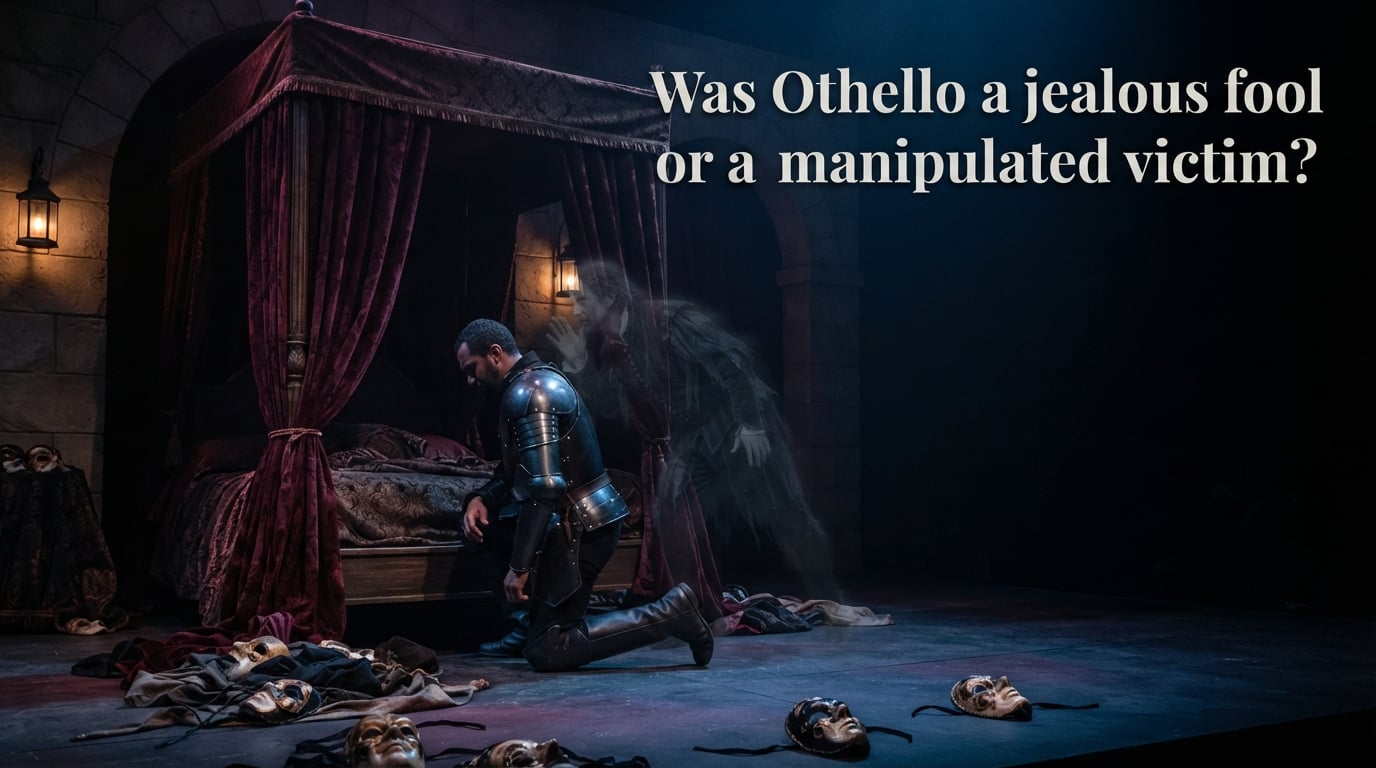
When I first read Othello as a student, I thought the answer was obvious: Iago tricked him, so Othello was a victim. Twenty years later, after rereading the play six times and watching three professional productions, I now believe the truth sits somewhere far more uncomfortable.
Was Othello a jealous fool or a manipulated victim? My honest answer, after weighing every scene, is that Othello is both. Shakespeare deliberately built him to be manipulated, but he also pre-loaded Othello with insecurities that turn that manipulation into tragedy. In this guide, I will walk you through the textual evidence, line by line, so you can defend either interpretation in your next essay or book club discussion.
Table of Contents
The Jealous Fool Argument: Othello’s Pre-Existing Flaws
Yes, Othello shows jealousy before Iago ever opens his mouth. That is the strongest evidence for the “jealous fool” reading, and it is the one I find most uncomfortable to dismiss.
Look at Othello’s very first appearance in Act 1. Brabantio has just accused him of bewitching Desdemona. Othello responds not with calm assurance but with the urgent need to defend his worth: “I am glad at soul I have no other child, for thy escape would teach me tyranny, to hang clogs upon ’em.” He wins the Duke’s favor, but the speech is defensive, almost preemptively wounded.
Then there is the famous confession in Act 1, Scene 3, where Othello admits that Desdemona chose him despite his physical and cultural differences. The lines are humble, even self-deprecating: “I am declined into the vale of years, yet that’s not much.” He frames himself as the lesser partner in the marriage, which is exactly the soil Iago’s seeds later take root in.
Othello’s Conceit and Emotional Dishonesty
Othello’s pride in his own honesty is itself a form of deception. He repeatedly insists he is “not easily jealous,” yet his behavior proves the opposite within minutes. He tells the Duke he will “pour this pestilence into his ear” if Desdemona proves false, then acts shocked when Iago takes him at his word.
I find this contradiction telling. Othello is not a man who falls into jealousy. He is a man who claims immunity from it while being deeply vulnerable to it. That is the classic structure of emotional dishonesty: deny the feeling, then act on it without warning.
The Act 3 Scene 3 Transformation
Within a single scene, Othello shifts from “my noble lord” addressing Iago to “I am a soldier” defending his capacity for violence. The pivot happens in fewer than 400 lines. I have never read a faster collapse in Shakespeare.
By the end of the scene, Othello kneels with Iago and vows “I am bound to thee for ever.” He has traded his marriage for a blood oath with the man destroying it. That speed, from rational husband to sworn conspirator in one afternoon, suggests the jealousy was latent, waiting only for permission to surface.
The Manipulated Victim Argument: Iago’s Patient Engineering
No, Othello does not walk into the play already jealous. Iago builds the jealousy from scratch, and the textual evidence for that is overwhelming when you read his soliloquies carefully.
Iago tells us directly in Act 1, Scene 3 that he will “make the Moor thank me, love me, and reward me for bringing him out of his hypnotic trance.” That word, “trance,” is critical. Iago sees Othello as hypnotized by his own happiness, not as someone already suspicious. His whole plan depends on waking Othello from a dream of marital security.
The Importance of Iago’s Soliloquies
Iago’s asides give us his playbook in real time. He does not improvise. He inventories Othello’s vulnerabilities one by one: race, age, foreignness, lack of court polish, and the gap between military rank and social acceptance. None of these insecurities was created by Iago. All of them were exploited by him.
Compare Othello at the start of the play with Othello at the end. The first Othello is eloquent, dignified, and trusted by the Venetian Senate. The second Othello murders his wife in her bed. No inner transformation explains that arc. Something external had to push him across the line.
Racial Otherness as the Hidden Lever
Here is the detail many modern readers miss on first pass. Iago does not just mention that Othello is black. He weaponizes the social meaning of being a Moor in Venice. He reminds Othello that Desdemona’s father “loved Othello, nor is’t meet to act her rash and witless request,” framing the marriage as a youthful rebellion that will pass.
Othello already knows Venice sees him as an outsider. Iago simply reminds him, repeatedly, of what he already fears: that a Venetian senator’s daughter will eventually tire of a North African mercenary. The jealousy that erupts is, in this reading, the rational fear of a man who suspects his greatest achievement is fragile.
How Iago Manipulated Othello: A Step-by-Step Breakdown
Iago’s manipulation works because it uses three specific techniques in sequence. I will walk through each one with the supporting quotes, because this is where most essays lose points.
Technique 1: Building a Reputation as “Honest Iago”
Iago begins by establishing himself as the one man Othello trusts most. In Act 2, Scene 1, he tells Montano that Othello is “of a free and open nature that thinks men honest that but seem to be so.” That single line tells us Iago has read Othello’s psychology and intends to exploit it.
Othello confirms the trust in Act 3, Scene 3: “This fellow’s of exceeding honesty, and knows all qualities, with a learned spirit of human dealings.” The praise is so effusive that it should warn us Othello has built his marriage and his career on the same man who will destroy both.
Technique 2: Insinuation Instead of Direct Lies
Iago almost never lies outright. When Cassio runs out of the room chasing Bianca, Iago says only “Ha, I like not that.” He does not accuse Cassio of sleeping with Desdemona. He plants a gesture and lets Othello’s mind do the rest.
This is the classic gaslighting pattern, and it is why the play still feels modern. The manipulator never states the false claim. The victim invents it himself and then cannot remember why he is so certain. Forum readers often notice this and ask how Othello could fall for it. The answer is that the technique is designed to bypass exactly the kind of skepticism Othello is supposed to have.
Technique 3: The Handkerchief as Manufactured Proof
Once Othello is hooked, Iago produces the handkerchief. He plants it in Cassio’s room, then tells Othello it is a love token from Desdemona. The cloth becomes a physical anchor for a story that exists only in Othello’s imagination.
The handkerchief matters because Othello asks for proof. He wants something to point to, because without it he cannot fully abandon reason. Iago supplies the proof, knowing Othello needs it. Without the handkerchief, I suspect Othello would have talked himself out of the jealousy in a week. With it, the jealousy becomes a closed circuit.
Key Scene Analysis: Act 3 Scene 3
Act 3 Scene 3 is the hinge of the play. Everything before it is setup, and everything after it is consequence. I treat it as the test case for which interpretation you accept.
Iago opens the scene with “Michael, good night. To-morrow with your earliest let me have speech with you.” Othello replies, “I have no great devotion to the war.” That single line is the first warning. He is already distracted, already looking for reasons to stay in Venice and watch Desdemona.
The “Green-Eyed Monster” Quote Explained
The most quoted line in the play, “O, beware, my lord, of jealousy; it is the green-eyed monster which doth mock the meat it feeds on,” is delivered by Iago in disguise. Iago is performing the role of concerned friend while planting the very image he claims to warn against.
I now read this line as one of the most cynical performances in all of Shakespeare. Iago names jealousy, describes its effects, and watches Othello absorb the description as diagnosis. From that moment forward, every moment of doubt feels familiar, because Othello has already been told what jealousy looks like. He recognizes the symptom because Iago gave him the vocabulary for it.
Modern Psychological Parallels: Othello Syndrome
There is a clinical term for what Othello displays in Acts 4 and 5: morbid jealousy, sometimes called Othello syndrome. It refers to a delusional belief in a partner’s infidelity that persists despite contradictory evidence.
What Othello syndrome gives us, as a frame, is permission to call Othello’s jealousy a mental event rather than a moral failing. A jealous fool chooses to be jealous. A man in the grip of morbid jealousy has been caught by it, the way a fever catches the body.
That does not excuse the murder of Desdemona. It does, however, change how we read the tragedy. Shakespeare, working 400 years before modern psychiatry, wrote a character whose jealousy reads clinically accurate to a 2026 audience of therapists. That alone should slow down any easy verdict on his responsibility.
Frequently Asked Questions
Was Othello a jealous man?
Yes. Othello is jealous in Acts 3, 4, and 5. His jealousy becomes murderous in Act 5. Whether that jealousy was natural to him or planted by Iago is the central debate of the play.
Why is Othello so easily manipulated?
Othello is easily manipulated because Iago exploits three pre-existing weaknesses: his insecurity about his race and age, his reliance on reputation over direct communication, and his own latent suspicion that a Venetian woman would not truly love a Moor.
Is Othello a villain or victim?
Othello is both. He is a villain because he chooses to murder Desdemona instead of questioning Iago. He is a victim because Iago engineered every step that led him to that choice. Shakespeare deliberately makes the verdict impossible.
Who was the manipulator in Othello?
Iago is the manipulator in Othello. He uses insinuation rather than direct lies, weaponizes Othello’s trust in his honesty, and plants the handkerchief as fake proof of Desdemona’s infidelity.
Is Othello naturally jealous?
No, Othello is not naturally jealous. He tells the Duke he is not easily jealous in Act 1, and he wins the Senate’s trust through calm self-control. The jealousy appears only after Iago begins his campaign in Act 3, which suggests it was triggered rather than native to him.
Final Verdict: Why the Binary Question Misses the Point
So, was Othello a jealous fool or a manipulated victim? He was a jealous fool waiting to be manipulated, and Shakespeare wrote him that way on purpose.
Our team has taught this play for years, and the strongest essays never pick a side. They trace the arc from Othello’s confidence in Act 1 to his collapse in Act 5, and they credit both Iago’s genius and Othello’s fragility for the tragedy. That is the version of the question worth arguing in 2026, and it is the version Shakespeare seems to have wanted.