
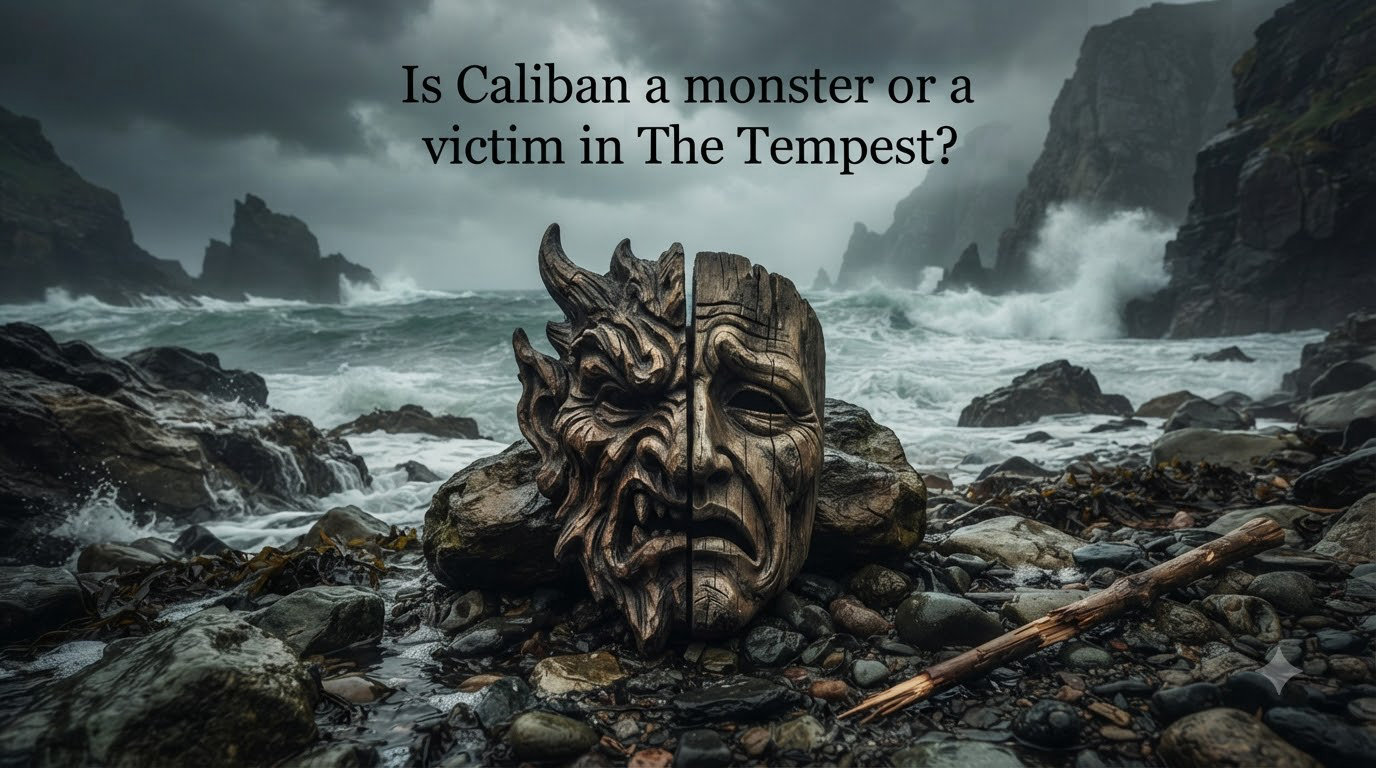
Caliban is simultaneously a monster and a victim in Shakespeare’s The Tempest. He is the son of the witch Sycorax and the only native inhabitant of the island, which Prospero colonizes and takes from him by force. On one hand, Caliban commits monstrous acts, including an attempted assault on Prospero’s daughter Miranda and a conspiracy to murder Prospero himself. On the other hand, he is enslaved, robbed of his homeland, physically tortured, and denied the dignity that his intelligence and poetic soul clearly deserve. Shakespeare deliberately writes Caliban as a character who cannot be reduced to either label alone.
That complexity is what makes Caliban one of the most debated characters in all of Shakespeare’s work. Audiences, students, and scholars have argued for over four centuries about whether he deserves sympathy or condemnation. In this analysis, I will walk through the textual evidence on both sides, examine Caliban’s relationship with Prospero and Miranda, and explore how modern productions and postcolonial criticism have reshaped our understanding of this unforgettable figure.
By the end, you will have a thorough, evidence-based answer to the question: is Caliban a monster or a victim in The Tempest? The short answer is that he is both, and Shakespeare’s refusal to resolve that tension is precisely what makes the character so powerful.
Table of Contents
Who Is Caliban? Origins and Background
Caliban is the son of Sycorax, a powerful witch who was banished from Algiers and marooned on the island years before the play begins. His father is never identified, though Caliban himself references the god Setebos, whom his mother worshipped. He was born on the island and is its only true native inhabitant. Before Prospero and Miranda arrived, Caliban lived alone on the island after his mother died.
This origin story matters enormously for the monster-versus-victim debate. Caliban is not a visitor or a foreigner. The island is his birthright, inherited from his mother. When Prospero arrives and claims dominion over the land, he is taking something that genuinely belongs to someone else. That fact alone plants the seeds of the victim argument before the play’s main action even begins.
Caliban himself makes this ownership claim explicit in Act 1, Scene 2. He tells Prospero: “This island’s mine, by Sycorax my mother, Which thou tak’st from me.” It is one of the most direct statements of dispossession in the play. Caliban is not complaining about being treated rudely. He is asserting a legal and moral right to the land that Prospero has seized.
Physically, Caliban is described in ways that other characters use to justify treating him as less than human. Prospero calls him a “freckled whelp hag-born, not honour’d with a human shape.” Trinculo wonders whether he is a man or a fish, calling him a “strange fish.” Stephano refers to him repeatedly as a “monster.” These descriptions come from characters who have reason to see Caliban as inferior, and they tell us as much about the speakers as they do about Caliban himself.
What Shakespeare never does is give the audience a neutral physical description. We only know what Caliban looks like through the eyes of characters who are exploiting him, mocking him, or controlling him. This is a crucial detail that many surface-level analyses miss. The question of whether Caliban is physically monstrous or simply labeled that way by his oppressors is left deliberately ambiguous, and that ambiguity is central to interpreting the character.
The Case for Caliban as a Monster
The evidence for viewing Caliban as a monster is substantial and cannot be dismissed. His most damning act occurs before the play’s main timeline begins. After Prospero and Miranda arrived on the island, Caliban initially showed them kindness and taught them how to survive. He showed Prospero where to find fresh water, fertile soil, and useful resources. In return, Prospero gave Caliban language and housed him in his own cell.
Then Caliban attempted to assault Miranda sexually. Prospero describes the incident in Act 1, Scene 2: “I had peopled else This isle with Calibans.” Miranda herself recalls it with horror, saying that Caliban did not take the gift of language as an opportunity for growth but instead used it to pursue his violent impulse. This attempted assault is the single strongest piece of evidence for the monster interpretation, and it is the reason Prospero gives for enslaving him.
Caliban does not deny the act. When Prospero confronts him, Caliban replies: “O ho, O ho! would’t had been done! Thou didst prevent me; I had peopled else This isle with Calibans.” He expresses open regret that he was stopped. This is deeply disturbing, and modern readers are right to find it repellent. Any serious analysis of Caliban must confront this moment honestly rather than explain it away.
Beyond the assault on Miranda, Caliban’s actions throughout the play reinforce the monster reading. When he encounters Stephano, a drunken butler, he immediately pledges servitude and begs Stephano to become his new master. He then plots to murder Prospero, promising to guide Stephano through the process if Stephano will give him Miranda as a reward. This willingness to trade one master for another and to plot murder for personal gain shows a character driven by appetite and revenge rather than moral reasoning.
Prospero himself reaches a conclusion about Caliban’s nature. In Act 4, Scene 1, he says: “A devil, a born devil, on whose nature Nurture can never stick; on whose rank nature, Nurture can never stick.” Prospero believes that no amount of education or kindness can overcome Caliban’s fundamental depravity. While Prospero is hardly an impartial judge, his assessment carries weight because he has spent years trying to civilize Caliban and has seen the results firsthand.
The Case for Caliban as a Victim
The counterargument is equally compelling. Before he committed any offense, Caliban was the rightful owner of the island. He was born there. His mother lived and died there. When Prospero arrived as a stranger, Caliban welcomed him, shared his knowledge, and helped him survive in an unfamiliar place. Prospero repaid that generosity by taking the island and enslaving its only inhabitant.
Caliban himself describes the betrayal in Act 1, Scene 2: “When thou camest first, Thou strokedst me and made much of me, wouldst give me Water with berries in’t, and teach me how To name the bigger light, and how the less, That burn by day and night; and then I loved thee And showed thee all the qualities o’ the isle.” This passage is devastating in its simplicity. Caliban describes a moment of genuine connection that Prospero exploited and then destroyed.
The enslavement itself is brutal. Prospero does not merely confine Caliban. He subjects him to physical torment using magic. When Caliban disobeys, Prospero sends spirits to pinch him, give him cramps, and fill his bones with aches. Trinculo and Stephano mock him, beat him, and use him for entertainment. Every relationship Caliban has in the play is defined by exploitation, and he has no ally who treats him as an equal.
Caliban’s curse speech reveals the depth of his suffering and rage: “You taught me language; and my profit on’t Is, I know how to curse. The red plague rid you For learning me your language!” This is one of the most famous lines in the play, and it cuts to the heart of the victim argument. Prospero taught Caliban language not as a gift of education but as a tool of control. Caliban’s only use for that language, in his own telling, is to express the anger and pain that his enslavement has produced.
It is also worth noting that Caliban’s conspiracy with Stephano is not simply villainy. It is the desperate act of an enslaved person trying to overthrow a tyrant. Caliban knows no other path to freedom. He has no allies, no weapons, and no leverage except his knowledge of the island. When he turns to Stephano, he is reaching for the only escape he can imagine, even if that escape is pathetic and doomed.
Caliban and Prospero: Master and Slave
The relationship between Caliban and Prospero is the engine that drives the entire play. Every scene between them crackles with tension because both characters have legitimate grievances against the other. Prospero was betrayed by Caliban’s attempted assault on Miranda. Caliban was betrayed by Prospero’s theft of his island and his brutal enslavement. Neither man is entirely wrong about the other, and neither is entirely right.
What makes this dynamic so rich is that Prospero and Caliban are mirrors of each other. Prospero was himself usurped. His brother Antonio stole his dukedom of Milan and set him adrift with his infant daughter. Prospero understands what it means to lose everything to someone more powerful. Yet when he arrives on the island, he does exactly the same thing to Caliban that Antonio did to him. He seizes power, displaces the rightful inhabitant, and rules through force and fear.
This parallel is not accidental. Shakespeare constructs the comparison deliberately, and it has been recognized by critics for centuries. Caliban even acknowledges the parallel obliquely when he says of Prospero’s books: “Remember First to possess his books; for without them He’s but a sot, as I am.” In Caliban’s eyes, Prospero’s power comes not from moral superiority but from his magic books. Remove those books, and Prospero is just another ordinary man, no better than Caliban himself.
The master-slave dynamic also reveals something uncomfortable about Prospero. He teaches Caliban language, gives him shelter, and initially treats him with apparent kindness. But these gifts come with strings attached. They are instruments of control that establish Prospero’s superiority and Caliban’s dependence. Prospero teaches language so that Caliban can follow commands, not so that he can think freely. When Caliban uses that language to curse or to assert his own humanity, Prospero punishes him for it.
Reddit discussions about The Tempest frequently highlight this hypocrisy. Users point out that Prospero demands sympathy for his own usurpation while showing none for Caliban’s. If Antonio’s betrayal of Prospero was wrong, then Prospero’s betrayal of Caliban was equally wrong. Shakespeare does not spell out this moral equation, but the structure of the play makes it impossible to ignore.
Caliban’s Poetic Soul: Language as Evidence of Humanity
One of the most striking pieces of evidence against the monster interpretation is the beauty of Caliban’s language. If Caliban were merely a beast, Shakespeare would not have given him some of the most gorgeous poetry in the entire play. Caliban speaks with a sensitivity and emotional depth that no other character matches.
His most famous speech comes in Act 3, Scene 2. Trying to reassure Stephano and Trinculo about the sounds of the island, Caliban says: “Be not afeard; the isle is full of noises, Sounds and sweet airs, that give delight and hurt not. Sometimes a thousand twangling instruments Will hum about mine ears, and sometime voices That, if I then had waked after long sleep, Will make me sleep again; and then, in dreaming, The clouds methought would open and show riches Ready to drop upon me, that when I woke I cried to dream again.”
This passage is extraordinary. It reveals a character who listens deeply, who experiences wonder, and who longs for something beyond the misery of his daily existence. The phrase “I cried to dream again” is one of the most moving in Shakespeare. A pure monster would not speak this way. A character capable of such tenderness and imagination possesses a soul, whether the other characters recognize it or not.
Caliban’s linguistic sophistication also matters because it was given to him by Prospero. Before Prospero arrived, Caliban spoke his own language. Prospero replaced it with his own, and then used Caliban’s speech as evidence of his inferiority. But Caliban’s command of that borrowed language consistently exceeds what Prospero intended. He does not use language merely to follow orders. He uses it to curse, to describe beauty, to assert his rights, and to express longing.
This is the content gap that many competitors miss. Caliban’s language is not just decorative. It is the primary evidence that he is more than the monster other characters claim he is. The gap between what characters say about Caliban and how Caliban actually speaks is one of the most important tensions in the play.
Colonial Allegory: Reading Caliban Through a Postcolonial Lens
Since the mid-twentieth century, postcolonial criticism has fundamentally reshaped how audiences read Caliban. Scholars like Aimé Césaire, who wrote a 1969 adaptation called A Tempest, have recast Caliban as a colonized subject struggling against a European colonizer. In this reading, Prospero represents the imperial powers that were exploring and claiming new territories during Shakespeare’s lifetime, and Caliban represents the indigenous peoples whose lands and cultures were destroyed in the process.
The historical context supports this interpretation. The Tempest was written around 1610 to 1611, a period when English explorers were actively colonizing the Americas. Reports of encounters with indigenous peoples circulated widely in London. The word Caliban is an anagram of cannibal, a term that Europeans used to demonize native populations and justify their conquest. Shakespeare’s audience would have understood the colonial dimension of the play even if they did not use the vocabulary of postcolonial theory.
From a colonial perspective, Caliban’s enslavement is not justice for his assault on Miranda. It is the mechanism by which a colonizer subjugates a native population. Prospero takes Caliban’s land, strips him of his autonomy, forces him to work, and controls him through violence and magic. The pattern mirrors the real-world dynamics of colonialism with uncomfortable precision.
Caliban’s famous line about language takes on additional force in this context: “You taught me language; and my profit on’t Is, I know how to curse.” The colonizer imposes his language on the colonized and then expects gratitude. The colonized uses that same language to resist. This is a dynamic that plays out in virtually every colonial encounter in history, and Shakespeare captures it with remarkable precision.
It is worth asking whether this makes The Tempest a racist play. The answer is complicated. The play contains language and attitudes that reflect the racial assumptions of Shakespeare’s time. But it also gives Caliban a voice, a legitimate grievance, and some of the most beautiful poetry in the canon. Shakespeare does not endorse colonialism so much as he stages its contradictions and lets the audience wrestle with them.
What Happens to Caliban at the End?
The ending of Caliban’s story is one of the most debated aspects of The Tempest, and it rarely gets the attention it deserves. When Prospero’s plots are resolved and the conspirators are exposed, Prospero makes a statement that carries enormous weight: “This thing of darkness I acknowledge mine.” The line is ambiguous. It could mean that Prospero accepts responsibility for Caliban, acknowledging the darkness within himself. Or it could mean that he dismisses Caliban as a thing of darkness and claims ownership of him one final time.
Caliban’s own final words suggest a shift in his character. He says: “I’ll be wise hereafter And seek for grace. What a thrice-double ass Was I, to take this drunkard for a god, And worship this dumb fool!” He repents his foolishness in following Stephano. But he does not apologize to Prospero. His regret is directed at his own poor judgment, not at his hatred of the man who enslaved him.
What Prospero plans to do with Caliban after the play ends is never stated. Does he free him? Does he leave him on the island alone? Does he take him back to Milan as a continued slave? The play does not tell us, and that silence is significant. Shakespeare leaves Caliban’s future unresolved, just as he leaves the question of Caliban’s nature unresolved.
This unresolved ending is itself an argument against any simple reading. If Caliban were purely a monster, the play would end with his punishment or destruction. If he were purely a victim, the play would end with his liberation. Instead, the ending is ambiguous because Caliban himself is ambiguous. Shakespeare trusts his audience to sit with that discomfort.
Caliban vs Other Shakespearean Villains
Comparing Caliban to other Shakespearean villains sheds additional light on his character. Unlike Iago, who destroys lives out of calculated malice and professional jealousy, Caliban acts from desperation and rage born of genuine suffering. Unlike Macbeth, who murders for ambition and power, Caliban plots against Prospero to reclaim what was taken from him. Unlike Richard III, who delights in his own villainy, Caliban experiences regret and shows flashes of genuine moral awareness.
This places Caliban in a unique category among Shakespeare’s antagonists. He is a villain with a legitimate grievance, a monster with a soul, and an enemy who is also a victim. No other character in Shakespeare’s work occupies this space so fully, and that is precisely why audiences have never stopped arguing about him.
How Modern Productions Interpret Caliban
Modern productions of The Tempest have taken wildly different approaches to Caliban, and those choices reveal how mutable the character is. Some productions cast a physically imposing actor and emphasize his brute force, leaning into the monster interpretation. Others cast a small or wounded-looking actor and emphasize his vulnerability, inviting the audience to see him as a victim of abuse.
Some directors have made bold racial choices. Casting a Black actor as Caliban alongside a white Prospero foregrounds the colonial dimension of the play and forces the audience to confront the racial dynamics that Shakespeare’s text implies. Other productions have cast Caliban with physical disabilities or deformities to challenge the audience’s assumptions about what makes someone monstrous.
The range of valid interpretations is itself a testament to Shakespeare’s writing. A character who can be played as terrifying, pitiable, sympathetic, or repulsive depending on the choices of the production is a character who resists easy categorization. Any production that tries to reduce Caliban to a single dimension misses the point of what Shakespeare created.
FAQs
Is Caliban a victim or a villain?
Caliban is both a victim and a villain, which is what makes him one of Shakespeare’s most complex characters. He is a victim because Prospero stole his island and enslaved him after Caliban initially showed him kindness. He is a villain because he attempted to assault Miranda and plotted to murder Prospero. Shakespeare deliberately writes him as neither purely innocent nor purely evil, forcing the audience to grapple with the tension between his genuine suffering and his genuine wrongdoing.
Is The Tempest a racist play?
The Tempest contains language and attitudes that reflect the racial assumptions of Shakespeare’s time, including the demonization of Caliban as a savage native. However, the play also gives Caliban a legitimate grievance, a powerful voice, and some of the most beautiful poetry in the canon. Many postcolonial critics argue that Shakespeare stages the contradictions of colonialism rather than simply endorsing it, making the play a complex document that can be read both as a product of its era and as a critique of imperial power.
Who is the villain of The Tempest?
There is no single villain in The Tempest. Prospero enslaves Caliban and controls everyone through manipulation and magic. Caliban attempts to assault Miranda and plots murder. Antonio usurped Prospero’s dukedom. Sebastian and Antonio conspire to kill Alonso. Each character commits morally questionable acts. The play is structured so that villainy is distributed across the cast rather than concentrated in one figure, which is part of what makes it so thought-provoking.
Is Caliban a bad guy?
Caliban does terrible things, including attempting to assault Miranda and plotting to murder Prospero with Stephano’s help. Those actions make it easy to label him a bad guy. But Caliban also suffers genuine injustice. He was enslaved, robbed of his homeland, and physically tortured. His bad actions exist alongside real victimization, and Shakespeare refuses to let the audience resolve that contradiction. Whether Caliban is a bad guy depends on which evidence you weigh more heavily.
How is Caliban presented as a victim in The Tempest?
Caliban is presented as a victim through several key details. He is the native inhabitant of the island whose home is taken by Prospero. He initially showed kindness to Prospero by teaching him how to survive on the island. He is enslaved and physically tortured with cramps and pinches inflicted by Prospero’s spirits. He is mocked and beaten by Stephano and Trinculo. And his famous line about learning language only to curse reveals the bitterness of a man stripped of everything except his anger.
Conclusion: Is Caliban a Monster or a Victim?
So is Caliban a monster or a victim in The Tempest? The honest answer is that he is both, and Shakespeare’s refusal to resolve that contradiction is the entire point. Caliban commits monstrous acts. He attempts to assault Miranda, plots to murder Prospero, and repeatedly chooses violence as his path to freedom. These actions are real and cannot be excused by his suffering.
But Caliban is also a victim of staggering injustice. His homeland is stolen. His body is enslaved. His mind is shaped by a language imposed on him for someone else’s benefit. He is tormented by spirits, mocked by drunks, and judged by the very man who robbed him. The beauty of his poetry and the depth of his longing prove that there is a soul inside him that his circumstances have never allowed to flourish.
What makes Caliban a masterpiece of characterization is that neither label tells the whole story. He is a monster with a legitimate grievance and a victim who commits terrible wrongs. In 2026, as audiences continue to stage and study The Tempest, that unresolved tension remains the most powerful thing about him. Shakespeare does not give us an easy answer. He gives us a character complex enough to carry four centuries of debate, and he trusts us to do the thinking ourselves.