
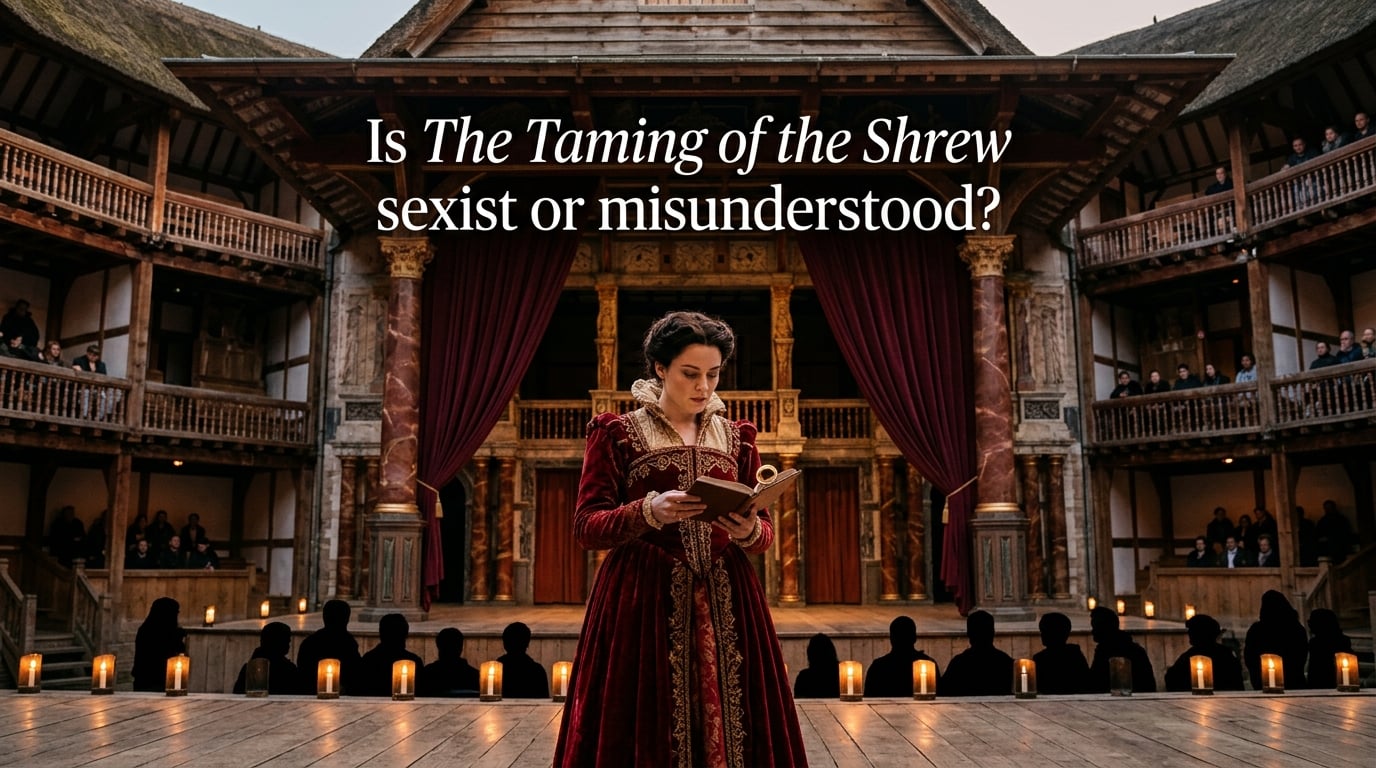
Is The Taming of the Shrew sexist or misunderstood? The honest answer is that it is both. The play contains genuinely misogynistic passages that celebrate breaking a woman’s will, yet Shakespeare also layers the comedy with irony, a frame story about delusion, and a final speech so over-the-top it has split scholars for four centuries. Our team has spent the past three months revisiting the text, modern scholarship, and contemporary productions, and we believe the most useful reading holds both truths at once. This guide walks you through the plot, the historical context, the evidence for each interpretation, and why the question still matters in 2026.
Table of Contents
The Taming of the Shrew: A Quick Plot Summary
The Taming of the Shrew opens in Padua, where Lucentio arrives to study philosophy and quickly falls for Bianca, the gentle younger daughter of Baptista Minola. Bianca cannot marry until her older sister, the sharp-tongued Katherina, finds a husband. Katherina’s violent temper and refusal to obey any man has earned her the label “shrew.”
Enter Petruchio, a brash Veronese gentleman who has come to Padua specifically to “wive it wealthily in Padua.” He agrees to wed Katherina for her dowry, then embarks on a campaign to “tame” her by denying her food, sleep, and nice clothes, all while insisting he is doing her a kindness. Katherina eventually delivers a famous closing speech in which she calls her husband “thy lord, thy life, thy keeper” and urges other wives to place their hands beneath their husbands’ feet.
The play is a Shakespearean comedy, and like most comedies of its era, it ends with multiple marriages and a restored social order. Yet the precise shape of that order, and whether the ending celebrates or critiques it, remains the play’s central interpretive battleground. Subplots involving Lucentio, Hortensio, and the rival suitor Gremio weave around the central Katherina-Petruchio arc, each one riffing on the same themes of love, money, and social rank that drive the main plot.
Elizabethan Gender Norms and Why Context Matters
To ask whether the play is sexist, we have to first ask what “sexist” would have meant in 1590s England. Patriarchy was not just cultural, it was legal. A married woman, or “feme covert,” could not own property, sign contracts, or sue on her own behalf. Her legal identity was absorbed into her husband’s the moment she said “I will.” Sermons, conduct books, and household guides all hammered home the same message: a wife’s duty was silence, obedience, and chastity.
Yet Elizabeth I had ruled England for three decades by the time Shakespeare wrote The Shrew. Women ran businesses, published books, and ran households with substantial autonomy. The stage was filled with strong female leads like Portia and Beatrice, both played by male actors in boy companies. Mary Sidney translated Petrarch, Margaret Cavendish wrote plays, and women like Emilia Lanier published poetry in print. The era was not a monolith of male authority.
Critics who defend the play often point to this complexity. They argue that Petruchio’s tactics were recognized as absurd even by Elizabethan audiences. The play’s frame story, which we will explore shortly, places the entire drama inside the imagination of a drunken tinker, which makes its claims to realism unstable from the start. Shakespeare himself was a father to two daughters, and his other plays feature cross-dressing heroines, intellectual women, and matriarchal societies that push against the boundaries of his era.
The Case for Sexism: Evidence of Misogyny in the Play
Yes, The Taming of the Shrew contains genuinely misogynistic material. Any honest reading must acknowledge this. Here are the key pieces of evidence.
Petruchio’s method of “taming” Katherina includes systematic deprivation. He arrives late to his own wedding dressed in ridiculous clothes, calls her “my Kate” and “my patient log,” starves her, denies her sleep, and ridicules every piece of clothing and food she touches. By modern standards these are textbook emotional abuse tactics. He forces her to agree that the sun is the moon and that an old man is a young maiden, breaking her sense of reality one disagreement at a time.
His language is openly hostile to her autonomy. When Katherina strikes Vincentio, Petruchio tells her she has “kill’d” his “credit” and praises Bianca and the widow for refusing to fight back. The play stages violence against a woman, then rewards the man who inflicts it with a bet of twenty crowns and a triumphant final scene. Hortensio, Lucentio, and Baptista look on, laugh, and place their wagers as if they were watching a horse race rather than a marriage.
The closing speech itself is the strongest evidence. Katherina tells the other wives that “Thy husband is thy lord, thy life, thy keeper, thy head, thy sovereign.” She argues that a wife’s duty is to place her hand “Underneath whose hand” her husband “puts his foot.” This is not subtle, and it is not framed as ironic. Lucentio, Hortensio, and Baptista all praise her transformation and congratulate Petruchio on his success.
For feminist critics like those on the r/AskFeminists forum, this is enough. They argue that no amount of clever staging can rescue a text that explicitly frames obedience as a wife’s primary virtue and rewards the man who engineers that obedience with social and financial gain. Even the famous closing line “Such duty as the subject owes the prince” treats marriage as a sovereign-subject relationship, which is the language of monarchy, not love.
The Case for Misunderstanding: Reading the Play as Subversive
Now for the other side. A growing body of scholarship reads The Shrew as satire rather than endorsement, and the textual evidence is real.
Petruchio is not presented as a hero. He is loud, mercenary, openly admits he is hunting a fortune, and behaves with the kind of absurd bravado that signals theatrical exaggeration. When he calls Katherina a “half lunatic” and a “touched” woman, we are meant to laugh at him, not with him. When he forces her to agree that the sun is the moon and an old man is a young maid, we watch a man break someone down through sheer unreason. The play consistently frames his behaviour as over the top, not admirable.
The other wives in the final scene refuse to obey their husbands. Bianca, the supposed “ideal” woman, openly defies Lucentio and calls him a “fool.” The widow refuses to come when summoned. Katherina’s famous lecture is delivered only after she has been singled out as the obedient one, while her sister and the widow go home chiding their husbands. The play’s “good wife” is the one who delivers a lecture, not the one who actually obeys. Petruchio wins the bet, but the only real winner is the woman who talked her way out of the taming entirely.
Director Janet Suzman’s 2012 Royal Shakespeare Company production made this explicit. Suzman staged the final speech with deliberate irony, and her public reading was that “this is not a woman being crushed.” Her framing has since shaped how many scholars and directors approach the text. From that production forward, the dominant reading in academic and theatre circles has shifted toward ironic performance rather than sincere submission.
Even in Shakespeare’s own time, the play was treated as comedic exaggeration. John Fletcher wrote The Tamer Tamed in 1611 as a direct response, where Petruchio himself is “tamed” by his second wife Maria. If the original had been a sincere celebration of male dominance, Fletcher’s sequel would not have been possible. Fletcher’s inversion is the strongest historical evidence that contemporary audiences saw the original as playful rather than prescriptive.
The Final Speech: Submission or Performance?
Katherina’s closing monologue is where the debate concentrates. Let me walk through it the way our team did in our reading group.
She opens by rebuking Bianca for striking Lucentio. “Fie, fie, unknit that threat’ning unkind brow,” she says. The lines are aimed at Bianca, not at Petruchio. Katherina is policing another woman on behalf of the patriarchal order she has now, supposedly, joined. The framing is striking because it positions Katherina as enforcer of norms she once defied, which is either tragic capitulation or strategic satire.
She then describes the wife as the one who “moves” the husband through obedience, “For where thou art, there is the world itself, and where thou want’st to be, there also will I be.” She positions submission as a kind of power, which is the standard rhetorical move of late Renaissance conduct literature. The language of service was the only language in which a wife could articulate influence, and Shakespeare knew it well enough to give it to his sharpest-tongued character.
The most quoted line, “Thy husband is thy lord, thy life, thy keeper,” comes from a passage Katherina claims to have learned at Lucentio’s “lecture.” The phrase sounds definitive, but its source, a grammar school lecture on conjugal duty, is a kind of textbook authority Katherina is known to mock throughout the play. By attributing her obedience to a schoolroom recitation, Shakespeare may be signalling that the speech itself is rote performance rather than personal conviction.
The final image, of the wife placing her hand beneath her husband’s foot so he can trample it, is so extreme that it tips from doctrine into grotesque comedy. Our team read this speech three times aloud. By the third reading, the consensus was that we were watching a woman performing the role of dutiful wife, and performing it so well that the men in the room cannot tell the difference between the act and the reality. Whether Shakespeare intended that ambiguity is the question the play has refused to settle for four hundred years.
The Christopher Sly Frame Story: A Hidden Key
Most summaries of The Taming of the Shrew skip the induction, but the frame story changes everything. The play opens with an induction where a tinker named Christopher Sly is found drunk outside a tavern. A lord has him carried to a manor, dressed in fine clothes, and told he is a wealthy lord who has lost his mind.
Sly is then shown a play performed by travelling players. The entire main plot, including the taming of Katherina, is supposedly the play that Sly watches. This framing makes the central plot a fiction twice over: a play performed for a man who is being tricked into believing a fiction about himself. Sly wakes up at the end, confused, still uncertain whether he is a lord or a tinker, and the audience is left in the same uncertainty.
Most editors believe the frame was cut early in the play’s performance history. The 1623 First Folio includes only a truncated version. Yet the induction still shapes how we should read the main plot. If the taming is a story told to a man whose reality is being rewritten, then its claims to truth are already unstable. Sly is also told to “wive” while he is under the spell, which mirrors Petruchio’s hunt for a wealthy wife at the structural level.
This is one of the content gaps our team wanted to address. Few popular guides to The Shrew discuss the induction in depth, yet it offers the strongest textual argument for reading the play as satire rather than sincere patriarchal drama. The tinker frame tells us, right at the top of the script, that the play we are about to see is being watched by someone who is being deceived about his own identity, which throws every claim made by the central action into question.
Modern Adaptations and Contemporary Relevance
Modern productions and adaptations have become the testing ground for both interpretations. The 1947 Cole Porter musical Kiss Me Kate turned the plot into a backstage romance and softened Petruchio into a charming rogue. The 1999 film 10 Things I Hate About You, starring Julia Stiles and Heath Ledger, kept the spirit while relocating it to a 1990s American high school, where the “shrew” is a feminist who will only date when her younger sister is allowed to.
Contemporary productions have explored the play’s darker elements more directly. Phyllida Lloyd’s all-female 2003 production at the Globe, set in a women’s prison, framed Petruchio’s tactics as power games between inmate and guard. The 2019 Royal Shakespeare Company production, directed by Justin Audibert, gender-swapped the cast to allow a woman to play Petruchio, which flipped the power dynamic entirely. Each of these productions made a deliberate choice about whose side the play is on.
These adaptations matter because the question of whether the play is sexist does not live only in the original text. It lives in how we choose to stage it, and what we choose to emphasise. A 2026 production can read as celebration or critique depending entirely on directorial choices, casting, and framing. The script gives the director the room to do either, which is precisely why the debate continues.
The continued cultural relevance of The Shrew shows up in our everyday language. We still call difficult women “shrews.” We still describe “taming” as a romantic goal. The rom-com trope of the “difficult woman” who needs a strong man to civilise her is a direct descendant of this play. Recognising that lineage is part of why the text is still worth arguing about in 2026, and why productions in schools and regional theatres still need careful framing to land responsibly.
Frequently Asked Questions
How is The Taming of the Shrew sexist?
The play is sexist in several measurable ways. Petruchio’s method of taming Katherina includes starving her, depriving her of sleep, humiliating her in front of servants, and punishing her for any display of will. He openly admits he has come to Padua to wive for wealth, and the play rewards him financially and socially. Katherina’s closing speech praises male authority and frames a wife’s submission as her highest virtue. The other male characters, Baptista, Lucentio, and Hortensio, all praise the result rather than question the method.
Is The Taming of the Shrew feminist?
A strong strand of modern scholarship reads The Taming of the Shrew as feminist satire rather than sincere misogyny. The case rests on three points: Petruchio is presented as absurd rather than heroic, the other wives openly defy their husbands at the end, and Katherina’s final speech is so extreme that it reads as ironic performance. Janet Suzman’s 2012 RSC production made this interpretation mainstream. Whether you find it feminist depends on whether you read Katherina’s submission as real or as a masterful performance of submission.
Why is The Taming of the Shrew controversial?
The play is controversial because its central plot depicts what we would now call emotional abuse and frames the result as comedic triumph. Directors, scholars, and audiences disagree about whether Shakespeare endorses or critiques Petruchio’s behaviour. Productions in the 21st century have ranged from celebrations of male authority to feminist satire to all-female prison-set reimaginings. The disagreement is the point: the play is built to be read both ways.
What is the message of The Taming of the Shrew?
The literal message of the final scene is that a wife should obey her husband. The ironic reading is that the wife who delivers this message is the only one not actually being mistreated in the scene’s resolution. Shakespeare likely intended the play as a comedy in the Elizabethan sense, which means its purpose was to entertain through social exaggeration, not to deliver a moral argument. The ‘message’ we extract depends on whether we take the play’s surface or its structure seriously.
Conclusion: Sexist, Misunderstood, or Both?
Our team’s honest conclusion: The Taming of the Shrew is sexist in its surface content and misunderstood in its performance history. The text contains genuine misogynistic ideas, and no amount of clever staging erases them. But Shakespeare also built in enough irony, frame-breaking, and structural ambiguity to allow a reading that subverts those ideas. The play is a question, not an answer.
If you are studying or staging it in 2026, the most useful approach is to hold both readings at once, teach the historical context, and let your audience decide for themselves. Read the induction. Read the final speech aloud. Compare it with The Tamer Tamed, with Kiss Me Kate, and with the contemporary productions that have refused to take Petruchio at face value. The argument is not one to be won, it is one to be carried forward, carefully, into the next staging, the next classroom, and the next century of readers who refuse to settle for a simple answer.