
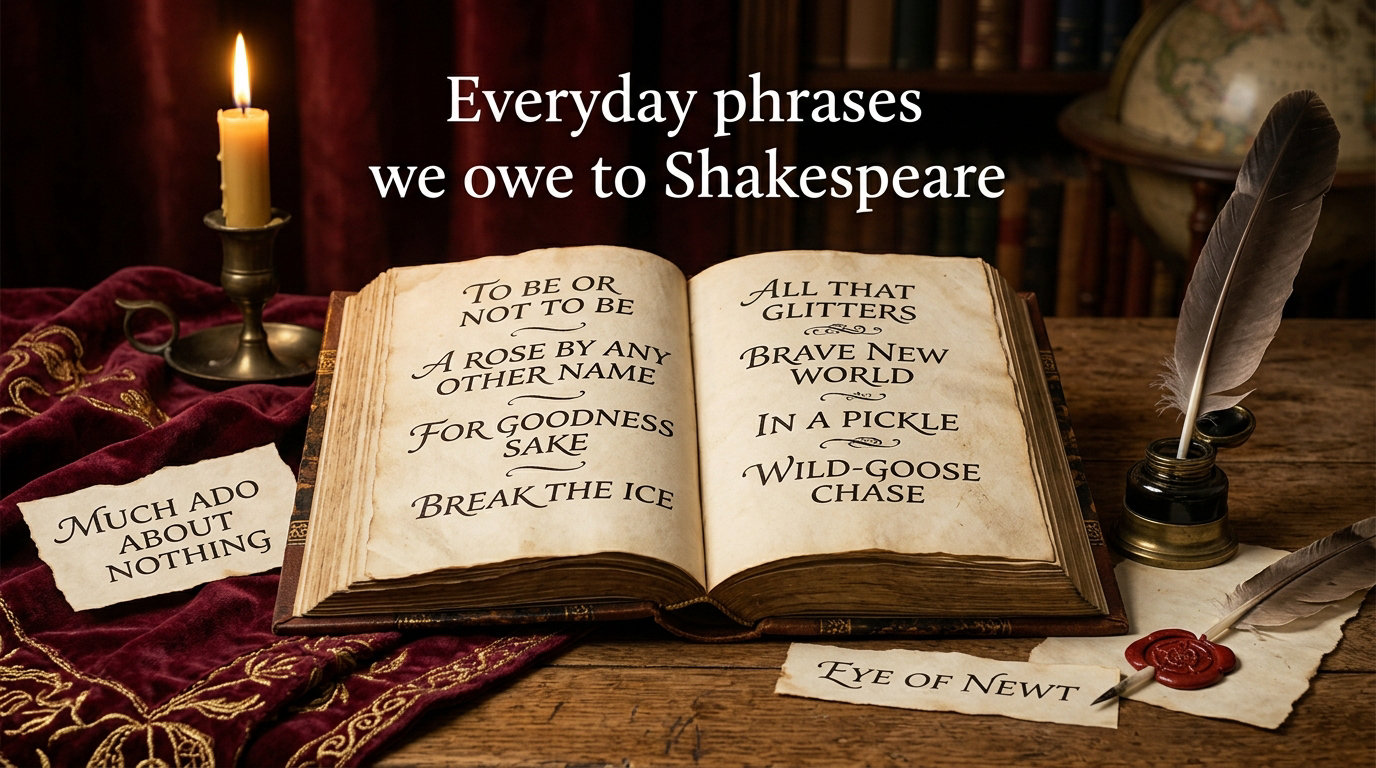
Think about the last conversation you had. Chances are you used at least one phrase that William Shakespeare wrote over four hundred years ago. You might have called a hopeless situation a “wild goose chase,” described someone as “wearing their heart on their sleeve,” or complained about having “too much of a good thing.” Each of those expressions came straight from Shakespeare’s quill.
Shakespeare coined or popularized over 1,700 words and countless phrases that remain embedded in modern English. He shaped the language so deeply that we quote him daily without ever realizing it. Editors at the Oxford English Dictionary have credited him with the first recorded use of thousands of terms.
In this guide, I will walk you through the everyday phrases we owe to Shakespeare, organized by the plays they came from. Each entry includes the phrase itself, its modern meaning, the act and scene where it first appeared, and the original dramatic context that gave it life. I will also cover words Shakespeare invented, the difference between phrases he coined versus ones he simply popularized, and answers to common questions about his linguistic legacy.
Whether you are a student, a teacher, a writer, or simply someone who loves language, you are about to discover just how much of your daily vocabulary belongs to the Bard.
Table of Contents
Everyday Phrases We Owe to Shakespeare
Here are thirty everyday phrases we owe to Shakespeare, organized by the plays where they first appeared. For each phrase, I have included the modern meaning and the dramatic moment that birthed it.
From Hamlet
“In my mind’s eye” (Act 1, Scene 2) means picturing something in your imagination. When Horatio tells Hamlet he has seen the ghost of the late king, Hamlet replies that he has already seen his father “in my mind’s eye.” The phrase captures the experience of seeing someone so clearly in memory that it feels real.
“In my heart of hearts” (Act 1, Scene 5) means feeling something at the deepest, most private level of emotion. Hamlet uses this after meeting the ghost, swearing to remember his father’s words from the very core of his being. We now say it when describing a feeling we know to be absolutely true.
“Method to the madness” (Act 2, Scene 2) means there is hidden logic beneath what appears chaotic. Polonius says “Though this be madness, yet there is method in’t” as he observes Hamlet’s strange behavior and realizes the prince is sharper than he seems. Modern usage shifted to “method to the madness.”
“What a piece of work is a man” (Act 2, Scene 2) expresses wonder at human complexity. Hamlet delivers this famous speech to Rosencrantz and Guildenstern, marveling at humanity while simultaneously calling people “the quintessence of dust.” People still quote the opening to describe someone impressive.
“The lady doth protest too much” (Act 3, Scene 2) means someone is denying something so forcefully that it seems suspicious. Hamlet’s mother watches a play and remarks that the queen character protests her love too aggressively. We use it today to suggest that excessive denial reveals hidden truth.
From Romeo and Juliet
“Star-crossed lovers” (Prologue) refers to two people whose romance is doomed by fate or circumstance. The Chorus opens the play by calling Romeo and Juliet “a pair of star-cross’d lovers” whose love is written in unlucky stars. The phrase now describes any couple fighting against impossible odds.
“Wild goose chase” (Act 2, Scene 4) means a hopeless or frustrating pursuit. Mercutio trades rapid-fire jokes with Romeo, comparing their banter to a horseback game where riders followed each other in a pattern resembling flying geese. The phrase stuck and now describes any fruitless search.
From The Tempest
“Brave new world” (Act 5, Scene 1) describes an unfamiliar or futuristic place filled with wonder. Miranda, who has grown up on a deserted island, sees other humans for the first time and exclaims “O brave new world, that has such people in’t.” Her father Prospero quietly replies that it is new to her.
“In a pickle” (Act 5, Scene 1) means being in a difficult or awkward situation. The clown Trinculo, drunk and confused on the island, stumbles into trouble and declares “I have been in such a pickle.” The expression has survived centuries as shorthand for being stuck in a mess.
“Vanish into thin air” (Act 4, Scene 1) means to disappear completely and mysteriously. Prospero conjures a magical banquet and then makes it disappear, with spirits melting “into air, into thin air.” We use it today when something or someone disappears without explanation.
From Othello
“Green-eyed monster” (Act 3, Scene 3) refers to jealousy. Iago warns Othello that “the green-eyed monster” called jealousy will destroy him if he lets suspicion take hold. The phrase became one of the most recognizable metaphors for envy in the English language.
“Wear your heart on your sleeve” (Act 1, Scene 1) means to show your emotions openly. Iago declares he would never “wear my heart upon my sleeve for daws to peck at,” meaning he refuses to expose his true feelings for others to exploit. Ironically, the phrase now describes someone honest and emotionally open.
“Neither here nor there” (Act 4, Scene 3) means something is irrelevant to the matter at hand. Desdemona and Emilia discuss marriage, and Emilia brushes off a point as “neither here nor there.” The expression remains a quick way to dismiss something as beside the point.
From The Merchant of Venice
“All that glitters isn’t gold” (Act 2, Scene 7) warns that appearances can be deceiving. The Prince of Morocco chooses a gold casket hoping to win Portia’s hand, only to find a skull inside with a scroll reading “all that glisters is not gold.” Note that Shakespeare wrote “glisters,” but the modern version “glitters” evolved from it.
“Love is blind” (Act 2, Scene 6) means people in love cannot see the faults in the object of their affection. Jessica and Lorenzo plan their elopement, and Jessica notes that love makes people overlook reality. The phrase has become a universal observation about romance.
“With bated breath” (Act 1, Scene 3) means waiting anxiously or holding your breath in anticipation. Shylock tells Antonio he will lend him money without “bated breath and whispering humbleness.” The “bated” comes from “abated,” meaning reduced, and the expression still describes eager suspense.
From Macbeth
“The be-all and the end-all” (Act 1, Scene 7) means the ultimate or final element of something. Macbeth contemplates murdering King Duncan and wonders if the assassination will be “the be-all and the end-all” of the matter, with no consequences. It never is, of course, and the phrase now means the definitive conclusion.
“One fell swoop” (Act 4, Scene 3) means something happening suddenly and all at once. Macduff learns that his entire family has been slaughtered and cries that they were “all butchered at one fell swoop” like birds attacked by a hawk. “Fell” means fierce or deadly, and the phrase endures for any sudden catastrophe.
From Julius Caesar
“It’s Greek to me” (Act 1, Scene 2) means something is completely incomprehensible. Casca describes a speech given by Cicero and says he could not understand a word because it “was Greek to me,” even though Cicero was speaking Latin. The phrase now describes anything that goes completely over your head.
From As You Like It
“Too much of a good thing” (Act 4, Scene 1) means even enjoyable things become unpleasant in excess. Rosalind, disguised as a boy, tells Orlando that she would marry him if she were a woman because “too much of a good thing” can be wonderful. The phrase now carries the opposite sense, warning against overindulgence.
“All the world’s a stage” (Act 2, Scene 7) means life is like a performance with people playing different roles. Jaques delivers this famous monologue describing the “seven ages of man,” from infancy to old age. People quote it to describe how we all perform parts throughout our lives.
From The Merry Wives of Windsor
“The world’s mine oyster” (Act 2, Scene 2) means every opportunity is available to you. Pistol asks Falstaff for money, and Falstaff refuses. Pistol replies, “Why, then the world’s mine oyster, which I with sword will open,” meaning he will take what he wants by force. Today the phrase lost its threatening edge and simply expresses boundless opportunity.
“As luck would have it” (Act 3, Scene 5) means by chance or fortune, whether good or bad. Falstaff disguises himself and narrowly avoids being caught, with the narrator noting “as luck would have it” things turned out a certain way. The expression remains one of the most common conversational fillers in English.
“A laughing stock” (Act 2, Scene 1) means someone who is mocked or ridiculed. Evans suggests that if Sir Hugh’s plan fails, they will all become “a laughing-stock” to the town. The phrase still describes anyone who becomes the butt of jokes.
From The Taming of the Shrew
“Break the ice” (Act 1, Scene 2) means to relieve tension or start a conversation in an awkward situation. Tranio encourages Petruchio to “break the ice” with Katharina, comparing the challenge to cracking a frozen river to reach what lies beneath. The metaphor survived intact and is now used in social, business, and romantic contexts alike.
From King Lear
“Full circle” (Act 5, Scene 3) means returning to the original position or starting point. Edmund declares “the wheel is come full circle” as he faces the consequences of his treachery, meaning fate has brought everything back around. We use it today when situations return to where they began.
From Henry IV
“Send him packing” (Part 1, Act 2, Scene 4) means to dismiss someone abruptly or send them away. Falstaff, caught in one of his many lies, says he would “send him packing” rather than face consequences. The expression remains a colorful way to describe rejecting or firing someone.
“Eaten me out of house and home” (Part 2, Act 2, Scene 1) means someone consumes so much that they drain your resources. Mistress Quickly complains to the Lord Chief Justice that Falstaff has “eaten me out of house and home.” Parents still reach for this phrase when teenagers empty the refrigerator.
From Henry VI, Part 2
“Dead as a doornail” (Act 4, Scene 10) means completely and unquestionably dead or defunct. The rebel leader Jack Cade uses the phrase when he declares a clerk of Chatham “as dead as a doornail.” The expression predates Shakespeare in oral tradition, but his written use cemented it in the language.
From Troilus and Cressida
“Good riddance” (Act 2, Scene 1) means being glad to be rid of someone or something troublesome. Pandarus uses the phrase “a good riddance” after dismissing someone annoying. It became a go-to expression for expressing relief when an unwanted person or thing departs.
Words Shakespeare Invented That We Still Use
Beyond phrases, Shakespeare single-handedly created hundreds of individual words that we use every day. Linguists at the Oxford English Dictionary have identified over 1,700 words that appear for the first time in his writings. He built new words by turning nouns into verbs, adding prefixes and suffixes to existing terms, and combining two words into something entirely fresh.
Here are some of the most surprising words Shakespeare gave us:
Addiction first appeared in Othello (Act 2, Scene 2), where it described a tendency or inclination. Today it carries a medical weight Shakespeare never imagined.
Eyeball showed up in The Tempest (Act 1, Scene 2). Shakespeare simply joined two existing words, and the result became standard vocabulary.
Generous debuted in Hamlet (Act 1, Scene 1), derived from the Latin word for noble birth. Shakespeare broadened it to mean magnanimous in spirit.
Bedazzled appeared in The Taming of the Shrew (Act 4, Scene 5), where the sun is described as bedazzling the eyes. The word now means to charm or impress overwhelmingly.
Lonely first surfaced in Coriolanus (Act 4, Scene 1). Before Shakespeare, English had words for solitude but not quite the emotional weight of feeling alone.
Other Shakespearean coinages include fashionable (Troilus and Cressida), manager (A Midsummer Night’s Dream), gloomy (Titus Andronicus), uncomfortable (Romeo and Juliet), and assassination (Macbeth). Each one entered the language through his plays and never left.
Did Shakespeare Actually Coin These Phrases?
Here is where things get interesting. Not every phrase credited to Shakespeare was truly invented by him. Scholars distinguish between phrases Shakespeare coined (created from nothing) and phrases he popularized (was simply the first to write down).
Oral tradition was rich and varied in Elizabethan England, and many expressions were already in common speech before Shakespeare captured them on paper. “Dead as a doornail” is a prime example. The phrase existed in spoken English at least a century before Shakespeare used it in Henry VI, but his written version became the definitive source.
Similarly, some scholars argue that “it’s Greek to me” may have been a common expression before Julius Caesar. Shakespeare was an extraordinary writer, but he was also an extraordinary listener. He absorbed the language of London’s streets, taverns, and marketplaces, then polished these phrases into literary gold.
The distinction matters if you care about accuracy. Shakespeare undoubtedly created many words and phrases from scratch. But part of his genius lay in recognizing a great expression when he heard one and preserving it for posterity. Either way, we owe him an enormous debt for the language we speak today.
Reddit users on r/etymology and r/shakespeare frequently debate which phrases Shakespeare truly coined versus popularized. These discussions highlight a key point: regardless of origin, Shakespeare’s versions are the ones that survived four centuries and reached our mouths.
FAQs
What are common phrases from Shakespeare?
Some of the most common phrases from Shakespeare include ‘wild goose chase’ (Romeo and Juliet), ‘break the ice’ (The Taming of the Shrew), ‘green-eyed monster’ (Othello), ‘all that glitters isn’t gold’ (The Merchant of Venice), ‘brave new world’ (The Tempest), and ‘the world’s mine oyster’ (The Merry Wives of Windsor).
What are 5 words that Shakespeare invented that we still use today?
Five words Shakespeare invented that we still use today are ‘addiction’ (Othello), ‘eyeball’ (The Tempest), ‘generous’ (Hamlet), ‘bedazzled’ (The Taming of the Shrew), and ‘lonely’ (Coriolanus). The Oxford English Dictionary credits Shakespeare with over 1,700 first-recorded word uses.
What is a word we owe to Shakespeare?
One word we owe to Shakespeare is ‘assassination,’ which first appeared in Macbeth (Act 1, Scene 7) in 1606. Shakespeare built it from ‘assassin’ by adding the suffix ‘-ation’ to create a noun for the act of murder, and it has been in continuous use ever since.
What is Shakespeare’s most famous line ever?
Shakespeare’s most famous line is ‘To be, or not to be, that is the question’ from Hamlet (Act 3, Scene 1). Other widely recognized lines include ‘Romeo, Romeo, wherefore art thou Romeo?’ from Romeo and Juliet and ‘All the world’s a stage’ from As You Like It.
What are some Shakespearean phrases that we use everyday?
Shakespearean phrases we use everyday include ‘in a pickle’ (The Tempest), ‘too much of a good thing’ (As You Like It), ‘as luck would have it’ (The Merry Wives of Windsor), ‘wear your heart on your sleeve’ (Othello), ‘vanish into thin air’ (The Tempest), and ‘one fell swoop’ (Macbeth).
How many words did Shakespeare invent?
Scholars estimate Shakespeare invented or first recorded over 1,700 words in the English language. He created new words by combining existing ones, converting nouns to verbs, adding prefixes and suffixes, and borrowing from other languages.
Conclusion
The everyday phrases we owe to Shakespeare surround us in ways we rarely notice. From “break the ice” to “good riddance,” his words live in our conversations, our emails, our headlines, and our text messages. The next time you catch yourself describing a situation as “the be-all and the end-all” or calling someone a “laughing stock,” take a moment to appreciate the playwright who put those words in your mouth four centuries ago. Shakespeare did not just write plays. He wrote the English language we speak today.