
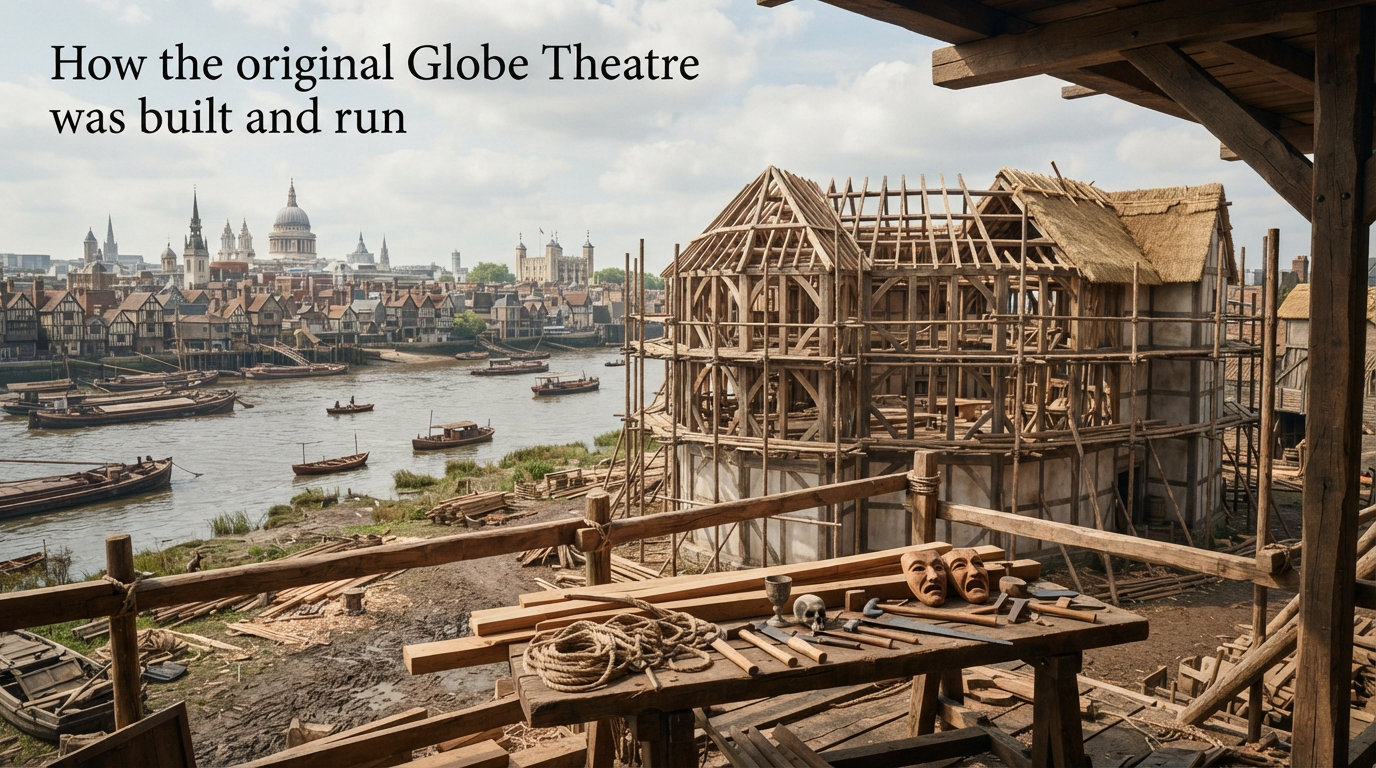
Understanding how the original Globe Theatre was built and run means stepping into the chaotic, creative heart of Elizabethan London. Built in 1599 by Shakespeare’s playing company, the Lord Chamberlain’s Men, the Globe was not just a building. It was a business, a workshop, and a cultural phenomenon rolled into one open-air wooden structure on the south bank of the Thames.
Most articles about the Globe stop at “it burned down in 1613 and was rebuilt.” That barely scratches the surface. The story of the Globe involves a daring midnight timber heist across a frozen river, a complex shareholder business model, a precise architectural design based on a 20-sided polygon, and daily operations that would look familiar to anyone who has worked in live entertainment today.
In this guide, we walk through the full lifecycle of the original Globe Theatre. You will learn why it was built, how construction actually worked step by step, what the building looked like inside and out, who owned and profited from it, how performances were run day to day, what audiences experienced, and what ultimately happened to the building. Whether you are a student, a Shakespeare enthusiast, or simply curious about Elizabethan theatre, this is the complete picture of how the Globe operated.
Table of Contents
Why the Globe Was Built: From the Theatre to Southwark
The Globe exists because of a landlord dispute and a clever legal loophole. To understand why it was built, you have to start with an earlier playhouse called simply the Theatre, built in 1576 in Shoreditch by James Burbage, a carpenter-turned-actor-turned-entrepreneur. The Theatre was the first purpose-built playhouse in London since Roman times. It served the Lord Chamberlain’s Men well for years, but there was a problem.
James Burbage did not own the land beneath the Theatre. He leased it from a Puritan landlord named Giles Allen, who had no love for theatre and made no secret of it. When Burbage died in 1597, the lease had only a short time left, and Allen made clear he intended to seize the building itself once the lease expired. The Burbage family, led by James’s sons Cuthbert and Richard, faced losing their primary venue.
The lease contained a clause that changed theatrical history. The agreement stated that Burbage owned the actual building, the timber structure itself, even though Allen owned the land. So Cuthbert and Richard Burbage hatched a plan: dismantle the Theatre, cart the timber away, and rebuild it somewhere else. They just needed a new location and some help covering the cost.
The location they chose was Bankside in Southwark, on the south bank of the Thames. This was the entertainment district of Elizabethan London, already home to bear-baiting arenas, brothels, and taverns. The area sat outside the strict jurisdiction of the City of London, which had banned theatres within its walls. Southwark was where Londoners went to have fun, making it the perfect spot for a new playhouse.
To fund the venture, the Burbages struck a deal that created the unique ownership structure of the Globe. They offered shares in the new theatre to members of the Lord Chamberlain’s Men, including William Shakespeare himself. The actors who held shares became “housekeepers,” meaning they jointly owned the building and received a portion of the profits. This was a radical idea at the time: actors not just performing in a theatre but actually owning it.
How the Original Globe Theatre Was Built and Run: The Construction
The construction of the Globe in 1599 is one of the most remarkable building projects in theatrical history. It was built largely from salvaged timber taken from the dismantled Theatre in Shoreditch, transported across London, and reassembled on a new site in Southwark. Here is how the process unfolded, step by step.
Step 1: Dismantling the Theatre
Over the Christmas period of 1598, while Giles Allen was away from London celebrating the holidays at his country home, the Burbage brothers and a crew of workmen dismantled the Theatre. This was technically legal under the lease terms, since the Burbages owned the building itself, but Allen later sued them anyway. The timber was carefully taken apart, beam by beam, and prepared for transport. A witness named John Street later testified that he saw the timbers being loaded up, confirming the event in court records.
Step 2: Transporting the Timber Across the Thames
The salvaged oak beams had to cross London from Shoreditch in the north to Southwark in the south. The most efficient route was by water. The timber was loaded onto barges and ferried across the River Thames during the winter of 1598 to 1599. This river crossing was both practical and symbolic: the Lord Chamberlain’s Men were literally carrying the bones of their old theatre to give it new life on the south bank, in the entertainment district where they could operate without interference from city authorities.
Step 3: Laying the Foundations
Once the timber arrived at the Bankside site, construction began with the foundations. Workmen dug trenches in the marshy Southwark ground and filled them with compacted limestone rubble to create a stable base. On top of this foundation, brick walls were laid to form the outer structure and provide a solid footing for the timber frame. This combination of limestone and brick was essential because the damp soil of the riverbank would have quickly rotted timber placed directly in the ground.
Step 4: Raising the Timber Frame
The main structure was built as a timber frame, a technique common in Elizabethan construction. Large oak beams were fitted together using mortise and tenon joints, held in place by wooden pegs rather than iron nails, which were expensive. The frame formed the skeleton of the building, and the salvaged beams from the Theatre were integrated wherever they would fit. The overall plan was based on an icosagon, a 20-sided polygon, which gave the Globe its distinctive round appearance.
Step 5: Walls, Roof, and Finishing
The spaces between the oak beams were filled with wattle and daub, a mixture of woven sticks and clay, then coated with lime-plaster to create smooth white walls. The galleries that surrounded the yard were built across three levels of seating. The roof over the galleries was thatched with water reed, a common roofing material in Elizabethan England. The central yard, where the groundlings stood, was left open to the sky. Above the stage, a canopy known as the Heavens was built and painted with stars and zodiac signs. The Globe was ready to open by the summer or autumn of 1599.
Architecture and Design: Shakespeare’s Wooden O
The Globe was an open-air amphitheatre shaped roughly like a 20-sided polygon, a design that gave it the nickname “the wooden O” in Shakespeare’s own words from the prologue to Henry V. The building measured approximately 30 metres in diameter and could hold somewhere between 1,500 and 3,000 people, depending on which historical source you consult. Modern estimates based on the reconstructed Globe suggest a practical capacity of around 1,500 to 1,700 people at full attendance.
The stage was rectangular and projected into the center of the yard, so it was surrounded on three sides by standing audience members. It stood about 5 feet high, raised above the groundlings who packed the pit below. This thrust stage design meant actors were in close contact with their audience, creating an intimacy that modern proscenium-arch theatres cannot easily replicate.
The Yard and the Groundlings
The central yard was an open, unroofed space paved with a mixture of ash, hazelnut shells, and other materials. People who paid a single penny stood here for the entire performance, earning them the nickname “groundlings.” These standing audience members were packed shoulder to shoulder. They had no shelter from rain or sun, and they were closest to the stage, which meant they could and did interact with the actors directly.
The Three Levels of Galleries
Surrounding the yard on three sides were three tiers of seated galleries, covered by the thatched roof. These seats cost more, typically two pennies for the lower galleries and up to six pennies for the most desirable seats with cushions. The galleries offered shelter from the weather and a better vantage point for watching the action below. The top gallery level was the cheapest seated option, while the lords’ rooms directly flanking the stage were the most expensive.
The Heavens and the Stage Structure
Above the stage, the canopy called the Heavens served both decorative and practical purposes. It was painted with a golden sky, stars, and signs of the zodiac, and it protected the actors from the elements. Beneath the stage was a cellar area accessed through a trapdoor, used for scenes involving ghosts, devils, and other characters who needed to appear from below. At the back of the stage stood a wall with two or three doors for entrances and exits, and possibly a balcony or upper playing area above, used for scenes like the famous balcony in Romeo and Juliet.
The Globe had no painted scenery in the modern sense and no artificial lighting. All performances took place in daylight during the afternoon. Actors relied on costumes, props, and spoken word to establish setting and mood. A flag flown above the building announced when a play was in progress: a black flag for tragedy, white for comedy, and red for history.
Who Owned and Ran the Globe Theatre
The Globe was owned and operated by the Lord Chamberlain’s Men, making it the first playhouse built specifically for and financed by an acting company rather than an outside investor. This ownership structure was the key to the company’s financial success and creative freedom. The theatre operated through a share system that divided both costs and profits among the company members.
There were two types of owners, called housekeepers and sharers. Housekeepers owned shares in the physical building itself and received a portion of the gallery ticket revenue. Sharers were the senior actors who held shares in the playing company and received a portion of the acting profits. Many members, including Shakespeare and Richard Burbage, held both types of shares. Cuthbert Burbage managed much of the business side, while his brother Richard was the company’s leading actor, famous for originating roles like Hamlet, Lear, and Othello.
Shakespeare’s stake in the Globe made him a wealthy man. His role was not just as a playwright and actor but as a co-owner who profited directly from every performance. When the company received a royal patent from King James I in 1603 and became the King’s Men, their prestige and earning power only increased. The Globe remained their primary venue for the next decade.
The Business Model
The Globe generated revenue through several streams. The primary source was ticket sales, divided between the gallery profits paid to housekeepers and the yard takings paid to the acting company. The housekeepers also collected rent from the acting company for the use of the building, creating a layered financial arrangement. Beyond ticket sales, the Globe earned money from refreshment sales, including ale, wine, apples, nuts, and gingerbread sold by vendors during performances. This was a significant revenue stream that competitors rarely mention in their accounts.
Daily Operations: How the Theatre Was Run
Running the Globe was a daily operation that required coordination between actors, stagehands, management, and vendors. Performances were held every afternoon except Sundays during the playing season, which typically ran from spring through autumn. There were no evening performances because the Globe had no artificial lighting and relied entirely on daylight.
A playbill announcing the day’s performance was posted in the morning. A trumpet fanfare sounded roughly half an hour before curtain to signal that the show was about to begin, giving people time to make their way to the theatre. The flag mentioned earlier also flew from the rooftop to advertise that a performance was happening, visible from across the Thames and throughout the surrounding streets of Bankside.
Ticket Pricing and the Box Office
Ticket pricing at the Globe reflected a clear social hierarchy. Groundlings paid one penny for standing room in the yard, roughly equivalent to about a tenth of a day’s wages for a skilled craftsman. A second penny bought a seat in the lower gallery. A third penny secured a better seat, and the most expensive seats in the lords’ rooms could cost up to six pennies. There was no advance booking system as we know it today. Audiences paid at the door on arrival, with collectors stationed at entry points to collect coins in pottery money boxes that were later smashed open in a back room to count the day’s takings.
The Acting Company and Actor Pay
The Lord Chamberlain’s Men, later the King’s Men, consisted of approximately 12 to 15 permanent members who held shares in the company. These sharers earned a portion of the profits after expenses and were the highest-paid members. Below them were hired men, salaried actors who received a fixed weekly wage, typically around 10 shillings per week in the early 1600s. Apprentice actors, often young boys training for female roles, received room and board plus training rather than a salary. Shakespeare himself acted in his own plays, though tradition suggests his roles were modest compared to Burbage’s leading turns.
Backstage Crew and Stage Management
The Globe employed a small but essential backstage crew. Stagehands managed props, costumes, and special effects, including trapdoor operations, smoke effects, and the cannon blanks used in battle scenes. A properties master maintained the company’s collection of swords, furniture, and theatrical devices. Costumes were among the most valuable assets the company owned, often purchased secondhand from noble households, and a wardrobe keeper was responsible for their maintenance and storage. Music was provided by company musicians stationed in the gallery above the stage, playing drums, trumpets, and other instruments for fanfares and atmospheric accompaniment.
Rehearsals and the Repertory System
The company operated on a repertory system, meaning they performed a different play nearly every day. This demanded enormous discipline from the actors, who had to keep dozens of plays in their memory simultaneously. Rehearsals were compressed compared to modern standards. A play might receive only a few full rehearsals before its first performance, with actors expected to learn their lines quickly from individual sides, which were scrolls containing only their own lines and cues rather than the full script. New plays were added constantly, with Shakespeare producing roughly two new plays per year for the company.
The Audience Experience: Groundlings to Gentlemen
Attending the Globe was a loud, physical, and deeply social experience that bore little resemblance to the hushed reverence of modern theatre. Audiences talked back to actors, moved around freely, ate and drank throughout performances, and responded vocally to what they saw on stage. The atmosphere was closer to a modern sporting event or rock concert than a quiet evening at the theatre.
The groundlings in the yard were the most interactive audience members. Standing just a few feet from the stage, they could touch the actors and shout commentary during the performance. Some historians believe Shakespeare wrote certain lines specifically to play to this crowd, mixing high poetry with bawdy humor to keep the groundlings engaged. The proximity meant actors had to project their voices over the noise of the crowd while also maintaining the emotional intensity of their performances.
Audiences at the Globe spanned the full social spectrum of Elizabethan London. Apprentices, laborers, and servants made up much of the groundling crowd, paying their single penny for an afternoon’s entertainment. Merchants, tradesmen, and their families occupied the galleries. Nobles and courtiers sometimes attended, and the lords’ rooms near the stage were designed for wealthy patrons who wanted to see and be seen. Women attended performances too, despite frequent complaints from Puritan critics who considered theatre a corrupting influence.
Refreshments, Pickpockets, and the Full Experience
Vendors moved through the crowd selling ale, wine, beer, apples, nuts, oranges, and gingerbread. These food and drink sales were an important secondary revenue stream for the theatre and kept audiences fed and watered during performances lasting two to three hours. Pickpockets were a known problem in the packed yard, and the Globe employed staff to deter and catch thieves. The open-air design meant performances went ahead rain or shine, though attendance would naturally drop during bad weather. Visitors who needed a bathroom used the privies outside the building, and the entire Bankside area offered further entertainment before and after the play.
The Fire of 1613 and the Rebuilt Globe
On June 29, 1613, the original Globe burned to the ground during a performance of Henry VIII, also known by its title All Is True. The fire started when a theatrical cannon fired during a scene representing the Duke of Buckingham’s arrival at a masque sent sparks or wadding into the thatched roof. The dry reed thatching caught fire almost immediately, and within an hour the entire building was consumed.
Remarkably, no one was killed. Contemporary accounts record that only one man’s breeches caught fire, and he was saved when a bystander doused the flames with a bottle of ale. The audience, estimated at around 3,000 people, evacuated safely through the two main exits. The speed of the fire was staggering, but the timber frame and thatched roof were essentially a giant tinderbox waiting for a spark.
The company rebuilt the Globe almost immediately. A second Globe Theatre, often called Globe 2, opened on the same site within about a year, by 1614. This rebuilt version incorporated several safety improvements learned from the disaster. The most significant change was the replacement of the thatched roof with clay tiles, which were fire-resistant. The new building was also slightly larger and incorporated modern architectural refinements. This second Globe served the King’s Men until the theatre closures of 1642.
The Decline and Demolition of the Globe
The Globe’s end came not through fire or financial failure but through political and religious upheaval. In 1642, the outbreak of the English Civil War led Parliament, dominated by Puritan lawmakers, to order the closure of all theatres in London. The decree banned stage plays entirely, condemning them as sinful distractions. The King’s Men, like every other playing company, were forced to stop performing.
The Globe stood empty and unused for several years. Without performances generating income, the company could not afford to maintain the building. In 1644, the Globe was pulled down to make way for tenement housing. Some sources suggest the timber was sold off or repurposed. The site was built over and largely forgotten, its exact location lost for more than 300 years until archaeological work in 1989 uncovered the original foundations beneath a modern building on Park Street in Southwark.
Shakespeare’s Globe: The Modern Reconstruction
The story of the Globe did not end with its demolition. In 1949, the American actor and director Sam Wanamaker visited London and was astonished to find no memorial to the most famous theatre in the English-speaking world. He made it his life’s mission to rebuild the Globe near its original site on Bankside. After decades of fundraising, planning, and scholarly research, construction of the modern reconstruction began in 1987.
The reconstructed Shakespeare’s Globe opened in 1997, a quarter-mile from the original site. It was built using traditional materials and techniques wherever possible, including oak timber framing, lime-plaster walls, and the first thatched roof permitted in London since the Great Fire of 1666. The reconstruction is not a perfect replica, as no complete architectural records of the original survive. Scholars made informed choices about dimensions, capacity, and stage layout based on fragments of evidence from court records, archaeological finds, and contemporary descriptions. The result is the closest thing we have to experiencing what a performance at Shakespeare’s Globe would have felt like, complete with open-air performances, groundling standing tickets, and daylight shows.
FAQs
Why did the Globe not have a roof?
The Globe did not have a roof over the central yard because it was an open-air amphitheatre designed to use natural daylight for performances. The galleries surrounding the yard were covered by a thatched roof to protect seated audience members, but the pit where the groundlings stood was left open to the sky. This design allowed maximum light and air circulation for an audience of up to 3,000 people packed into the building.
How accurate is the rebuilt Globe Theatre?
The reconstructed Shakespeare’s Globe, which opened in 1997, is a best-guess approximation rather than an exact replica. No complete architectural plans of the original Globe survive, so scholars based the reconstruction on archaeological evidence from the 1989 foundation dig, contemporary written descriptions, and court records. Key known differences include the use of fire exits, modern safety features, and a slightly smaller capacity. The thatched roof, oak timber frame, lime-plaster walls, and open-air design all closely follow Elizabethan construction methods.
What happened to the original Globe Theatre?
The original Globe Theatre built in 1599 burned down on June 29, 1613, during a performance of Henry VIII when theatrical cannon fire ignited the thatched roof. It was rebuilt within about a year by 1614 with a tiled roof instead of thatch. That second Globe operated until 1642, when Parliament ordered all London theatres closed during the English Civil War. The building was demolished in 1644 to make room for tenement housing, and the site was lost until archaeologists rediscovered the foundations in 1989.
Did they build the Globe for Hamnet?
No, the Globe Theatre was not built for Hamnet Shakespeare or in connection with him. The Globe was built in 1599 by the Lord Chamberlain’s Men, Shakespeare’s acting company, as a replacement venue after a lease dispute over their previous playhouse, the Theatre in Shoreditch. Hamnet, Shakespeare’s son, died in 1596 at age 11, three years before the Globe was constructed. The building was a business venture funded by the company’s shareholders.
What was the first play performed at the Globe Theatre?
The first play believed to have been performed at the Globe was Shakespeare’s Julius Caesar, staged in 1599 shortly after the theatre opened. The Swiss visitor Thomas Platter recorded seeing a performance of a play about Julius Caesar at a London theatre in September 1599, which scholars generally identify as the Globe. This makes Julius Caesar the earliest documented play performed in the new building.
How many people could the original Globe Theatre hold?
Historical estimates vary, but the original Globe Theatre likely held between 1,500 and 3,000 people at full capacity. Modern reconstructions and scholarship generally settle on a practical capacity of around 1,500 to 1,700. Of those, approximately 700 to 1,000 stood as groundlings in the open yard, while the remainder filled the three levels of covered galleries surrounding the stage.
Conclusion
Understanding how the original Globe Theatre was built and run reveals a story of ingenuity, enterprise, and theatrical innovation. The Globe was born from a landlord dispute, constructed from salvaged timber smuggled across the Thames, and financed through a pioneering shareholder model that gave actors ownership of their own venue. It was a building that combined practical engineering with artistic ambition, from its 20-sided icosagon frame to its painted Heavens canopy above the stage.
Day to day, the Globe operated as a serious commercial enterprise with tiered ticket pricing, a backstage crew managing props and effects, musicians providing live accompaniment, and a repertory system that demanded new material constantly. Audiences ranged from penny-paying groundlings in the muddy yard to nobles in cushioned gallery seats, all sharing the same performance in an atmosphere more like a festival than a formal theatre.
The Globe’s destruction by fire in 1613 and its eventual demolition in 1644 did not end its influence. The modern reconstruction on Bankside, opened in 1997 thanks to Sam Wanamaker’s decades-long campaign, allows audiences in 2026 to experience something close to what Shakespeare’s original audiences enjoyed. If you want to go deeper, visit Shakespeare’s Globe in London, read the original court records from the Giles Allen lawsuit, or explore the archaeological findings published after the 1989 foundation excavation. The Globe was not just a building. It was the engine room of English drama, and its story is still being told.