
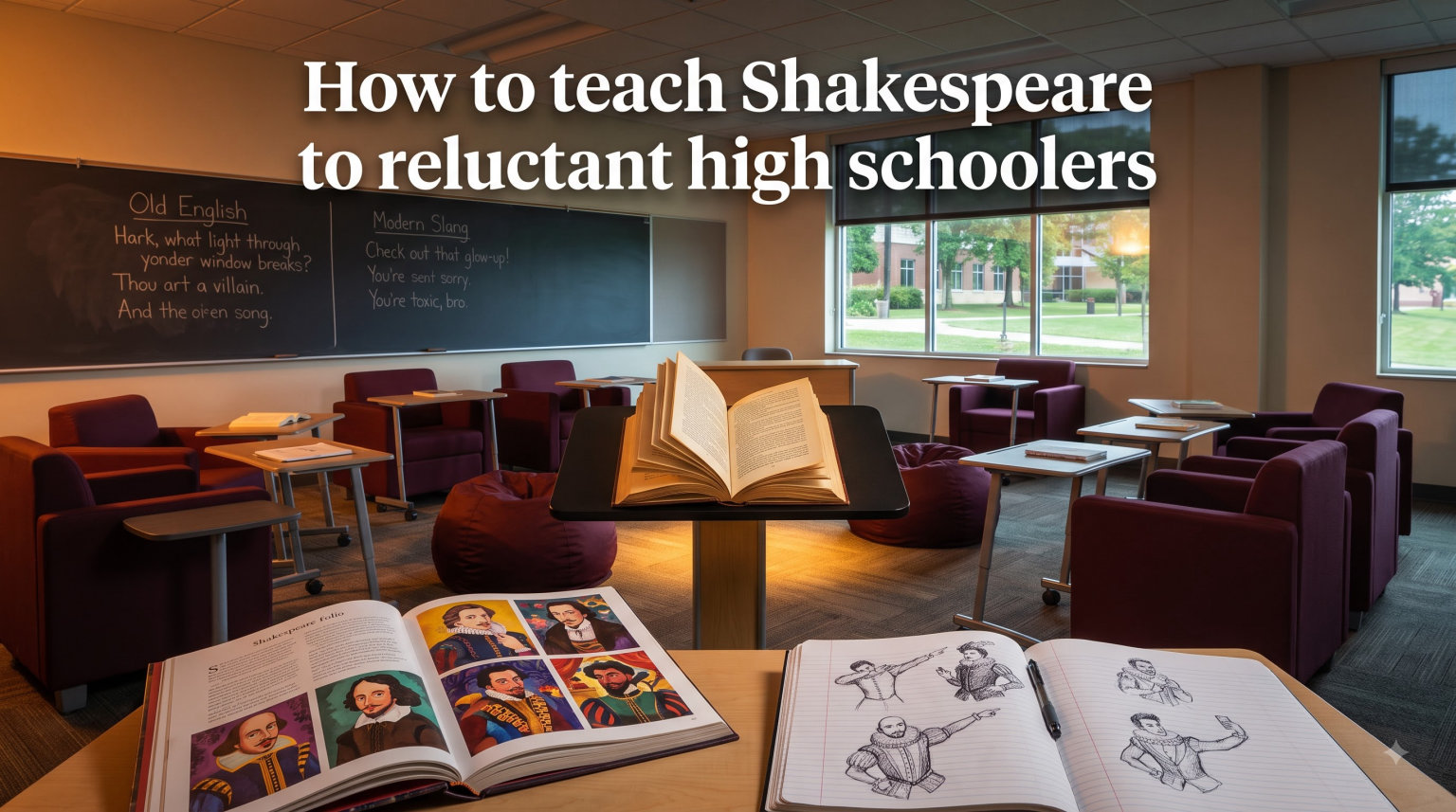
I remember the day I first heard a sophomore groan, “Do we HAVE to read this?” when I pulled out Romeo and Juliet. That was twelve years ago, and I’ve been learning how to teach Shakespeare to reluctant high schoolers ever since.
If you’re a high school English teacher staring down a unit on Shakespeare with a class full of glazed eyes, I get it. I’ve been there. After running Shakespeare units with 4,000+ students across nine grade levels, I want to share what actually works. Not theory. Not ideology. Real classroom-tested strategies that turn dread into genuine engagement, even with the most stubborn skeptics.
This guide covers the seven core strategies I use every year, how to make the language accessible, ways to connect the Bard to modern media, and specific plays that work best for reluctant learners. Let’s make Shakespeare the best part of your English class.
Table of Contents
Why Shakespeare Still Matters in 2026
Before diving into tactics, let’s address the elephant in the faculty lounge: should we even be teaching Shakespeare in 2026? Critics argue the canon is dated, irrelevant, and reinforces a colonial literary tradition. Some of those critiques are valid. But here’s what I’ve seen in my classroom: when taught well, Shakespeare teaches skills that no other text can match.
First, cultural capital is real. Students who can confidently discuss Shakespeare navigate college literature courses, decode Western references in films and music, and read between the lines in any complex text. We don’t teach Shakespeare because he’s sacred. We teach him because he keeps showing up everywhere once you start looking.
Second, Shakespeare wrote for teenagers. Romeo is a moody 16-year-old. Juliet is a rebellious 13-year-old. Hamlet procrastinates on his essay. Macbeth hears his dad’s voice in his head. These are not distant characters. They’re your students’ friends, siblings, and sometimes themselves. The themes — jealousy, revenge, identity, first love, parental pressure — never go out of style.
Third, the language teaches critical thinking. Wrestling with ambiguous syntax, archaic vocabulary, and layered meaning builds the exact analytical muscles students need for standardized tests, college writing, and informed citizenship. That’s a real-world skill, not a dusty credential.
How to Teach Shakespeare to Reluctant High Schoolers: 7 Core Strategies
When I ask teachers on Reddit’s r/ELATeachers what works, the same strategies surface again and again. Here are the seven I swear by, refined over a decade of trial and error.
1. Start With Bellringers, Not the Whole Play
Don’t open with “Today we begin Hamlet.” Start with a 5-minute bellringer. A sonnet on the board. A quote analysis. A juicy passage question. By the time students realize they’ve been doing Shakespeare for ten minutes, you’ve already won half the battle. This technique, popularized by teachers like David Rickert, lowers the stakes dramatically.
2. Read Aloud, Always
I have never once regretted reading Shakespeare aloud with a class. Reading aloud transforms difficult passages into something communal, performative, and surprisingly funny. One teacher on Reddit shared that her students now fight over who gets to read Mercutio. That doesn’t happen when they’re reading silently.
Rotate readers. Use volunteers. Assign parts. Let dramatic voices emerge. The sound of Shakespeare in your classroom is half the magic.
3. Paraphrase Actively With Students
Don’t paraphrase for them. Paraphrase WITH them. After reading a dense passage, ask the class to translate it into modern English together. Write a paraphrase side-by-side with the original text. This builds comprehension and confidence without removing the challenge.
The Folger Method emphasizes this exact approach: students encounter the original language with support, not as a punishment.
4. Use Film Adaptations Strategically
Show film clips, not entire films. Show the famous scenes first, then have students read the actual text. The 1996 Baz Luhrmann Romeo + Juliet works because it keeps the original language. The 1995 Sense and Sensibility shows how Shakespearean themes survive in modern adaptations.
Showing adaptations before reading builds context and visualization. Showing them after gives students something to compare against the original.
5. Act Out Scenes
Even shy students surprise themselves when they step into a role. Modern adaptations with gender-swapped casting, contemporary costumes, and improvised dialogue work wonders. For the famous balcony scene, try a TikTok version. For the Macbeth witches, try a modern crime boss interpretation.
Performance embeds the language in memory. Students who act out “Is this a dagger which I see before me?” never forget the line.
6. Focus on Key Lines, Not Full Speeches
Don’t assign a five-page monologue for homework. Instead, pick three or four key lines per scene and analyze them deeply. “To be or not to be” is more powerful when students spend 20 minutes unpacking its three possible meanings than when they skim past it in a 400-line soliloquy.
This is the difference between drowning students in iambic pentameter and teaching them to hear it.
7. Connect to Modern Media and Memes
I’m a teacher, and I use memes. Students respond to “Wherefore art thou Romeo” as a TikTok trend. They connect to Hamlet’s “To be or not to be” through gaming streams. They recognize Lady Macbeth’s guilt through true crime documentaries. Make the connections explicit. Don’t leave it to them to bridge 400 years on their own.
Making the Language Accessible
The single biggest barrier between students and Shakespeare is the language. Solve this, and you’ve solved 80% of the reluctance problem.
Here’s my three-tier approach. First, use a modern paraphrase as a scaffold, not a substitute. No Fear Shakespeare, the Folger editions, and the SparkNotes side-by-side versions give students the support they need without replacing the original text. Let students read the modern version alongside the original, then graduate to the original alone.
Second, build a class glossary. As you encounter archaic words (“thou,” “wherefore,” “hither”), add them to a shared document. After a few weeks, students have a personalized reference. This scales across the year and across plays.
Third, watch for the major linguistic shifts. “Wherefore” doesn’t mean “where.” It means “why.” “Thee” is the object form of “you.” Pronouns flipped during the 17th century. Once students grasp these patterns, the language becomes a code to crack, not a wall to scale.
Don’t hide from difficult passages. Walk through them together. The Folger Method works because it insists on close reading with the original text, not bypasses the original.
Connecting Shakespeare to Modern Media
Shakespeare did not write in a vacuum. He wrote for the masses, using pop culture references, current events, and bawdy humor we’d recognize today. Lean into that lineage with your students.
Compare the Lovers’ Quarrel in A Midsummer Night’s Dream to a K-drama love triangle. Compare Hamlet’s indecision to a Marvel hero weighing the multiverse. Compare Julius Caesar’s funeral oration to a modern political speech. Use song lyrics, movie trailers, and viral videos as companion texts.
When I teach Romeo and Juliet, I open with the West Side Story comparison. The Jets and the Sharks ARE the Montagues and the Capulets. The connection is immediate, and students stop seeing Shakespeare as foreign.
Shakespeare’s plots became your favorite movies. The more you can show this, the less students will resist the original source material.
Building Confidence in Struggling and ESL Readers
Some students face extra barriers. Struggling readers freeze at the first weird sentence. ESL students see unfamiliar syntax and unfamiliar vocabulary at the same time. Both groups need different scaffolding.
For struggling readers, use graphic novel versions of the plays. The Marvel and Classical Comics adaptations are accurate, accessible, and engaging. Pair them with audio versions of the original text. Listen in class. Read along. Let students see the visuals while they hear the words.
For ESL students, slow down the iambic pentameter. Normal speech patterns make comprehension easier. Provide a vocabulary list with every scene. Highlight cognates where they exist. Compare the language to modernized versions like the Donmar Warehouse productions.
I’ve seen students who started a unit saying “I can’t read this” finish by quoting Macbeth in the hallway. That shift doesn’t happen by accident. It happens because teachers built the right scaffolding and refused to lower expectations.
Plays That Work Best for Reluctant Learners
Not all Shakespeare plays are equally accessible. After years of teaching, here’s my shortlist:
Romeo and Juliet is still the best entry point. Short scenes, fast action, real teenagers, and a tragedy that resonates with every high school student who’s ever had a crush or a curfew.
Macbeth works because it’s a thriller with witches, murder, and paranoia. The supernatural elements hook students who think Shakespeare is “just love stories.”
A Midsummer Night’s Dream is perfect for reluctant readers. It’s funny, surreal, and forgiving. Even if students don’t catch every reference, the magic and mistaken identities keep them engaged.
Save Hamlet and King Lear for students who have already built confidence. The philosophical depth is real, but it rewards readers who already trust the language.
FAQs
What is the best way to teach Shakespeare to high school students?
Start with engagement, not full immersion. Use bellringers, read aloud daily, paraphrase together, and show film adaptations before reading the original text. Focus on key lines rather than entire speeches, and connect scenes to modern media students already love. Build confidence through scaffolding before expecting deep analysis. The Folger Method of close reading with original-language support is widely considered the gold standard.
How do you make Shakespeare interesting for reluctant readers?
Make Shakespeare performative, not passive. Read aloud in class, act out scenes, and use modern adaptations as a bridge. Graphic novel versions of the plays help visual learners. Show film clips before assigning reading, then compare the adaptation to the original text. Focus on themes students care about: jealousy, identity, revenge, forbidden love. The moment students see themselves in the characters, the resistance fades.
What are the biggest challenges when introducing Shakespeare to teenagers?
The three biggest challenges are archaic language, perceived irrelevance, and intimidation. Students freeze at unfamiliar syntax, assume Shakespeare is boring because teachers assign it as a chore, and feel stupid when they don’t understand passages. Address these by paraphrasing together, connecting to modern media, and creating low-stakes early entry points like bellringers and short soliloquies rather than full-play assignments.
How to break up the monotony of reading Shakespeare?
Break the play into chunks. Assign only key scenes, not entire acts. Use multiple entry points: reading aloud, film clips, acting, paraphrasing, and close reading. Rotate between individual, paired, and group work. Use bellringers at the start of class for sonnets and quote analysis. Mix in modern adaptations as companion texts. The more variety, the less any one approach feels monotonous.
Should Shakespeare be taught in high school?
Yes, but with intention. Shakespeare teaches critical thinking, cultural literacy, and analytical skills that transfer to any text. He wrote for popular audiences, not elites, and his themes — love, jealousy, power, identity — remain universal. The key is teaching Shakespeare as a living, entertaining playwright rather than a museum piece. When taught well, students leave understanding the references in modern media and the foundation of Western literature.
Final Thoughts on Teaching Shakespeare to Reluctant High Schoolers
Teaching Shakespeare to reluctant high schoolers is one of the most rewarding challenges in education. The students who resist loudest often become the most moved when they finally crack the code. I’ve had juniors who started the year rolling their eyes at “wherefore” and ended it performing a scene they wrote themselves.
Start with low-stakes engagement. Read aloud. Use film. Connect to what students already love. Build confidence gradually. The Bard wrote for the masses, and his work still resonates in 2026 when teachers bring it to life in their classrooms.
Try one strategy this week. Add a bellringer. Show a 3-minute film clip. Let students choose their roles. You’ll see the shift. Shakespeare’s audience was standing in the pit at the Globe, and yours is sitting in your classroom waiting for you to make it real.