
Yes, a trip to Stratford-upon-Avon is absolutely worth it for literature lovers. This small Warwickshire market town is the only place on earth where you can stand in the room where William Shakespeare was born, walk to the church where he was baptised and buried, and finish the day watching one of his plays performed by the Royal Shakespeare Company. No other town in England offers that complete literary arc for fans of the Bard.
I went in spring with a copy of Hamlet in my bag and came back convinced that Stratford-upon-Avon isn’t just a tourist stop, it’s a working chapter of English literature. The town is compact, walkable, and crammed with five connected Shakespeare Trust properties, a world-class theatre, and the kind of layered Tudor history that makes a 400-year-old text feel suddenly alive.
If you’ve ever finished a play and wondered what it would feel like to walk the streets its author walked, this is the closest you can get. In this guide, I’ll walk you through the key sites, address the “too touristy” worry, and help you decide whether a day trip or overnight stay fits your literary appetite.
Table of Contents
Why Stratford-upon-Avon Is a Literary Pilgrimage Unlike Any Other
Stratford-upon-Avon is the only English town where Shakespeare was born, grew up, married, worked, retired, and died. That fact alone makes it the single most important literary pilgrimage site in the English-speaking world. For literature lovers, this is the equivalent of visiting Kafka’s Prague or Joyce’s Dublin.
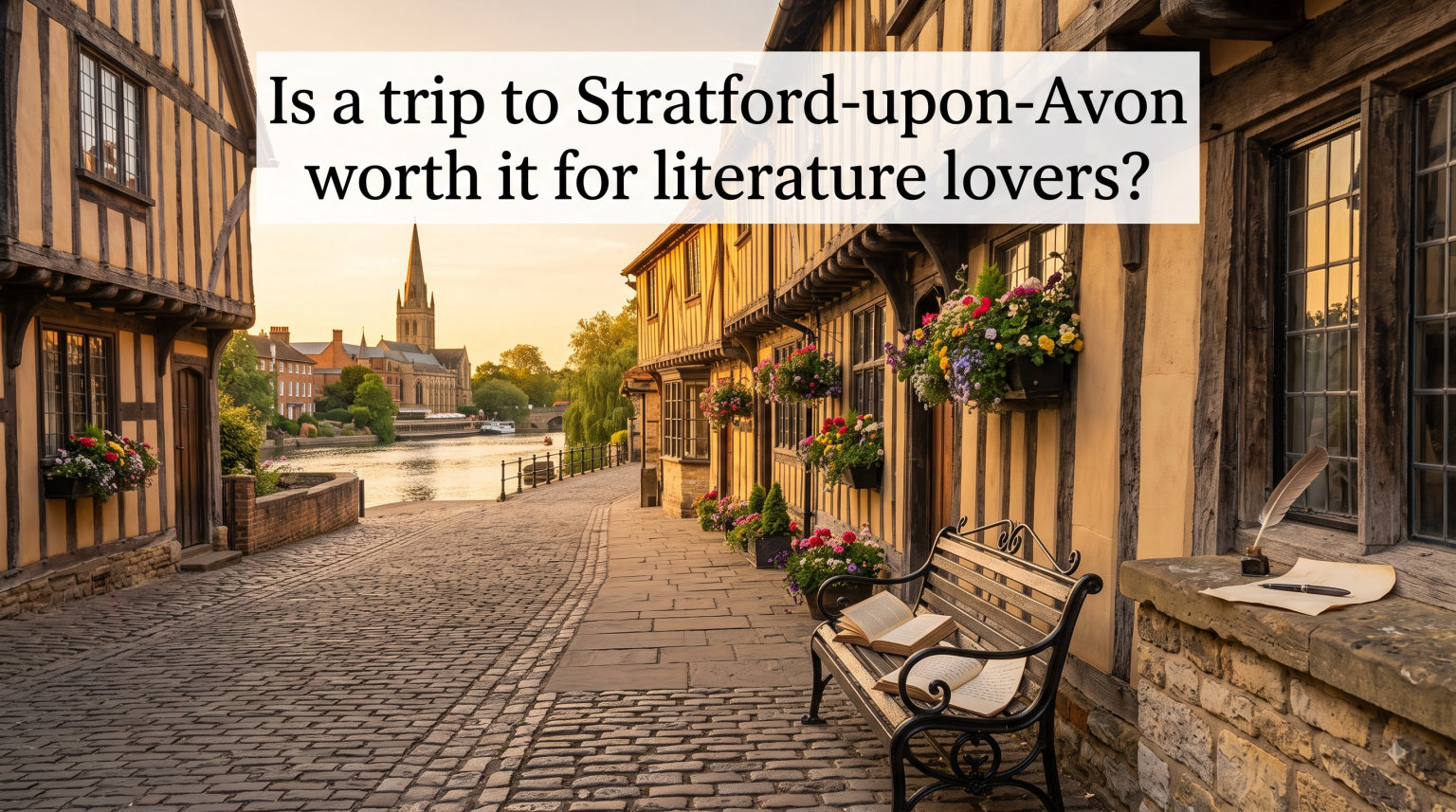
Tudor architecture is everywhere you look. The half-timbered buildings lean slightly into each other along Henley Street, and the River Avon drifts past the rear gardens of properties Shakespeare himself would have known. The town has preserved its medieval market town character remarkably well, even with the inevitable tourist trappings.
What surprised me most was how quiet some of the streets become after the day-trippers leave on the 5pm train. Early mornings and late afternoons, you can almost hear the echoes of the 16th century, especially along the riverside paths near the Royal Shakespeare Theatre.
The Shakespeare Birthplace Trust manages five properties in and around the town, and they are designed to be visited together. Each one tells a different chapter of the Bard’s life, turning the town into a readable biography in itself. For literature lovers, this depth is what separates Stratford from any other heritage site in the UK.
Shakespeare’s Birthplace: Walking Into the Bard’s Childhood
Shakespeare’s Birthplace on Henley Street is the most important stop on any literary pilgrimage. The half-timbered house where Shakespeare was born in 1564 has been preserved and restored by the Shakespeare Birthplace Trust, and you can actually walk through the very room where he entered the world.
The costumed guides at the Birthplace are unusually good. They don’t pretend to be Shakespeare himself, but they answer questions in character as Tudor townsfolk, which makes the experience feel intimate rather than scripted. One guide explained to me how the Shakespeare family would have lived above their glove-making workshop, with apprentices sleeping in the same room as the children.
The museum section on the ground floor is small but thoughtful. It includes the actual window where visitors scratched their names into the glass during the 18th and 19th centuries, including the signatures of Charles Dickens and Lord Byron. Seeing those scratched names reminds you that literary pilgrims have been coming here for centuries.
The garden at the rear is quieter than the house itself. It contains a mulberry tree, planted from a cutting of the one Shakespeare supposedly planted in New Place. If you visit in May or June, the scent is overwhelming. I sat on a bench for 20 minutes reading Sonnet 18 aloud, and other visitors smiled rather than stared.
Worth noting: the Birthplace gets crowded between 11am and 2pm. I went at 9am when they opened and had the upstairs room almost entirely to myself. For literature lovers, that quiet hour is worth queuing for.
Holy Trinity Church: Where the Poet Rests
Holy Trinity Church on the banks of the Avon is where Shakespeare was baptised in 1564 and where he was buried in 1616. Standing in this quiet medieval church, looking at his worn chest tomb, is one of the most emotionally charged moments a literature lover can experience anywhere in England.
The famous curse inscription on Shakespeare’s tombstone reads: “Good friend for Jesus’ sake forbeare, to digg the dvst encloased heare. Bleste be ye man yt spares thes stones, and cvrst be he yt moves my bones.” This isn’t just a gothic flourish. The threat was effective: his bones have never been disturbed.
Entry to the church itself is free and very much worth it for the medieval stained glass and the riverside setting. There is a small charge to enter the chancel where Shakespeare’s grave sits, and an even smaller charge to view the grave of his wife Anne Hathaway in the same area. For literature lovers, neither is optional.
The churchyard is the perfect place to read a poem or two. I sat under the yew tree near the Avon and worked through the entire sequence of the 154 sonnets. There is something powerful about reading Sonnet 71 (“No longer mourn for me when I am dead”) within feet of the man who wrote it.
The walk from the town centre to Holy Trinity along the Avon is one of the most pleasant half-miles in the Midlands. Allow at least 90 minutes for the church and chancel combined, plus time to sit.
The Royal Shakespeare Company: Living Literature in Performance
The Royal Shakespeare Company (RSC) is the heart of Stratford-upon-Avon’s literary identity, and quite possibly the single best reason to make the trip. Catching an RSC production turns a museum visit into a living encounter with the texts.
The Royal Shakespeare Theatre sits directly on the River Avon, with a glass-fronted balcony that overlooks the water. The main house seats around 1,000 people, and the auditorium is designed to put the audience close to the actors. Watching a Shakespeare play here, in the town where he was born, is a fundamentally different experience from seeing it in London or New York.
Tickets are priced in tiers and sell out fast, especially for the major productions. I would book at least 6 to 8 weeks before your visit, and longer for the summer season. Standing tickets are released on the day for around £10, and these are the same seats used for press night. If you are visiting specifically for literature, the play is non-negotiable.
The RSC also runs the Swan Theatre (a smaller, more intimate space) and The Other Place (a studio theatre). Backstage tours, exhibitions, and pre-show talks are worth booking as well. The RSC has a beautiful bookshop on the ground floor that is independently excellent, even if you skip the show.
For literature lovers in London, the Globe Theatre is wonderful, but it specialises in the theatrical experience. The RSC offers the theatrical experience plus the geographical and historical context. If you have to choose one, and you care about the source, choose Stratford.
Anne Hathaway’s Cottage and Other Shakespeare Sites
Anne Hathaway’s Cottage in the village of Shottery is one mile west of the town centre. This is the farmhouse where Shakespeare’s wife grew up, and where he would have courted her before their marriage in 1582. The thatched roof and original Tudor furniture make it feel like a real home rather than a museum.
The cottage garden is famous for its apple trees, roses, and the “courtship tree” supposedly planted by Shakespeare. It is more peaceful than the Birthplace, and the audio tour is genuinely moving. Literature lovers in particular appreciate the cottage because it gives Anne Hathaway a presence she rarely gets in the plays themselves.
Shakespeare’s New Place is the site of his family home from 1597 until his death. The original house was demolished in 1759, but the gardens are beautifully restored and contain an interactive exhibition. Hall’s Croft, the home of his eldest daughter Susanna and her husband Dr John Hall, is also worth a visit for the medical history angle and the lovely knot garden.
Mary Arden’s Farm (Wilmcote) is Shakespeare’s mother’s childhood home. It is more of a half-day visit than a quick stop, with rare-breed Tudor animals and costumed farming demonstrations. Skip it if you are short on time, but it is a delight if you have an extra morning.
Shakespeare’s Schoolroom and Guildhall is a small but fascinating site that shows where the young Shakespeare would have studied. The grammar schoolroom is still used by the local secondary school, which makes the experience feel layered with living history.
Beyond the Tourist Trail: Hidden Literary Gems
Stratford-upon-Avon has more depth than the obvious sights suggest. I picked up a few quieter corners that serious literature lovers will appreciate.
The Stratford Town Walk with Shakespeare character actors is led by performers who actually quote the plays as you wander. The 2-hour walk is cheaper than the bus tour and more theatrical. Our guide did a 5-minute Falstaff monologue in front of the Garrick Inn that drew spontaneous applause from passers-by.
The Garrick Inn claims to be the oldest pub in Stratford-upon-Avon, dating back to the 15th century. Shakespeare certainly walked past it. The interior is dark, atmospheric, and serves excellent local ales. It is the perfect place to finish a day of literary sightseeing with a quiet pint and a session of sonnets.
The American Fountain on the Bancroft Gardens is a 19th-century gift from an American, George Childs, in gratitude for the inspiration Shakespeare gave to American literature. It is also where the RSC theatre audiences gather on warm evenings before performances. Sitting on the steps watching the swans on the Avon is free London-therapy grade peace.
The RSC’s own bookshop, the British Shakespeare Company shop, and the small independent retailers on Meer Street are worth browsing. I picked up a Folger’s edition of Hamlet at the RSC shop for a fair price, and the staff actually knew their Shakespeare, which is more than I can say for most chain bookshops.
If you are visiting around the birthday celebrations in late April or the birthday or Hamnet-related events throughout the year, the town takes on a festival atmosphere that is genuinely moving. The recent popularity of Maggie O’Farrell’s novel Hamnet has brought a wave of new pilgrims, particularly readers interested in Shakespeare’s family life.
Is Stratford-upon-Avon Too Touristy? An Honest Assessment
Yes, parts of Stratford-upon-Avon are touristy. Henley Street in the height of summer can feel like a theme park for Shakespeare, with M&S Shakespeare-branded tea towels next to the actual birthplace. If you arrive expecting a deep literary experience and walk straight into the summer queue at the Birthplace, you will probably leave a bit disappointed.
But the touristy layer is shallow. Step off Henley Street, walk down to the river, or visit in the shoulder season, and the town reveals itself. The Shakespeare Birthplace Trust sites are run by serious academics and actors, not theme-park operators. The RSC is genuinely one of the best theatre companies in the world. The churches, gardens, and walking paths are real.
My honest recommendation: visit in spring or autumn, stay overnight, and avoid the Henley Street squeeze. The town is at its best at 8am and 7pm, when the day-trippers are either still on trains or have already gone. If you do this, Stratford-upon-Avon stops being a tourist trap and becomes what it always was: a real English market town with an extraordinary literary inheritance.
For literature lovers specifically, the question isn’t really whether the town is touristy. The question is whether a touristy town preserves Shakespeare’s living legacy better than any other option. The answer is yes, and it isn’t close.
Planning Your Trip: Day Trip vs Overnight Stay
A day trip to Stratford-upon-Avon from London is feasible. The train from Paddington via Oxford takes about 2 hours, and you can realistically fit the Birthplace, Holy Trinity Church, and a quick walk along the river into one long day. You will not have time for the RSC performance, which is the main sacrifice.
From Birmingham, Stratford-upon-Avon is just 45 minutes by train, which makes it an easy half-day trip. From Oxford, it’s under an hour, and combining it with a Cotswolds stop is a popular itinerary for literature lovers travelling through the Heart of England.
An overnight stay is significantly better for literature lovers. It gives you the morning quiet at the Birthplace, the afternoon at Holy Trinity, a pre-theatre dinner, an RSC performance, and the next morning to walk the river before the crowds arrive. Two nights is the sweet spot if you also want to visit Anne Hathaway’s Cottage and Shakespeare’s New Place without rushing.
My recommended two-day itinerary:
- Day 1 morning: Shakespeare’s Birthplace (9am opening)
- Day 1 midday: Walk to Shakespeare’s New Place and Hall’s Croft
- Day 1 afternoon: Holy Trinity Church and riverside walk
- Day 1 evening: RSC performance
- Day 2 morning: Anne Hathaway’s Cottage in Shottery
- Day 2 afternoon: Shakespeare’s Schoolroom and Town Walk
Practical Logistics: Getting There and Around
By train from London, take the Great Western Railway service from Paddington via Oxford. The journey is direct and takes just over 2 hours. From Birmingham Moor Street, the Shakespeare Line runs shuttle services every 30 minutes and takes around 45 minutes.
The town centre is genuinely walkable. Everything in the main cluster (Birthplace, New Place, Hall’s Croft, town centre, theatre) is within 15 minutes on foot. Anne Hathaway’s Cottage and Mary Arden’s Farm are about a mile out, and the local sightseeing bus or a taxi is the easiest way to reach them.
The Shakespeare Birthplace Trust offers combined tickets for all five properties, which saves money if you plan to visit more than two. The RSC handles its own ticketing separately. Booking plays in advance is essential, especially for weekend performances and the summer season.
For 2026, the Shakespeare Birthplace Trust has expanded its evening events and literary talks, which are worth checking the calendar for before you go. The town itself is easy to navigate, and the tourist information centre on Bridgefoot is helpful for last-minute bookings.
Frequently Asked Questions
How many days do you need in Stratford-upon-Avon?
Two days is the ideal length for a Stratford-upon-Avon trip focused on literature. You can hit the main sites in one long day, but you will miss the RSC performance in the evening. A single overnight lets you see the Birthplace, Holy Trinity Church, and Anne Hathaway’s Cottage without rushing, plus an RSC play.
Is Stratford-upon-Avon worth visiting for adults?
Yes, Stratford-upon-Avon is well worth visiting for adults, especially those interested in literature, theatre, and Tudor history. The town offers a depth of Shakespeare-related sites that no other English destination can match, plus world-class RSC productions. Adults who aren’t Shakespeare fans will still enjoy the half-timbered architecture and the riverside setting.
What is the main reason people visit Stratford-upon-Avon?
The main reason people visit Stratford-upon-Avon is its connection to William Shakespeare. The town is his birthplace, the location of his burial, and home to the Royal Shakespeare Company. It is the only English town where Shakespeare was born, lived, married, and died, making it a unique literary pilgrimage for fans of the Bard.
Can you do a day trip to Stratford-upon-Avon from London?
Yes, a day trip to Stratford-upon-Avon from London is easily done in about 2 hours each way by train from Paddington. A long day allows you to visit Shakespeare’s Birthplace, Holy Trinity Church, and the town centre. You will need to skip the RSC performance, which is the main reason to consider an overnight stay instead.
Is Stratford-upon-Avon worth it if I don’t like Shakespeare?
It depends on what you do enjoy. Stratford-upon-Avon is worth visiting for Tudor architecture, riverside scenery, and theatre in general, even without strong Shakespeare interest. The RSC also stages modern classics and new writing. However, if you have no interest in Shakespeare, English literature, or Tudor history, most of the town’s appeal will be lost.
Final Verdict: Worth Every Mile for Literature Lovers
Is a trip to Stratford-upon-Avon worth it for literature lovers? Unequivocally yes. This is the only English town where Shakespeare was born, lived, married, and buried, and the only place where you can experience his texts in performance with the geographical context fully intact. Walk the same streets, sit in the same church, and watch the plays come alive at the Royal Shakespeare Company. That combination doesn’t exist anywhere else.
Book your train, pick an RSC performance, and give yourself at least one night. The literature will thank you for it.