
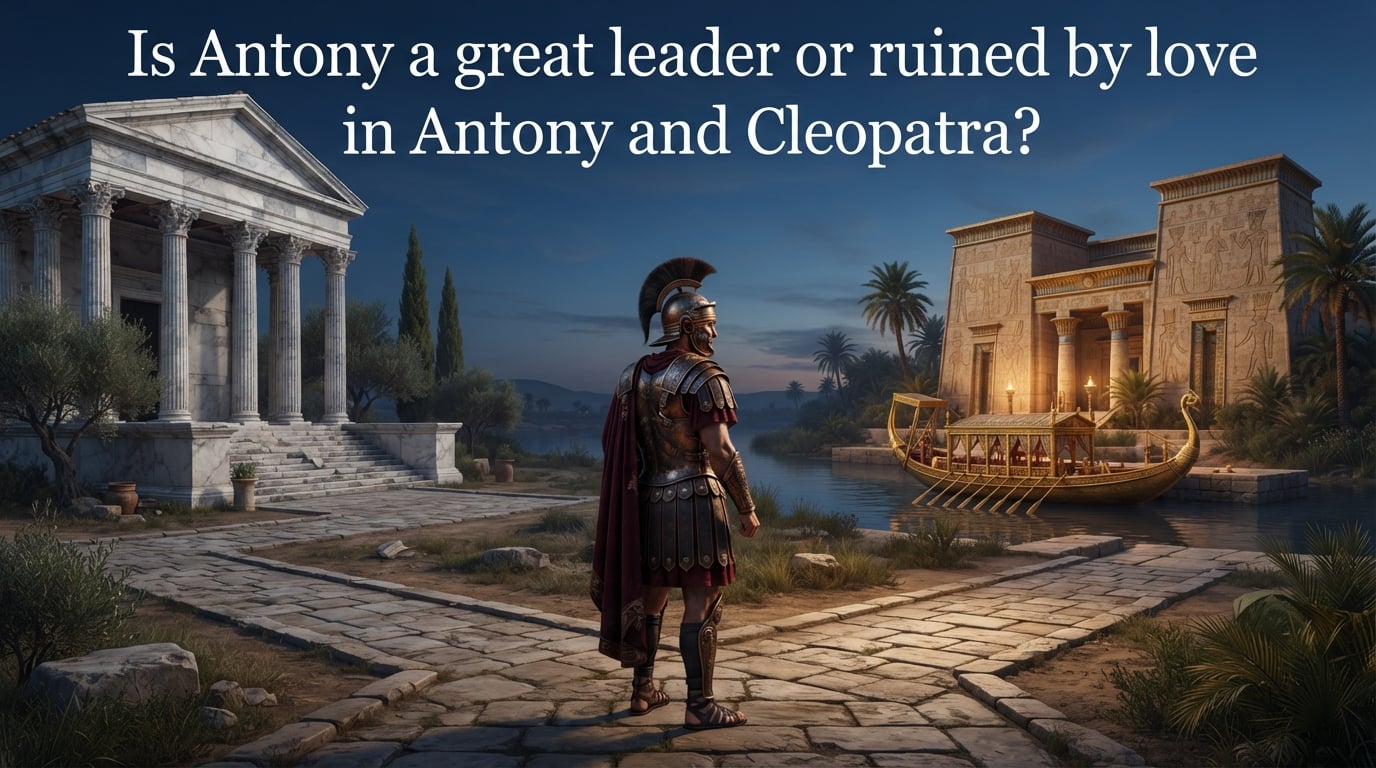
Shakespeare’s Antony is both a great leader and a man ruined by love, and that is exactly what makes him tragic. In Antony and Cleopatra, Mark Antony enters as one of the three most powerful men in the Roman world, a battle-hardened triumvir whose military reputation once rivaled anyone alive. Yet by the final act, he has lost his empire, his fleet, and his life, undone by a passion he cannot control. The play asks us to hold both truths at once: his greatness is real, and so is his destruction.
When readers and students ask whether Antony is a great leader or ruined by love in Antony and Cleopatra, the honest answer is that Shakespeare built the entire play around the tension between these two possibilities. Antony never stops being a soldier at heart. His tragedy is not that love replaces his courage, but that it warps his judgment until the two halves of himself cannot coexist.
What follows is a close analysis of Antony’s character across the play, drawing on textual evidence, historical context, and Shakespeare’s dramatic structure. We will look at his military credentials, his transformation through Cleopatra, the love-versus-duty conflict, and how Shakespeare positions Octavius Caesar as his foil. By the end, you will have a clear framework for understanding why Antony’s story resists a simple either-or answer.
Table of Contents
Antony as a Roman Leader and General
Before he is a lover, Antony is one of Rome’s greatest living soldiers. Shakespeare’s audience would have known this from Julius Caesar, where Antony delivers the funeral oration that turns the Roman crowd against the conspirators and proves himself a master of political rhetoric. His “Friends, Romans, countrymen” speech is not decoration. It establishes him as a man who can command masses with his voice alone.
By the opening of Antony and Cleopatra, Antony rules as one of the three triumvirs governing the Roman world, alongside Octavius Caesar and Lepidus. This is not a symbolic title. The triumvirate controls armies, territories, and the political future of the Mediterranean. Antony commands the eastern provinces, which makes him the most strategically placed of the three. He has real power and the military record to justify it.
The play reminds us of his battlefield reputation repeatedly. Even his rivals acknowledge what he once was. Octavius himself admits that Antony was a man “whose legs shall march” to fortune, and describes his former glory in terms that border on awe. Pompey the Great fears Antony specifically because he knows Antony’s military capabilities. When Pompey considers whether to fight the triumvirs by sea, he worries most about Antony, calling him the experienced soldier of the group.
Shakespeare also gives us testimony from Antony’s own followers. Enobarbus, the most clear-eyed character in the play, describes Antony as a soldier who once embodied Roman discipline and courage. The play’s opening scene sets the contrast immediately. Philo complains that Antony’s “eyes” now turn toward Cleopatra instead of toward his duties. The very first image is of a great man in the act of being distracted from his greatness.
This framing matters. Shakespeare does not present Antony as a mediocre leader who happened to fail. He presents a genuinely exceptional leader whose abilities make his decline all the more devastating. If Antony had been weak from the start, there would be no tragedy. The play’s emotional power depends on the audience knowing what he is losing.
How Love Transformed Antony: The Cleopatra Relationship
Cleopatra does not merely distract Antony. She reshapes his identity. The play opens in Alexandria, with Antony neglecting his Roman responsibilities entirely, and the Egyptian court provides a world of sensory excess that stands against everything Roman discipline represents. Shakespeare frames this as a transformation, not a small lapse.
The most famous description of Cleopatra comes not from Antony but from Enobarbus, whose barge speech paints her as almost supernatural. He describes her on the river Cydnus in language that overwhelms the senses: she lies in a golden pavilion, attended by boys who fan her, and the air itself seems to “beg” for her presence. Enobarbus admits that Antony cannot be pulled away from a woman described this way. The speech explains the hold she has without reducing it to simple seduction.
What love does to Antony is specific and destructive. He ignores messengers from Rome. He neglects his wife Fulvia’s cause during her conflict with Octavius. When news finally reaches him that Fulvia is dead and war is brewing, Antony recognizes his own dereliction. He says the “strong neck of Egypt” has become his prison. This is self-awareness, not blindness. Antony knows what he is doing and cannot stop.
His behavior in Egypt represents everything a Roman leader should not be. He feasts, he drinks, he spends nights in pleasure while his empire demands attention. Shakespeare draws on Plutarch’s Lives for this portrayal, and the historical record supports the broad strokes. But Shakespeare heightens the contrast dramatically. The Antony of Julius Caesar would never have let messengers wait. The Antony of this play does it repeatedly.
The transformation is not just behavioral. It is psychological. Antony begins to measure his self-worth through Cleopatra’s approval rather than through Roman honor. When she flatters him, he feels like a king. When she mocks him, he questions everything. This emotional dependency is what the play identifies as his true undoing. Cleopatra herself is not a villain. She is a sovereign queen with her own political agenda. But Antony’s response to her is what destroys him.
Is Antony a Great Leader or Ruined by Love in Antony and Cleopatra?
The answer Shakespeare constructs is that Antony is both simultaneously, and the play’s genius lies in refusing to separate the two. Antony’s leadership greatness and his ruin through love are not competing explanations. They are the same story told from two angles. His capacity for passion is inseparable from his capacity for command, and that is precisely what makes him a tragic figure rather than a simple failure.
Consider the evidence for his continued greatness. Even deep in his decline, Antony rallies. After the messengers finally wake him to Rome’s crises, he returns to his duties, marries Octavia to seal a political peace with Octavius, and briefly reasserts himself as a statesman. He commands the land forces at the beginning of the war against Octavius with real tactical skill. Pompey’s earlier fear of Antony was not misplaced. The soldier is still in there.
But the evidence for his ruin is equally overwhelming. At the Battle of Actium, the decisive naval engagement, Antony does something inexplicable for a Roman general. When Cleopatra’s ships flee the battle, Antony abandons his own fleet to chase after her. He follows love instead of commanding his forces. This single decision costs him the war, his reputation, and ultimately his life. No great leader should make this choice, and Antony knows it.
Forum discussions among Shakespeare readers capture this frustration well. One common observation is that Antony seems to have “lost himself” in the relationship. Another notes that the image of Antony as “a great politician and general only led astray by Cleopatra” is itself a legacy of Shakespearean romanticism. The historical Mark Antony was more politically calculating than Shakespeare’s version. But Shakespeare’s artistic choice is deliberate. He makes Antony’s love the engine of his tragedy because that is what creates dramatic meaning.
The nuanced reading is this: Antony does not stop being a great leader. He stops being able to act as one consistently. His love for Cleopatra creates moments of catastrophic judgment that undo everything his leadership built. The great general who conquered at Philippi is the same man who chases a queen’s ships at Actium. Shakespeare’s tragedy is that greatness and self-destruction live in the same person, triggered by the same capacity for devotion.
Love vs Duty: The Central Conflict
The conflict between love and duty is not just the play’s central theme. It is Antony’s daily, visible struggle, and Shakespeare dramatizes it through specific scenes rather than abstract commentary. Every time Antony tries to perform his Roman role, Cleopatra pulls him back, and every time he surrenders to Egypt, Rome’s demands grow louder.
The messengers from Rome in Act 1 are the clearest early signal. A messenger arrives with news from Rome, and Antony dismisses him impatiently, asking what business Rome could possibly have that matters more than Cleopatra’s presence. Cleopatra mocks him for even considering Roman affairs. Antony then tries to reassert his authority, declaring that his “kingdom” requires attention, but his words ring hollow. The audience watches a man negotiate with himself in real time and lose.
Shakespeare gives Antony language that shows full awareness of this split. Antony describes himself as torn between two worlds, and his speeches repeatedly circle back to the idea that he has betrayed his own nature. He calls the “strong Egyptian fetters” something he should break but cannot. This is not a man ignorant of his problem. It is a man who understands his duty and finds himself unable to choose it consistently.
The conflict reaches its breaking point when Antony must choose between his Roman marriage to Octavia and his passion for Cleopatra. The marriage to Octavia is pure political strategy, designed to hold the triumvirate together. But when tensions with Octavius resurface, Antony abandons Octavia and returns to Egypt. This is the moment his duty collapses entirely. He has chosen love over political survival, and the consequences are irreversible.
What makes this conflict so compelling is that Shakespeare never resolves it in Antony’s favor. Duty does not win, and neither does love. Both destroy him. The play suggests that once a leader allows personal passion to compete with public responsibility at this level, neither can function properly. Antony’s duty becomes half-hearted, and his love becomes desperate. The middle ground disappears.
Antony vs Octavius Caesar: A Leadership Comparison
Shakespeare constructs Octavius Caesar as the deliberate opposite of Antony, and their contrast defines what each style of leadership produces. Octavius represents cold reason, political calculation, and emotional control. Antony represents passion, charisma, and emotional transparency. The play asks which approach wins, and the answer is not flattering to Antony’s style.
Octavius never lets personal feeling interfere with political strategy. His marriage arrangements are purely transactional. When he offers his sister Octavia to Antony, he does so to buy time and secure a temporary alliance, not because he believes in the match. When the alliance breaks, he uses Octavia’s abandonment as a political weapon to justify war against Antony. Every emotion Octavius displays serves a strategic purpose.
Antony’s leadership, by contrast, is personal. He leads through loyalty, charisma, and shared experience. His soldiers love him because he fights alongside them and feels things deeply. This is a real form of leadership, and the play acknowledges its power. Antony’s followers, especially Enobarbus, remain devoted long after rational calculation would suggest defection. There is something magnetic about a leader who leads with his whole self.
But Shakespeare shows the cost of emotional leadership. Octavius wins because he never loses control of himself. When Antony abandons his fleet at Actium to chase Cleopatra, Octavius capitalizes immediately. He does not grieve or rage. He simply takes the advantage. Octavius represents the future of Rome because Rome itself was moving toward empire, toward centralized rational control, away from the old heroic individualism that Antony embodies.
The comparison reveals something important about the play’s worldview. Shakespeare is not saying Antony’s passionate leadership is inferior in a human sense. He is saying it is incompatible with the political reality of Rome’s transformation. Antony belongs to an older world of warrior-kings. Octavius belongs to the new world of bureaucratic empire. The tragedy is that Antony’s time is passing, and his love for Cleopatra simply accelerates what was already happening.
Antony as a Tragic Hero
Antony fits the classical tragic hero structure with remarkable precision, and Shakespeare’s construction of his arc follows the Aristotelian pattern of hamartia, peripeteia, and anagnorisis. Understanding this structure helps explain why the question of leader versus lover is so difficult to answer cleanly. Tragedy requires both greatness and a fatal flaw in the same character.
Antony’s hamartia, his tragic flaw, is not simply love. It is his inability to compartmentalize, to separate the emotional self from the public role. A leader who loves passionately but keeps his judgment intact could survive. Antony cannot. When he loves, he loves completely, and that totality is what makes him heroic as a person and catastrophic as a general. His flaw is an excess of the very quality that makes him admirable.
The peripeteia, the reversal of fortune, comes at Actium. Up until that naval battle, Antony could still recover his position. He had returned to Rome, made political alliances, and commanded respect. The moment he chases Cleopatra’s fleeing ships, everything reverses. His allies begin to defect. His military reputation shatters. Octavius gains the upper hand permanently. One decision undoes decades of achievement.
The anagnorisis, the moment of recognition, comes in Antony’s final scenes. In his last speech before his suicide, Antony reflects on his own fall with clarity. He describes himself as someone who has lost what he once was, and his language carries genuine self-knowledge. He does not blame Cleopatra entirely. He does not blame fortune alone. He recognizes that his own choices led him here, and that recognition is what gives his death tragic dignity rather than mere pity.
Crucially, Shakespeare restores Antony’s heroism in the final act. His death is staged as a return to form. Even brought low, he conducts himself with a soldier’s courage, and Cleopatra’s grief over his body elevates him to something mythic. The play does not let him die as a broken man. He dies as a great man who fell, which is the essence of tragedy. This is why both readings of his character, great leader and ruined lover, remain valid to the end.
The Role of Enobarbus: Voice of Reason
Enobarbus is Shakespeare’s most important instrument for commenting on Antony’s choices, and his function as a loyal critic gives the audience a way to process what is happening without needing Antony to articulate it himself. Enobarbus sees Antony clearly, loves him genuinely, and tells the truth when no one else will.
Enobarbus delivers the play’s most perceptive character analyses. His barge speech, describing Cleopatra, explains why Antony is trapped in language that Antony himself could never produce. Enobarbus also cuts through Antony’s rationalizations. When Antony claims he can return to Rome and handle his duties, Enobarbus expresses doubt with soldierly bluntness. He functions as the play’s reality check.
The turning point of Enobarbus’s arc is his decision to desert Antony. After Actium, as Antony’s situation deteriorates, Enobarbus concludes that his loyalty is no longer rational. He leaves for Octavius’s camp. But Shakespeare does not let this defection stand as a simple betrayal. Enobarbus dies of grief almost immediately, broken by the shame of abandoning a man he still loves. His death mirrors Antony’s decline. When the most clear-eyed follower loses faith, the audience knows the end is near.
Enobarbus matters because he confirms both sides of the Antony question. He testifies to Antony’s genuine greatness, the qualities that earned such loyalty. And he testifies to Antony’s genuine ruin, the failures that made even devotion impossible to sustain. His presence prevents the play from romanticizing Antony’s choices while also preventing it from dismissing them.
Egypt vs Rome: The Symbolic Duality
The opposition between Egypt and Rome is not just geographical. It is the play’s central symbolic structure, and Antony exists in the impossible space between them. Egypt represents passion, excess, sensuality, and emotional freedom. Rome represents discipline, duty, rational order, and political control. Antony belongs to Rome by birth and obligation but keeps choosing Egypt with his heart.
Shakespeare dramatizes this duality through language and imagery. Egyptian scenes overflow with descriptions of gold, perfume, music, and physical beauty. Roman scenes are tight, political, and clipped. The two worlds even have different rhythms of speech. Antony himself changes his language depending on which world he occupies. In Rome, he speaks of empire and obligation. In Egypt, he speaks of love and beauty.
The problem is that these worlds cannot be merged. Every time Antony tries to live in both, one corrupts the other. His Roman duties suffer because his heart is in Alexandria. His Egyptian love suffers because his Roman identity keeps pulling him back. The play suggests that this duality is not unique to Antony. It is a universal human tension between the public self and the private self, between what we owe the world and what we owe our own hearts.
Antony’s tragedy is that he cannot choose permanently. If he chose Rome fully, he would survive but lose his soul. If he chose Egypt fully, he would be happy but lose his identity. His death becomes the only resolution to a split that cannot be healed. Shakespeare uses the Egypt-Rome opposition to argue that some internal conflicts have no living solution.
FAQs
Who did Cleopatra love more, Caesar or Antony?
Shakespeare portrays Cleopatra’s love for Antony as deeper and more consuming than her earlier relationship with Julius Caesar. While her bond with Caesar was political and strategic, producing a son, her passion for Antony dominates the entire play. Her grief at Antony’s death and her decision to die rather than be paraded through Rome by Octavius suggest that Antony was the love of her life in Shakespeare’s telling.
Was Antony a good person?
Antony is neither purely good nor purely bad, which is what makes him a compelling tragic figure. He shows genuine loyalty, courage, and charisma that inspire devotion in his followers. But he also neglects his responsibilities, betrays political allies, and makes decisions that cost thousands of lives. Shakespeare presents him as a fundamentally noble man whose flaws, not malice, bring about his destruction.
How is Antony portrayed in Antony and Cleopatra?
Antony is portrayed as a once-great Roman general and triumvir who has fallen into emotional dependency on Cleopatra. Shakespeare presents him as a man of enormous talent and charisma whose judgment has been compromised by love. He is heroic, passionate, self-aware, and increasingly unable to act on his own principles. His portrayal blends admiration for his past glory with sorrow at his present decline.
What is Antony’s conflict between love and duty in the play?
Antony’s central conflict is that his love for Cleopatra and his duty to Rome demand opposite things and he cannot satisfy both. Rome requires his military leadership, political attention, and emotional discipline. Egypt and Cleopatra offer passion, freedom, and emotional surrender. Every scene forces him to choose, and his inability to commit fully to either side drives the play’s tragedy toward its inevitable conclusion.
What is the tragic flaw of Antony and Cleopatra?
Antony’s tragic flaw is his inability to separate emotional passion from professional judgment. His love for Cleopatra is not itself the flaw. The flaw is that this love overrides his military and political reasoning at the moments that matter most, such as his decision to chase her ships at the Battle of Actium. Cleopatra’s corresponding flaw is her tendency to act impulsively out of fear or vanity, which ultimately destroys them both.
Conclusion
Antony is a great leader ruined by love, and Shakespeare’s achievement is making those two facts coexist rather than compete. His military record, his charisma, and his ability to inspire loyalty are genuine and never disappear from the play. His neglect of duty, his catastrophic decision at Actium, and his emotional dependency on Cleopatra are equally real. The question of whether Antony is a great leader or ruined by love in Antony and Cleopatra has no single answer because the play is built to deny one.
What Shakespeare offers instead is a portrait of a man whose greatest strengths and greatest weaknesses are the same thing. His capacity for total devotion makes him both a leader worth following and a general who cannot be trusted at critical moments. That is the tragedy, and it remains as relevant now as it was when the play was first performed. The tension between what we owe our public roles and what we owe our private hearts is not a problem Shakespeare solves. It is one he insists we live with, knowing that the cost of choosing either side fully may be everything we are.