
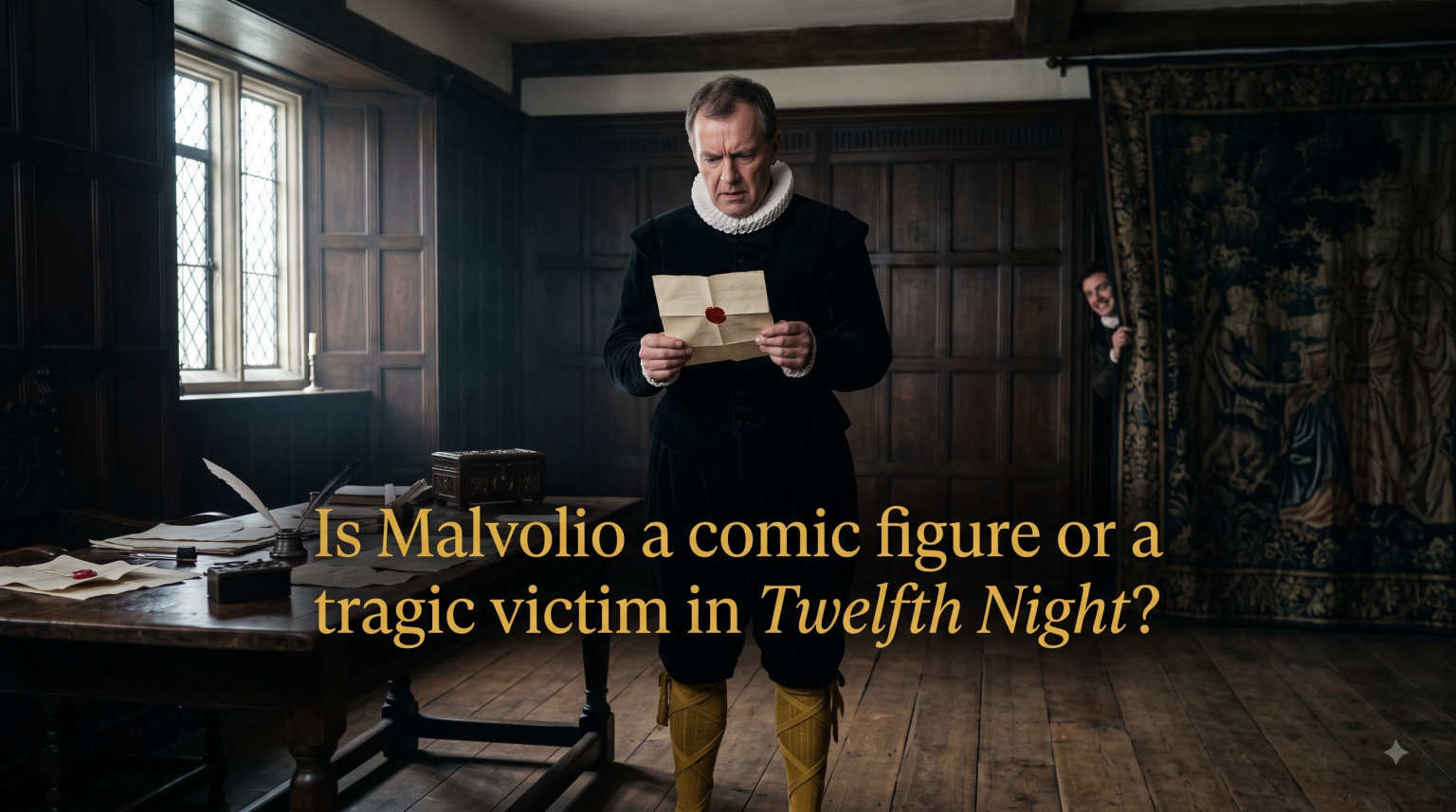
Few characters in Shakespeare’s comedies divide audiences the way Malvolio does in Twelfth Night. Some productions play him for belly laughs, dressing him in absurd yellow stockings and letting the audience howl at his humiliation. Others lean into the darkness, leaving playgoers unsettled by how far the joke goes before it stops being funny.
This tension sits at the heart of one of the most enduring debates in Shakespeare studies. Is Malvolio a comic figure whose pomposity deserves to be punctured, or a tragic victim crushed by a punishment wildly out of proportion to his faults? The answer most critics, performers, and readers arrive at today is that he is both at once, and that duality is exactly what makes him Shakespeare’s most complex comic character.
I have spent years studying Twelfth Night, reading the critical tradition from Charles Lamb through to modern new-historicist scholarship, and watching productions that interpret Malvolio everywhere from broad clown to broken man. This guide walks through the textual evidence on both sides of the debate, the performance history that shifted how we see him, and why this question still matters for readers and students in 2026.
Whether you are writing an essay, revising for an exam, or preparing a role for the stage, understanding how Malvolio works as both comic and tragic is the key to appreciating what Shakespeare accomplished with this character. Let us break it down piece by piece.
Table of Contents
Who Is Malvolio in Twelfth Night?
Malvolio is the steward in the household of Countess Olivia, meaning he manages her estate, her servants, and her daily affairs. He is not nobility, but he holds a position of real authority within Olivia’s world, and he knows it. Shakespeare introduces him as efficient, proper, and thoroughly convinced of his own importance.
From his first appearance, Malvolio’s personality is clear. He is humourless, rigid, and priggish, constantly correcting others and sucking the joy out of every room he enters. When Sir Toby Belch and Sir Andrew Aguecheek carouse late at night, Malvolio bursts in to scold them with cold disapproval.
His tone drips with condescension as he tells Olivia’s uncle that his behavior is unbecoming. This killjoy disposition makes him an immediate target. Sir Toby, Maria, Fabian, and even Feste the clown all resent his joylessness and his habit of lording his authority over them.
He is the straight man in a world built on festivity, and that friction is the engine of the play’s subplot. His rigidity and self-righteousness are not incidental character traits. They are the specific flaws the conspirators will exploit.
Malvolio’s connection to Puritanism is central to his character, and Shakespeare’s original audience would have picked up on it immediately. In Elizabethan England, Puritans were associated with opposition to theatre, festivity, and drinking, precisely the things Twelfth Night celebrates. Olivia herself calls him “a kind of Puritan,” and the word carried real political charge.
Shakespeare was writing for an audience that resented Puritan attempts to close the theatres. Making Malvolio a killjoy Puritan type gave them a satisfying villain to laugh at. His very name telegraphs his nature just as clearly.
“Malvolio” breaks down into the Italian roots “mal” (bad or ill) and “volere” (will), giving us roughly “ill-wishing” or “bad desire.” Shakespeare loved naming characters to reflect their essence, and Malvolio’s name tells us he is defined by a will that is somehow twisted or wrong.
Whether that means he has malicious intent or simply wrong-headed desires is part of what makes him so interesting. What kind of person is Malvolio in Twelfth Night? He is ambitious, self-righteous, and socially awkward, a man who dreams of rising above his station while lacking the charm to make anyone want him to succeed.
He is not evil in the way of Iago or Richard III, but his smugness and lack of self-awareness make him easy to dislike. That is exactly what the conspirators exploit.
Is Malvolio a Comic Figure or a Tragic Victim in Twelfth Night?
Malvolio is both a comic figure and a tragic victim, and that dual nature is the point Shakespeare built into the character. He is comic in the traditional sense because his pomposity, self-delusion, and absurd behavior when tricked generate genuine laughter. He becomes tragic because the punishment inflicted on him, imprisonment in a dark room, psychological torment, and public humiliation, far exceeds anything he actually did wrong.
The comic reading dominated for centuries. Audiences laughed at Malvolio as a killjoy getting his comeuppance, a Puritan spoilsport who deserved to be taken down. But modern criticism and performance have increasingly emphasized the tragedy, pointing out that his only real crimes are being annoying and harboring social ambition.
The prank destroys his dignity, his reputation, and possibly his sanity, all for the entertainment of his tormentors. What makes this debate so rich is that Shakespeare does not resolve it.
The play ends with Malvolio storming off, vowing revenge, never reconciled, never forgiven. That unresolved final note is why the question “comic or tragic?” still generates essays, exam questions, and heated post-show bar arguments centuries later.
The Comic Case: Why Malvolio Makes Us Laugh
The argument for Malvolio as a comic figure rests on how thoroughly Shakespeare engineers him for laughter. Every trait that makes him annoying in Act 1 becomes fuel for comedy in Act 2. His rigidity, his vanity, and his secret ambition are all exposed and mocked with surgical precision by the subplot.
The genius of the comedy is that Malvolio brings it on himself. He is not an innocent victim struck by random misfortune. His downfall flows directly from his own character flaws, specifically his vanity and his readiness to believe that a woman far above his station secretly loves him.
Self-Delusion and the Fantasy of Greatness
The centerpiece of Malvolio’s comedy is his capacity for self-delusion. When Maria drops a forged letter that appears to be from Olivia, Malvolio does not question it for a second. He reads the letter’s instructions, to smile constantly, to wear yellow stockings, and to be cross-gartered, and immediately imagines himself married to Olivia and commanding the household.
His monologue on greatness is one of the most quoted passages in the play and reveals the depth of his self-deception. “To be Count Malvolio!” he exclaims, already imagining the title. He reasons that it is no impossibility, talking himself into believing that Olivia’s apparent affection is logical, even inevitable.
The famous line from the forged letter reads: “If this fall into thy hand, revolve. In my stars I am above thee; but be not afraid of greatness: some are born great, some achieve greatness, and some have greatness thrust upon them.” Malvolio seizes on this as confirmation of his destiny, never pausing to wonder why Olivia would communicate her love through a cryptic riddle found in the garden.
His ambition so overwhelms his judgment that the absurdity of the situation is invisible to him. This is classic comic territory. The audience knows the letter is fake.
We watch Malvolio construct an elaborate fantasy on a foundation of nothing, and the gap between what he believes and what is actually true generates the comedy. Shakespeare lets us see the machinery of the deception while Malvolio cannot, creating the dramatic irony that drives the humor forward.
Yellow Stockings and Crossed Garters: The Visual Comedy
Once Malvolio acts on the letter’s instructions, the comedy becomes physical and visual. He appears before Olivia wearing yellow stockings, a color she notoriously hates, and cross-gartered, a style she finds ugly. He smiles incessantly, which to Olivia signals madness because she has no idea why her steward is grinning at her.
The theatricality of this scene is brilliant. On stage, the audience sees a man who believes he is being charming and irresistible behaving in a way that genuinely appears insane. Olivia’s confused reaction (“Why, this is very midsummer madness”) confirms for us just how deranged Malvolio looks.
He thinks he is courting. She thinks he has lost his mind. The yellow stockings and crossed garters work on multiple levels, funny because they are ugly, funnier because Malvolio wears them with total confidence, and uncomfortable when we remember that he is wearing them because he was deliberately manipulated.
Maria’s Prank and Sir Toby’s Revenge
The prank itself is masterminded by Maria, Olivia’s gentlewoman, who can imitate Olivia’s handwriting perfectly. Sir Toby Belch, Sir Andrew Aguecheek, and Fabian eagerly join in. Their stated motivation is that Malvolio is “an affectioned ass” who lectures and restricts them, and they want revenge for his interference with their revelry.
The comedy here works because the conspirators are not wrong about Malvolio. He really is insufferable and he really does spoil their fun. The audience has watched him act pompously and is primed to enjoy seeing him cut down to size.
Shakespeare makes sure we feel the satisfaction of the prank before he shows us its cost. This careful sequencing is what makes the comic reading so persuasive. For three acts, everything points toward laughter.
Malvolio’s arrogance invites punishment. The prank is clever and the humiliation is theatrical. It all feels like perfectly balanced comic justice, right up until the moment it does not.
The Tragic Case: Why Malvolio Deserves Our Sympathy
The shift from comedy to tragedy happens gradually, and it is what separates a superficial reading of Malvolio from a serious one. The prank begins as fun but escalates into sustained psychological abuse, and the play never gives Malvolio a moment of redemption or reconciliation.
The tragic reading asks an uncomfortable question: does Malvolio actually deserve what happens to him? His crimes are being annoying, socially ambitious, and bad at reading social cues. His punishment is the total destruction of his dignity, and the disproportion is where the tragedy lives.
The Punishment Does Not Fit the Crime
Consider what Malvolio actually does wrong in the play. He scolds Sir Toby for drinking too loudly, corrects the household staff, harbors private ambitions of social advancement, and is pompous while lacking self-awareness.
None of these are crimes that warrant what follows. He is publicly humiliated, declared mad, locked away in darkness, and tormented by a man pretending to be a priest. When the truth comes out and he realizes he has been tricked, there is no apology.
The conspirators laugh it off and move on. Shakespeare seems aware of this disproportion. Even Sir Toby, the ringleader, begins to feel the joke has gone too far by Act 4, admitting that the “foolery” has crossed past entertainment into cruelty.
Imprisonment in the Dark Room
The darkest sequence in the subplot is Malvolio’s confinement. After his bizarre behavior in the yellow stockings, the conspirators convince Olivia that her steward has gone mad, and he is locked in a dark room. Feste disguises himself as Sir Topas, a fictional curate, and visits Malvolio to interrogate him about his sanity.
The cruelty here is psychological, not physical, and that makes it worse in some ways. Feste challenges Malvolio’s perception of reality, questioning whether the room is dark, whether Malvolio knows where he is, even whether the daylight he claims to see exists. Malvolio pleads for basic human treatment, insisting he is not mad and knows what is real, but no one will listen.
Reading this scene, it is hard to maintain the pure comic reading. Malvolio is genuinely suffering. His voice in the dark room is the voice of a man crying for help while everyone around him laughs.
The humor that once seemed harmless now feels like cruelty dressed up as entertainment. Reddit discussions about this very scene reflect how modern audiences experience it. Viewers who start out laughing at Malvolio frequently report a shift in sympathy during the imprisonment sequence, noting that the prank stops being funny when it resembles actual gaslighting.
This is not a modern projection onto the text. Shakespeare built the discomfort in deliberately.
Feste’s Cruelty and the Unresolved Ending
Feste’s role deserves special attention because he is the one who takes the prank furthest into cruelty. As the wise fool of the play, Feste has license to speak truths others cannot. But when he disguises himself as Sir Topas and torments Malvolio in the dark room, he is not speaking truth, he is wielding power over a helpless person for his own amusement.
This complicates our reading of Feste, who is otherwise the most sympathetic and insightful character in the play. The contrast is jarring: the man who sees through everyone else’s pretensions uses his cleverness to torture someone who cannot fight back. Shakespeare gives us no indication that Feste regrets this.
The ending seals the tragic interpretation. When Malvolio finally discovers the letter was forged, he confronts the conspirators. Olivia offers a perfunctory apology, but there is no justice, no reckoning, no comic restoration of harmony.
Malvolio’s final line is one of the most disturbing exits in all of Shakespeare’s comedies: “I’ll be revenged on the whole pack of you.” This is not the exit of a comic buffoon who has learned his lesson. It is the exit of a man whose world has been destroyed, who has been made a fool against his will, and who leaves vowing violence.
Shakespeare leaves this promise unresolved. We never see the revenge and we never see forgiveness. The play’s final song belongs to Feste, but its emotional residue belongs to Malvolio.
Critical Perspectives: How Scholars and Actors Interpret Malvolio
The debate over Malvolio is not new. It has evolved across centuries of criticism and performance, and understanding that history helps explain why the character remains so divisive.
In the eighteenth and nineteenth centuries, Malvolio was played almost universally as a comic villain. He was the Puritan spoilsport, the pompous killjoy who deserved everything he got. Audiences laughed at his humiliation without guilt, and productions encouraged that response by playing the character broadly and unsympathetically.
The Romantic critic Charles Lamb was one of the first to push back against this reading. Lamb argued that Malvolio’s “inherent pride” and social ambition made him more complex than a simple clown. He noted that the character’s name, meaning “ill-will,” cut both ways: it described both Malvolio’s own nature and the ill-will directed at him by the conspirators.
Lamb saw the unresolved discord at the end of the play as evidence that Shakespeare knew Malvolio’s suffering went beyond comedy. The real turning point came in 1969, when director John Barton made the radical decision to cast Malvolio sympathetically in a Royal Shakespeare Company production.
Barton’s Malvolio was not a clown. He was a dignified, capable man whose genuine affection for Olivia and real professional competence made his downfall genuinely painful. This production is widely credited with changing how modern audiences and performers approach the role.
Since Barton, performances have split along a spectrum. Donald Sinden played Malvolio with tragic grandeur, emphasizing the character’s dignity and the cruelty of his fall. Stephen Fry’s 2012 Globe production was perhaps the most celebrated modern interpretation, drawing on Fry’s own experience of depression to make Malvolio’s dark-room imprisonment feel viscerally real.
Audiences who saw Fry’s performance reported being moved to tears rather than laughter during the confinement scene. Academic criticism has followed a parallel trajectory, with new historicist and cultural materialist readings of the 1980s and 1990s placing Malvolio in the context of Elizabethan social hierarchy.
These scholars argued that Malvolio’s “crime” is not just being annoying but daring to imagine he could rise above his class. The prank, in this reading, is not just personal revenge but social control, the aristocracy and their servants putting a middle-class upstart back in his place.
This class dimension adds a layer of tragedy that purely character-based readings miss. Malvolio wants to marry Olivia not just out of vanity but because he believes in a meritocratic world where talent and hard work can elevate a person. The play’s laughter at his ambition is, from this angle, the laughter of a society that has decided he is not allowed to dream that big.
Why Malvolio Still Matters Today
The reason Malvolio generates such strong reactions in 2026 is that his situation maps onto modern anxieties with unsettling precision. He is a man who wanted more than his social position allowed, who believed in his own worth, and who was publicly destroyed for daring to act on that belief.
Think about workplace dynamics. Malvolio is the competent middle manager who takes the rules seriously, alienates coworkers with his rigidity, and then gets humiliated by the office clique for being unlikable.
The prank against him is the office prank that goes too far, the group chat screenshot shared for laughs, the public callout that was supposed to be funny but leaves real damage. Modern audiences recognize this pattern because they have lived it, on one side or the other.
The dark-room scene speaks to contemporary concerns about gaslighting and psychological manipulation. Feste does not hit Malvolio. He convinces Malvolio that his perception of reality is wrong, that he is mad, that the darkness is not dark and the daylight is not real.
This is the language of coercive control, and Shakespeare wrote it four centuries before we had a clinical term for it. The class dimension also resonates deeply with modern audiences.
Malvolio is mocked for social ambition, for not knowing his place, for wanting to cross a boundary that his society has drawn firmly around him. In a world still wrestling with questions of class, privilege, and who is allowed to aspire to greatness, his story feels less like a historical artifact and more like a mirror.
Even the unresolved ending speaks to us. Real life does not always offer clean reconciliation, and sometimes people walk away hurt and angry while the people who hurt them never face consequences. Malvolio’s exit, vowing revenge, is unsettling precisely because it is realistic. Not every story ends with forgiveness.
FAQs
Is Malvolio a victim?
Yes, Malvolio is a victim. While he is pompous and self-important, his punishment, imprisonment in a dark room, psychological torment by Feste, and public humiliation, far exceeds anything he actually did wrong. His final exit vowing revenge shows that the experience has genuinely damaged him, and the play never offers him justice or reconciliation.
What kind of person is Malvolio in Twelfth Night?
Malvolio is Olivia’s strict, humourless, and self-important steward. He is efficient at his job but alienates everyone around him with his rigidity and condescension. He harbors secret ambitions of social advancement, which makes him vulnerable to Maria’s prank. Critics associate him with Puritanism, and his name literally means ill-willing.
How is Malvolio a comic yet tragic figure?
Malvolio is comic through his self-delusion, his absurd yellow stockings and cross-gartered appearance, and the dramatic irony of watching him build a fantasy on a forged letter. He becomes tragic when the prank escalates into imprisonment and psychological abuse that far exceeds his faults, leaving him broken and vowing revenge in the play’s unresolved ending.
Is Malvolio a comic character?
Malvolio is comic in the traditional Shakespearean sense, as his pomposity and self-delusion generate genuine laughter. He was played purely for laughs for centuries. However, modern productions and criticism increasingly emphasize his tragic dimensions, arguing that the cruelty of his punishment transforms the comedy into something darker.
Conclusion
So, is Malvolio a comic figure or a tragic victim in Twelfth Night? The honest answer is that he is both, and that is what makes him extraordinary. Shakespeare designed him to generate laughter that curdles into discomfort, to start as a punchline and end as a person.
The comic evidence is real: the self-delusion, the yellow stockings, the forged letter, the dramatic irony. So is the tragic evidence: the disproportionate punishment, the dark-room imprisonment, the gaslighting by Feste, and the unresolved exit vowing revenge.
Neither reading cancels the other out. If you are analyzing Malvolio for an essay or exam, the strongest answer acknowledges both dimensions and explains how they interact.
Do not pick a side. Instead, trace how Shakespeare moves the character from comic to tragic, how the laughter gives way to sympathy, and how that tonal shift reflects the play’s deeper concerns about class, ambition, and the cruelty of social hierarchies. That is where the real complexity lives, and it is why this question still matters.