
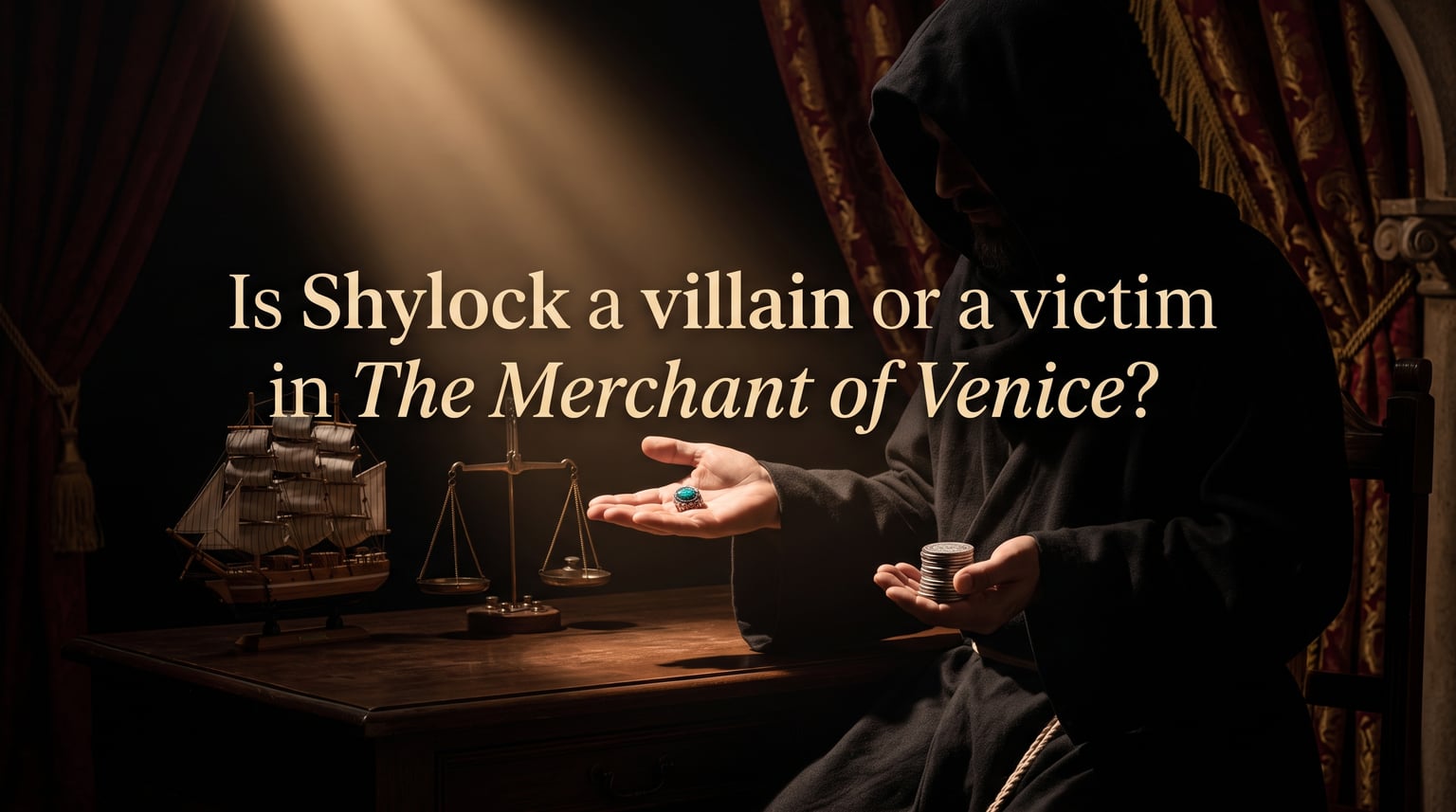
Few questions in Shakespeare studies ignite as much debate as this one: is Shylock a villain or a victim in The Merchant of Venice? I have spent years teaching this play to university students, and every semester the same argument resurfaces with fresh energy. Some readers see only a vengeful moneylender clutching his pound of flesh. Others see a grief-stricken father ruined by Christian prejudice. After close reading the text and weighing centuries of performance, my view is that Shylock is both, and that this dual nature is precisely the point. He is a villain because he is a victim, and his tragedy lies in the impossibility of separating those identities.
In this guide, I will walk through the textual evidence on both sides, examine the key scenes that define Shylock’s character, place the play in its historical anti-Semitic context, and explore how modern productions have reshaped our understanding. I have included the play’s most quoted lines in full because, as I tell my students, the meaning of Shylock lives in his language. By the end, you will have a clear scholarly framework for your own interpretation, whether you are writing an essay, preparing for an exam, or simply trying to understand why this 16th-century character still divides audiences in 2026.
Table of Contents
Who Is Shylock in The Merchant of Venice?
Shylock is a wealthy Jewish moneylender living in Venice, and he is one of Shakespeare’s most complex creations. He enters the play not as a romantic hero but as a financial counterweight to Antonio, the Christian merchant of the title. Antonio has borrowed three thousand ducats on behalf of his friend Bassanio, and when his own ships are delayed at sea, the bond falls due. That bond, with its penalty of a pound of flesh, sets the entire plot in motion.
Structurally, Shylock is the antagonist who opposes the play’s titular merchant. Yet Shakespeare gives him far more depth than a simple villain requires. He is a father, a widower, a faithful servant of his religion, and a man who has endured years of public insult. The famous question Howard Jacobson posed in his 2016 Guardian essay remains the most useful framing: villain and victim are not opposites here. They are intertwined.
The Case for Villain: Evidence of Shylock’s Antagonism
The strongest evidence that Shylock functions as a villain comes from his own words and his chosen actions. He is not a passive figure pushed into cruelty. He chooses it, he plans it, and he insists on it even when offered multiple escapes.
Shylock’s Money Obsession: “My Ducats and My Daughter”
When Jessica, his daughter, steals his money and runs away with the Christian Lorenzo, Shylock’s grief is revealing. He cries out in Act 2, Scene 5: “My daughter! O my ducats! O my daughter! Fled with a Christian! O my Christian ducats!” He then adds, “Justice! The villainies of the world will not be safe unless I take the law.” At first read, this looks like comic miserliness. Jessica has stolen both his gold and his child, and his lament confuses the two losses.
Look closer, though, and the speech betrays something darker. Shylock’s first instinct is revenge, and he explicitly equates the loss of his wealth with a justification for violence. In his soliloquy in Act 3, Scene 1, he confesses: “I’ll not be made a soft and dull-eyed fool, to drop the serum of my respect into the e’er-bleached Christian.” He chooses hatred as a deliberate strategy, the way one might choose an investment. That is villainous calculation, not victim reflex.
The Cruel Terms of the Bond
The bond itself is the clearest evidence of villainy. Antonio needs three thousand ducats quickly, and Shylock offers the loan with a twist: if Antonio cannot repay on time, Shylock will take a pound of his flesh. Antonio agrees, joking that Shylock would never enforce such a penalty. Shylock’s reply is chilling. “When Jacob grazed his uncle Laban’s sheep,” he says, “this villain took a stratagem to enrich himself, and I will do it too.” He invokes biblical precedent to justify what amounts to sanctioned murder.
The bond scene’s language carries disturbing undertones. Shylock says he wants Antonio “once upon the hip” so he can “feed fat the ancient grudge I bear him.” For an Elizabethan audience, these phrases had a physical, almost predatory weight. Modern readers often note the homoerotic menace, the suggestion that Shylock wants not just revenge but a kind of intimate domination. Either way, the imagery is that of a hunter closing in on prey. That is not the language of a wronged man seeking compensation. It is the language of a predator.
Servants’ Perspectives: How Lancelot and Jessica View Him
If you want to understand how a community saw Shylock, listen to those who lived closest to him. Lancelot Gobbo, his servant, leaves Shylock not for better wages but because the household is unbearable. Jessica calls her home “our house is hell” in Act 2, Scene 3. These are not the complaints of strangers. They are the testimony of people who knew him best.
Jessica’s elopement is not just a daughter’s rebellion. It is a young woman choosing a Christian lover over her Jewish father, taking his money and a precious heirloom ring with her. When Jessica later trades that turquoise ring, a gift from Shylock’s dead wife Leah, for a monkey, the cruelty is complete. She has stolen a relic of his grief and treated it as currency. Even sympathetic readers of Shylock cannot fully excuse Jessica’s theft and betrayal. Whether Shylock is villain or victim, his daughter certainly behaves like someone escaping a monster.
The Case for Victim: Evidence of Shylock’s Discrimination
Turn the coin, and the evidence for victimhood is just as strong. Shylock is not born cruel. He is made cruel by decades of insult, exclusion, and the quiet violence of being treated as less than human by the Christian community he serves.
Christian Hatred: “You Have Rated Me About My Monies”
In Act 1, Scene 3, Shylock reminds Antonio of past abuse: “Signor Antonio, many a time and oft / In the Rialto you have rated me / About my moneys and my usances.” “Rated” here means insulted publicly. Antonio has called Shylock a dog, a misbeliever, a cutpurse. He has spat on Shylock’s Jewish gaberdine in the street. These are not abstract prejudices. They are repeated, named, witnessed acts of contempt.
What would you do if your customers insulted your religion every time you served them? If they spat on your clothing and called you an animal? Shylock’s hatred of Antonio is not random. It is a response to a lifetime of being told he was subhuman. In his most famous speech, Act 3, Scene 1, he makes this argument directly: “Hath not a Jew eyes? Hath not a Jew hands, organs, dimensions, senses, affections, passions? Fed with the same food, hurt with the same weapons, subject to the same diseases, healed by the same means, warmed and cooled by the same winter and summer as a Christian is?” This is not villainy. This is one of the earliest declarations of universal humanity in English literature.
The “If You Prick Us” Speech: Shylock’s Most Human Moment
The speech continues with the line that has echoed across four centuries: “If you prick us, do we not bleed? If you tickle us, do we not laugh? If you poison us, do we not die? And if you wrong us, shall we not revenge?” Auden called Shylock “the supreme type of the tragic victim,” and this speech is the reason. Shylock is asking for nothing more than recognition: I am human, treat me as such, and I will respond as you would.
The tragedy of the speech is that he answers his own question. If you wrong us, we shall revenge. He is admitting his own capacity for cruelty in the same breath that he demands equality. This is what makes him morally complex. He is not asking for mercy. He is asking to be treated as a moral equal, and then acknowledging that equal moral standing means equal moral failure. Shakespeare gives the persecuted man the dignity of being able to sin like his persecutors.
Jessica’s Betrayal and the Stolen Turquoise Ring
Jessica’s theft is a wound Shylock carries into the courtroom. He has lost his daughter to the very Christians who have insulted him for years. The money she steals is painful, but the ring she trades for a monkey is worse. That ring was Leah’s. Leah was Shylock’s wife, who died before the play begins. The ring was a relic of her love.
When Shylock discovers the loss, his grief is genuine. He says: “I had rather be married to a death’s-head with a bone in his mouth than to be married to one of these same dog-days Christians.” It is an ugly line. It is also the cry of a man whose household, his faith, his marriage, and his child have all been taken or rejected. He is being asked to forgive the people who have taken everything from him, and Shakespeare does not pretend that this is easy.
The Memory of Leah: Shylock’s Hidden Emotional Life
Leah appears only as a name in the play, but she is crucial to understanding Shylock as a human being. Leah was his wife. She loved him. She gave him the turquoise ring that Jessica pawns. When Shylock confronts Tubal about Jessica’s behavior, he does not ask first about the money. He asks about the ring. He wants it back because it is his last physical link to Leah.
This detail shatters the image of Shylock as a cold moneylender. He is a widower. He is a man who treasured a small blue stone because his dead wife once wore it. He is also a father who has been abandoned by the child he raised. When Shakespeare wants us to see Shylock as villain, he shows us the bond. When Shakespeare wants us to see Shylock as victim, he shows us Leah’s ring. The choice, in the end, is ours.
Key Scenes: Where Villain and Victim Collide
Three scenes do most of the work in defining Shylock’s character. Each one shows both sides of him at once. Read them carefully and you will see why the question cannot be answered simply.
Act 1, Scene 3: The Bond Negotiation
Antonio arrives at Shylock’s house to borrow money. Shylock at first refuses, on the grounds that Antonio is a Christian and Shylock hates Christians. Then he pauses and offers a plan. He will lend the money, but if Antonio defaults, he will take a pound of his flesh. The audience hears the terms and knows this is dangerous. Antonio, in his generosity, agrees to the absurd penalty because he is sure his ships will return in time.
What Shylock really wants here is unclear. He says he wants to “be friends” and “forgive” the past insults. He also wants Antonio dead. He quotes biblical precedent, he makes puns about “flesh” and “feed,” and he constructs a trap. The scene establishes him as both a businessman with reason to hate and a schemer with intent to harm. The villain and the victim sit at the same table.
Act 2, Scenes 5 and 6: Jessica’s Elopement
Jessica steals money, jewels, and Leah’s ring, and runs away with Lorenzo. Shylock learns of the theft in front of his friend Tubal and the audience. His reaction is the famous “My ducats and my daughter” speech, which is played for comedy in many productions but for grief in others.
The genius of this scene is that we hear Shylock’s pain through his own language, and that language is laced with references to the abuse he has suffered. He tells Tubal: “I say my daughter is my flesh and blood. I say my daughter is my flesh and blood. Sir, I say my daughter is my flesh and blood.” The repetition sounds obsessive, but it also sounds like a man trying to convince himself that his family still exists. His daughter has rejected him. His wife is dead. His money is gone. The scene ends with him deciding that Antonio must pay with his flesh.
Act 4, Scene 1: The Courtroom and Forced Conversion
The courtroom is the climax of both interpretations. Portia, disguised as a young lawyer, offers Shylock multiple chances to accept three times the bond’s value and walk away. Shylock refuses. He wants the law. He wants the pound of flesh. He insists on his right to enforce the contract, even when his lawyers urge restraint.
Then Portia turns the tables. She says Shylock may take the flesh, but not a single drop of blood. He must weigh the pound exactly. Shylock realizes he cannot do this without killing Antonio, which would be murder, and he agrees to take the money instead. At this point, Antonio adds his own penalty: Shylock must convert to Christianity and leave his wealth upon his death to Jessica and Lorenzo.
The conversion is the play’s most disturbing moment. Shylock loses everything. His faith is stripped from him. His wealth is given to the daughter who betrayed him. He leaves the courtroom a broken man, forced to become what he has spent his life resisting. Even readers who see him as villain usually feel that the punishment exceeds the crime. Shakespeare knew this. The forced conversion is meant to disturb.
Portia’s Mercy Speech vs Shylock’s Demand for Justice
Portia’s speech on mercy, “The quality of mercy is not strained,” is often quoted against Shylock. She says mercy is “twice blest” and “becomes the throned monarch better than his crown.” It is a beautiful speech, and it is also a speech that asks Shylock to forgive the very people who have spit on him and stolen his child.
Shylock rejects the speech, and he is right to notice its hypocrisy. He says: “My deeds upon my head! I crave the law, / The penalty and forfeit of my bond.” He is not asking for sympathy. He is asking for the law to do what the law promises. In a Christian Venice, the law is supposed to be neutral. Shylock demands that neutrality. His refusal of mercy is not cruelty. It is the demand that the Christian court treat him as fairly as it would treat Antonio.
Historical Context: Anti-Semitism in Venice and Elizabethan England
To understand Shylock, you have to understand the world Shakespeare inherited. Jewish people had been expelled from England in 1290, more than 250 years before Shakespeare wrote the play. They were not legally permitted to live in England during his lifetime. Shakespeare had almost certainly never met a Jewish person. Yet he created one of the most vivid Jewish characters in Western literature, and he did so in a period of intense European anti-Semitism.
The Venetian Ghetto and Jewish Moneylending
In 1516, the Venetian Senate ordered all Jewish residents to live in a walled district of the city called the Ghetto. The word “ghetto” comes from the Venetian foundry (getto) located near the area. Jews could leave during the day but had to be inside by nightfall. They were permitted to lend money at interest, a profession forbidden to Christians by canon law, which meant Jewish moneylenders were both essential and despised. They were needed for commerce and resented for charging interest.
Shakespeare’s Venice reflects this reality. Shylock is a wealthy moneylender who serves Christian clients while being publicly insulted by them. He is necessary and unwelcome, trusted and mistrusted, invited and spat upon. The contradictions of his position are not just personal. They are structural.
Elizabethan Stereotypes on the English Stage
Elizabethan audiences expected Jewish characters to be villains. Christopher Marlowe’s The Jew of Malta, written around 1589, featured Barabas, a Jewish character who is openly evil. Shakespeare’s Shylock is partly a response to that tradition. He has villainous traits, but he also has the speech on Jewish humanity and the memory of Leah. Shakespeare gives Shylock something Marlowe never gave Barabas: an inner life.
The famous stage direction in the early quartos of The Merchant of Venice was for the actor playing Shylock to wear a red wig and a false nose. The performance tradition associated with this look was caricature, not sympathy. Even in Shakespeare’s own time, Shylock was played as a grotesque. The sympathetic Shylock is a modern invention, and a deliberate one.
The Barbarity of Forced Conversion
Forced conversion was not a literary device in Shakespeare’s time. It was a real and recent horror. Spanish Jews had been expelled in 1492 unless they converted. Portuguese Jews had faced similar pressure in 1497. English Jews who remained after the 1290 expulsion had been killed or converted. The conversion of Shylock at the end of The Merchant of Venice would have read to an Elizabethan audience as the ultimate punishment. It would still read that way today.
Performance History: How Shylock Has Been Played
The way actors have played Shylock tells you almost as much as the text itself. For most of the play’s history, he was a villain. In the last 80 years, he has become something else. The change is one of the most significant shifts in modern Shakespeare performance.
Eighteenth and Nineteenth Centuries: The Villain Clown
From the Restoration through the 19th century, Shylock was typically played as either a comic villain or a scheming monster. Charles Macklin’s 1741 production introduced the red-wigged, physically grotesque Shylock that dominated the stage for over a century. Edwin Booth played him as a melodramatic villain in the 19th century. Henry Irving’s 1879 production in London was a sensation, but Irving’s Shylock was still largely the embodiment of evil, wrapped in Jewish caricature.
This is the Shylock most readers inherited. He was a clown, a threat, a butt of humor. Audiences laughed at his greed and cheered when Portia defeated him. That response was so widespread that George Eliot, in 1879, expressed fear that an English audience might “laugh the play out of countenance.”
The Post-Holocaust Shift Toward Sympathy
After World War II, the meaning of Shylock changed. Audiences who had seen photographs of concentration camps could not laugh at the image of a Jewish man being stripped of his money, his family, his faith, and his dignity. Directors began to play the “If you prick us” speech as the emotional center of the play rather than a digression.
This shift did not make Shylock a saint. He still demands his pound of flesh. He still refuses mercy. But audiences began to see those refusals as the understandable response of a man who had been mocked for being Jewish his entire life. The villain and the victim no longer cancelled each other out. They reinforced each other.
Modern Productions: Al Pacino and Beyond
The 2004 film version with Al Pacino, directed by Michael Radford, is the most visible example of the sympathetic Shylock. Ben Brantley’s review in the New York Times described Pacino’s Shylock as both “cunning and sorrowful,” giving the line “If you poison us, do we not die?” a “despairing” weight that critics found almost unbearable. Other recent productions, including those in London, Stratford, and New York, have continued this trend. Shylock is now routinely played as a man whose villainy is inseparable from his grief.
This is the Shylock most modern readers meet. He is more human than the grotesque of the 18th century, more tragic than the melodramatic villain of the 19th. He is also more disturbing, because his cruelty looks like ours. When he refuses mercy, we recognize the refusal because we have made it ourselves.
Conclusion: A Villain Because He Is a Victim
So, is Shylock a villain or a victim? After weighing the evidence, my view is that Shakespeare intended Shylock as both, and that the question itself is part of the play’s enduring power. Shylock is a villain because he chooses revenge over mercy, pursues a brutal bond to its bitter end, and refuses the multiple chances Portia offers him. He is a victim because Christians have insulted him for years, his daughter has stolen his money and his wife’s ring, his wife is dead, and the law he trusted to be neutral delivers him into forced conversion. Remove either side and the character collapses into stereotype. Together, they produce one of the most morally complex figures in Western literature.
If you are writing about Shylock for an essay or exam in 2026, my suggestion is to refuse the simple answer. Argue that he is villainous in action but victimized by circumstance. Use the “If you prick us” speech as your central text. Quote the Leah ring as evidence of his emotional depth. Note the forced conversion as Shakespeare’s final verdict on a society that destroys the people it depends on. The Merchant of Venice is not anti-Semitic because Shylock is a villain. It is, in my reading, anti-anti-Semitic because Shylock’s humanity cannot be erased, even by the author of his ruin.
Frequently Asked Questions About Shylock
Who is the real villain in The Merchant of Venice?
There is no single real villain in the play, and that is the point. Antonio and the Christian characters persecute Shylock for his religion. Shylock responds with a brutal bond and a refusal of mercy. Portia defeats Shylock through legal trickery and forces his conversion. The play distributes villainy across all the characters, which is why most modern critics describe it as a study of moral complexity rather than a story with one clear antagonist.
Is Shylock a bad person?
Shylock is not simply bad or good. He is a man with real grievances who responds to those grievances in cruel ways. He is rude, greedy, and vengeful. He is also a widower, a father who has been betrayed, and a member of a despised minority. The play asks the audience to recognize both sides of him at once. Whether he counts as a bad person depends on how much weight you give his suffering and how much you condemn his revenge.
What crime did Shylock commit?
In the legal terms of the play, Shylock’s crime is attempting to murder Antonio by enforcing a bond that demanded a pound of flesh. Once Portia rules out shedding any blood, Shylock cannot lawfully collect the penalty, and his insistence on it becomes attempted homicide. He is also guilty in the eyes of the Venetian court of conspiring against a Christian. By the end, he is convicted, fined, and forced to convert to Christianity, which is presented as a punishment greater than prison.
How is Shylock cruel?
Shylock is cruel in three main ways. First, he insists on a pound-of-flesh bond that could kill Antonio and that no sane lender would actually enforce. Second, he refuses every offer of three times the loan’s value in the courtroom, choosing vengeance over money. Third, he expresses disgust at Christians in language that is harsh and dehumanizing in return. Each of these choices is taken voluntarily, after he has had chances to relent, which is what makes them cruelty rather than self-defense.
What does Shylock symbolize in The Merchant of Venice?
Shylock functions as a symbol of several things at once. He represents the Jewish moneylender stereotype that haunted European imagination for centuries. He represents the outsider who is needed but never accepted. He represents the human cost of prejudice, both in his suffering and in his revenge. For post-Holocaust audiences, he also represents the danger of ignoring what anti-Semitic rhetoric makes possible. Shakespeare did not single out one meaning. The richness of the play comes from how many meanings Shylock can carry.
How do most critics describe Shylock?
Modern critics usually describe Shylock as a tragic figure or a morally complex character rather than a simple villain. Harold Bloom called him one of Shakespeare’s great tragic personalities. W.H. Auden identified him as the supreme type of the tragic victim. Older criticism, from the 18th and 19th centuries, treated him as a villain or comic figure. The shift began in the 20th century, particularly after the Holocaust, and has continued in productions through the 2010s and into 2026.
I hope this analysis has helped you see Shylock more clearly, whether you are preparing for an exam, writing an essay, or thinking through the play for the first time. The Merchant of Venice is not an easy play to love, but it is one of the most rewarding to argue with. And in 2026, four centuries after Shakespeare wrote it, we are still arguing.