
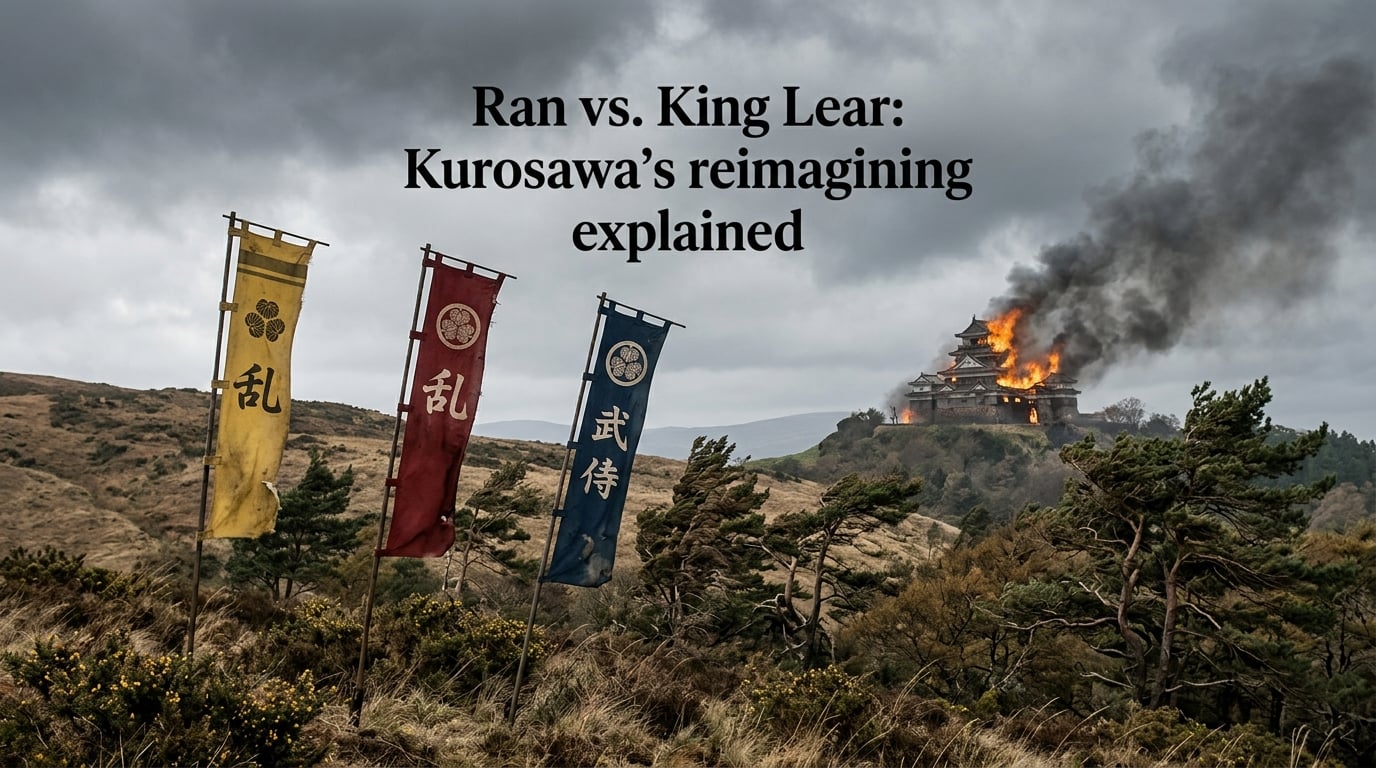
Ran (1985) is Akira Kurosawa’s sweeping reimagining of William Shakespeare’s King Lear, transplanted from medieval Britain to the blood-soaked battlefields of feudal Japan. When discussing Ran vs King Lear, the most striking fact is how faithfully Kurosawa preserves the skeleton of Shakespeare’s tragedy while replacing its philosophical heart with something entirely his own. The film follows Hidetora Ichimonji, an aging warlord who divides his kingdom among his three sons, triggering a cascade of betrayal, madness, and annihilation that mirrors Lear’s catastrophic division of Britain among his three daughters.
But Ran is far more than a Japanese costume version of Shakespeare. Kurosawa spent decades developing the project, originally drawing inspiration from a completely different historical source before the King Lear parallels became unavoidable. The result is a film that solves structural problems Shakespeare scholars have debated for centuries while introducing characters and themes that have no precedent in the original play at all.
Our team has studied both works across multiple viewings and readings, comparing scene-by-scene parallels, scholarly analysis, and discussions from film communities. Whether you are a Shakespeare enthusiast approaching Kurosawa for the first time, a film student writing a comparative essay, or simply someone who watched Ran and wondered how closely it follows the play, this breakdown covers every major parallel and divergence. We will map the characters beat by beat, examine the philosophical frameworks that separate the two works, and explain why many critics consider Ran the definitive screen adaptation of King Lear.
Table of Contents
The Origins of Two Tragedies
Shakespeare’s King Lear (c. 1605-1606)
King Lear was written and first performed around 1605 to 1606, during the period scholars consider Shakespeare’s greatest creative phase. The play draws loosely on the legend of Leir of Britain, a mythical Celtic king found in Geoffrey of Monmouth’s 12th-century chronicle Historia Regum Britanniae. Shakespeare transformed this folkloric tale into something unprecedented: a tragedy so vast in scope and so raw in its depiction of human suffering that critics for centuries struggled to categorize it.
The version of King Lear most readers encounter today is a conflation of two distinct texts. The 1608 Quarto and the 1623 First Folio contain hundreds of word-level differences, and scholars still debate which represents Shakespeare’s true intentions. This textual instability mirrors the play’s own thematic preoccupation with uncertainty and the impossibility of knowing anything for certain.
King Lear was not immediately popular. Nahum Tate’s 1681 adaptation, which gave the play a happy ending with Cordelia surviving and marrying Edgar, dominated English stages for over 150 years. Audiences preferred this sanitized version. It was not until the 19th century that Shakespeare’s original tragic ending was restored to regular performance, and not until the 20th century that Lear was recognized as perhaps Shakespeare’s supreme achievement.
Kurosawa and the Three Arrows Parable
The story of how Ran came to be is almost as layered as the film itself. Akira Kurosawa did not set out to adapt King Lear. His original inspiration was the historical Japanese parable of Mori Motonari, a 16th-century daimyo who reportedly handed each of his three sons a single arrow and asked them to break it. Each snapped his arrow easily. He then bound three arrows together and challenged them to break the bundle. None could. The lesson was clear: unity is strength.
Kurosawa found this story moving and began developing it as a screenplay in the late 1970s. But as he worked, he realized something unsettling. The Mori Motonari parable is about sons who listen to their father. Kurosawa wanted to explore what would happen if the sons refused. If three sons, given every reason to stay united, instead turned on each other and destroyed everything their father built, what story would that be?
The answer was King Lear. The parallels became impossible to ignore. An aging ruler divides his power among three children. The two eldest prove treacherous. The youngest, who spoke honestly and was banished for it, is the only loyal one. Kurosawa embraced the connection and wove Shakespeare’s tragedy into his Japanese warlord narrative, creating something that belongs to both traditions and neither simultaneously.
A Late-Period Masterpiece Decades in the Making
Ran was released in 1985, when Kurosawa was 75 years old. It was the most expensive Japanese film ever made at the time, with a budget of roughly $12 million. Kurosawa had been developing storyboards for the film since the 1970s, painting hundreds of color drawings to plan every shot before cameras rolled. Financing was notoriously difficult to secure, and the production required international co-production support, including from French producer Serge Silberman.
The long gestation period shows. Every frame of Ran feels deliberate, almost painterly, the work of a filmmaker who knew this might be his last grand statement. Kurosawa had already adapted Shakespeare once before, transforming Macbeth into Throne of Blood (1957) with stunning results. Ran was his second and final Shakespeare engagement, and it distills a lifetime of filmmaking wisdom into three hours of visual storytelling.
Ran vs King Lear: Character Mapping
The most efficient way to understand the relationship between these two works is through direct character mapping. Kurosawa translated Shakespeare’s British court into a Sengoku-period warlord clan, changing not just names and settings but genders, relationships, and motivations. The table below shows how each major figure in King Lear corresponds to a character in Ran, along with the key differences Kurosawa introduced.
| King Lear Character | Ran Equivalent | Key Difference |
|---|---|---|
| King Lear | Hidetora Ichimonji | Hidetora is a ruthless warlord who conquered by violence, not a hereditary monarch. His suffering carries karmic weight Lear’s does not. |
| Goneril (eldest daughter) | Taro (eldest son) | Gender flipped. Taro is ambitious but cautious, not purely vicious like Goneril. |
| Regan (middle daughter) | Jiro (middle son) | Gender flipped. Jiro is insecure and easily manipulated, more weak than wicked. |
| Cordelia (youngest daughter) | Saburo (youngest son) | Gender flipped. Saburo is blunt where Cordelia is principled, but both are banished for refusing flattery. |
| The Fool | Kyoami (the jester) | Kyoami is darker and crueler than Shakespeare’s Fool, openly mocking Hidetora’s decline. |
| Kent (loyal earl) | Tango (loyal retainer) | Tango serves the same function but his loyalty carries the samurai code of obligation. |
| No equivalent | Lady Kaede | Entirely original. Kurosawa’s most complex villain, motivated by generational revenge against Hidetora. |
| Gloucester / Edgar / Edmund subplot | Largely excised | Kurosawa removed the parallel father-son subplot entirely, focusing all narrative energy on Hidetora’s line. |
| No direct equivalent | Tsurumaru (blind flute player) | Blinded by Hidetora years before. His presence embodies the film’s karmic vision of suffering. |
The Gender Reversal and What It Changes
By converting Lear’s three daughters into three sons, Kurosawa made a choice that reshapes the entire emotional architecture of the story. In King Lear, the betrayal cuts deep partly because these are daughters, and Renaissance audiences expected filial love from women in ways that felt especially sacred. The cruelty of Goneril and Regan shocks because it violates a nurturing expectation.
In Ran, the sons are samurai heirs competing for territory and military power. Their betrayal is brutal, but it operates within a code of martial ambition that almost makes it expected. The feudal system itself incentivizes the very treachery Hidetora condemns. This shift makes Ran less a story of personal ingratitude and more a meditation on systems of violence that consume everyone within them, including their creators.
Lady Kaede: Kurosawa’s Most Brilliant Addition
Lady Kaede has no equivalent in King Lear, and that is precisely why she matters. She is initially the wife of Taro, Hidetora’s eldest son. After Taro’s death, she becomes Jiro’s consort and methodically manipulates him into destroying what remains of Hidetora’s legacy. Her motivation is not ambition for its own sake. Hidetora wiped out her family and destroyed her father’s castle years before the film begins. She has waited her entire life for revenge.
This makes Kaede one of the most complex characters in either work. Goneril and Regan in King Lear are motivated by greed and spite, and Shakespeare gives them little psychological depth. Kaede is a survivor of genocide playing a long game of retribution against the man who murdered her family. She is terrifying, but she is also right to hate Hidetora. Kurosawa forces the audience to acknowledge that the man whose suffering we are watching helped create the very monster now destroying him.
Where Goneril and Regan are flat villains, Kaede is a tragic figure whose revenge is both justified and self-destructive. She drives Jiro to murder his own brother, only to die in a burning castle holding a severed head she has spent years trying to acquire. Her arc encapsulates the film’s Buddhist vision of karma: the cycle of violence punishes everyone, victim and perpetrator alike.
Plot Parallels and Divergences
King Lear and Ran follow the same narrative skeleton beat for beat through their first two acts, then diverge in ways that reflect their different philosophical foundations. The comparison below traces each major plot point across both works.
The Abdication Scene
Both works open with an aging ruler deciding to divide his territory among his children while he still lives. In King Lear, Lear asks each daughter to declare her love publicly, rewarding the most flattering answers. In Ran, Hidetora simply announces his decision to pass control to his three sons, having already drawn up the territories.
The mechanism differs but the psychology is identical. Both men are vain rulers who mistake flattery for love and honesty for disrespect. Lear’s love test is a public ego exercise. Hidetora’s abdication is a military calculation. But both are acts of hubris from men who cannot imagine that surrendering power means surrendering control.
The Banishment of the Honest Child
Cordelia refuses to flatter Lear with exaggerated declarations of love and is disinherited. Kent defends her and is banished. In Ran, Saburo tells Hidetora plainly that dividing power three ways is foolish and that his brothers cannot be trusted. He is disowned. Tango defends Saburo and is exiled.
The parallel is exact. The one child who tells the truth is cast out. The retainer who supports the truth-teller is punished alongside them. Kurosawa follows Shakespeare so closely here that the dialogue beats align, even though the specific language and cultural context are completely different.
The Elder Children’s Betrayal
In both works, the elder children quickly strip their father of his remaining dignity and power once they hold the reins. Goneril and Regan reduce Lear’s retinue of knights step by step, treating his followers as an unnecessary expense. Taro and Jiro strip Hidetora of his retainers, his freedom of movement, and eventually his identity.
The emotional trajectory is the same: the father who gave everything discovers that giving away power means giving away respect. Both Lear and Hidetora are astonished by this, and their astonishment is the first crack in their sanity.
The Storm and the Descent Into Madness
This is where Ran vs King Lear reaches its most powerful visual parallel. In King Lear, the storm scene on the heath is Shakespeare at his most verbally sublime. Lear rails against the elements, against his daughters, against the nature of authority itself, in some of the greatest poetry ever written in English. The storm is both literal and cosmic, a reflection of Lear’s internal collapse.
In Ran, the storm scene is staged on a volcanic plain under an apocalyptic sky. Hidetora stumbles through this landscape in stunned silence, and Kurosawa lets the images carry what Shakespeare’s language carries. There is no soliloquy. There is no speech. There is only an old man walking through hell, and the audience understanding through pure visual storytelling that his mind has broken.
This is the key artistic difference between the two works. Shakespeare uses language to externalize internal collapse. Kurosawa uses composition, color, movement, and silence. Both achieve devastating emotional impact through opposite means.
The Castle Burning: Ran’s Most Famous Sequence
Ran contains a scene with no direct equivalent in King Lear: the burning of the Third Castle. After his madness, Hidetora wanders into the Third Castle, which his sons attack with massive armies. What follows is a battle sequence played almost entirely without sound, with only Toru Takemitsu’s mournful Mahler-inspired score on the soundtrack. No battle cries, no clashing steel, no screaming. Just the visual carnage of thousands of soldiers destroying each other while a madman sits in a burning tower.
This sequence has no parallel in King Lear because Shakespeare’s play is constrained to a stage. Kurosawa uses the freedom of cinema to show what Shakespeare could only describe. The scale of the violence, the beauty of its staging, and the horror of its meaning combine into something that many critics consider the single greatest sequence in Kurosawa’s career.
The Ending: Providence vs. Chaos
This is where the two works diverge most significantly in meaning. In King Lear, Cordelia returns with a French army, is captured, and is hanged in prison. Lear enters carrying her body, howling with grief, and dies of a broken heart. The ending is devastating, but it exists within a Christian moral framework where suffering has meaning, cosmic justice is possible, and the deaths of the innocent will be answered by providence.
Ran ends differently. Saburo finds Hidetora, and for a brief moment, reconciliation seems possible. Then Saburo is shot dead by a hidden sniper. Hidetora dies of grief. The final image is Tsurumaru, the blind flute player, stumbling toward the edge of a cliff, carrying a scroll painting of the Buddha that he cannot see. He is saved from falling at the last moment, but the image lingers on his blindness, his vulnerability, and the ruined castle behind him.
Where King Lear suggests that suffering might be redeemed, Ran suggests that suffering simply is. There is no providence. There is no divine justice. There is only the human capacity for self-destruction and the cosmic indifference that watches it happen. The Buddha scroll Tsurumaru carries is ironic. Enlightenment offers no protection from the world that chaos has made.
Thematic Comparison: Two Visions of Collapse
Christian Providence vs. Buddhist Karma
The deepest philosophical difference between King Lear and Ran is their underlying worldview. Shakespeare wrote within a Christian intellectual tradition, even when his plays question it. King Lear constantly probes whether the universe has a moral order. Characters cry out to the gods. The storm feels like divine judgment. Even the play’s darkest moments are shadowed by the possibility of redemption.
Kurosawa replaces this with a Buddhist framework of karma and cyclical suffering. Hidetora is not merely a victim of bad children. He is a man who spent his entire life conquering, burning, and killing. Every horror that befalls him in the film is something he inflicted on others. Kaede’s family. Tsurumaru’s eyesight. The burned landscapes he walks through. His suffering is not arbitrary cruelty from the gods. It is the direct consequence of his own actions returning to destroy him.
This karmic dimension is what makes Ran vs King Lear such a rich comparison. Lear is largely innocent of the specific crimes his children commit against him. He is vain and foolish, but he has not spent his life as a war criminal. Hidetora has. When his world collapses, the audience must reckon with the fact that he built this world through violence, and violence is what unmade it.
Color Symbolism: Armies as Living Icons
One of Ran’s most celebrated artistic achievements is its color-coded military system. Each of Hidetora’s sons commands an army identified by a distinct color. Taro’s forces march under yellow banners. Jiro’s soldiers wear red. Saburo’s supporters ride under blue. Hidetora himself is associated with white, the color of age and surrender.
This is not mere aesthetic decoration. The color system functions as visual shorthand that allows the audience to track complex battlefield movements without dialogue or explanation. When yellow and red troops converge on the Third Castle, we instantly understand which sons are attacking. When the colors mix and scatter, we read the chaos of civil war in a single image.
Few analyses fully explore how this color system reinforces the film’s themes. The armies are interchangeable in their violence. Yellow kills red, red kills blue, and the colors blur together in the smoke of burning castles. The visual message is clear: beneath the different colors, all war is the same war. The distinctions men kill each other over are meaningless against the backdrop of mutual annihilation.
Kurosawa also uses color as emotional commentary. The yellow army advancing across green fields creates a sense of diseased nature. The red army’s movements feel like spreading blood. White, the color of Hidetora, becomes the color of absence and death. This symbolic layer gives Ran a visual density that Shakespeare achieves through metaphor and wordplay.
Madness as Revelation vs. Madness as Punishment
In King Lear, Lear’s madness becomes a strange form of wisdom. On the heath, stripped of everything, he sees the poor and suffering of his kingdom for the first time. His breakdown is also a breakthrough. He learns empathy through losing his mind. There is something almost redemptive in Shakespeare’s vision of madness as a path to truth that sanity conceals.
Ran offers no such consolation. Hidetora’s madness is pure collapse. He does not gain wisdom. He does not see the suffering of peasants with new eyes. He simply stops functioning, a broken machine grinding to a halt. His madness is the karmic weight of a lifetime of violence finally crushing the mind that orchestrated it.
Where Lear’s madness humanizes him, Hidetora’s madness reduces him. The difference reflects the two works’ fundamentally different views of suffering. For Shakespeare, even in tragedy, the human spirit can be refined through affliction. For Kurosawa, suffering simply destroys. There is no silver lining in chaos.
Visual Storytelling vs. Verbal Poetry
The most obvious formal difference between these works is their medium. King Lear is a verbal masterpiece. Its power lives in language, in the rhythms and imagery of Shakespeare’s verse, in the thunder of Lear’s curses and the aching beauty of his grief. Take away the words and almost nothing remains.
Ran is a visual masterpiece. Its power lives in images: the massed armies, the burning castle, the old man alone on a volcanic plain, the blind musician at the cliff’s edge. Kurosawa communicates through composition what Shakespeare communicates through poetry. The two artists are doing fundamentally the same thing, making audiences feel the full weight of human suffering and cosmic indifference, but they are doing it through opposite channels.
This is why the Ran vs King Lear comparison is so instructive for both film students and literature students. Each work demonstrates the absolute limits of its medium. Shakespeare shows what language alone can achieve. Kurosawa shows what the moving image alone can achieve. Neither could do what the other does, and that is the point.
Critical Reception and Lasting Legacy
How Ran Was Received
Ran premiered at the 1985 Tokyo International Film Festival to widespread acclaim, though its reception in Japan was initially more muted than in the West. Japanese critics and audiences had complex relationships with Kurosawa by this point. Some viewed him as too Western in his approach, others as a national treasure past his prime. International critics were far more unanimous in their praise.
The film received Academy Award nominations for Best Director, Best Art Direction, Best Cinematography, and Best Costume Design, winning for Costume Design. The Best Director nomination was remarkable for a non-English-language film at the time and acknowledged what many critics considered Kurosawa’s most personal and ambitious work. Ran also won a BAFTA for Best Foreign Language Film and was selected by numerous critics’ associations as the best film of its year.
The Critical Consensus: Ran Solves Lear’s Problems
Among Shakespeare scholars and film critics, a consensus has emerged that Ran does something King Lear struggles to do on its own. Multiple critics, including writers at The Guardian, have argued that Ran solves structural problems inherent in Shakespeare’s play. King Lear is notoriously difficult to stage effectively. Its scope is vast, its Gloucester subplot can feel like a distracting parallel, and its tonal shifts from courtly drama to apocalyptic tragedy to pastoral interlude can jangle audiences.
Kurosawa addresses these issues by stripping the story to its essentials. He removes the Gloucester subplot entirely, eliminating narrative redundancy. He replaces verbal description of battles with actual battles, giving the story a physical scope that the stage cannot match. And his Buddhist philosophical framework gives the story a coherent worldview that some scholars feel King Lear itself lacks.
As one Reddit user in the r/TrueFilm community observed, Kurosawa took a play that can feel unwieldy on stage and gave it visual structure that makes its themes land with crushing force. This sentiment echoes across film forums, where viewers consistently report that Ran clarifies King Lear’s emotional architecture in ways that stage productions often cannot.
The Gloucester Subplot Question
One of the most common questions in any Ran vs King Lear discussion is what happened to the Gloucester subplot. In King Lear, a parallel storyline follows the Earl of Gloucester, whose illegitimate son Edmund betrays his legitimate son Edgar, leading to Gloucester having his eyes gouged out. This subplot mirrors and amplifies the main Lear plot.
Kurosawa cut it entirely. Some scholars see this as a loss, arguing that the Gloucester story deepens the play’s meditation on blindness and recognition. Others see it as a masterstroke of adaptation. By removing the subplot, Kurosawa focuses all narrative energy on Hidetora and his sons, creating a leaner, more relentless tragedy. The blindness theme survives in the character of Tsurumaru, who was blinded by Hidetora and appears throughout the film as a living emblem of the warlord’s past crimes.
This decision also reflects a difference in cultural storytelling traditions. Japanese Noh and samurai cinema tend toward concentrated, unified narratives rather than the interwoven plots common in Elizabethan drama. Kurosawa chose the form that served his cultural and artistic purposes, and most critics agree the result justifies the choice.
Ran’s Influence on Cinema and Adaptation Theory
Ran has become a central text in adaptation studies, frequently taught in both film and literature courses as a model of how to translate a work across cultural and medium boundaries. It demonstrates that adaptation need not mean faithful reproduction. The most powerful adaptations, Ran suggests, are those that understand the source material deeply enough to transform it, preserving thematic essence while reinventing form.
The film’s visual language, particularly its color-coded armies and silent battle sequences, has influenced countless subsequent filmmakers. Its approach to adapting Western literary sources through non-Western cultural lenses paved the way for later works that refuse to treat the European canon as untouchable. Ran proves that Shakespeare belongs to everyone, and that the most respectful thing a great filmmaker can do with a great play is make it entirely their own.
FAQs
Is Ran a good adaptation of King Lear?
Ran is widely considered the finest film adaptation of King Lear ever made. Critics and scholars argue it solves structural problems in Shakespeare’s play by removing the Gloucester subplot, giving the story visual scope the stage cannot match, and providing a coherent philosophical framework through Buddhist karma. It won an Academy Award and received a Best Director nomination for Kurosawa.
Is Ran accurate to King Lear?
Ran follows King Lear’s plot structure closely through its first two acts: an aging ruler divides power among three children, banishes the honest one, and descends into madness as the elder children betray him. However, Kurosawa changes the daughters to sons, removes the Gloucester subplot entirely, adds the original character Lady Kaede, and replaces Shakespeare’s Christian moral framework with Buddhist philosophy. It is a reimagining rather than a literal adaptation.
Why did Kurosawa make Ran?
Kurosawa originally planned a film based on the parable of Mori Motonari, a 16th-century daimyo whose three sons demonstrated unity by breaking arrows. As Kurosawa developed the story, he reversed the parable to explore what would happen if the sons turned on each other, and recognized the parallel to King Lear. He embraced the Shakespearean connection, spending years developing storyboards before filming began in 1985.
What does Ran mean in Japanese?
The title Ran means chaos or revolt in Japanese. It reflects the film’s central theme of civilizational collapse, as Hidetora’s division of his kingdom plunges the realm into anarchic violence. The single character also carries connotations of rebellion and disorder, capturing both the sons’ betrayal and the broader cosmic chaos that consumes every character.
Final Thoughts on Ran vs King Lear
The Ran vs King Lear comparison reveals two masterpieces that achieve similar emotional devastation through opposite artistic means. Shakespeare uses the most powerful poetry in the English language to explore whether suffering has meaning. Kurosawa uses the most powerful images in cinema to suggest that it might not. Together, they form a complete portrait of human tragedy: the hope that suffering redeems us, and the fear that it simply destroys.
If you have only experienced one of these works, the other will deepen your understanding in ways neither can alone. Read King Lear with Ran’s visual language in mind, and the play’s imagery sharpens. Watch Ran with King Lear’s philosophical questions in view, and the film’s silences grow louder. Both works endure because they confront the same terrifying question from different sides of the world: what happens when the structures we build to protect us become the engines of our destruction?