
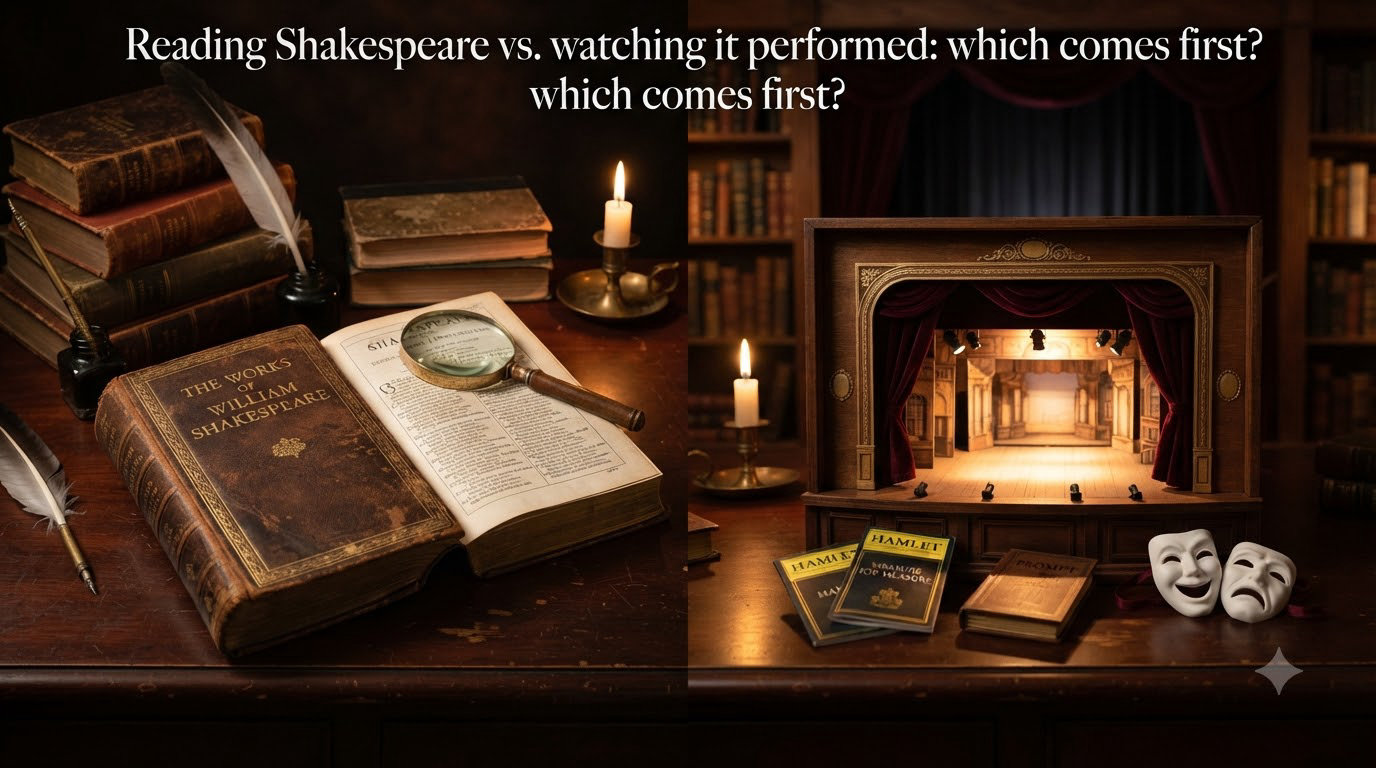
Reading Shakespeare vs watching it performed is one of the most common questions newcomers ask before opening a folio or buying a theatre ticket. Both approaches unlock different parts of the experience, and the honest answer is that neither one is wrong.
I’ve gone back and forth on this for years, and I’ve landed on a simple principle. The best introduction is the one that gets you to engage with the plays in the first place, because Shakespeare was meant to be lived with, not just consumed in one format.
This guide breaks down the benefits of each approach, compares them side by side, and offers practical recommendations based on how you actually like to learn. Whether you’re a student, a casual reader, or a theatre lover, you’ll find a path forward here.
Table of Contents
Reading Shakespeare vs Watching It Performed: The Core Difference
The core difference between reading Shakespeare and watching it performed is control. When you read, you direct the play entirely in your head. When you watch, a director makes those choices for you.
Shakespeare wrote his plays as scripts for actors, not novels for readers. The First Folio of 1623 collected his works because his fellow actors wanted to preserve the scripts they had performed. In that sense, the original “correct” way to encounter Shakespeare was in a theatre.
That said, Shakespeare has been read on the page for four centuries. Soliloquies like Hamlet’s “To be or not to be” often land harder when you sit with them silently. Many readers report that they imagine their own dream cast, free from any director’s interpretation.
The split between reading and watching is, in part, a modern phenomenon. Cheap printed editions and mass literacy made Shakespeare a reading-room author. Television, film, and streaming have made him a viewing-room author too. Today, both are valid.
Why Reading Shakespeare First Works for Many
Reading Shakespeare first works because it lets you build your own mental stage before anyone else’s vision lands. You become the director, casting and staging the play in your imagination.
I teach beginning Shakespeare this way, and the response is almost always positive. Students come away owning the language rather than borrowing it from a production they saw once.
Benefits of Reading Shakespeare for Comprehension
Reading lets you move at your own pace. You can pause on a line, look up a word, and reread a passage. No actor is rushing you toward the next beat.
When you read, you also engage more deeply with Shakespeare’s syntax. His inverted word order, his iambic pentameter, and his poetic devices all become clearer when you slow down enough to hear the rhythm. A line like “But, soft! What light through yonder window breaks?” rewards a quiet reread.
Reading also gives you access to a soliloquy as a private thought. Soliloquies are written to be overheard by an audience, but they read like internal monologues. When you read them silently, you slip into the character’s mind in a way that even a brilliant actor cannot always replicate.
Another advantage is budget and access. A used copy of a Shakespeare complete works costs less than a movie ticket. You can read at 2 a.m. in pajamas, on a train, or on a beach. The page is portable and patient.
Finally, reading protects you from a bad production. A poorly directed Shakespeare play can actively confuse you about what the text is doing. Reading first means you understand the play even if the production is uneven.
Why Watching Shakespeare Performed Has Unique Advantages
Watching Shakespeare performed has unique advantages because it does the hard work of decoding Elizabethan English for you. Trained actors know how to deliver an archaic line so the meaning lands before your brain has to wrestle with the words.
Many readers give up on Shakespeare because the language feels like a wall. Watching a clear, well-paced production is often the bridge that gets them past that wall and back to the page with confidence.
Benefits of Watching Shakespeare for Clarity
Actors make the language physical. Tone of voice, facial expression, and body language turn ambiguous lines into clear meanings. When Hamlet says “Get thee to a nunnery,” the same words can sound cruel, tender, or bitter depending on delivery.
Watching also gives you context that the page often omits. Shakespeare wrote relatively few stage directions, so reading forces you to imagine entrances, exits, and combat. A performance shows you who is on stage, where they stand, and how they move. That visual scaffolding helps you track the plot.
Another benefit is the variety of productions. Unlike most novels or films, Shakespeare plays are remade constantly. You can watch the same Hamlet half a dozen times and get six different interpretations. Comparing productions deepens comprehension in a way that rereading the same edition cannot.
Live theatre, in particular, is irreplaceable. The shared energy of an audience, the unpredictability of actors, and the physical presence of performers create something no page can deliver. Many lifelong Shakespeare fans trace that love to a single live performance.
Watching also helps with pronunciation. Shakespeare wrote in iambic pentameter, a heartbeat-like rhythm. Hearing it spoken makes the rhythm click into place. Once your ear locks onto that rhythm, the plays become much easier to read on the page.
Reading vs Watching Shakespeare: A Side-by-Side Comparison
Reading vs watching Shakespeare comes down to which tradeoffs matter most to you. Here is a quick comparison of how each approach handles the core elements of the experience.
Imagination: Reading forces you to imagine every detail. Watching hands that work to a director’s vision.
Pacing: Reading is self-paced and adjustable. Watching is the director’s pace, which is often brisk.
Language decoding: Reading requires effort to parse archaic English. Watching translates the language into body and voice.
Accessibility: Reading requires only a book or a phone. Watching requires a performance, a film, or a recording.
Memory: Reading leaves more vivid mental images that you control. Watching leaves a specific cast’s interpretation.
Cost: Reading is nearly free with a library card. Watching live theatre can be expensive, though film versions are affordable.
Re-watch value: Reading invites endless rereading of favorite passages. Watching invites comparison across productions.
Best for analysis: Reading wins for close textual study, footnotes, and marginal notes.
Best for emotional impact: Watching usually wins for first-contact emotional gut-punches.
Neither list is exhaustive, but it shows the central trade. Reading gives you freedom and depth. Watching gives you clarity and performance.
Should You Read or Watch Shakespeare First? Recommendations by Learning Style
You should usually read Shakespeare first if you enjoy slowing down and analyzing language, and watch Shakespeare first if you learn best through visual and auditory cues. Both paths are legitimate.
If you’re unsure, start with what feels less intimidating. A bad first encounter, whether on the page or on the stage, can sour you on Shakespeare for years. Pick the format where you are most likely to finish the play.
If You Are a Visual Learner
Start with a well-regarded filmed production. The BBC’s televised Shakespeare collection, the Branagh film adaptations, and the Royal Shakespeare Company recordings are all solid entry points.
Watch with the text in hand if you can. Pause and reread passages that catch your ear. Then rewatch scenes you loved and notice details you missed.
Once you have one play inside you visually, switch to reading the next one. You will find that the visual scaffolding transfers, and the text becomes much easier to navigate.
If You Prefer Reading and Analysis
Start with a clean, modern-spelling edition. Arden, Folger, and Norton all publish beginner-friendly Shakespeare editions with helpful footnotes.
Read a short play first. A Midsummer Night’s Dream, The Tempest, or Romeo and Juliet are all under 200 pages and move quickly. Save the longer histories for later.
After you have read a play, find one filmed or live production of it. Watch it once for the experience, then rewatch key scenes while reading along. This seals the language in your memory.
If You Want a Balanced Path
Alternate. Read one scene, then watch the same scene performed. This is the method I use when introducing Shakespeare to adults, and it almost never fails.
The reading primes you to catch the lines you love. The performance shows you what those lines can do in the mouths of skilled actors. Together, they build a richer memory than either alone.
How Reading and Watching Shakespeare Work Together
Reading and watching Shakespeare work together because they reinforce different parts of the experience. Reading builds comprehension; watching builds appreciation. Doing both builds a habit.
The synergy is real. Many lifelong Shakespeare readers only became that way after seeing a great production. Many lifelong theatre-goers only fell for the plays after rereading the text in a quiet room.
If you only have time for one, choose the format that will keep you coming back. But if you have time for both, alternate. The plays reward the second pass, no matter which form it takes.
Frequently Asked Questions
Is Shakespeare better read or watched?
Shakespeare is neither objectively better read nor watched. Reading gives you control, pace, and the chance to study the language closely. Watching gives you live interpretation, body language, and the rhythm of iambic pentameter spoken aloud. Most readers get the most out of Shakespeare by doing both, starting with whichever format feels more comfortable to them.
Should I watch or read Shakespeare first?
You should read Shakespeare first if you enjoy analyzing language and forming your own interpretations. You should watch first if you learn best through performance and need help decoding Elizabethan English. Beginners often find that watching a strong production first removes the intimidation factor of the language and makes the text easier to approach later.
Is watching a play the same as reading it?
Watching a play is not the same as reading it. Reading gives you control over pacing, the ability to reread passages, and freedom to imagine your own staging. Watching gives you the director’s interpretation, the actors’ voices, and visual context for actions the text leaves vague. Each experience reveals parts of the play the other cannot.
What grade level reading is Shakespeare?
Original Shakespeare is usually rated around a high school reading level, typically grades 10 to 12, because of his inverted syntax and archaic vocabulary. Modernized editions with updated spelling and helpful footnotes can bring the effective reading level down to middle school. The difficulty is less about vocabulary size and more about sentence structure, which is why watching first often helps.
Does reading Shakespeare spoil watching it performed?
Reading Shakespeare does not spoil watching it performed. In fact, knowing the plot in advance usually deepens your appreciation of the performance, because you can focus on delivery, staging, and interpretation instead of following the storyline. Many theatre fans reread the play the day of a performance so the language is fresh in their ears.
The Honest Answer on Reading Shakespeare vs Watching It Performed
The honest answer on reading Shakespeare vs watching it performed is that the question itself is a trap. There is no correct order, only the order that gets you to engage with the plays.
Start with whichever form feels less intimidating. Build a habit. Then layer the other on top. Within a few months, you’ll have your own answer, and it will be the right one for you.