
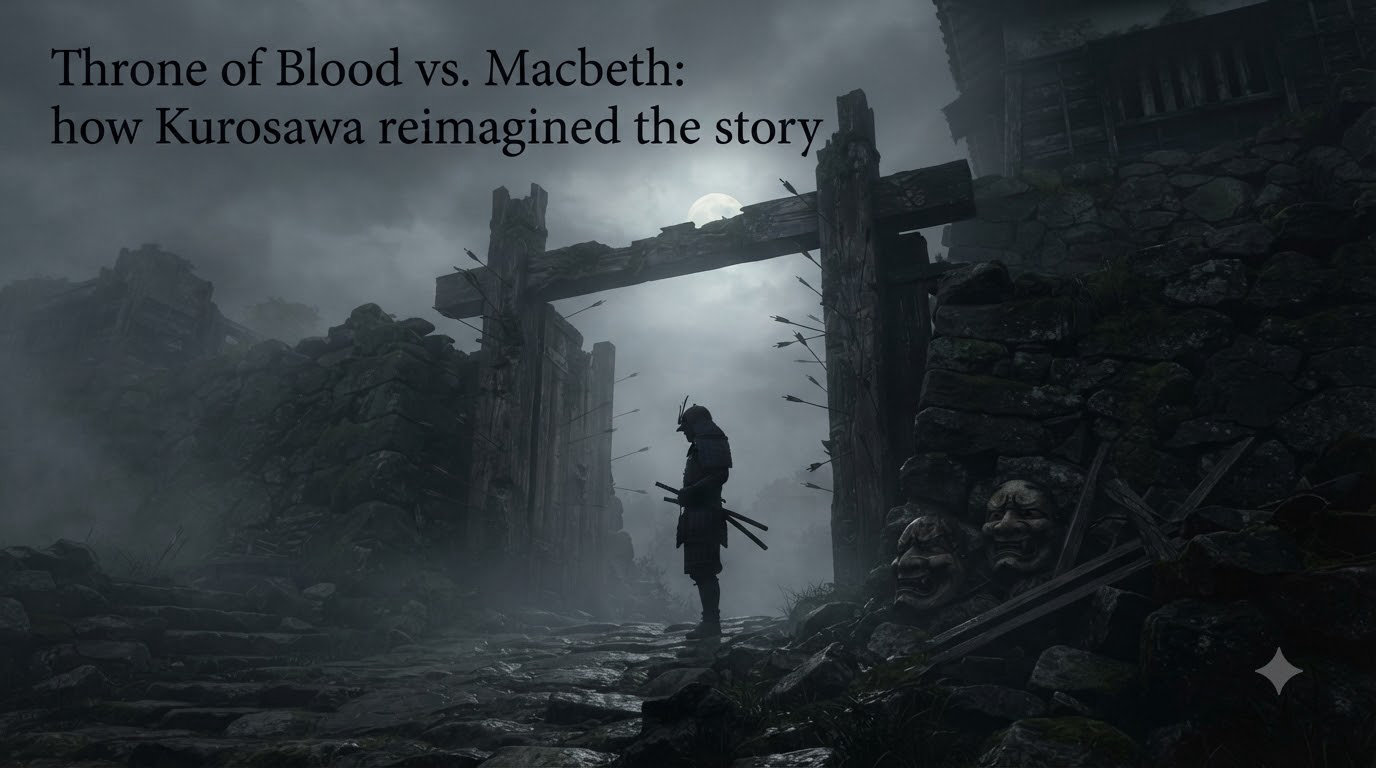
When I first watched Akira Kurosawa’s Throne of Blood (1957) on a Criterion disc at nineteen, I expected a Japanese-language Macbeth with samurai swords. What I got instead was a fog-drenched, deliberately alien ritual that refused to feel like Shakespeare at all – and that, I came to understand, is exactly the point. Kurosawa never set out to translate the play. He set out to transpose it, the way a composer reworks a folk song into a new key.
This is the heart of the Throne of Blood vs Macbeth conversation: one is a 400-year-old Scottish tragedy told in iambic verse, the other a Japanese film that bends Shakespeare into Noh theater, feudal loyalty, and the silence between words. The plot bones are the same. The flesh they wear is entirely different. That difference is not a failure of adaptation; it is the whole point of adaptation. Kurosawa understood something many later Shakespeare filmmakers have missed: the point of borrowing a story is not to reproduce it, but to find what the new medium can say that the old one could not.
I’ll walk you through the plot, the settings, the character correspondences, the Noh influences, the visual techniques, and the all-important ending. If you have never seen the film, my goal is to give you a map. If you have, I hope to surface details you may have missed. Either way, by the end you’ll understand why critics still call Throne of Blood one of the greatest Shakespeare adaptations ever filmed, and why comparing it directly to Macbeth often misses the point.
Table of Contents
The Two Stories: Plot Comparison Between Macbeth and Throne of Blood
Yes, both stories follow the same scaffold: a warrior receives a prophecy that he will rise to power, acts on it with his wife’s encouragement, murders his king, and is eventually destroyed by his own ambition. Washizu Taketori in Kurosawa’s film is Macbeth. His wife Asaji is Lady Macbeth. Captain Miki is Banquo. The Forest of Cobwebs (Kumonosu-jō) is the woods of Birnam. The differences live in how each story breathes, not in what it says.
Shakespeare’s Macbeth opens with three witches on a Scottish heath, who deliver prophecies to Macbeth and Banquo. The pair then write a letter to Lady Macbeth, who begins plotting before her husband even arrives home. In Throne of Blood, Kurosawa condenses the prophecy into a single encounter: Washizu and Miki lose their way in the Web of Cobweb Forest, encounter a mysterious spirit (a dim, ghostly figure seated at a spinning wheel), and hear their futures described through a chorus of chanting forest spirits. There is no letter scene. Asaji is not informed from afar; she is already waiting, and the pressure she exerts is colder and more relentless than anything Shakespeare’s Lady Macbeth attempts.
After the murder of their respective lords – King Duncan for Macbeth, Lord Tsuzuki for Washizu – both stories spiral into paranoia, a banquet scene with a ghost, and a final military confrontation. Banquo’s ghost haunts Macbeth; in Kurosawa’s film, the ghost is the ghost of Miki, whom Washizu has ordered killed. The banquet scene plays out in nearly silent register, with Toshiro Mifune’s Washizu staring at an empty seat and slowly unraveling before his startled guests. Around him, the chorus of attendants freezes, then begins a slow, ritualized backing away that is one of the most economical ways I have ever seen a film depict a room turning against its master.
The endings diverge sharply. Shakespeare’s Macbeth is killed by Macduff, and Malcolm, Duncan’s son, takes the throne. Order is restored. In Kurosawa’s film, Washizu’s own troops turn on him. Their arrows rain down in countless volleys until his body is a pin-cushion, and the victorious commander, Noriyasu, simply replaces him at the head of the castle. The cycle of power continues. There is no healing, no heir, no salvation. Kurosawa denies his audience the comfort of a return to legitimacy, and the film ends on a beat of pure exhaustion rather than closure.
Setting Shift: From Medieval Scotland to Sengoku-Era Japan
Kurosawa relocated the story to feudal Japan during the Sengoku Jidai, the warring states period of the 15th and 16th centuries, because the political landscape of medieval Scotland made no sense to a Japanese audience and – more importantly – because the bushido code of loyalty and betrayal mapped beautifully onto a samurai context. A general who kills his lord to take his throne is, in the Japanese cultural memory, an almost archetypal traitor. That resonance is what Kurosawa was chasing. The Sengoku period was full of exactly the kind of figure Washizu represents: a brilliant commander whose ambition outruns his lord’s trust, and whose rise is the first half of a story that always ends in assassination.
In Shakespeare’s Scotland, the play wrestles with Divine Right of Kings and the cosmic order of a Christian universe. Macbeth’s crime is not merely treason; it is a rupture of the Great Chain of Being. In Throne of Blood, the moral framework is Buddhist and feudal. The crime is betrayal of a lord, and the punishment is not divine retribution but the working out of karma – a fog that swallows the guilty, arrows that find their mark, and a void where ambition should have left a kingdom. The audience is meant to recognize the moral order, but they are not meant to be reassured by it.
The Web of Cobweb Forest itself is a Kurosawa invention. Shakespeare places Birnam Wood outside the castle; Kurosawa places his forest around the castle like a noose. The forest is the moral landscape of the film, populated by spirits and prophecies and the spinning wheel that converts fate into something almost mechanical. The mist is so constant that you forget what clear weather looks like. When, very late in the film, the army of Noriyasu advances on the castle hidden behind cut boughs of pine, the visual reference to Birnam Wood is unmistakable, but the image is filtered through a Japanese visual vocabulary of forest warfare that predates Shakespeare’s source.
Character Correspondences: Washizu, Asaji, Miki, and Their Shakespearean Twins
The character mapping is mostly one-to-one, but the most striking figures are the ones Kurosawa altered. Washizu is Macbeth, but Toshiro Mifune plays him with a physical intensity – the sweat, the wild eyes, the warrior’s body breaking under the weight of guilt – that gives us something the original play only implies. Where Shakespeare’s Macbeth is defeated by his own imagination, Kurosawa’s Washizu is undone by his own muscles. He kills, but he cannot stop shaking. By the time of the banquet scene, his hands have a tremor that no amount of courtly composure can mask.
Asaji Washizu, played by Isuzu Yamada, may be the most radical departure in the film. Lady Macbeth is often read as the conspirator who goads her husband into action. Asaji does not need to goad. She proposes the murder, executes the plan, and is the one who, after the assassination, walks calmly through the corridors of the castle wiping the blood from her hands. Her famous scene – sitting at her mirror, the dawn light catching her face, slowly screwing up her mouth to detach blood from her fingertips – is the film’s most quoted image. Critics have called her one of the most terrifying wives in cinema history, and watching the scene for the first time I understood why: she is not performing guilt, she is performing the absence of it, which is far more disturbing.
Her madness is quieter and more devastating than Lady Macbeth’s sleepwalking. Asaji’s breakdown is played as a slow, ritualized possession. She crawls through the castle corridors on her hands and knees, half in a trance, half in a Noh-style glide, searching for the spirit of Miki. There is no “Out, damned spot” speech. There is no doctor. There is only a body giving itself over to the void. Yamada’s physical control in this scene is one of the great feats of Japanese screen acting: she spends nearly a full minute gliding across a stone floor, and the camera follows her without a single cut, so that the audience cannot escape her progression.
Miki is Banquo, but with a stillness that Banquo never possesses. The forest spirit foreshadows that Miki’s descendants will rule after Washizu, which is exactly what the witches promise Banquo in Shakespeare. The difference is that Kurosawa visualizes the prophecy with a silver chalice sitting on the spirit’s altar, soaking in moonlight, identical to the one that will one day crown Miki’s heir. Miki himself refuses to act on the prophecy, but he is killed for it anyway. His son, Yoshimaru, escapes and will eventually return as the deliverer at the end. The structural echo of Fleance, Banquo’s son in Shakespeare, is preserved, but the Japanese version carries a clearer suggestion of dynastic continuity that the original play, ending in Malcolm’s coronation, does not so pointedly require.
Why Kurosawa Chose Noh Theater to Tell Macbeth’s Story
Kurosawa chose Noh theater because Noh was the only Japanese performance tradition built around stillness, mask, and ritualized movement – the opposite of Shakespeare’s verbal velocity. Where Shakespeare’s tragedy runs on language, Noh runs on the spaces between words. A Noh actor does not speak; he chants, in a half-spoken, half-sung style, supported by a chorus and a hayashi ensemble of flute and drums. The visual vocabulary is so codified that a small hand gesture or a tilt of the head carries the weight of a paragraph. Kurosawa had worked in theater before moving to film, and he had already absorbed Noh conventions in earlier projects; Throne of Blood is the work in which he committed most fully to translating those conventions to cinema.
Kurosawa applies this restraint to every scene. The witch scene is staged as a Noh tableau. The banquet scene is built around a single frozen moment – Washizu staring at the empty seat, recognizing that something is wrong – and then a slow, almost dancelike unraveling. The battle scene before the final assault is presented as a procession rather than a skirmish. Even the murder of Lord Tsuzuki is filmed in a Noh register: Washizu approaches, the camera does not cut, the kill is implied off-screen, and the silence carries the act. Noh traditionally uses a bridgeway, the hashigakari, that the principal actor crosses to enter the stage; in Throne of Blood, the castle corridors function as the same kind of deliberate path.
The masks themselves are central. Asaji is shown wearing a hannya mask in her madness scene, the demon mask of a woman transformed by jealousy into a serpent. The mask is one of the most recognizable images in all of Noh, and Kurosawa uses it to externalize Asaji’s inner state. Several critics have described the moment as the most efficient piece of psychological acting in cinema: a single mask, replacing a face, replacing a thousand words. The hannya mask carries centuries of Noh meaning – it represents a woman whose rage has consumed her humanity – and Kurosawa deploys it without exposition, trusting the visual literacy of his audience to read the reference.
Kurosawa also borrows the Noh principle of jo-ha-kyu, a three-part structure of slow introduction, accelerating development, and rapid conclusion. The first hour of Throne of Blood is deliberately slow, almost meditative. The middle section accelerates. The final battle unfolds with the speed and inevitability of a wave. Watching the film is, in this sense, watching a Noh play stretched across 110 minutes. Critics have sometimes complained about the pacing, but they are usually applying the wrong structural model. Within Noh and within Japanese aesthetic traditions, the slow beginning is the whole point. It is the silence from which the violence can erupt.
Visual Techniques: Fog, Mist, Masks, and the Spinning Wheel
The fog is the film’s signature. Kurosawa and his cinematographer, Asakazu Nakai, used wind machines and steam to keep the air around Spider Web Castle constantly thick. The effect is not decorative. It is structural. Fog separates the living from the dead, the visible from the hidden, the moral from the amoral. The moment Washizu returns to the castle after the murder, the fog swallows him. The moment his reign begins to collapse, the fog closes in again. By the time the arrows fly, the forest has crept to the castle walls and the world has become almost opaque.
The witch scene in the forest is the film’s most analyzed sequence. The spinning wheel is usually read as a metaphor for fate’s mechanical turning. I think it is more precise than that. The spinning wheel in the Throne of Blood prologue operates like a film projector: it converts story into image, prophecy into motion. The spirit at the wheel is, in this reading, a kind of ghostly director, showing Washizu and Miki the film they are about to live. This is one of the few scenes in world cinema where the apparatus of cinema itself becomes the subject of the scene, and it is striking that Kurosawa made the metaphor so explicit in a 1957 film, before film theory had absorbed the idea of self-reflexive cinema.
The deep focus compositions are equally deliberate. Kurosawa stages several key scenes in long, unbroken shots where a figure in the foreground is mirrored by another in the deep background, separated by layers of mist. The famous corridor scene where Asaji glides forward, her husband watches from behind, and the two figures are framed by the receding architecture of the castle is a textbook example of sumi-e composition, the Japanese ink-painting tradition in which negative space carries as much weight as the figure. Kurosawa studied sumi-e composition as a young painter, and the influence shows in every interior frame of the film.
And then the arrows. The final scene – Washizu trapped in the castle, his troops refusing to attack, his own allies turning their bows on him – is one of the most physically devastating endings in all of cinema. Mifune does not overact. He simply walks, looks up, and is hit. The arrows come in waves, hundreds of them, until he is slumped and twitching. The image is not heroic. It is surgical. Kurosawa shows what ambition actually looks like when it runs out of road: a body, surrounded by the consequences of its own choices.
The Banquet Scene: A Side-by-Side Comparison
Nowhere are the two works more usefully compared than in their banquet scenes, because both serve the same dramatic function – a guilty conscience made visible – while using entirely different vocabularies. In Shakespeare’s Macbeth, Banquo’s ghost appears at the banquet table, and Macbeth reacts with horror in front of his thanes. Lady Macbeth attempts to cover for him, scolding him, dismissing the empty chair as a fit of illness. The scene is verbal: Macbeth speaks his terror, the thanes murmur, Lady Macbeth manages the room.
In Throne of Blood, the equivalent scene is almost wordless. Miki’s ghost does not appear. Instead, Washizu sees an empty seat, and the empty seat is enough. The chorus of attendants freezes. Washizu rises, his hand on his sword, and the room holds its breath. Kurosawa replaces Shakespeare’s externalized haunting with an interior one, and the result is, in my view, the more disturbing of the two: the ghost is the one Washizu carries inside him, and no one in the room can be certain whether they are watching a man confronted by the dead or a man finally breaking with reality.
The two scenes also serve different political functions. In Shakespeare, the banquet scene exposes Macbeth to his thanes, and their quiet withdrawal from him is the first sign that his support is collapsing. In Kurosawa, the same withdrawal happens, but the supporting characters are samurai retainers whose withdrawal is itself a ritual, signaling that the formal bonds of loyalty have begun to dissolve. The political vocabulary is feudal Japanese rather than medieval Scottish, but the structural consequence is identical: the tyrant has become a target.
Fate, Free Will, and the Prophecy in Both Versions
In both Macbeth and Throne of Blood, the prophecy is the engine of the tragedy. Shakespeare leans into ambiguity: did the witches plant the idea, or did they simply reveal what would happen anyway? Kurosawa makes the answer more deterministic. Washizu does not choose to kill Lord Tsuzuki because he wants power. He chooses because he is told he will, and then he tells himself he chose. The forest spirit’s prophecy is not a suggestion. It is a delayed-action fuse. By the time the prophecy is fulfilled, Washizu is no longer the agent of his own story; he is the actor in one the forest has already scripted.
This is the philosophical hinge of the entire film. Kurosawa’s Japan of the 1950s was, in his own framing, a country whose future had been pre-written by the war and the occupation. Free will, in the public imagination, was a polite fiction. Throne of Blood replaces Christian sin with Buddhist karma: the actions are set in motion, the violence will be paid back, and the contest is not whether to escape but how to face the closing net. The film is, in this sense, a postwar document as much as it is an adaptation of Shakespeare. It diagnoses a national condition: the sense that history is a wheel, and the only choice is whether to ride it gracefully.
The Ending: How Kurosawa’s Final Scene Rejects Restoration
Shakespeare’s Macbeth ends with restoration. Malcolm, the rightful heir, takes the throne, and the political order is restored. The audience is meant to leave with the sense that the rupture has been healed. Kurosawa refuses this consolation. Noriyasu becomes the new lord. The cycle continues. The forest still murmurs. The spinning wheel still turns. The new lord is no better than the old one; he is simply the one who managed to die with the arrows aimed at someone else.
For a Japanese audience in 1957, this ending carried the weight of recent memory. The war had ended in fire and occupation. The new order had replaced the old one not by moral restoration but by force. There was no clean return. There was only the next regime and the next wave of ambition. Kurosawa’s ending is not nihilistic; it is realistic. Power does not heal itself. It recycles. A film made in the United States in 1957, even a great one, would almost certainly have closed on a note of moral recovery. Throne of Blood closes on a note of moral exhaustion, and that difference tells you almost everything you need to know about the gap between the two works.
How to Watch Throne of Blood for the First Time
If you have never seen Throne of Blood, the Criterion Collection Blu-ray is the version to seek out. The transfer is faithful to the original Toho production, and the supplementary materials include a thoughtful commentary by film historian Michael Wilmington. The BFI has also released a clean edition in the UK. Avoid early DVD transfers from the 1990s: the fog scenes are muddy in low-resolution versions, and the image loses much of its atmospheric depth. The film was restored by Toho in the 1990s and again for Criterion, and the more recent versions capture the layers of mist with a fidelity that older transfers simply cannot match.
Watch it with subtitles on, but try not to read every line in real time. Noh-trained performance is a face-reader’s art, and the impact of Mifune and Yamada is significantly reduced when you are reading translation at the bottom of the screen. Let the faces lead. The subtitles will fill in what you missed. If you have time, watch a second time a few days later without trying to follow the dialogue, focusing instead on the camera movement, the choral chanting, and the way the fog shifts from one scene to the next. The two-pass approach is how most film schools teach the film.
Read the Macbeth source first. You do not need to know the play by heart, but knowing the basic arc before watching makes the Noh-based deviations easier to recognize as choices rather than omissions. Read it as a 30-minute companion essay; even a SparkNotes summary will do. Then go in cold on the film. Knowing the original helps you see what Kurosawa kept, what he cut, and what he invented. Without that context, a viewer in 2026 can easily miss how deliberate the departures are.
Pay attention to the forest. The fog and the tree branches are not backdrops. They are the film’s grammar. Every scene set in the open carries a different visual register than the castle interiors, and the contrast between the two spaces is part of the story. The forest is the realm of the prophecy and the supernatural. The castle is the realm of politics and crime. Kurosawa codes this distinction visually so consistently that the film can be read by the set alone.
Look for the choral narration. The Noh chorus is present throughout the film, sometimes as off-screen chanting, sometimes as a group of attendants whose synchronized movement doubles as commentary. This voice is not the narrator of Shakespeare’s play; it is something closer to fate itself, watching. When you hear the chorus, the camera is usually framing Washizu in long shot, holding him at a distance, and the choral commentary tells you what the world thinks of him even when no character in the scene has spoken.
FAQs
How similar is Throne of Blood to Macbeth?
Throne of Blood follows the same plot skeleton as Macbeth: a warrior receives a prophecy that he will rise to power, murders his lord with his wife’s help, and is destroyed by his own ambition. The major characters map directly: Washizu is Macbeth, Asaji is Lady Macbeth, Miki is Banquo, and the Forest of Cobwebs stands in for Birnam Wood. The differences are in the atmosphere, the dialogue style, and the ending, which refuses the restoration that closes Shakespeare’s play.
Which Kurosawa movie is inspired by Macbeth?
Throne of Blood (1957), released in Japan as Kumonosu-jō (Castle of the Spider’s Web), is Akira Kurosawa’s Macbeth adaptation. It is the first of three Shakespeare films Kurosawa would direct, followed by The Bad Sleep Well (1960), a Hamlet-inspired corporate thriller, and Ran (1985), Kurosawa’s epic transposition of King Lear.
Why did Kurosawa choose Noh theater for his Macbeth adaptation?
Kurosawa chose Noh theater because its vocabulary of stillness, mask, ritualized gesture, and choral narration mirrors the themes of Macbeth while replacing Shakespeare’s iambic verse with a distinctly Japanese performance tradition. Noh also gave him a visual language for the supernatural, the prophetic, and the morally dead without resorting to melodrama. The result is a film that feels like a Noh stage production translated into cinema.
What is the significance of the witch in Throne of Blood?
The witch in Throne of Blood is a ghostly spirit seated at a spinning wheel in the Web of Cobweb Forest. The figure delivers prophecies to Washizu and Miki and stands in for Shakespeare’s three witches. The spinning wheel is often read as a metaphor for a film projector, with the witch as a director who shows the warriors the film of their own lives before they live it.
What are the main differences between Throne of Blood and Macbeth?
The main differences are setting (medieval Scotland vs feudal Japan), performance style (Shakespearean verse vs Noh theater), the role of the supernatural (three witches vs a single witch-spirit), Lady Macbeth’s characterization (Asaji is more predatory and more directly involved in the murder), and the ending (Malcolm restores order in Macbeth, while Kurosawa’s Noriyasu simply replaces Washizu and the cycle continues).
Why is Throne of Blood considered a masterpiece?
Throne of Blood is considered a masterpiece because it transforms Shakespeare’s source material into a work of cinema that is fully Japanese and fully art-house, without ever feeling like a translation. Its Noh-derived performance style, atmospheric fog, formalist compositions, and Toshiro Mifune’s physical performance have made it a touchstone for film studies, Shakespeare adaptation, and Japanese cinema alike. Filmmakers from Stanley Kubrick to Martin Scorsese have cited it as an influence.
Does Throne of Blood work without knowing Macbeth?
Yes. Throne of Blood is a complete work on its own terms, and a viewer who has never read Macbeth can follow the story and themes through the film’s own visual and Noh-based cues. The forest spirit, the chorus, the masks, and the ritualized gestures all communicate the prophecy and the moral arc without requiring Shakespearean context. Knowing Macbeth adds a layer of comparison, but the film does not depend on it.
What is the spinning wheel in Throne of Blood?
The spinning wheel in Throne of Blood is operated by the witch-spirit in the Web of Cobweb Forest. It is most often read as a metaphor for fate’s mechanical turning, but critics have also interpreted it as a metaphor for a film projector, with the witch-spirit functioning as a director showing Washizu and Miki the film of their own lives. Either reading places the wheel at the center of the film’s meditation on destiny, time, and the apparatus of cinema itself.
Conclusion: Why Throne of Blood Reimagined Macbeth So Powerfully
The Throne of Blood vs Macbeth comparison is not a question of which version is better. Shakespeare’s Macbeth is one of the great works of English drama, and no film can replace it. What Kurosawa did was something rarer: he took the play’s bones and rebuilt them in a different cultural body. The plot is the same. The shapes of the characters are the same. But the air they breathe, the silence that holds them, the images that follow them out of the room – those are Kurosawa’s.
When I watch Throne of Blood now, decades after that first Criterion viewing, I see less and less of Shakespeare in it. I see a Japanese film about feudal power, fog, and the absurdity of ambition. That is the highest praise I can give an adaptation: it teaches you to forget the original, so that you can see the new work on its own terms. Kurosawa did not translate Macbeth. He answered it. And the answer he gave – that ambition in any era reduces the ambitious to the same haunted posture, the same trembling hands, the same arrows – is more universal than anything Shakespeare could have written into the play directly.
If you have not yet watched the film, my honest recommendation is to give it the same attention you would give a great novel. Not because it is difficult – it is not, on its surface – but because it is dense. The fog is doing something. The masks are doing something. The chorus is doing something. Once you start listening with your eyes, the film opens up into one of the most distinctive works of cinema ever made, and the question of how Kurosawa reimagined Shakespeare stops being academic. It becomes the film itself. The fog, the masks, the silence, and the arrows do not need Shakespeare to be legible. They only need you to sit still and watch.