
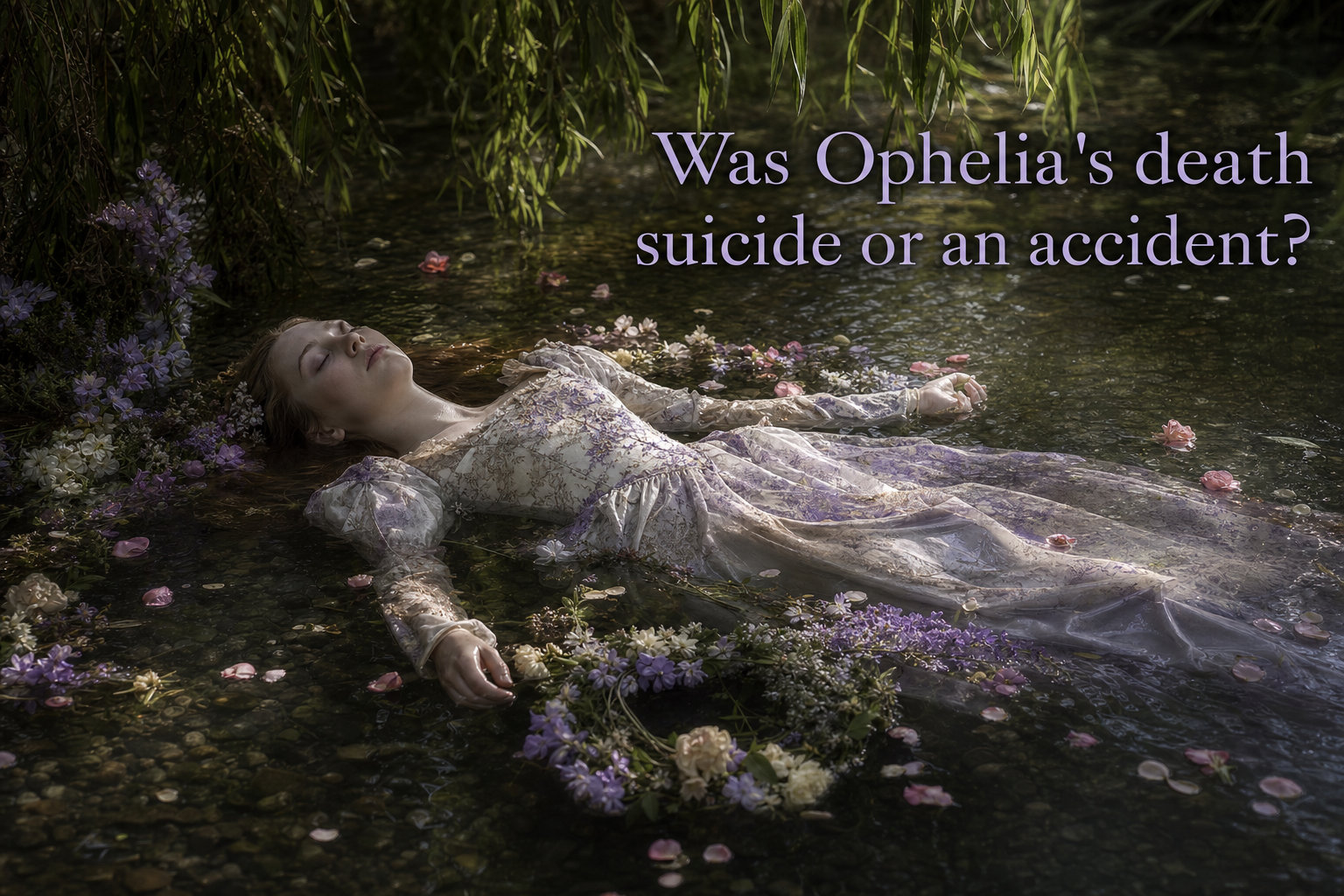
Shakespeare’s Hamlet never tells us directly whether Ophelia’s death was suicide or an accident. The text presents her drowning through the poetic, evasive words of Queen Gertrude in Act 4 Scene 7, then underscores the suspicion through the gravediggers’ gossip and the priest’s reluctance in Act 5 Scene 1. Whether you read it as suicide or accident depends largely on which lines you weigh most heavily.
In this guide, I walk through Gertrude’s account, the textual clues, the Elizabethan context, and the modern readings that keep this question alive in 2026 classrooms and book clubs. I have taught this scene to first-year literature students for over a decade, and I have seen the same two camps form every time. Some students land firmly on suicide, while others insist that a mad woman slipping from a willow branch is a tragedy, not a crime.
Table of Contents
What does Gertrude’s account reveal about Ophelia’s death?
Gertrude’s account of the drowning in Act 4 Scene 7 is the only firsthand description of Ophelia’s death we receive. She tells Laertes that Ophelia fell into the brook while climbing a willow tree to hang garlands of flowers. The branch broke, and Ophelia tumbled into the water.
Her clothes spread out around her momentarily, holding her up “mermaid-like” as she sang snatches of old hymns and ballads. Eventually, her garments grew heavy with water and pulled her down to a “muddy death.”
“When down her weedy trophies and herself
Fell in the weeping brook. Her clothes spread wide,
And mermaid-like awhile they bore her up;
Which time she chanted snatches of old tunes,
As one incapable of her own distress,
Or like a creature native and indued
Unto that element.”
Notice how carefully Gertrude’s language distances Ophelia from intention. The phrase “incapable of her own distress” suggests a mind unmoored from reality. The word “native” compares her to a creature born to water.
Gertrude paints a portrait of someone who drifted into death rather than chose it. This poetic framing is exactly why the accidental drowning theory has held such grip on readers for centuries. Yet the same passage contains ambiguity, because Gertrude never explicitly denies Ophelia’s agency.
She simply does not affirm it. For a death that would be considered self-slaughter under church law, this conspicuous omission is striking. A queen who wanted to protect Ophelia’s memory from the stigma of suicide would speak exactly the way Gertrude does.
Why do some readers see Ophelia’s death as an accident?
The accidental death reading rests on the specifics of Gertrude’s physical description. Ophelia was climbing a willow tree to hang flower garlands when the branch broke. She was not, on the surface of the text, seeking the water.
Her fall appears to be the result of an ordinary accident compounded by madness and misfortune. Ophelia’s mind was already broken by grief. After Polonius’s death and Hamlet’s cruelty in the nunnery scene, she had descended into a childlike, scattered state.
A person in such a condition might genuinely wander into a brook without grasping the danger. Gertrude describes Ophelia singing to herself as if she were in her own world. A determined suicide, the argument goes, would more likely be silent and resolute, not singing folk songs about a dead father.
The willow branch snapping is a concrete mechanical event. It requires no inner motive, only a weak limb. Many students find this reading emotionally satisfying. It frames Ophelia as a victim of circumstance, madness, and physical accident rather than a woman who calculated her own end.
Why do scholars interpret Ophelia’s death as suicide?
The suicide reading takes its strongest evidence from outside Gertrude’s monologue. The gravediggers in Act 5 Scene 1 openly debate whether Ophelia’s burial constitutes a Christian one. They note that the crowner has ruled her death suspicious and that she should not be buried in consecrated ground.
The priest who performs her funeral rites flatly refuses to give her the full Christian service. He declares that he would not have done more for her had she been a daughter of the church.
“Her death was doubtful,
And, but that great command o’ersways the order,
She should in ground unsanctified have lodged
Till the last trumpet.”
In Elizabethan England, suicide was legally and theologically a serious matter. The term self-slaughter appears in the play itself, used by Claudius in his prayer scene. A self-killer would traditionally be denied Christian burial, with stakes driven through the body and the corpse buried at a crossroads.
Claudius is the king, and his great command overrides the priest’s preference. This political pressure is why Ophelia receives any burial at all. The text also contains Hamlet’s bitter exchange with Laertes at the grave.
Hamlet declares that his love for Ophelia exceeded Laertes by a measure of forty thousand brothers. The intensity of this grief, paired with Laertes’ furious leap into the grave, suggests that everyone present understood the death as something more than a slip from a willow branch. Laertes even blames Hamlet outright for her death.
How did Ophelia’s mental state shape her final moments?
Ophelia’s madness is the hinge on which the entire question turns. In Act 4 Scene 5, she appears before the court distributing flowers and singing incoherent songs. Rosemary for remembrance, pansies for thoughts, fennel, columbines, rue, and a dead man’s daisy.
Her mind has become a garden of symbolic fragments. She is not plotting, but she is also not entirely absent. She acts, walks, climbs a tree, sings, and then drowns.
Modern scholarship has debated whether madness removes moral responsibility for suicide. Elizabethan theology generally held that the soul, not the mind, chose to die. A madwoman who killed herself still committed self-slaughter in the eyes of the church.
Modern psychological readings, particularly feminist ones, have reframed the drowning as Ophelia’s only remaining act of personal agency. In a court that has used her as a pawn, killed her father, and rejected her love, stepping into the water becomes a final assertion of self.
I find this reading compelling, though it requires us to imagine intention where the text is silent. What the text gives us is a woman whose grief has destroyed her capacity to reason, placed near a brook, with no one watching her. Whether she chose the water or the water chose her is the question Shakespeare seems to have wanted his audience to keep asking.
How does Ophelia’s death connect to Hamlet’s own struggle with suicide?
The parallel between Hamlet and Ophelia is hard to ignore once you start looking. Hamlet contemplates suicide in his most famous soliloquy, weighing the shuffled o’er of mortal coils against the undiscovered country. He talks himself out of it because of what he calls the dread of something after death.
Ophelia, by contrast, never articulates this theological fear. Her madness has stripped her of the reasoning Hamlet uses to preserve himself. By making Ophelia’s death the silent echo of Hamlet’s debate, Shakespeare seems to ask what happens when a person no longer has the faculty to argue themselves out of self-destruction.
The prince is saved by his intellect; the woman he rejected is lost without hers. This thematic mirror is one reason the question has refused to settle in over four centuries of interpretation.
FAQs
Was Hamlet responsible for Ophelia’s death?
Hamlet did not physically cause Ophelia’s drowning, but his rejection of her in the nunnery scene and his killing of her father Polonius contributed directly to her descent into madness. Laertes openly blames Hamlet at the funeral, and many readers consider him morally responsible for the chain of events that led to her death.
What was Hamlet’s reaction to Ophelia’s death?
Hamlet reacted with explosive grief at her funeral, leaping into her grave and declaring his love for her exceeded what forty thousand brothers could feel. He then fought with Laertes in the open grave. His outburst suggests his feelings for Ophelia had never truly died, despite his earlier cruel rejection of her.
Why did the priest refuse Ophelia a full Christian burial?
The priest in Act 5 Scene 1 refused Ophelia a full Christian burial because her death was treated as suspected suicide, which the church considered self-slaughter. He performs only maimed rites and notes that she should have been buried in unsanctified ground had the king’s command not overruled him.
Did Gertrude try to save Ophelia from drowning?
There is no textual evidence that Gertrude attempted to save Ophelia. Gertrude describes the drowning as something she observed from afar after the fact, and the play never shows anyone intervening. The lack of any rescue attempt is itself part of why the question of suicide versus accident remains open.
So, was Ophelia’s death suicide or an accident?
The honest answer is that Shakespeare left the question deliberately unresolved. The textual evidence cuts both ways. Gertrude’s account of a madwoman slipping from a willow branch supports an accidental drowning.
The priest’s maimed rites, the gravediggers’ doubts, the political pressure from Claudius, and the play’s own vocabulary of self-slaughter all point toward a death the court wished to disguise as something other than suicide. Read either way, Ophelia’s death remains one of the most haunting in Shakespeare’s canon.
If you teach this play or are simply wrestling with it on your own, my suggestion is to sit with both readings rather than choose one. The point of the scene is not to make you decide. It is to make you feel the pressure of deciding.
In 2026, that pressure still translates. We still argue about Ophelia, paint her, write songs about her, and ask what really happened by that willow-brook. Shakespeare wrote a death that keeps refusing to settle into a single answer, and that is exactly why it has lasted.