
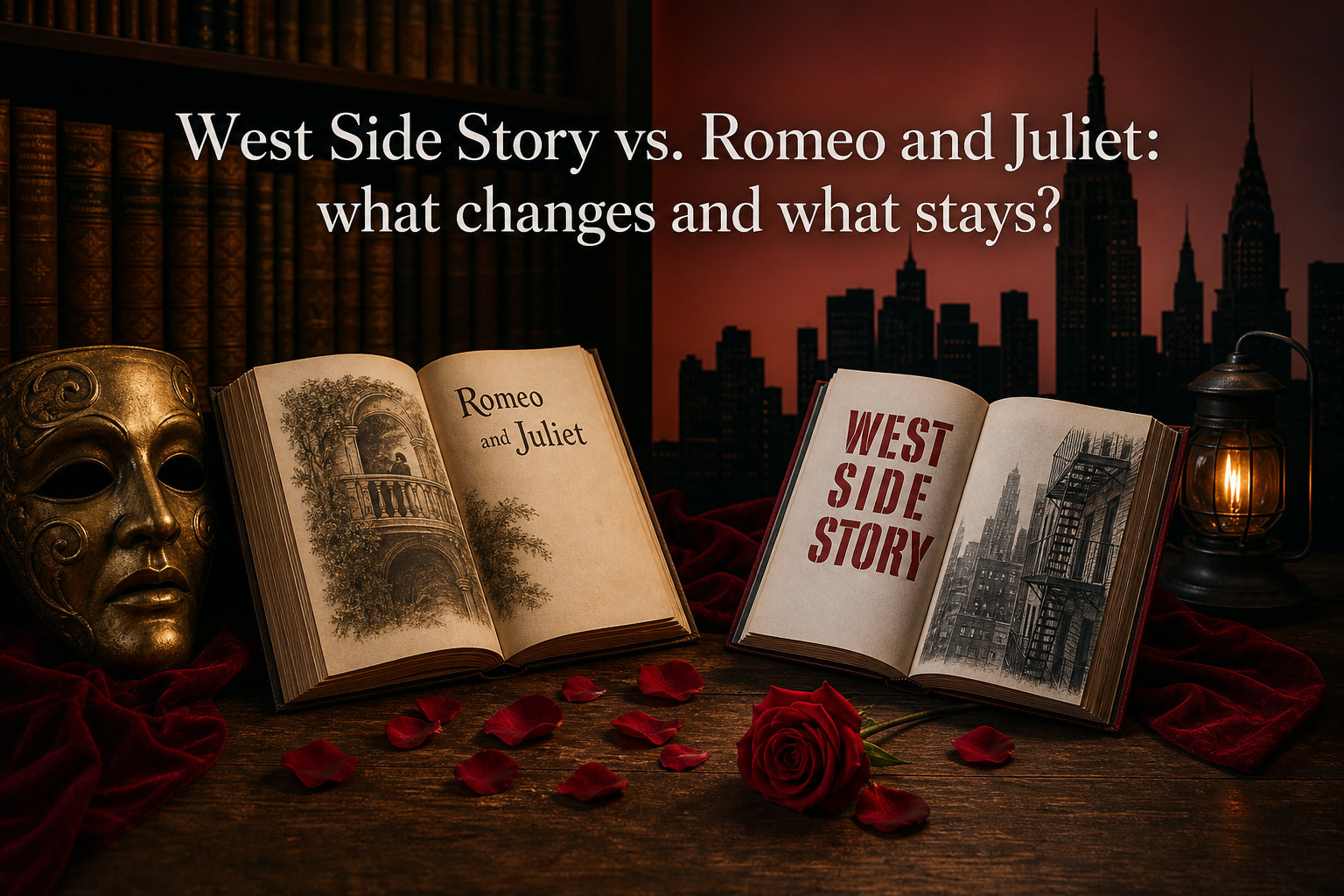
Few love stories have been retold as many times as Romeo and Juliet. Shakespeare wrote it in the 1590s as a play about two teenagers destroyed by a family feud. Nearly four centuries later, a team of Broadway artists took that same skeleton and rebuilt it for the streets of 1950s New York City.
The result was West Side Story, a musical that swapped Renaissance Verona for a neighborhood torn apart by rival gangs. When you put West Side Story vs Romeo and Juliet side by side, the architecture is almost identical. But the materials, the mortar holding it together, and the message it leaves you with are strikingly different.
I have spent years studying both works, watching every film adaptation, and reading what scholars, teachers, and fans have written about the connection. This guide breaks down exactly what changes and what stays when Shakespeare’s tragedy becomes a Broadway musical. We will cover character mapping, setting shifts, thematic parallels, the different endings, and even how the 2021 Spielberg film changed things a second time.
Whether you are writing a comparison essay, teaching both works in a classroom, or just curious about how one story transforms across centuries, you will find a clear answer here.
Table of Contents
Why West Side Story Exists: The Adaptation Origin Story
West Side Story did not start as a Shakespeare tribute. It started as a conversation about modern America.
In 1949, choreographer Jerome Robbins approached composer Leonard Bernstein and playwright Arthur Laurents with an idea. He wanted to create a musical about religious conflict between Jewish and Catholic families on Manhattan’s Lower East Side. The working title was East Side Story, and it would map directly onto Romeo and Juliet.
That version never got off the ground. The team shelved it because the idea felt too similar to another play running at the time. But a few years later, while reading newspaper headlines about gang violence and Puerto Rican immigration to New York, Laurents and Bernstein realized the story had a new home.
The conflict between white and Puerto Rican teenagers on the Upper West Side gave the Shakespearean template fresh urgency. Stephen Sondheim, then a young lyricist making his Broadway debut, joined the team to write the words. Bernstein composed the score, Robbins choreographed, and Laurents wrote the book.
The result premiered on Broadway in 1957 and immediately drew attention for how faithfully it mirrored Shakespeare’s structure while saying something completely new about American life. The creators never hid the connection. They built West Side Story as a direct adaptation, not a loose inspiration.
Every major character, plot beat, and emotional arc in Romeo and Juliet has a counterpart in the musical. The mapping is so precise that scholars use it as a textbook example of literary adaptation.
Character Comparison: Who Maps to Whom
The character mapping between the two works is remarkably deliberate. The creative team assigned each Shakespearean figure a modern equivalent, and once you see the pattern, you cannot unsee it.
Tony and Romeo are the romantic leads. Tony is a former Jet trying to leave gang life behind, just as Romeo arrives at the Capulet ball already weary of the Montague feud. Both fall in love at first sight and pursue that love even when it guarantees their destruction.
Tony is softer than Romeo in some ways, more haunted by violence. But both are idealists who believe love can override loyalty to a group.
Maria and Juliet are the hearts of their stories. Maria is a young Puerto Rican woman recently arrived in New York, sheltered by her brother Bernardo. Juliet is a nobleman’s daughter, equally sheltered by her family.
Both meet their love interest at a dance or ball. Both defy their families within hours of that meeting. The difference is that Juliet is given enormous dramatic agency in the second half of her play, while Maria’s story is more filtered through the people around her.
Bernardo and Tybalt fill the same structural role. Bernardo is Maria’s brother and the leader of the Sharks. Tybalt is Juliet’s cousin and the most aggressive Capulet.
Both hate the rival faction with a personal ferocity. Both kill the best friend of the male lead, triggering the chain of events that leads to tragedy.
Riff and Mercutio are the best friends whose deaths set the disaster in motion. Riff leads the Jets and is Tony’s closest friend. Mercutio is Romeo’s witty, mercurial companion.
Both die at the hands of the antagonist. And both deaths push the hero toward violence and revenge.
Anita and the Nurse serve as the female lead’s confidante. Anita is Bernardo’s girlfriend and the person Maria trusts most. The Nurse is Juliet’s lifelong caretaker.
Both women initially support the secret romance, then face a crisis when the violence escalates. Anita’s journey is darker: she becomes a victim of the Jets’ assault, which shatters her faith in the possibility of peace.
Chino and Paris are the designated suitors the families have chosen. Chino is the young man Bernardo has picked for Maria. Paris is the nobleman Juliet’s parents want her to marry.
Both represent the acceptable, safe match that the heroine rejects. In the final act, Chino shoots Tony just as Paris dies in the Capulet tomb.
The Jets map to the Montagues and the Sharks map to the Capulets. The family feud becomes a racial and ethnic turf war, but the structural function is identical. Two groups that hate each other define their identity through that hatred, and the lovers are crushed between them.
The Setting Shift: Verona to the Upper West Side
The most visible change between the two works is the setting, and the creators used it to transform the entire emotional register of the story.
Shakespeare’s Verona is an aristocratic Italian city governed by princes and family honor. Violence is formalized through sword duels, and the stakes are tied to social standing and lineage. The streets are public spaces where families confront each other openly.
West Side Story moves the action to the Upper West Side of Manhattan in the late 1950s. The neighborhood is being demolished for urban renewal projects, and the characters live in the rubble.
The violence is intimate and chaotic, fought with switchblades in alleys and on rooftops. There is no prince to restore order, only police officers who treat both gangs with contempt.
Specific locations map onto each other precisely. The Capulet ball becomes the gym dance where Tony and Maria first meet across a crowded room. The famous balcony scene becomes the fire escape scene, where Tony climbs up to Maria’s apartment the way Romeo climbs into the Capulet orchard.
The Capulet tomb becomes the dark street where Tony dies in Maria’s arms. This shift from aristocratic Europe to working-class urban America does more than update the look. It changes the social meaning of the conflict entirely.
What Stays the Same: The Thematic Parallels
Despite the centuries and the setting change, the core themes of both works are nearly identical. This is what makes the adaptation so powerful.
Forbidden love across enemy lines. In both stories, the central romance is forbidden not because the lovers are incompatible, but because the groups they belong to demand total loyalty. Romeo is a Montague and Juliet is a Capulet.
Tony is a Jet and Maria is a Shark’s sister. The love itself is simple. The barrier is identity, the tribal label that each side insists matters more than anything else.
Generational conflict and inherited hatred. Neither Romeo and Juliet nor Tony and Maria created the conflict they are trapped in. The feud was there before they were born.
The adults on both sides have taught their children whom to hate, and the young people inherit a war they never chose. Both works indict the older generation for passing down violence like an inheritance.
The destructive power of prejudice. Shakespeare frames the Montague-Capulet feud as a self-perpetuating cycle of hatred with no rational cause. West Side Story makes the hatred specific and racial, but the mechanics are the same.
People who have more in common than they admit are taught to see each other as enemies. The prejudice does not need a logical foundation to be lethal.
Loyalty versus individual desire. Every character in both works must choose between group loyalty and personal feeling. Romeo kills Tybalt to avenge Mercutio, choosing friendship over his marriage. Tony tries to stop the rumble, choosing peace over Jet loyalty.
The tension between what the group demands and what the heart wants drives every plot turn. In both works, that tension is irreconcilable.
The inevitability of tragedy. Both works create a sense that catastrophe is unavoidable. Once Mercutio dies, the dominoes fall. Once the rumble turns deadly, Tony’s fate is sealed.
Neither story believes the lovers can escape. The tragedy is structural, not accidental.
Love as an act of rebellion. In both works, choosing to love the enemy is the most radical thing the protagonists can do. It is not just romantic. It is a political act that threatens the entire system of hatred both sides depend on.
What Changes: The Key Differences
This is where the adaptation gets interesting. While the skeleton stays the same, the creative team made deliberate changes that alter the story’s meaning.
The conflict shifts from family name to race and immigration. The Montague-Capulet feud is ancient and arbitrary. The Jets-Sharks conflict is rooted in racism, xenophobia, and economic competition.
White teenagers who feel abandoned by society direct their anger at Puerto Rican newcomers they see as threats. This makes the hatred more recognizable and more uncomfortable for audiences than a vague family grudge.
There is no Friar Laurence figure. In Romeo and Juliet, Friar Laurence marries the couple in secret and devises the potion plan that goes wrong. He is the adult who tries to help and fails.
West Side Story removes this character entirely. There is no wise mentor, no secret marriage, no elaborate scheme. The absence of a Friar figure makes the lovers more isolated and the tragedy more direct.
The lovers do not marry. Romeo and Juliet are married by Friar Laurence in a secret ceremony. Tony and Maria imagine a future together and go through a symbolic wedding in the “One Hand, One Heart” number, but there is no legal or religious marriage.
This means there is no annulment plot, no exile order from the Prince, and no potion scheme. The story is simpler and more psychological.
The lovers are on different sides of the central conflict. Romeo and Juliet are both from feuding families, but they exist in the same social class. Tony and Maria are separated not just by gang affiliation but by race, language, and immigration status.
Maria is Puerto Rican. Tony is white. The barrier between them is thicker and more rooted in real-world prejudice than the Montague-Capulet divide.
The violence is escalated and modernized. Shakespeare’s characters fight with swords in formal duels governed by honor codes. West Side Story’s characters fight with knives and fists in coordinated gang rumbles.
The Jets and Sharks even try to formalize their violence through a planned “war council,” but it devolves into a chaotic stabbing. The modernization makes the violence feel rawer and more senseless.
The role of authority is fundamentally different. In Romeo and Juliet, Prince Escalus is a legitimate ruler who banishes Romeo as a measured punishment. In West Side Story, the police are corrupt, racist, and ineffective.
Officer Krupke and Lieutenant Schrank openly favor the Jets over the Sharks. There is no justice system to appeal to, which reflects a much darker view of American institutions than Shakespeare’s view of Verona’s governance.
The Endings: Why Maria Lives but Juliet Dies
The most discussed difference between the two works is the ending, and it reveals the deepest change in meaning.
In Romeo and Juliet, both lovers die. Juliet takes a sleeping potion, Romeo believes she is dead and poisons himself, and Juliet awakens to find his body and stabs herself. The deaths are mutual and absolute.
The families reconcile over their children’s corpses, and the Prince declares that heaven has punished their hatred. The symmetry of the double death is what shocks the feud into ending.
West Side Story ends differently. Tony is shot and killed by Chino. But Maria survives.
She finds Tony’s body, picks up the gun, and nearly turns it on herself. Then she stops. Instead of dying, she delivers a raw, devastated speech to both gangs, who are gathered in silence.
She tells them they killed Tony, that their hatred is responsible, and that she will never forgive them. This is a profound change from Shakespeare’s ending.
Juliet’s death completes the symmetry of the tragedy. Maria’s survival breaks it. By living, Maria becomes the witness and the conscience of the story.
She does not get the release of death. She must carry the grief, the anger, and the burden of speaking truth to both sides. That burden is the point.
Romeo and Juliet suggests that only the total destruction of the lovers can shock the warring factions into peace. West Side Story is more cynical and more modern.
The gangs come together to carry Tony’s body, but there is no sense that the hatred has ended. Maria’s survival implies that the damage is ongoing, that the survivors live with the consequences, and that peace is not guaranteed.
The 2021 Spielberg Film: What Changed Again
Steven Spielberg’s 2021 film adaptation of West Side Story introduced another layer of changes. Comparing it to both the 1957 stage original and Shakespeare’s play reveals how the story keeps evolving.
Spielberg and screenwriter Tony Kushner made the Puerto Rican experience central rather than peripheral. Characters speak Spanish extensively, and much of the Sharks’ dialogue is not subtitled.
This forces audiences to sit with the experience of not understanding. It gives Bernardo, Anita, and Maria interior lives that the original musical only hinted at.
The character of Anybodys was reimagined as non-binary. Played by Iris Menas, this version is explicitly searching for a place where gender categories do not define belonging.
This adds a dimension of identity exploration that neither the original musical nor Shakespeare’s play contained. It speaks to the same theme of being excluded by rigid group definitions.
Doc’s drugstore, where characters gathered in the original, became Valentina’s store, owned by Doc’s widow. Played by Rita Moreno, who played Anita in the 1961 film, Valentina becomes a maternal figure who sings “Somewhere” as a lullaby of hope.
This shifts the emotional center of the story toward the women. The song “I Feel Pretty” was also moved from before the rumble to after it, changing its meaning from naive optimism to desperate denial.
Maria sings it knowing the violence has already begun, which turns a bubbly number into something heartbreaking. These choices show how each generation that revisits the story reshapes it.
Shakespeare’s Verona became Bernstein’s New York, which became Spielberg’s New York. The bones stay the same, but the flesh changes to speak to the moment.
Modern Relevance and Social Commentary
Both works feel startlingly current because the problems they describe have not gone away.
The racial tension at the heart of West Side Story maps directly onto contemporary debates about immigration, xenophobia, and who gets to belong in America. The Puerto Rican characters are told to go home, mocked for their accents, and treated as invaders.
Those dynamics play out in real life every day, in every city. The musical is not a period piece. It is a mirror.
Romeo and Juliet speaks to a different but related truth. The arbitrary loyalty to group identity over human connection is not just a Renaissance problem.
It appears in political polarization, in nationalism, in every conflict where people choose a label over a person. Both works ask the same uncomfortable question.
What would happen if you saw the person behind the enemy label? And both works answer it the same way. The people around you will try to destroy you for it.
FAQs
How is West Side Story different from Romeo and Juliet?
West Side Story transplants Shakespeare’s plot from Renaissance Verona to 1950s New York City, replacing family feuds with racial gang conflict. The lovers do not marry, there is no Friar Laurence figure, the violence involves knives instead of swords, and Maria survives at the end while Juliet dies. The conflict is rooted in racism and immigration rather than ancient family hatred.
Why does Maria survive in West Side Story but Juliet dies?
Maria survives because the creators wanted to show the aftermath of violence rather than its completion. Juliet’s death creates tragic symmetry and forces the families to reconcile over her body. Maria’s survival means she must live with the grief and confront both gangs directly. Her survival sends a darker, more modern message: the damage does not end with death, and peace is not guaranteed.
What are the differences between the 1957 stage version and the 2021 film of West Side Story?
Spielberg’s 2021 film centers the Puerto Rican perspective, uses extensive unsubtitled Spanish dialogue, reimagines Anybodys as a non-binary character, replaces Doc with Valentina (Doc’s widow, played by Rita Moreno), and moves the song I Feel Pretty to after the rumble. The film gives Maria, Bernardo, and Anita more interiority than the stage original.
How do Romeo and Juliet change as the story goes on?
Both characters mature rapidly under pressure. Romeo begins as a melancholy romantic pining for Rosaline and transforms into a decisive man willing to kill, marry, and die for love. Juliet starts as an obedient daughter and becomes the more proactive partner, orchestrating the marriage, defying her parents, and choosing death over a forced marriage to Paris. Their growth is compressed into a few days, which makes the transformation feel desperate and absolute.
How is West Side Story connected to LGBTQ representation?
The 2021 Spielberg film cast Iris Menas, a non-binary actor, as Anybodins and explicitly wrote the character as non-binary. Anybodins is rejected by the Jets for not fitting their gender expectations and searches for a place to belong outside rigid categories. This addition, not present in the stage original, connects to the broader theme of being excluded by group definitions of identity.
Who wrote West Side Story and why was it created?
West Side Story was created by Jerome Robbins (choreographer and director), Leonard Bernstein (composer), Stephen Sondheim (lyricist), and Arthur Laurents (book writer). They wanted to adapt Romeo and Juliet for modern America, initially as a story about Jewish and Catholic conflict before shifting to the racial tension between white and Puerto Rican gangs in 1950s New York. The musical premiered on Broadway in 1957.
Conclusion: What Endures Across Centuries
When you trace the line from Shakespeare’s Verona to Bernstein’s Upper West Side to Spielberg’s 2021 adaptation, one thing becomes clear. The details change constantly, but the emotional core does not.
Two young people fall in love across a divide their society insists is unbridgeable. The people around them respond with violence. And the story ends in grief that could have been avoided if anyone had chosen a person over a label.
West Side Story vs Romeo and Juliet is not a competition. It is a demonstration of how great stories survive by transforming.
The creative team behind the musical understood that Shakespeare’s template was sturdy enough to hold entirely new content. They kept the structure, the character archetypes, and the thematic spine. They changed the setting, the social stakes, and the ending to say something their audiences needed to hear about racism, immigration, and American violence.
If you are studying both works, the most useful thing you can do is experience them. Read the play, watch the 1961 film, and watch the 2021 version. The differences will become visceral rather than abstract.
You will feel how the same story hits differently when the swords become knives, when the noble families become teenagers on a city block, and when the heroine lives to tell the survivors what they have done. That is the power of adaptation. It does not replace the original. It proves the original still has something to say.