
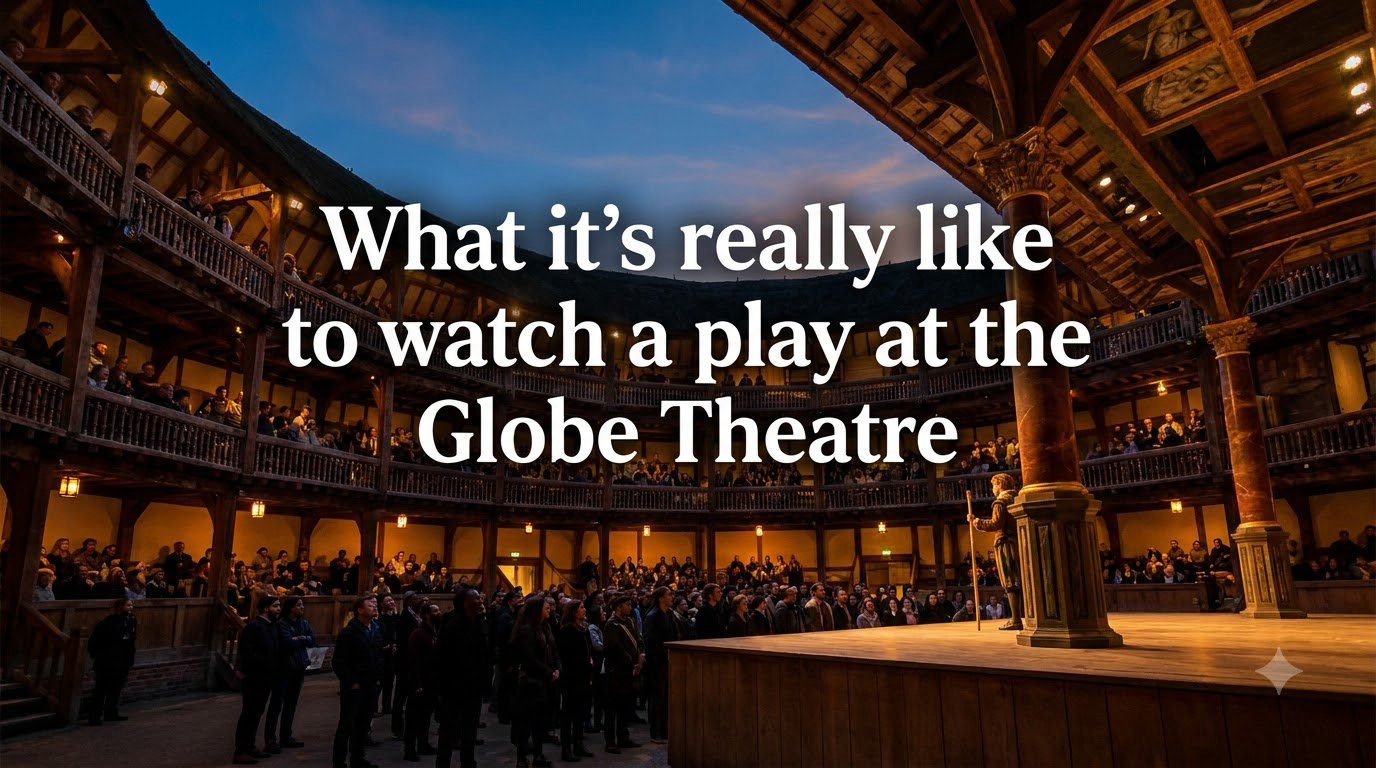
There is nothing quite like settling in to watch a play at the Globe Theatre. No dimmed lights hiding the audience, no velvet curtains waiting to rise, no amplified sound system carrying every whisper to the back row. Instead, you get daylight, wood, plaster, open sky, and the strange, electric feeling that you are watching theatre the way people did more than four centuries ago.
I have sat in the galleries on hard oak benches and stood in the yard shoulder to shoulder with strangers who became friends by the final act. Each experience was different, and each one taught me something new about what makes this space so singular. The Globe is not a museum piece behind glass.
It is a working theatre that asks you to meet it halfway, and the effort is worth every aching muscle the next morning. This guide covers everything you need to know before you go. You will learn the history behind the reconstruction, how to choose between standing in the yard and sitting in the galleries, what happens during a performance when there is no roof over your head, and the practical tips that most first-time visitors wish they had known.
Whether you are a Shakespeare enthusiast planning a pilgrimage or a tourist looking for something beyond the standard West End show, this is what it is really like to watch a play at the Globe Theatre.
Table of Contents
Stepping Into the Past: The Globe Theatre Experience
The Globe Theatre you visit today on London’s Bankside is a careful reconstruction of the playhouse where Shakespeare’s own company, the Lord Chamberlain’s Men, performed starting in 1599. The original building was an open-air, wood-framed amphitheatre that could hold around 3,000 spectators drawn from every social class in Elizabethan London. It burned to the ground in 1613 when a theatrical cannon fired during a performance of Henry VIII ignited the thatched roof, and though it was rebuilt the following year, the Puritans eventually tore it down in 1644.
The modern Globe exists because of one man’s stubborn obsession. American actor and director Sam Wanamaker arrived in London in 1949 expecting to find a monument to the most famous theatre in history. Instead, he found a brewery and a plaque on a wall.
He spent the next four and a half decades campaigning, fundraising, and fighting bureaucratic resistance to build a faithful reconstruction. He died in 1993, three years before construction was completed, and never saw the finished theatre. The building opened in 1997, the first thatched-roof building permitted in London since the Great Fire of 1666.
What makes the reconstruction so remarkable is the commitment to historical accuracy. The building is an icosagon, a 20-sided polygon that approximates a circle, built from green oak beams joined with wooden pegs rather than metal nails. The walls are lime plaster over a lath frame, just as they would have been in Shakespeare’s day.
The stage extends into the audience on three sides, creating a thrust configuration that eliminates the barrier between actor and spectator. Above the stage hangs the Heavens, a painted canopy decorated with stars, moons, and zodiac figures, representing the celestial realm in Elizabethan cosmology. Below it, the trap door opens to the underworld.
When you sit in the galleries or stand in the yard, you are surrounded by this architecture on all sides, wrapped inside what Shakespeare himself called a wooden O in the prologue to Henry V. That spatial design is not just aesthetic, it shapes everything about how the plays work.
There is no fourth wall here. Actors can see every face, hear every reaction, and step directly into the crowd. The Globe was built to hold attention in a world without electric lights, and the reconstruction preserves that challenge.
Every performance is a negotiation between the stage and the audience, and you are part of it whether you realize it or not. It is worth understanding how different this is from the modern West End experience most visitors know. In a conventional London theatre, you sink into upholstered seats, the lights drop to black, and the action unfolds behind a proscenium arch that frames the stage like a painting.
Sound is engineered, temperature is controlled, and the audience sits in passive darkness. The Globe strips all of that away. You share the same light as the actors, the same air, and the same vulnerability to whatever the sky decides to do.
That rawness is precisely what some visitors find intoxicating and others find challenging. No one finds it forgettable.
Your Seating Choice Changes Everything
The single biggest decision you will make is whether to stand in the yard as a groundling or sit in one of the surrounding galleries. This choice determines your comfort level, your budget, your view, and ultimately your entire experience. Both options are authentic to Shakespeare’s time, and neither is objectively better.
They are just different ways to experience the same play. The choice you make should reflect your own tolerance for physical discomfort, your budget, and what kind of experience you are hoping to have.
The Yard: Life as a Groundling
The yard is the flat, open space directly in front of and around the stage, with no seating whatsoever. In Shakespeare’s era, the poorest audience members paid a penny to stand here, and they earned the nickname groundlings from a passage in Hamlet. Today, yard tickets are still the cheapest option, and standing in this space puts you closer to the actors than any seat in the building.
The trade-off is stamina. Most productions run between two and a half and three hours, and you will be on your feet for every minute of it. You cannot sit on the ground, lean against the stage rails, or bring a folding stool.
Staff enforce this rule throughout the performance, gently but firmly. Some visitors report being able to shift weight, stretch, and occasionally crouch during quieter scenes, but the expectation is that you stand.
What you gain in exchange is immersion. The stage is at eye level and often just a few feet away. You can see the sweat on an actor’s face, hear the breath between lines, and feel the energy of the crowd moving around you.
Groundlings are part of the performance in a way that seated audiences never are, and actors know it. They make eye contact, toss props into the yard, and sometimes address the standing crowd directly. This is as close as you can get to the original Elizabethan theatregoing experience without a time machine.
My advice for first-time groundlings is simple. Wear comfortable, supportive shoes and eat beforehand. Use the restroom before settling in, because leaving the yard mid-performance means losing your spot.
Position yourself near the front if you want maximum interaction, or toward the back near the gallery entrance if you want a quick escape route. Accept that your legs will hurt by the end, and know that leaving early is perfectly acceptable. No one will judge you, and many visitors do exactly that.
The Galleries: Seated but Far from Luxurious
The three tiers of covered galleries wrap around the yard on three sides, offering wooden bench seating with a roof overhead. In Shakespeare’s day, these seats cost more and attracted wealthier patrons who wanted to be seen as much as to see. Today, gallery tickets range from mid-price to premium, and most first-time visitors default to them for the obvious reason that you get to sit down.
The catch is that sitting does not mean comfortable. The benches are hard, bare oak with no backs, arranged in rows that can feel cramped during a sold-out performance. You are sharing a bench with several other people, all of you packed together on a surface designed for a population with different expectations of personal space.
Renting a cushion is the single most common piece of advice from experienced Globe visitors, and it costs just a few pounds. Skipping it is a mistake you will only make once.
View quality varies dramatically by location. The lower gallery offers the best sight lines and the closest seated perspective. Middle gallery seats provide a broader view of the whole stage and yard, which some people actually prefer for comedies and large-cast productions.
Upper gallery seats are the cheapest seated option but come with restricted views and a steep, vertiginous angle. Restricted-view tickets are clearly marked when you book and are often a good deal if you do not mind missing part of the action.
One factor almost no guide mentions is sun exposure. On the side of the theatre facing the stage, gallery seats in the lower tiers may fall in shadow during afternoon performances. Seats on the opposite side can sit in direct sun for hours, especially during matinees in summer.
Check where your seat falls relative to the afternoon sun when booking, and bring a hat or sunscreen if you are on the exposed side. This small bit of planning can be the difference between a pleasant afternoon and a sweltering one.
What Happens When the Performance Begins
The moment a Globe performance starts, you understand immediately why this theatre is different from anything else in London. There is no blackout, no hush falling over a darkened room, no orchestra tuning in the pit. An actor simply walks onto the stage in full daylight, and the play begins.
Natural Daylight and the Open Sky
The yard is entirely open to the sky, which means every daytime performance happens in natural daylight. Matinee shows are lit by the sun, and evening performances during the summer season start in daylight and gradually transition as dusk settles over Bankside. The galleries are covered by the thatched roof, but the open sides mean natural light reaches every corner of the building.
This changes everything about how you experience the play. You can see the other audience members as clearly as the actors. People shift in their seats, whisper to neighbours, and react visibly to the performance.
It can feel distracting at first if you are used to the focused darkness of a conventional theatre, but it quickly becomes part of the charm. You are watching a play in a room full of living, breathing people, and that collective energy feeds back to the stage.
The open sky also means you are at the mercy of the London weather. A sudden gust of wind can carry a bird across the yard, and a passing cloud changes the light on stage in an instant.
During one performance I attended, a light rain began falling on the groundlings halfway through the second act. A ripple of laughter and groans spread through the standing crowd. The actors barely acknowledged it, pressing on as their Elizabethan predecessors would have done.
For evening performances, the Globe uses minimal artificial lighting that approximates candlelight or early gas lighting, maintaining the connection to historical performance conditions. The transition from daylight to dusk to controlled evening light can create some of the most magical moments of the entire experience. This is particularly striking during plays that reference nightfall or darkness in their text.
Choosing between a matinee and an evening show matters more here than at any other London theatre. Matinees give you the full daylight experience, which is the closest match to how Elizabethan audiences would have watched plays, since performances in Shakespeare’s time took place in the early afternoon.
However, matinees also mean maximum sun exposure for yard standing and for seats on the unshaded gallery side. Evening performances offer cooler temperatures and the dramatic dusk-to-darkness transition, but you miss the pure daylight effect, and they tend to sell out faster.
When Actors Talk Back to You
The thrust stage design means actors perform surrounded by audience on three sides, and the absence of a fourth wall changes the fundamental dynamic of the performance. Soliloquies that feel internal and private on a proscenium stage become direct conversations with the audience at the Globe. When Hamlet asks whether he should suffer the slings and arrows of outrageous fortune, he is asking you.
This intimacy is most intense for groundlings standing at the edge of the stage, but it extends to the galleries as well. Actors make eye contact across the full span of the auditorium. Comic actors in particular use the crowd as a resource, improvising responses to audience reactions and singling out individuals for gentle teasing.
Forum discussions among Globe regulars are full of stories about these interactions. One Reddit user described an actor handing sprigs of lavender to groundlings during a production, then referencing the scent in a later speech. Another recalled a performer breaking character for a single sentence to respond to a baby crying in the galleries, turning a potential disruption into a moment of comedy that brought the house down.
This responsiveness cuts both ways. It also means that audience behaviour shapes the performance in ways that modern theatre audiences are not always prepared for. Ringing phones, loud conversations, and people arriving late or leaving mid-scene all affect the actors visibly.
The Globe experience asks more of its audience than a conventional theatre. Part of watching a play here is accepting that responsibility and recognizing that your presence is part of the show.
Practical Tips for First-Time Globe Visitors
Preparation makes the difference between a magical evening and a miserable one at the Globe. The theatre’s commitment to historical authenticity means modern comforts are limited, so a little planning goes a long way. Here is what experienced visitors recommend.
What to Wear and Bring
Dress for the weather, not for the theatre. The Globe is an open-air venue, and the dress code is essentially non-existent. For yard standing, comfortable walking shoes with good arch support are absolutely essential, more important than anything else you wear.
For gallery seats, layers are the key. The building can be warm in the sun and surprisingly cool once the evening settles, so bring a light jacket even in summer. A wide-brimmed hat and sunscreen are worth packing for matinee performances on the exposed gallery side.
If you are standing in the yard, bring as little as possible. There are no coat checks for groundlings, and you will be holding whatever you carry for three hours. A small crossbody bag for essentials is fine, but a backpack will become a burden.
If you have gallery seats, rent a cushion at the venue. This is the most frequently repeated piece of advice from experienced visitors, and the few pounds it costs will save you considerable discomfort on those hard oak benches.
What Happens When It Rains
Rain does not stop a Globe performance. The show goes on regardless of weather, which is one of the most common surprises for first-time visitors. Groundlings get wet, full stop.
The theatre does not provide ponchos or umbrellas for the yard, so bring your own if rain is in the forecast. Gallery ticket holders stay dry under the thatched roof, though wind can carry drizzle into the outer rows.
Performances are only cancelled in cases of genuinely dangerous weather, such as lightning storms or extreme winds. The box office communicates cancellations as early as possible, usually by midday for evening shows. If your performance is cancelled, you are typically offered a rebooking or a refund.
Arrival, Food, and Phone Etiquette
Arrive at least 30 to 60 minutes before the published start time, especially for evening performances. The Globe does not have assigned standing positions for groundlings, so arriving early lets you claim a spot near the front of the yard. For gallery ticket holders, early arrival gives you time to pick up a cushion, find your seat, and settle in without rushing.
Food and drink are available at the venue, including a bar and snack counter. You can bring drinks into the auditorium, including the yard, but glass is typically prohibited for safety reasons. Eating during the performance is discouraged, and most visitors finish snacks before the show begins.
The Globe’s food offerings are basic, so consider eating a proper meal beforehand if you are standing for three hours. There are plenty of restaurants and pubs along Bankside within a short walk of the theatre.
Phone etiquette is a growing concern at the Globe, and the open-air environment makes it harder to enforce silence than in a darkened conventional theatre. Ringing phones and glowing screens are visible to everyone, including the actors on stage. Turn your phone completely off before the performance begins, not just on silent.
The actors can see the yard and galleries clearly, and a screen lighting up is a genuine disruption to the intimate dynamic that makes this theatre special. If you must check your phone, step outside the auditorium entirely rather than glancing at it in your seat.
Frequently Asked Questions
Is the Globe Theatre comfortable?
The Globe is not designed for comfort. Gallery seats are hard oak benches with no backs, and groundlings stand for the entire 2.5 to 3 hour performance. Renting a cushion for gallery seats is highly recommended, and wearing supportive shoes is essential for yard standing. Most visitors find the discomfort a fair trade for the authentic experience.
What should I wear to the Globe Theatre?
Dress for the weather and for comfort. If you are standing in the yard, wear supportive walking shoes and bring a rain jacket if weather is uncertain. If you have gallery seats, layer your clothing since the open-air building can shift from warm to cool during evening performances. There is no dress code, so prioritize practicality over formality.
What was it like for audiences watching a play at the original Globe?
In Shakespeare’s time, the original 1599 Globe held about 3,000 spectators from all social classes. Groundlings paid a penny to stand in the yard, eating, drinking, and talking through performances. Wealthier patrons sat in the covered galleries. The atmosphere was loud, rowdy, and interactive, with audiences directly responding to the actors. The modern reconstruction recreates much of that energy.
Is the Globe Theatre worth it?
Yes, for most visitors the Globe Theatre is absolutely worth it. It offers a theatrical experience found nowhere else in London, combining historical authenticity with genuinely skilled performances. Even people who do not typically enjoy Shakespeare report being swept up by the intimate, interactive atmosphere. The cheaper yard tickets make it accessible on almost any budget.
Where is the best place to sit at the Globe Theatre?
Lower gallery seats offer the best combination of view, comfort, and proximity to the stage. Middle gallery seats provide a wider perspective that works well for large-cast productions. The yard standing area puts you closest to the actors but requires standing for three hours. Upper gallery seats are the most affordable but have restricted views and a steep angle.
How early should I get to the Globe?
Arrive 30 to 60 minutes before the performance. Yard standing positions are first come first served, so arriving early lets groundlings claim spots near the front. Gallery ticket holders benefit from early arrival to rent cushions, find seats, and grab drinks without rushing. The venue opens about an hour before showtime.
What happens if it rains during a performance at the Globe?
Performances continue in the rain. Groundlings in the open yard will get wet, so bring a waterproof jacket or poncho. Gallery seats are covered by the thatched roof and stay dry. The Globe only cancels for dangerous weather such as lightning or high winds, and cancelled shows are typically rebooked or refunded.
Conclusion: A Theatre Experience Like No Other
Watching a play at the Globe Theatre is unlike anything else you will do in London, or anywhere else for that matter. It is not the polished, climate-controlled experience of a West End musical, and it does not try to be. What it offers instead is something rarer: a direct connection to the way theatre worked when it was written.
The discomforts are real. Your legs will ache if you stand in the yard, your back will protest on the gallery benches, and the London weather will make its presence known whether you invited it or not. But those limitations are part of what makes the experience authentic.
Shakespeare wrote for a crowd that stood, talked, ate, and reacted in real time, and the Globe puts you in that crowd. The building is designed to bring you as close to that original energy as four centuries of distance allow.
If you are planning your first visit, book directly through the Shakespeare’s Globe website for the best ticket selection. Choose the yard if you want maximum immersion and do not mind standing, or pick lower gallery seats if you want to sit with a good view. Arrive early, dress practically, turn off your phone, and let yourself be drawn into a performance style that no modern theatre can replicate.
You will leave tired, possibly damp, and almost certainly talking about what you just saw. That is exactly what audiences have been doing on this spot for more than four hundred years, and it is what makes learning what it is really like to watch a play at the Globe Theatre an experience worth having at least once. Whether you return as a groundling, a gallery regular, or simply a fond memory, the wooden O on Bankside will be waiting.