
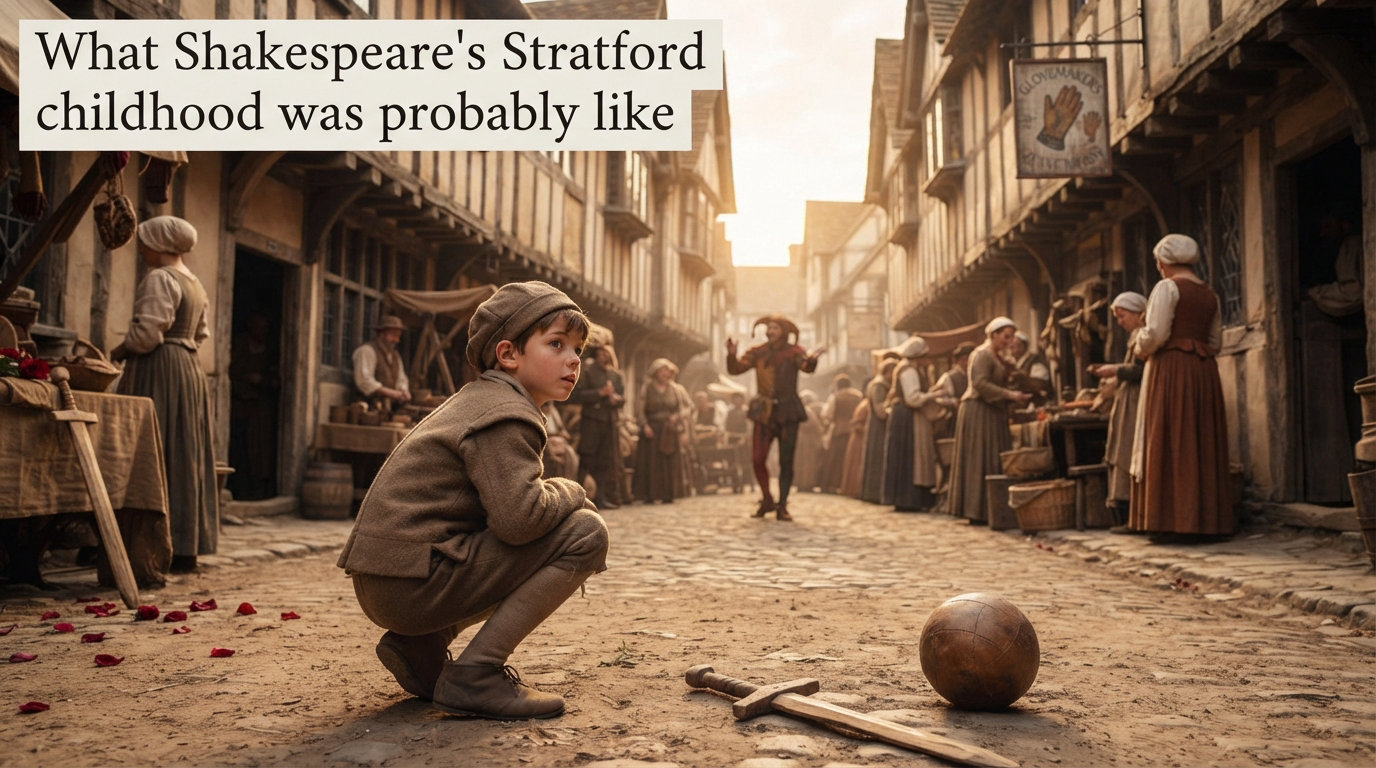
William Shakespeare was born in 1564 into a busy Tudor market town that would shape his imagination for the rest of his life. We know surprisingly little about his earliest years for certain. But historians have pieced together a vivid picture from property records, tax documents, school rolls, and church entries that still survive in Stratford-upon-Avon.
When I set out to understand what Shakespeare’s Stratford childhood was probably like, I found that the gaps in the record tell us as much as the facts do. No diaries survive. No childhood letters exist. No personal notes from the man himself have come down to us. What we have instead is a rich portrait of the world around him: a thriving wool town, a prominent family, a demanding grammar school, and travelling actors who arrived each year to perform in the guildhall.
The word “probably” matters here. Nearly everything we say about young William’s daily life is reconstruction, not certainty. The Shakespeare Birthplace Trust, the Folger Shakespeare Library, and generations of scholars have built careful arguments from the evidence that does exist. And that evidence is better than you might expect for a glover’s son in a provincial town.
This guide walks through what historians and primary sources tell us about that childhood. We will cover the town he grew up in, the family that raised him, the house on Henley Street, the grammar school education that drilled Latin into him for years, and the travelling players who may have planted the first seeds of theatrical ambition. We will also explore how those early Stratford experiences echo through the plays he wrote decades later.
If you have ever wondered what daily life felt like for a bright boy in 1570s Warwickshire, what follows is as close as 2026 scholarship can bring us. Forum discussions on sites like reddit.com/r/shakespeare reveal that many people struggle to separate fact from fiction when it comes to Shakespeare’s early years. This article aims to make that distinction clear.
Table of Contents
Tudor Stratford: The Market Town That Shaped a Boy
Stratford-upon-Avon in the 1560s was a prosperous market town of roughly 1,500 to 2,000 people, sitting on the banks of the River Avon in Warwickshire. It was not a city, not a port, and certainly not London. But it was a place where commerce, religion, and local government came together in ways that mattered enormously to a child growing up there.
A Town Built on the Sheep Trade
The town had grown rich on sheep. Stratford sat near the Cotswolds, and the entire region revolved around the processing, marketing, and distribution of wool and sheep products. Fleeces were graded, traded, and shipped to distant markets. Hides were tanned for leather. Tallow was rendered for candles and soap. A boy like William, son of a glove-maker and wool dealer, would have been surrounded by the sights and smells of this trade from his first breath.
Market days brought farmers, merchants, and craftsmen crowding into the streets around the high cross. Sheep and cattle were driven across Clopton Bridge, a substantial stone structure that still stands today. The guildhall hosted council meetings and court sessions. For a child with sharp eyes and good ears, this was an education in human behaviour all on its own. The haggling, the disputes, the gossip, the deals struck in back rooms — all of it was free theatre.
The town was also physically compact. Stratford’s layout followed the medieval burgage plot system: long, narrow strips of land running back from the street, each with a house at the front and a workshop, garden, or animal pen behind. The Shakespeare family home on Henley Street followed exactly this pattern. You could walk from one end of the town to the other in about ten minutes, passing tanners, butchers, brewers, bakers, and ironmongers along the way.
Civic Life and the Changing Church
Religion was changing fast during William’s childhood. The Reformation had swept away the old Catholic practices only a few decades earlier, and Queen Elizabeth I’s religious settlement was still settling. Families responded to these changes in different ways, some privately clinging to old customs while others embraced the new order with enthusiasm.
The Guild of the Holy Cross, which had run the town’s school, hospital, and charitable functions for centuries, had been dissolved in 1547. Its properties and responsibilities were transferred to the newly created Corporation of Stratford. The grammar school itself was refounded as King Edward VI’s School, ensuring that education continued even as the institutional framework shifted around it.
This mattered directly for young William. The town his father helped govern was also the town that paid for his schooling. Civic life and education were tightly bound together in a way that seems distant now but was completely natural in Tudor England. A bright boy’s access to learning depended on his father’s standing in local government.
The River Avon wound through the edge of town, providing fish, transport, and a playground for children. Beyond the built-up streets lay open fields, meadows, and the great Forest of Arden. A surviving fragment of this ancient woodland stretched across Warwickshire, and the name “Arden” carried deep local meaning. It was Mary Arden’s family name too. These surroundings of woodland, wildflowers, and scattered farms would later surface in Shakespeare’s writing with startling specificity.
John Shakespeare and Mary Arden: The Family Behind the Boy
William’s parents were, by local standards, comfortably off during his early years. His father John had come to Stratford from the nearby village of Snitterfield in the early 1550s. Trained as a glove-maker and whittawer (a worker in soft white leather), he set up shop on Henley Street and quickly began climbing the ladder of civic respectability.
John Shakespeare: Glove-Maker, Wool Dealer, Bailiff
John was not just a craftsman. He was also a dealer in wool, hides, and agricultural products, essentially a middleman between the farms of the surrounding countryside and the markets of Stratford. This trade, combined with his glove-making, made him one of the more prosperous men in town. He bought property, lent money to neighbours, and positioned himself as someone of substance and ambition.
His civic rise was rapid and impressive. John served successively as ale-taster, constable, affeeror, chamberlain, and alderman. In 1568, when William was about four years old, he reached the top of the ladder: he was elected bailiff, the equivalent of mayor. As bailiff, John Shakespeare presided over council meetings, sat as a magistrate, and entertained visiting theatrical companies on behalf of the town.
This single detail matters more than almost any other for understanding William’s childhood. His father was the man who officially welcomed travelling actors to Stratford. Young William would have grown up in a household where the arrival of professional players was a regular event, discussed, prepared for, and probably attended.
Mary Arden and the Farming World
Mary Arden, William’s mother, came from a different but equally solid background. She was the daughter of Robert Arden, a prosperous farmer from Wilmcote, about three miles from Stratford. The Ardens were a prominent local family with distant connections to the old Catholic gentry of the region. Mary grew up in a substantial farmhouse, now known as Mary Arden’s Farm, surrounded by land, livestock, and the rhythms of agricultural life.
The marriage of John and Mary in around 1557 united a tradesman’s ambition with a farming family’s deep roots. Mary brought property and connections to the match. John brought energy and commercial drive. Together they had eight children: Joan (died in infancy), Margaret (died in infancy), William (born 1564), Gilbert, another Joan, Anne, Richard, and Edmund. William was the third child but the eldest son, the first to survive infancy.
Growing up as the eldest son of the bailiff of Stratford meant William occupied a particular social position. His family was respected, known, and connected throughout the town. The house was probably busy, with apprentices, servants, younger siblings, and the constant activity of a working leather shop at the front. Mary would have managed the household, tended gardens, and raised the children while John handled business and civic duties.
A Family on the Rise, and Then the Fall
The family’s prosperity did not last. In the late 1570s and early 1580s, John Shakespeare’s fortunes declined sharply and visibly. He stopped attending council meetings. He fell into debt. He was removed from the board of aldermen in 1586. Property was sold off or mortgaged to cover obligations.
Historians still debate the exact causes of this reversal. Possible explanations include legal troubles over unlicensed wool dealing, Catholic sympathies that drew official suspicion, poor business decisions, or some combination of all three. Whatever the cause, the effect on the family was real and lasting. The comfortable standing that William had grown up with was eroded just as he entered adulthood.
For a teenage William, watching his father’s social standing crumble must have been a formative experience. Scholars have often wondered whether this reversal shaped the young man who would later write so powerfully about ambition, downfall, and the fragility of status. The trajectory from bailiff to debtor is one that resonates through plays from “King Lear” to “The Merchant of Venice” to “Timon of Athens.”
What Shakespeare’s Stratford Childhood Was Probably Like
The daily reality we can reconstruct for young William points to a childhood that was busy, sensory, and deeply embedded in the rhythms of a working Tudor household. Here is where the evidence runs thinnest and historians lean most heavily on context, comparison, and careful inference. But the picture that emerges is surprisingly detailed.
Life on Henley Street
We know William was born in the family home on Henley Street, probably in April 1564. The baptismal record at Holy Trinity Church dates from April 26, and baptism typically followed within days of birth. Plague struck Stratford that same summer and killed roughly a quarter of the population. The Shakespeares survived, but the threat of epidemic disease was a constant backdrop to Tudor childhood that shaped every parent’s experience.
The Henley Street house itself tells us a great deal about daily life. It was a substantial timber-framed building with a workshop space at the front where gloves were made and sold, a hall where the family ate and gathered, and upstairs rooms for sleeping. The house has been modified many times over the centuries, but its core layout reflects the working world William knew.
A Tudor tradesman’s household ran on rhythm and labour. Fires had to be lit before dawn. Water had to be carried from a well or pump. Meals were cooked over open hearths. Children were expected to help from an early age, fetching, carrying, minding younger siblings, and running errands. William, as the eldest son, would have had responsibilities around the shop and household. He may have helped sort leather, deliver finished gloves to customers, or mind the counter.
The Streets, the River, and the Forest
The streets of Stratford were unpaved, noisy, and thick with activity. Carts rattled past on market days. Animals were driven through to the shambles. Craftsmen called out their wares and apprentices ran errands. The river offered swimming in summer and ice-skating in winter when it froze over. The fields beyond the town provided space for roaming, bird-nesting, and exploring.
Religion was a daily presence that structured the entire week. The family would have attended Holy Trinity Church, the same medieval parish church where William was baptised and where he would eventually be buried. Sunday services, holy days, the rhythms of the liturgical calendar, fasting days and feast days — all of these shaped the tempo of Tudor life from childhood onward.
Then there was the natural world beyond the streets. The Forest of Arden lay nearby, or at least what remained of it. Much of the ancient woodland had been cleared for farmland by the 1570s, but substantial woods remained. Hedgerows, meadows, riverbanks, and coppices were all within walking distance. The wildflowers, birds, and seasonal changes of this countryside appear throughout Shakespeare’s plays with a precision that suggests direct, personal familiarity from his earliest years.
When the Players Came to Town
This is where Shakespeare’s Stratford childhood becomes especially vivid and compelling. Tudor towns like Stratford were regularly visited by troupes of professional players who performed in guildhalls, innyards, and market squares. These travelling companies were licensed by noble patrons and toured the country presenting plays, moralities, and entertainments to provincial audiences hungry for spectacle.
As bailiff, John Shakespeare was responsible for officially receiving these companies and approving their performances. The first recorded visit by a troupe in Stratford during John Shakespeare’s tenure dates from 1569, when William was about five years old. Other companies followed throughout the 1570s, including the Earl of Worcester’s Men and the Earl of Leicester’s Men.
Young William almost certainly saw these performances. For a child already steeped in language and stories, the effect must have been profound. The costumes, the gestures, the speeches, the crowd’s reactions — all of it offered a window into a world of performance that few provincial boys would have encountered so directly. Many scholars believe these early encounters planted the theatrical ambition that would eventually carry William to London.
We can only guess at William’s temperament as a boy. No contemporary described his childhood personality, and the later anecdotes (the deer-poaching story at Charlecote, the early hints of theatrical talent) are unreliable at best. What the evidence does suggest is a child of unusual verbal ability, sharp observation, and deep curiosity about the people and the world around him. The Stratford environment gave him ample raw material to feed those qualities.
The Stratford Grammar School: Education That Shaped a Genius
William almost certainly attended the King’s New School in Stratford, the local grammar school refounded after the dissolution of the medieval guild. The school occupied rooms above the guildhall, a short walk from the Shakespeare home on Henley Street. As the son of a town alderman and former bailiff, William was entitled to free tuition. His father’s civic position made that privilege possible.
The Hornbook and the Long School Day
A grammar school education in Tudor England was rigorous, demanding, and almost entirely focused on Latin. Boys typically entered around age seven, after learning basic reading and possibly some writing and arithmetic at a petty school. The first reading tool was often a hornbook: a wooden paddle with a printed sheet mounted on it, covered by a transparent layer of animal horn for protection. On it were the alphabet, syllables, and the Lord’s Prayer.
The school day was punishingly long. Classes began around six or seven in the morning in summer, an hour later in winter, and ran into the late afternoon with breaks for meals. There was little play, little free time, and almost no instruction in English literature as we understand it. The entire curriculum was built around mastery of Latin grammar, vocabulary, and classical texts.
Physical punishment was routine and accepted. The schoolmaster carried a rod or birch and used it freely to enforce discipline and correct errors. Education was understood as discipline in the most literal sense: training the mind through hardship, repetition, and obedience. The masters in Stratford during William’s likely school years included men like Walter Roche and Thomas Jenkins. Whether William thrived or suffered under this regime, we do not know for certain. But he clearly absorbed its lessons for the rest of his life.
Latin, Ovid, and the Classical Foundation
Boys progressed through a carefully graded sequence of study. They began with the basics of Latin accidence and syntax, memorising declensions and conjugations through relentless repetition and recitation. They then moved on to reading and translating classical authors: Cato’s maxims, Aesop’s fables, the comedies of Terence and Plautus, the works of Ovid, Virgil, Cicero, and Horace.
They composed Latin verses, delivered Latin speeches, and acted in Latin plays as part of their training. This last detail is important. Boys did not merely read the classical dramatists. They performed them, memorising roles, projecting their voices, and learning how scenes were built and paced. The grammar school classroom was, in effect, a small theatre where dramatic technique was absorbed by doing.
Ovid was especially important to the curriculum and to Shakespeare’s imagination. The Metamorphoses, with its tales of transformation, passion, disguise, and divine intervention, left fingerprints all over his later writing. So did Terence and Plautus, whose Roman comedies provided structural templates that Shakespeare would reshape in his own comedies, from “The Comedy of Errors” to “Twelfth Night.”
The connection between this education and Shakespeare’s later work is impossible to miss. His command of rhetoric, his dense web of classical allusion, his understanding of dramatic structure, and his facility with language in multiple registers all have roots in the grammar school classroom. The boys who sat beside him learned the same material. But something in young William transformed that raw material into something the world had never seen before.
Frequently Asked Questions About Shakespeare’s Early Years
What was Shakespeare’s childhood like in Stratford-upon-Avon?
Shakespeare grew up in Stratford-upon-Avon, Warwickshire, as the eldest son of a prosperous glove-maker who served as bailiff (mayor) of the town. He attended the local grammar school, learned Latin intensively, and was exposed to travelling actors who performed in the guildhall. His childhood was probably busy and structured, rooted in the rhythms of a working tradesman’s household in a market town built on the wool trade.
What was Stratford like in Shakespeare’s time?
Stratford-upon-Avon in the 1560s and 1570s was a prosperous market town of about 1,500 to 2,000 people on the River Avon. It sat near the Cotswolds and was a major centre for the processing and trading of wool, leather, and sheep products. The town had a guildhall, a grammar school, a substantial parish church, and was regularly visited by travelling companies of actors.
What was Shakespeare like as a child?
No contemporary described Shakespeare’s childhood personality, so we cannot know for certain. The evidence suggests a boy of unusual verbal ability, sharp observation, and deep curiosity. His later writing shows detailed knowledge of plants, flowers, and country life that points to a childhood spent exploring the fields and forests around Stratford. His grammar school education gave him an exceptional command of Latin and rhetoric.
Who were Shakespeare’s parents?
Shakespeare’s father was John Shakespeare, a glove-maker and wool dealer who rose to become bailiff (mayor) of Stratford before his fortunes declined in the late 1570s. His mother was Mary Arden, daughter of Robert Arden, a prosperous farmer from Wilmcote. The Ardens were a prominent local family with distant ties to the Catholic gentry of Warwickshire.
What did Shakespeare learn at the grammar school?
At the King’s New School in Stratford, Shakespeare learned Latin almost exclusively. The curriculum covered grammar, rhetoric, and classical authors including Ovid, Virgil, Cicero, Terence, and Plautus. Boys memorised texts, composed Latin verses, delivered speeches, and acted in Latin plays. This education gave Shakespeare the rhetorical skills, classical knowledge, and dramatic technique that underpin his entire body of work.
How did Shakespeare’s childhood influence his plays?
Shakespeare’s Stratford childhood left clear traces in his writing. The Forest of Arden appears directly in As You Like It. Wildflowers from the Warwickshire countryside appear with botanical precision in A Midsummer Night’s Dream, Hamlet, and The Winter’s Tale. His father’s rise and fall shaped his understanding of social mobility. The grammar school’s Latin training gave him mastery of rhetoric and dramatic structure derived from classical models.
The Lasting Mark of a Stratford Childhood
Looking back at the evidence, what Shakespeare’s Stratford childhood was probably like comes into focus as a life of striking contrasts. He grew up comfortable, then watched that comfort slip away. He was steeped in classical learning while also absorbing the living language of market stalls, innyards, and country lanes. He sat through Latin plays in a schoolroom while watching professional actors perform in the guildhall below.
The Stratford that shaped him was a small world, but not a narrow one. It was a town where wool merchants, glove-makers, farmers, clerics, actors, and civic officials crossed paths every single day. It was a place where a bright boy could learn about ambition from watching his father’s rise, about loss from watching his father’s fall, about nature from the fields and forests beyond the streets, and about storytelling from the players who arrived each season with new tales to tell.
Scholars in 2026 continue to debate the details of that childhood. Which plague outbreak threatened the infant William most directly? How deeply did John Shakespeare’s financial troubles affect his eldest son’s prospects? Did the young boy truly sit in the guildhall watching the travelling players, or only hear about them later from his father? We will probably never have definitive answers to these questions, and that uncertainty is part of what makes the subject endlessly compelling.
What we can say with confidence is that the Stratford childhood left permanent traces in Shakespeare’s writing. The Forest of Arden surfaces directly in “As You Like It,” not as an abstract literary setting but as a real place with real textures, scents, and emotional associations. The wildflowers of Warwickshire appear with botanical precision in “A Midsummer Night’s Dream,” where Oberon sends Puck to fetch “a little western flower” called love-in-idleness, a real pansy that grows in the region to this day.
That same plant knowledge runs through “Hamlet,” where Ophelia names rosemary, pansies, fennel, columbine, and rue with a specificity that comes from firsthand acquaintance. It surfaces in “The Winter’s Tale,” where Perdita catalogs the flowers of spring with the eye of someone who grew up among them. These are not scholarly borrowings. They are memories of a Warwickshire childhood, carried forward into art.
The social dynamics of a small market town echo just as clearly through the plays. The hierarchies, jealousies, alliances, gossip, and petty disputes of provincial life provide the raw material for the comedies and histories alike. Shakespeare understood how reputation worked in a small community because he grew up in one. He understood how quickly standing could be lost because he watched it happen in his own home.
The grammar school’s legacy is equally clear. Shakespeare’s rhetorical skill, his command of argument and counter-argument, his ability to build a scene and pace a story, and his effortless movement between high and low registers of language all have roots in the Latin education he absorbed as a boy. Even his understanding of dramatic convention comes from acting in Terence and Plautus as a schoolboy above the guildhall.
For anyone visiting Stratford-upon-Avon today, walking the streets young William knew adds a layer of meaning to the experience. The Henley Street birthplace, the guildhall schoolroom, Holy Trinity Church, and the river all still anchor the town he grew up in. The Shakespeare Birthplace Trust maintains these sites with extraordinary care, and the knowledge their guides share brings the Tudor world vividly to life. Forum users on reddit.com/r/shakespeare consistently describe visiting Stratford as emotionally powerful and recommend the Birthplace guides as knowledgeable and generous with their expertise.
If this exploration of what Shakespeare’s Stratford childhood was probably like has taught me anything, it is that genius does not emerge from nowhere. It grows in particular soil, under particular conditions, shaped by particular people and places. Stratford gave Shakespeare his raw material: the wool trade and the market stalls, the Latin lessons and the classical plays, the river and the forest, the ambitious father and the capable mother.
To understand the plays, it helps to understand the boy. And to understand the boy, you have to understand the town that raised him. That is the Stratford that made Shakespeare, and its mark is on every page he ever wrote.