
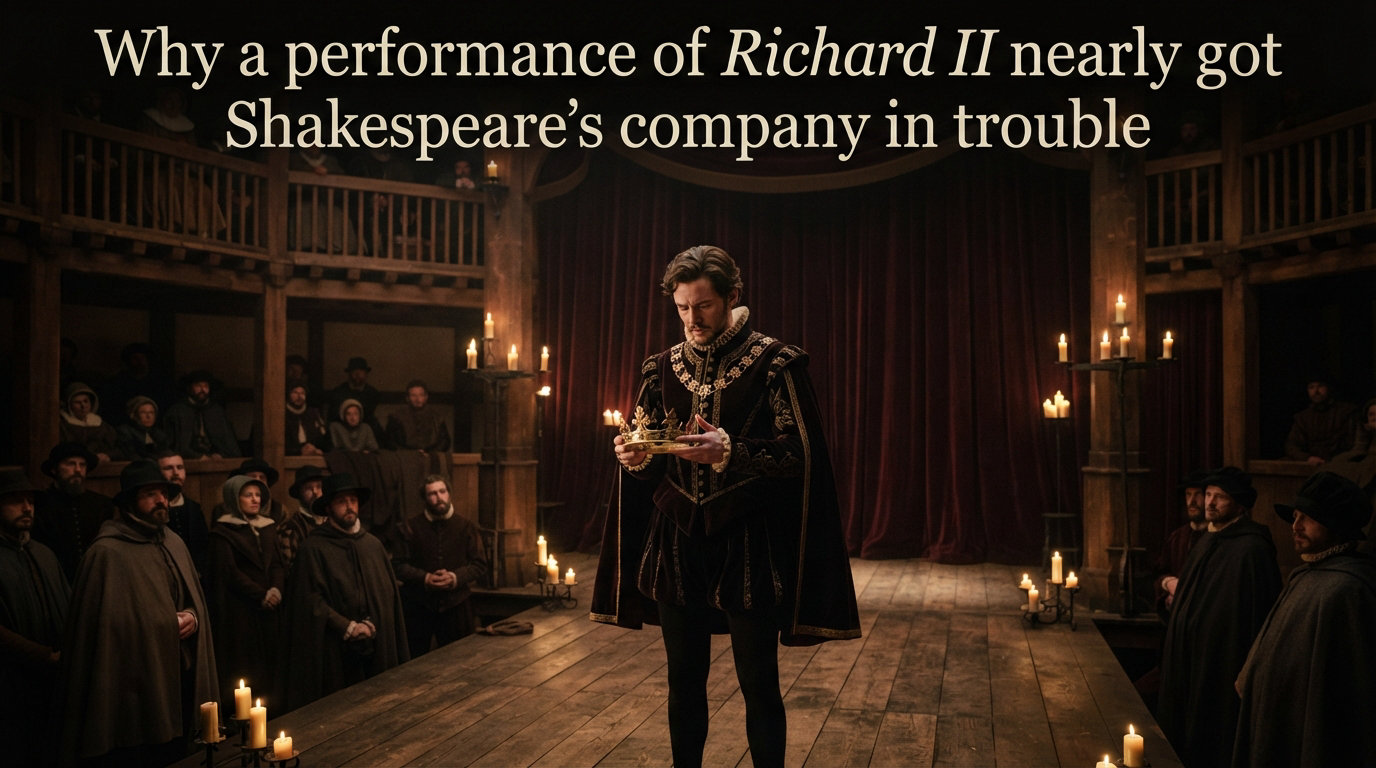
On a freezing Saturday in February 1601, the Lord Chamberlain’s Men walked onto the stage of the Globe Theatre and performed a play that would almost destroy them. The patent they held, the reputations they had built, and Shakespeare’s career itself all hung in the balance for a few terrible hours. Here’s the full story of why that performance of Richard II nearly got Shakespeare’s company in trouble.
I’ve spent years studying the political climate of Elizabethan England, and this episode stands out as one of the most dangerous moments in theatrical history. A paying commission turned a routine matinee into something that looked very much like treason.
Table of Contents
The 1601 Globe Theatre Performance That Sparked the Crisis
The performance at the Globe took place on Saturday, February 7, 1601, the day before the Earl of Essex marched through London in open rebellion. According to the testimony of Augustine Phillips, one of the leading actors in Shakespeare’s company, the players received an unusual request from supporters of the Earl of Essex.
Phillips later testified before the Privy Council that two men, Stephen Fulbrooke and the Earl of Southampton’s steward, came to the players with “a request that they should play the play of the deposing and killing of King Richard the Second.”
Phillips added a telling detail. The conspirators offered the company “forty shillings” beyond the regular takings. The Lord Chamberlain’s Men performed the play, not realizing, or perhaps not wishing to realize, that they were being used as a political weapon.
What Phillips Said When Questioned
The Phillips testimony is the clearest primary source we have. He told investigators that the request was framed as a special treat for Lord Essex and his friends. The forty shillings was supposedly extra to cover the costs of staging the play.
What the players failed to understand is that Richard II was not just any history play. It was a play about deposing a legitimate monarch, and Essex’s conspiracy was about forcing Elizabeth I to name a successor and to share power with his faction.
What Was the Essex Rebellion of 1601?
The Essex Rebellion of 1601 was a failed uprising against Queen Elizabeth I led by Robert Devereux, the 2nd Earl of Essex. Once the Queen’s favourite, Essex had fallen from grace after a disastrous military campaign in Ireland and years of political manoeuvring against his rivals at court.
By the early months of 2026, Essex had grown desperate. He plotted with the Earl of Southampton and a small circle of supporters to overthrow the Queen’s chief ministers, Robert Cecil and the Earl of Nottingham. Their plan was to force their way into the royal court, seize power, and force Elizabeth to name King James of Scotland as her heir.
The rebellion failed almost before it began. The streets of London refused to rise in support, and Essex was arrested, tried for treason, and executed on February 25, 1601. Southampton, Shakespeare’s patron, was sentenced to death but later pardoned, though he spent the rest of Elizabeth’s reign in the Tower.
Why Richard II Was the Most Dangerous Play in Shakespeare’s Repertoire
Richard II was dangerous because its central act was the deposition of a king. The play depicts the legitimate King Richard II being formally deposed by his cousin Henry Bolingbroke, who becomes Henry IV. Audiences of the day would have recognised this as a direct commentary on the divine right of kings and the succession crisis facing Elizabethan England.
Elizabeth I was in her late sixties and had no children. The question of who would succeed her had been politically explosive for decades. Anyone watching a play about a king being deposed could see the mirror to their own situation.
The Deposition Scene
The deposition scene in Act IV is the heart of the danger. Richard II is forced to surrender his crown, his sceptre, and his rule. The scene contains the famous “hollow crown” speech, but it also contains a precise, almost legal, transfer of power from the rightful king to the usurper.
Performances of this scene were so politically charged that early printed Quartos of the play either cut the deposition entirely or contained it only in censored form. The Fourth Quarto of 1608, published years after the Essex rebellion, restored the full scene. This is direct evidence that the scene was considered dangerous during Elizabeth’s reign.
The Essex Faction’s Hope
Essex’s supporters believed that a performance of Richard II would stir up the London crowds. They thought that showing the deposition of a king would give people the idea that deposing a monarch was legitimate, or at least possible. The choice wasn’t random. It was a calculated piece of political theatre designed to change how London’s common people thought about regicide and rebellion.
Why the Performance Failed to Rouse Londoners
The staging was a political failure. Historians often describe the rebellion as “comically inept,” and the play failed to rouse the citizens of London even on the morning of the uprising. The expected crowds did not materialise to support Essex’s march through the city.
There are several reasons the play likely failed as propaganda. The deposition scene portrays Richard II as a weak and unfortunate king, not a tyrant. Audiences watching the play felt sympathy for Richard rather than anger at his fate. That emotional response was the opposite of what Essex’s faction intended.
Additionally, the play includes detailed warnings about the chaos and bloodshed that follow a deposition. To anyone half-thinking, the message was that overturning a monarchy brings suffering to an entire nation, not liberation.
Queen Elizabeth I’s Reaction and the Aftermath for Shakespeare’s Company
Queen Elizabeth I personally referenced the performance in a recorded conversation with the antiquarian William Lambarde. When Lambarde mentioned the troublesome times she had endured, Elizabeth replied, “I am Richard II, know ye not that?” The Queen’s comment confirms that she saw the play as a direct political attack on her person.
After the rebellion collapsed, the Lord Chamberlain’s Men faced serious questioning. The Privy Council investigated whether Shakespeare’s company had conspired in the planning of the rebellion. The deposition scene was treated as potential evidence of treasonous intent.
How the Company Escaped Punishment
The Lord Chamberlain’s Men avoided punishment largely because they could argue they were simply hired performers. The forty shillings payment was framed as nothing more than a private commission. The company had not planned the rebellion, and Shakespeare himself was never charged with any offence.
Augustine Phillips’s testimony was particularly important. He cooperated with investigators and provided a clear account of the commission. The company’s willingness to testify helped distance it from the actual plotters. Within a few years, the accession of King James I in 1603 would transform the Lord Chamberlain’s Men into the King’s Men, and Shakespeare’s company would reach the height of its prestige.
Frequently Asked Questions
What was the Essex Rebellion of 1601?
The Essex Rebellion of 1601 was a failed uprising against Queen Elizabeth I led by Robert Devereux, the 2nd Earl of Essex. It took place on February 8, 1601, and collapsed within hours when Londoners refused to support the march. Essex was executed for treason three weeks later.
What is the deposition scene in Shakespeare’s Richard II?
The deposition scene is the sequence in Act IV of Richard II where the legitimate king is formally forced to surrender his crown to the usurper Henry Bolingbroke. The scene was considered politically dangerous during Elizabeth’s reign because it staged the removal of a crowned monarch, and early printed editions censored it for that reason.
Did Queen Elizabeth see any of Shakespeare’s plays?
Evidence suggests Queen Elizabeth I saw some of Shakespeare’s plays, including Twelfth Night, though we cannot confirm she saw Richard II. She told the antiquarian William Lambarde that she was Richard II, which shows she understood the political parallel in the play even without attending a performance.
What was Shakespeare’s source for Richard II?
Shakespeare drew his material for Richard II primarily from Raphael Holinshed’s Chronicles of England, Scotland, and Ireland, second edition of 1587, with additional material from Edward Hall’s The Union of the Two Noble and Illustre Families of Lancaster and York, and possibly Samuel Daniel’s narrative poem The Civil Wars.
Is Shakespeare’s Richard II a tragedy?
Richard II is classified as a history play in the First Folio, not a tragedy. It is the first part of a tetralogy that continues with Henry IV Part 1, Henry IV Part 2, and Henry V. Modern scholars sometimes debate the tragic dimensions of the title character, but formally it belongs to the histories.
Conclusion
The performance of Richard II on February 7, 1601 nearly got Shakespeare’s company in trouble because it turned a popular play into a tool of political rebellion. The Lord Chamberlain’s Men accepted forty shillings to perform a play about the deposition of a king, on the eve of an actual attempted overthrow of Elizabeth I.
The company’s survival was not guaranteed. It took careful testimony, distance from the actual conspirators, and the political chaos of the succession crisis to allow Shakespeare’s company to escape the fate that befell Essex and Southampton. The episode remains a powerful reminder that in Elizabethan England, theatre was never just entertainment.