
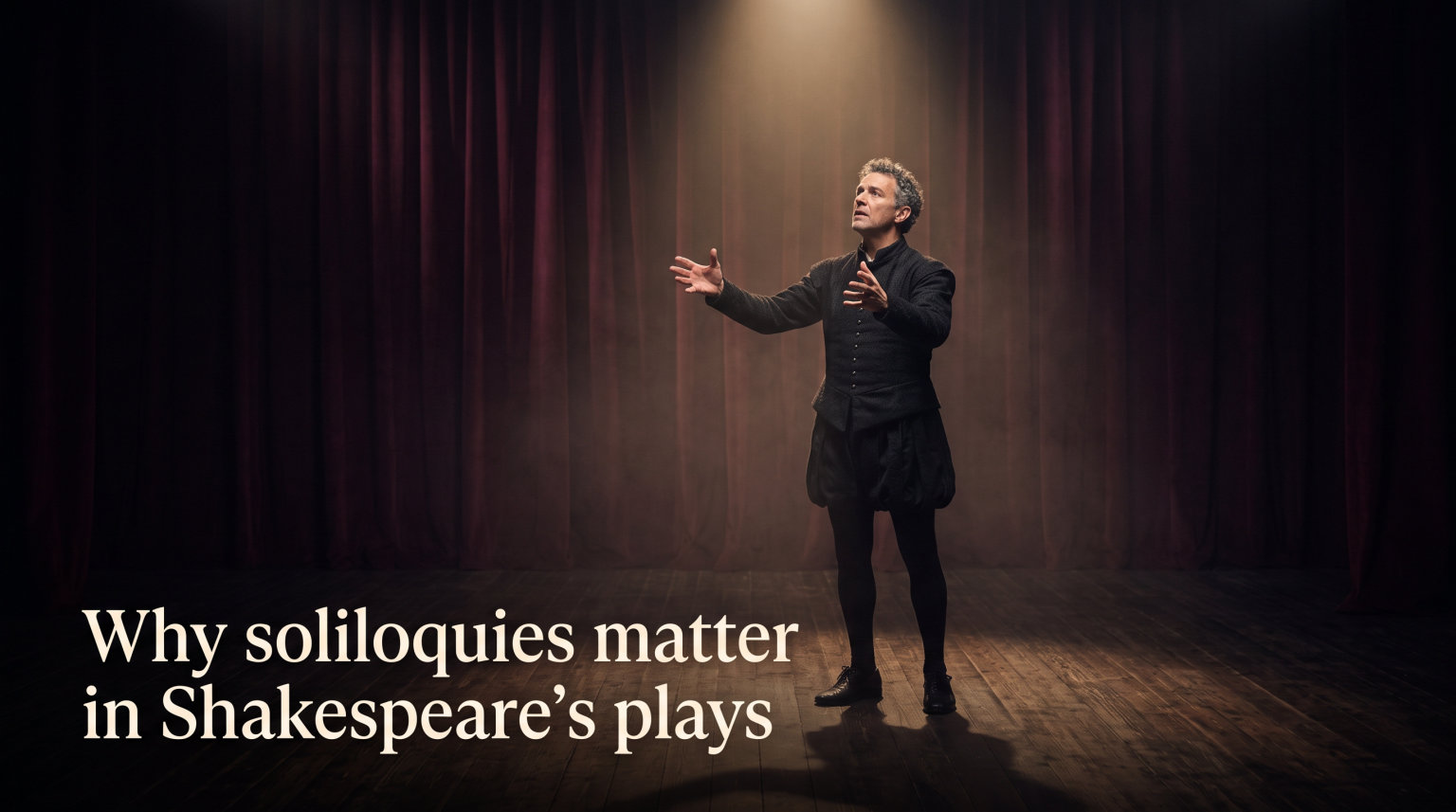
When Hamlet steps forward and asks “To be, or not to be,” he does something no other dramatic form allows. He lets us inside his mind.
That moment is a soliloquy, and it represents one of the most powerful tools in Shakespeare’s theatrical toolkit. Our team has spent years studying and teaching these speeches, and we keep returning to the same question our readers ask: why do soliloquies matter in Shakespeare’s plays more than four hundred years later?
The answer goes deeper than memorized lines for exams. Soliloquies are where Shakespeare does his most intimate character work. They are where plot turns are seeded, where audiences become confidants, and where the deepest psychological conflicts play out in real time on stage.
In this guide, we break down what soliloquies are, how they function dramatically, and why they remain unmatched in revealing character interiority. Whether you are a student wrestling with a first essay, a performer preparing an audition, or a lifelong reader of the plays, understanding soliloquies changes how you experience every scene Shakespeare wrote.
We also clear up the common confusion between soliloquies, monologues, and asides. We explore famous examples across multiple plays beyond Hamlet, trace the historical roots of the convention in Elizabethan theatre, and examine how modern performers bring these speeches to life in 2026 productions.
Table of Contents
What Is a Soliloquy? Definition and Meaning
A soliloquy is a dramatic device in which a character speaks their inner thoughts aloud while alone on stage, revealing their psychology, motivations, and conflicts directly to the audience. The word comes from the Latin solus (alone) and loqui (to speak), literally meaning “talking to oneself.”
Unlike normal dialogue between characters, a soliloquy creates a direct channel between the speaker and the audience. The character is not addressing another figure on stage. Instead, they are thinking out loud, working through a decision, confessing a plan, or wrestling with a private dilemma that no other character can hear.
Shakespeare recognized this convention as a way to bypass the usual limits of theatre. On stage, we cannot see a character’s thoughts the way a novelist can simply describe them. The soliloquy solves that problem by letting characters narrate their own minds.
The result is a moment of theatrical intimacy unlike anything else in drama. When Macbeth sees a dagger hovering before him, when Hamlet questions whether life is worth living, when Iago lays bare his scheme to destroy Othello, we are witnessing private thought turned into public speech. That paradox is what makes soliloquies so compelling.
Soliloquy vs Monologue vs Aside: What Sets Them Apart
One of the most common questions we hear from students is how to tell these three terms apart. The distinction matters because each device does dramatically different work, and mixing them up leads to confused analysis.
A soliloquy is spoken by a character who is alone on stage (or believes they are alone). The speech reveals private thoughts the character would never share with another person. Hamlet’s “To be or not to be” is the classic example because he is wrestling with a question he cannot discuss with anyone.
A monologue is a long speech delivered by one character to other characters who are present on stage. The speaker is aware of their audience within the world of the play. Mark Antony’s “Friends, Romans, countrymen” speech in Julius Caesar is a monologue, not a soliloquy, because he is addressing the Roman crowd and attempting to persuade them.
An aside is a brief remark, usually just a line or two, spoken by a character to the audience while other characters remain on stage. The other characters do not hear it. Asides function as quick private commentary on the action happening around the speaker.
Here is a simple way to remember the difference. Soliloquies happen when a character is alone and thinking aloud. Monologues happen when a character speaks at length to others. Asides happen when a character sneaks a private comment to the audience mid-scene.
Shakespeare uses all three, but the soliloquy carries the most dramatic weight. It is reserved for moments of genuine self-examination, moral crisis, or strategic revelation. That is why soliloquies tend to be longer and more structurally complex than either monologues or asides.
The Historical Roots of Soliloquies in Elizabethan Theatre
Shakespeare did not invent the soliloquy, but he perfected it. The convention existed before him in the work of medieval playwrights and in the morality plays of the fifteenth and sixteenth centuries. Characters in those earlier plays often stepped forward to announce their intentions to the audience because stagecraft was simple and narration was necessary.
By the 1590s, when Shakespeare began writing, the soliloquy had become a standard feature of English drama. Christopher Marlowe used it effectively in Doctor Faustus, where the protagonist’s private speeches chart his descent from ambition to despair. Thomas Kyd’s The Spanish Tragedy also relied heavily on characters speaking alone to frame the action and reveal hidden motives.
What changed with Shakespeare was the depth and complexity he brought to these speeches. Earlier playwrights used soliloquies primarily for exposition, a way to fill the audience in on what had happened offstage. Shakespeare transformed the device into an instrument of psychological exploration.
The physical conditions of Elizabethan theatre also shaped how soliloquies worked. The Globe Theatre had a thrust stage that jutted into the audience on three sides. There was no curtain to hide behind, no darkened auditorium to separate actors from spectators. Daylight performances meant actors could see every face in the crowd.
This intimacy made direct address feel natural rather than artificial. When an actor stepped forward to deliver a soliloquy, they were physically surrounded by the audience. The convention of speaking private thoughts aloud fit the architecture of the space. It was not a gimmick but a logical response to the performance conditions Shakespeare wrote for.
Why Soliloquies Matter in Shakespeare’s Plays
If you strip soliloquies from Shakespeare’s work, the plays collapse in on themselves. Characters would become opaque, plots would lose their turning points, and audiences would lose their only window into the moral and emotional machinery driving the action forward.
Here are the five core reasons why soliloquies matter in Shakespeare’s plays:
They reveal character psychology: Audiences gain direct access to a character’s inner world, including fears, desires, and conflicts that no other character on stage can perceive.
They advance the plot: Soliloquies plant the seeds of future action, expose hidden schemes, and foreshadow events before they unfold in the visible drama.
They create dramatic irony: When we know what a character is planning but the other characters do not, every subsequent scene becomes charged with tension.
They build audience intimacy: The character speaks to us as if we are trusted confidants, forging an emotional connection that standard dialogue cannot achieve.
They explore universal questions: Shakespeare uses soliloquies to confront mortality, ambition, jealousy, guilt, and love in ways that speak across centuries.
Each of these functions works differently depending on the play and the character. The sections that follow examine each one in detail with specific textual examples.
Revealing Character Psychology and Inner Conflict
The single greatest achievement of Shakespeare’s soliloquies is their psychological depth. Without them, characters would be collections of actions and dialogue. With them, we see the full machinery of a mind at work.
Consider Macbeth’s “Is this a dagger which I see before me” speech. He is about to murder King Duncan, and his soliloquy shows us a man hovering between intention and action. He sees a hallucinated dagger, questions whether it is real, and talks himself through the final steps toward a crime he knows is wrong. We watch a conscience being overridden in real time.
That is something dialogue alone could never achieve. Another character asking Macbeth “Are you sure about this?” would be a completely different dramatic moment. The soliloquy lets us hear the private negotiation between ambition and morality that no external conversation could expose.
Iago’s soliloquies in Othello work in the opposite direction. Where Macbeth wrestles with guilt, Iago reveals his scheming with cold calculation. In soliloquy after soliloquy, he lays out his plan to destroy Othello, admits his motives are thin, and confesses that he enjoys manipulation for its own sake. The audience becomes the only witness to a villain’s genuine self.
What makes Shakespeare’s psychological writing so remarkable is the speed of mood shifts within a single speech. Forum discussions among Shakespeare enthusiasts consistently highlight this quality. A character can move from resolve to doubt to determination within ten lines, and the audience tracks every shift because the soliloquy makes the process visible.
Hamlet’s “O, what a rogue and peasant slave am I” demonstrates this rapid internal movement. He berates himself for inaction, convinces himself to stage a play to catch the king’s guilt, then second-guesses whether even that plan is sufficient. The soliloquy captures thinking in motion, not a polished argument but a mind working through a problem out loud.
This is why modern psychology and Shakespearean criticism often overlap. The soliloquies give us something that feels astonishingly close to stream of consciousness, a literary technique that would not be formally named for another three hundred years. Shakespeare was mapping the interior life of his characters centuries before psychology existed as a discipline.
Advancing the Plot Through Private Speech
Soliloquies do not just reveal character. They are also engines of narrative momentum. Shakespeare uses them to plant information that other characters cannot deliver and to set up consequences that pay off scenes or acts later.
Iago’s soliloquies again provide the clearest example. At the end of Act 1 in Othello, he delivers a soliloquy stating his plan to convince Othello that Desdemona has been unfaithful. The audience now knows the scheme, and every interaction between Iago and Othello that follows is charged with dramatic tension because we understand what Iago is really doing.
Without that soliloquy, Iago’s manipulations would appear to come from nowhere. The audience would be confused about his motives and methods. The soliloquy turns a potentially baffling plot into a masterclass in dramatic construction by giving us the blueprint before the plan unfolds.
Edmund in King Lear uses soliloquies the same way. His “Thou, Nature, art my goddess” speech establishes his determination to displace his legitimate brother Edgar through deception. We know his plan from the start, which means every scene where he appears innocent to other characters is layered with the irony of our superior knowledge.
Soliloquies also handle exposition efficiently. Instead of characters awkwardly telling each other things they already know, Shakespeare lets a solitary character brief the audience directly. This keeps dialogue natural while still communicating necessary background. The plot advances without the contrived conversations that plague lesser dramatists.
Foreshadowing is another plot function. When Macbeth hears that Banquo’s descendants will become kings, delivered in a vision rather than a standard soliloquy but processed in his subsequent private speeches, it sets up his future paranoia and violence. The information planted in a private moment drives the entire second half of the play.
Creating Dramatic Irony and Audience Intimacy
Dramatic irony occurs when the audience knows something the characters on stage do not. Shakespeare’s soliloquies are the primary mechanism for creating this effect, and it is one of the most powerful tools in all of dramatic storytelling.
When Iago tells us his plan and then turns to Othello with a friendly smile, we experience dramatic irony at its finest. We know the friendship is false. We know the warnings Othello receives are part of a trap. This gap between what we know and what the characters know generates a distinctive kind of suspense that keeps audiences leaning forward.
The intimacy factor is equally important. When a character speaks in soliloquy, they are essentially confiding in us. We become their secret-keeper. This creates an emotional bond that standard dialogue cannot replicate, because dialogue is always performative within the social world of the play. Soliloquy drops the performance.
One question that comes up frequently in forum discussions is why audiences accept the convention at all. In real life, people do not announce their private thoughts to a room full of strangers. Yet in the theatre, we accept it without question. The answer lies in the collaborative nature of theatrical experience.
Audiences enter an implicit contract with the performers. We agree to the rules of the stage, and one of those rules in Shakespeare’s theatre is that soliloquies are a window into truth. When a character speaks in soliloquy, we trust that we are hearing something more honest than anything they say in dialogue. This convention creates a hierarchy of truth within the play that the audience alone can access.
This is also why soliloquies are so effective at building empathy for morally compromised characters. We may disapprove of Macbeth’s violence, but we understand his fear and ambition because we heard them expressed in private. We may despise Iago’s cruelty, but we are fascinated by the honesty of his self-knowledge. Soliloquy makes even villains comprehensible by showing us the human being beneath the monstrous action.
Famous Soliloquies Across Shakespeare’s Plays
Most discussions of Shakespeare’s soliloquies begin and end with Hamlet. While “To be or not to be” deserves its fame, focusing on it alone misses the extraordinary range of soliloquies across the canon. Here we examine some of the most significant examples from different plays.
Hamlet: “To Be or Not to Be”
The most famous soliloquy in English literature does not actually advance the plot. Instead, it poses the universal question of whether existence is preferable to annihilation. Hamlet weighs the suffering of life against the uncertainty of death, concluding that fear of the unknown is what keeps people alive. Its power lies in its abstraction. Every audience member can find their own life reflected in Hamlet’s reasoning.
Macbeth: “Is This a Dagger” and “Tomorrow, and Tomorrow”
Macbeth contains two of Shakespeare’s most powerful soliloquies, and they bookend his moral arc. The dagger speech comes before Duncan’s murder and shows a man on the edge, his imagination already conjuring horrors. “Tomorrow, and tomorrow, and tomorrow” comes after Lady Macbeth’s death and shows a man who has passed beyond feeling into numb despair. Together, they trace a complete psychological collapse.
Othello: Iago’s Calculations
Iago delivers more soliloquies than any other Shakespearean villain, and each one strips away another layer of deception. In “Thus do I ever make my fool my purse,” he reveals his exploitation of Roderigo. In “Divinity of hell,” he confirms his plan to destroy Othello through jealousy. These speeches make Iago one of literature’s most terrifying characters because we see his self-awareness and his complete absence of restraint.
Richard III: “Now Is the Winter of Our Discontent”
The opening soliloquy of Richard III immediately establishes its protagonist as a villain who knows exactly what he is. Richard announces his physical deformity, his bitterness, and his determination to compensate for both through political scheming. He tells us he is “determined to prove a villain,” and the audience spends the rest of the play watching him keep that promise.
Romeo and Juliet: Private Devotion
Romeo’s “But soft, what light through yonder window breaks” demonstrates how soliloquies can serve tenderness as powerfully as darkness. Speaking alone in the Capulet orchard, Romeo describes Juliet in images of light and celestial bodies. The soliloquy reveals the depth of his feeling before he has even spoken to her, establishing that his love is genuine rather than performative.
The Tempest: Prospero’s Renunciation
In his later play The Tempest, Shakespeare gives Prospero a soliloquy in which the magician describes his magical powers and then renounces them. “Ye elves of hills” echoes medieval poetry even as it serves as Shakespeare’s own farewell to the stage. The speech works as both character revelation and meta-theatrical commentary, a dramatist writing his own retirement into his character’s final act.
Literary Techniques Shakespeare Uses in Soliloquies
The content of Shakespeare’s soliloquies matters, but so does the craft behind them. He deploys a specific set of literary techniques that make these speeches intellectually rich and emotionally resonant.
Extended metaphor runs through many soliloquies. Macbeth’s dagger speech is built around a single hallucinated image that he interrogates from multiple angles. Hamlet’s “To be or not to be” is structured around the metaphor of sleep and dreaming. These metaphors give abstract ideas concrete shape, making philosophical arguments feel immediate and physical.
Antithesis, the juxtaposition of opposing ideas, gives soliloquies their characteristic rhythm. Hamlet’s “To be or not to be” is itself an antithesis, and the speech continues to balance opposing terms throughout. This technique mirrors the internal conflict of the speaker, with each opposing phrase representing a different side of the argument happening inside their mind.
Rhetorical questions allow characters to dramatize uncertainty without resolving it. When Macbeth asks “Is this a dagger which I see before me?” the question is not seeking an answer. It is performing the act of doubt, showing us a mind that cannot trust its own perceptions. Rhetorical questions make thinking visible.
Iambic pentameter, the five-beat verse line Shakespeare uses throughout his plays, takes on particular force in soliloquies. The regular rhythm can reflect a character’s controlled reasoning or, when broken, signal emotional rupture. Enjambment, where a thought spills over from one line to the next, creates the sense of thinking that cannot be contained by formal structure.
Imagery and personification make abstract states tangible. Macbeth personifies murder as a wolf, Hamlet personifies death as an undiscovered country. These devices translate inner experience into pictures the audience can see and feel, bridging the gap between a character’s private world and our shared understanding.
How Modern Performers Bring Soliloquies to Life
The way actors deliver soliloquies has changed dramatically since Shakespeare’s time, and the interpretive choices performers make shape how audiences experience these speeches. This is one of the most exciting areas of Shakespearean production in 2026, and it rarely gets the attention it deserves in academic guides.
In Elizabethan theatre, soliloquies were almost certainly delivered directly to the audience. The thrust stage placed actors among the spectators, and daylight meant performers could make eye contact with individuals in the crowd. A soliloquy was not a private musing overheard by accident. It was a direct conversation between character and audience.
Modern productions take different approaches. Some directors, particularly in traditional staging at venues like the reconstructed Globe in London, encourage actors to address the audience directly, recreating the original performance convention. This approach treats the soliloquy as a shared experience rather than a private one.
Other productions, especially in film adaptations, use a naturalistic approach. Actors deliver soliloquies in voiceover or as internalized thought, with lips barely moving. This interpretation treats the soliloquy as truly private, something the audience overhears rather than something addressed to them. Both approaches are valid, but they create fundamentally different audience experiences.
Forum discussions reveal that Shakespeare enthusiasts are divided on this question. Some prefer the direct-address style because it makes them feel involved in the drama. Others find naturalistic delivery more psychologically convincing because it mirrors how we actually experience private thought. The debate itself testifies to the richness of Shakespeare’s device.
What remains constant across interpretations is the content of the speeches. Whether whispered or projected, whether addressed to the back row or delivered as internal monologue, the words themselves carry the psychological and dramatic weight. Shakespeare wrote soliloquies that work under almost any performance condition, which is one reason they have survived for four centuries.
FAQs
Why are soliloquies important in Shakespearean drama?
Soliloquies are important in Shakespearean drama because they give audiences direct access to a character’s inner thoughts, motivations, and moral conflicts. They reveal psychology that dialogue cannot expose, advance the plot by planting key information, create dramatic irony by sharing secrets with the audience, and build emotional intimacy between character and spectator. Without soliloquies, Shakespeare’s characters would be far less psychologically complex and his plots far less dramatically charged.
What literary techniques does Shakespeare use in his soliloquies?
Shakespeare uses several literary techniques in his soliloquies, including extended metaphor, antithesis, rhetorical questions, vivid imagery and personification, and iambic pentameter. He also uses repetition, enjambment, and apostrophe to heighten emotional impact.
What is the significance of a soliloquy in literature?
In literature, a soliloquy is significant because it is the primary dramatic method for revealing a character’s private thoughts and inner life. Unlike prose fiction, where a narrator can describe a character’s mind, drama requires action and speech. The soliloquy solves this limitation by letting characters speak their thoughts aloud when alone on stage.
What is the significance of soliloquies in Macbeth?
In Macbeth, soliloquies are significant because they trace the protagonist’s complete moral arc from reluctant ambition to hollow despair. The dagger soliloquy before Duncan’s murder shows a conscience struggling against violent intent. Later soliloquies reveal growing paranoia and emotional detachment, culminating in the Tomorrow and tomorrow speech after Lady Macbeth’s death, which expresses total nihilism.
What is the difference between a soliloquy and a monologue?
The key difference is audience and privacy. A soliloquy is spoken by a character who is alone on stage, revealing private thoughts directly to the audience. A monologue is a long speech delivered by one character to other characters who are present and listening. Hamlet’s To be or not to be is a soliloquy because he is alone and thinking aloud.
Did Shakespeare invent the soliloquy?
No, Shakespeare did not invent the soliloquy. The device existed in medieval morality plays and was used by earlier Elizabethan dramatists including Christopher Marlowe and Thomas Kyd. What Shakespeare did was elevate the soliloquy from a simple tool for exposition into an instrument of profound psychological exploration, which is why his soliloquies remain the gold standard four centuries later.
Conclusion: Why Soliloquies Still Matter
Understanding why soliloquies matter in Shakespeare’s plays comes down to a single principle. They are the place where character becomes transparent, where plot gains its deepest roots, and where the audience crosses the line from observer to confidant.
No other dramatic device achieves what the soliloquy achieves. It transforms private thought into public speech without sacrificing intimacy. It creates dramatic irony that makes every subsequent scene more powerful. And it gives us access to minds so richly imagined that they still feel alive in 2026, four centuries after Shakespeare wrote them.
The next time you read or watch a Shakespeare play, pay attention to the moments when a character is left alone on stage. Those moments are not interruptions to the story. They are the story, told from the inside. Read the soliloquy aloud, listen for the shifts in thought and feeling, and notice how Shakespeare uses the speech to pull you into a character’s most private world. That is where his genius lives, and that is why soliloquies will always matter.