
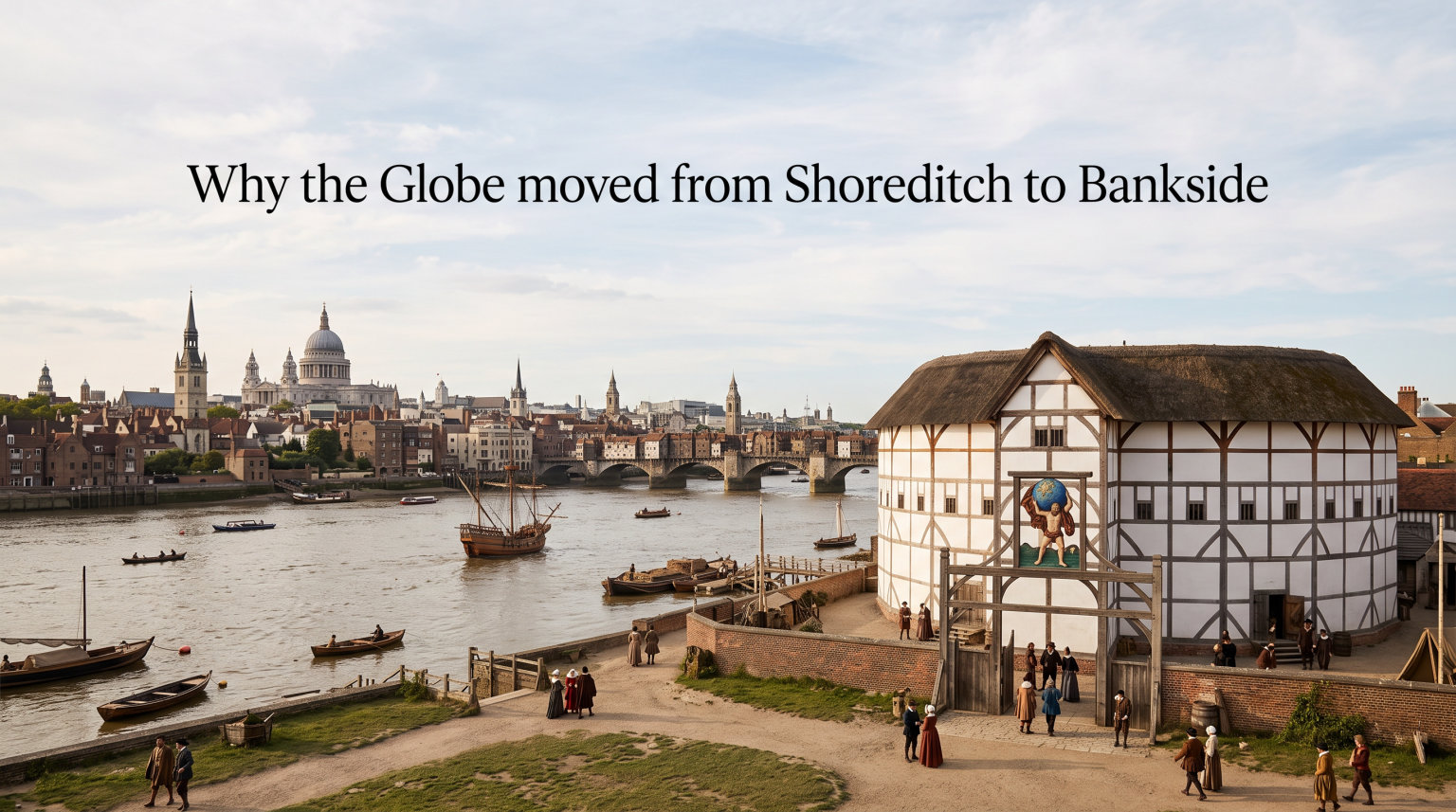
Shakespeare’s Globe Theatre moved from Shoreditch to Bankside because a bitter lease dispute with the landlord, Giles Allen, left the Lord Chamberlain’s Men with nowhere to perform. Allen refused to renew the ground lease in 1597, hoping to seize the valuable playhouse building for himself. But the Burbage family owned the rights to the structure itself, and they responded with one of the boldest acts in theatrical history.
They literally dismantled their theatre, carried the timbers across the frozen Thames, and rebuilt it as the Globe in Southwark. This is the story of why the Globe moved from Shoreditch to Bankside, and how that dramatic relocation shaped the plays we still perform today. The Globe Theatre relocation was not simply a change of address but a survival strategy that kept the company alive at the exact moment Shakespeare was writing his greatest tragedies.
If you have ever wondered why Shakespeare’s most famous playhouse ended up on the south bank of the Thames rather than in the city where audiences actually lived, the answer comes down to land law, stubborn landlords, and a creative loophole in a lease agreement. The Globe did not appear out of nowhere in 1599. It was literally rebuilt from the bones of an older playhouse called The Theatre, which stood in the fields of Shoreditch from 1576.
Let me walk you through how that building ended up on Bankside, what drove the move, and why it matters for anyone who cares about Shakespeare, Elizabethan theatre, or the history of English drama.
Table of Contents
The Shoreditch Origins: James Burbage Builds The Theatre (1576)
The story of the Globe begins with James Burbage, a joiner-turned-actor who understood that professional theatre needed a permanent home. Until the 1570s, acting companies performed in inn yards, guildhalls, and temporary scaffolds. Burbage changed that in 1576 when he built a dedicated playhouse in Shoreditch, just outside the northern boundary of the City of London.
He called it simply The Theatre, and it was groundbreaking. It was the first permanent building constructed specifically for dramatic performance in England since Roman times. Built for around 700 pounds, a substantial investment, it could hold roughly 3,000 spectators in its wooden galleries and open yard.
Audiences paid a penny to stand in the pit as groundlings, or more to sit in the covered gallery seats. The economics were simple and effective. Every performance was a chance to fill the yard and galleries with paying customers, and The Theatre quickly became the most important playhouse in London.
Burbage leased the land from a landowner named Giles Allen, a Puritan-leaning gentleman who apparently saw the arrangement as a straightforward business deal. The lease ran for 21 years, which meant it would expire in 1597 or 1598 depending on how you read the documents. This date would become the most consequential deadline in English theatre history.
James Burbage died in 1597, just as the lease was about to run out, and passed the operation of The Theatre to his sons. Cuthbert Burbage handled the business side, while Richard Burbage had become the most celebrated actor of his generation. Richard would go on to create the original stage performances of Hamlet, King Lear, Othello, and Macbeth.
Their father had built the foundation, but keeping it would prove far harder than building it. In 1594, the Lord Chamberlain’s Men formed as a playing company under the patronage of the Lord Chamberlain. Shakespeare was a founding member, both as playwright and actor, and Richard Burbage was their leading man.
The Theatre in Shoreditch became their primary performance venue. For several years, the company thrived there, staging the early comedies and histories that made Shakespeare’s reputation. But the clock on the lease was ticking, and the Burbage brothers assumed they could negotiate a renewal with Giles Allen.
That assumption would prove catastrophically wrong.
The Lease Dispute That Changed Theatre History
The core reason the Globe Theatre moved from Shoreditch to Bankside was a lease dispute that spiralled into a legal war. In 1597, with the 21-year lease on The Theatre’s land about to expire, the Burbage brothers approached Giles Allen to renew. Allen refused.
His refusal was not arbitrary. Allen had realised that the Burbages had built something extremely valuable on his land, a thriving playhouse drawing thousands of paying customers each week. If he let the lease lapse, he could potentially claim the building itself and either run the theatre or sell it off.
The land was worth far more with a functioning playhouse on it than without one. There was a complication, though, and it would save the Burbage family. The original lease agreement contained a specific clause stating that any building the Burbages constructed on the land belonged to them, not to the landlord.
Allen might have owned the soil, but the Burbages owned the timber, the galleries, the stage, and every nail that held the structure together. This was the legal foundation for everything that happened next. Without this clause, the story of the Globe would have ended before it began.
The dispute dragged through 1597 and into 1598. Allen stalled negotiations and reportedly made threatening noises about pulling the playhouse down himself. The Lord Chamberlain’s Men found themselves without a permanent home and were forced to perform at the nearby Curtain Theatre, another Shoreditch playhouse, while the legal mess sorted itself out.
What makes this dispute so significant is what it reveals about the precarious position of Elizabethan theatre. Playhouses existed entirely at the mercy of landowners, patrons, and city officials. The City of London authorities actively despised theatres, viewing them as magnets for crime, disease, and public disorder.
They repeatedly tried to shut down playhouses within their jurisdiction. The Lord Chamberlain’s patronage was the only thing protecting the company, and when political winds shifted, even that protection could vanish. By late 1598, the Burbages realised Allen would never agree to reasonable terms.
They had a building they legally owned but no right to keep it on Allen’s land. The solution was audacious. If they could not stay in Shoreditch, they would take their theatre somewhere else.
The Great Timber Heist: Dismantling The Theatre (1598)
What happened over Christmas 1598 is one of the most extraordinary episodes in the history of English theatre. The Burbage brothers, led by Cuthbert and Richard, hired a carpenter named Peter Streete and a crew of workmen to physically dismantle The Theatre. They timed the operation for the Christmas period, when Giles Allen was away from London celebrating the holiday.
This was not a quiet operation. Dismantling a large wooden playhouse required significant labour, carts, and organisation. The Burbages reportedly had between twelve and fifteen men working on the site, taking the building apart piece by piece and carefully preserving the valuable oak timbers.
The structural beams and everything that could be reused were loaded onto carts and transported to a storage site near Bridewell on the Thames waterfront. The timing was deliberate and strategic. Christmas was the one period when Allen, a man of social standing, would almost certainly be away from London.
The Burbages exploited his absence to do what they had every legal right to do: remove their own property from his land. They simply did it in a manner that prevented Allen from interfering or locking them out. When Allen returned and discovered his moneymaking playhouse had vanished overnight, he was furious.
He launched a lawsuit against the Burbages, but the legal position was clear. The lease had granted ownership of the building to the Burbages, and they were within their rights to remove it. The courts eventually sided with the players, though Allen pursued the matter for years afterward.
This is where a detail most accounts skip becomes important. Moving a theatre was enormously expensive, and the Burbages needed financial backing. Cuthbert and Richard Burbage struck a deal with five of the leading actors in the Lord Chamberlain’s Men, including Shakespeare himself.
Each actor contributed approximately 10 pounds to become a part-owner, or shareholder, in the new venture. Shakespeare, William Kemp, John Heminges, Augustine Phillips, and Thomas Pope each held a 10 percent stake. The Burbages retained the remaining half.
This was not just a fundraising exercise. It made the actors genuine business partners with a direct financial stake in the playhouse’s success. Every performance, every paying groundling, and every gallery seat directly enriched the men standing on the stage, which was a major reason the company flourished while rivals faltered.
The timbers now sat in storage on the Thames waterfront, waiting for their new home. The question was where to rebuild.
Why Southwark and Bankside Were Chosen
The Burbages did not move the Globe to Bankside by accident. Southwark was the deliberate, strategic choice for reasons that went far beyond simply finding available land. Understanding why Southwark specifically was chosen reveals a great deal about how Elizabethan London worked.
The most important reason was jurisdiction. The City of London, the square mile governed by the Lord Mayor and aldermen, was openly hostile to theatres. City authorities considered playhouses a nuisance that attracted crowds, spread plague, and drew workers away from their jobs on holy days.
They banned theatre within the city walls and repeatedly petitioned the Privy Council to suppress playhouses entirely. Building a new theatre north of the river, in or near the City, would have meant constant harassment and potential closure. Southwark offered an escape from all of that.
Southwark sat on the opposite bank of the Thames and fell under different jurisdiction. The area known as Bankside was part of the Liberty of the Clink, a district governed not by the City of London but by the Bishop of Winchester. The Bishop’s authorities were far more tolerant of entertainment and commercial activity.
Bear-baiting arenas, brothels, and taverns already operated freely in the area, and there was no municipal hostility to crowds and performance. The south bank was already an established entertainment destination when the Burbages arrived. The Rose Theatre, built in 1587 by Philip Henslowe, had proven that a Bankside playhouse could succeed commercially.
The Swan Theatre, further west at Paris Garden, had been operating since 1595. When the Globe joined them in 1599, it completed a triangle of major playhouses that drew huge audiences across the river every afternoon. Southwark also had the population to fill all three venues.
The south bank was one of the most densely populated areas outside the city walls, home to artisans, merchants, sailors, and labourers. London Bridge connected Southwark to the city, and thousands of people crossed it daily. Watermen ferried additional theatregoers across the Thames for a small fare.
There was one more practical advantage. The Thames itself made transport easy. The Burbages could move The Theatre’s timbers from their storage site by barge directly to the Bankside construction site, avoiding the difficulties of hauling heavy oak beams through London’s narrow streets.
So the choice of Bankside was strategic on every level. It offered legal protection, an existing entertainment ecosystem, a willing audience, and practical logistics. The Burbages had found the one place in London where their rebuilt theatre could thrive without interference.
Building the Globe: Peter Streete and the 1599 Opening
The same carpenter who dismantled The Theatre now rebuilt it. Peter Streete was a respected builder who had worked on major London structures, and the Burbages trusted him to transform their salvaged timbers into a new playhouse. Construction began in early 1599 on land leased from the estate of Sir Nicholas Brend.
The site sat conveniently close to the Rose Theatre and the bear-baiting arenas. The Globe reused the structural timbers from The Theatre, which is why the project moved so quickly. Rather than sourcing and seasoning new oak, Streete could work with proven, solid beams that had already supported a playhouse for two decades.
The building rose fast, and by the summer of 1599 it was ready. The new theatre was an open-air octagonal structure, roughly 100 feet in diameter, with three levels of covered gallery seating surrounding an open yard where groundlings stood. The stage projected into the yard, covered by a painted canopy designed to resemble the heavens.
Behind the stage sat the tiring house, the backstage area where actors changed costumes and stored props. The roof over the galleries was thatched with reed, a detail that would prove fateful fourteen years later. The Globe opened in 1599, and while records are not definitive, many scholars believe Julius Caesar was among the first plays performed in the new space.
Shakespeare had entered his most prolific period, and the company now had a permanent home they controlled. Over the next decade and a half, the Globe would host the premieres of Hamlet, Othello, King Lear, Macbeth, Antony and Cleopatra, and The Tempest. The actor-shareholder structure meant everyone involved had reason to make the theatre succeed.
Shakespeare wrote the plays, Richard Burbage starred in them, and the company as a whole profited. The Globe was not just a building. It was a business venture owned by the people who worked in it, and that ownership model would sustain the company for decades.
The Fire of 1613 and the Second Globe
For fourteen years, the Globe thrived as the most successful playhouse in London. Then, on June 29, 1613, disaster struck during a performance of Henry VIII, a collaborative play by Shakespeare and John Fletcher. The production used theatrical cannons to create dramatic sound effects during the entrance of the King.
One cannon fired a charge of gunpowder that sent a piece of flaming wadding into the air. The burning wadding landed on the Globe’s thatched reed roof and caught fire instantly. The fire spread with terrifying speed, because thatched roofing made of dry reeds was essentially kindling.
Within an hour the entire playhouse was engulfed. According to an eyewitness letter that survives, no one was killed, which is remarkable given that roughly 3,000 people were inside. The only reported injury was a man whose breeches caught fire, which he extinguished with a bottle of ale.
This detail has become one of the most famous anecdotes in theatre history. The company lost the building, but they saved what mattered most. The actors reportedly rescued their playing costumes, and the financial structure of the company meant they had resources to rebuild.
The Burbages and their partners quickly negotiated a new lease with the Brend estate and set about constructing a replacement. The Second Globe was completed within about a year and reopened in 1614. This time, the builders learned from the fire and covered the new roof with clay tiles rather than thatch, making a repeat blaze far less likely.
The new building was also slightly larger and may have incorporated improved sightlines and stage machinery. The Second Globe served the King’s Men, as the company was known after James I took the throne, for another thirty years. Shakespeare had retired to Stratford by this point and died in 1616, but his plays continued to draw audiences.
The end came not from fire but from politics. In 1642, the Puritan-controlled Parliament passed an ordinance banning all stage plays, viewing theatre as sinful and morally corrupting. The Globe went dark, and with no performances and no income, the playhouse stood empty for two years.
In 1644, the Second Globe was torn down and its timbers repurposed for tenement housing. The physical building that had housed Shakespeare’s greatest achievements was erased from the London cityscape.
The Elizabethan Theatre District Ecosystem
One thing that most accounts of the Globe’s move overlook is that the relocation to Bankside placed Shakespeare’s company in the heart of a thriving entertainment district. The south bank of the Thames in the 1590s was not just a convenient location outside city jurisdiction. It was London’s answer to a modern entertainment complex.
The Rose Theatre, run by the impresario Philip Henslowe and the actor Edward Alleyn, had been operating on Bankside since 1587. Henslowe’s famous diary, which survives today, records the plays performed there and the money taken at the door. The Rose was the Globe’s direct commercial competitor.
The arrival of the Lord Chamberlain’s Men nearby intensified the rivalry between the two companies. Henslowe commissioned new plays, hired writers including Ben Jonson and Thomas Dekker, and fought to hold his audience against the new arrival. This competition pushed both companies to stage better and more ambitious productions.
The Swan Theatre, located a short walk west at Paris Garden, added a third major playhouse to the south bank. Built in 1595, it was known for its elegant design and was famously depicted in a surviving drawing by the Dutch traveller Johannes de Witt. This drawing is one of the only contemporary illustrations of an Elizabethan playhouse interior.
With the Rose, the Swan, and the Globe all operating within walking distance of each other, Bankside offered Londoners a choice of three professional theatres on any given afternoon. Bear-baiting arenas sat alongside the playhouses, and the Bear Garden, later replaced by the Hope Theatre in 1614, hosted blood sports that drew enormous crowds.
Bulls and bears were set against dogs for public entertainment, and the same audiences who watched Shakespeare’s plays in the afternoon might attend a baiting afterwards. Brothels, known as stews, operated openly in the Liberty of the Clink. Taverns and alehouses lined the streets leading down to the river.
This concentration of entertainment was not accidental. It was the direct result of the City of London’s hostility to leisure. By pushing playhouses, blood sports, and brothels south of the river, the city authorities had inadvertently created a specialised entertainment zone.
Bankside became a destination, and the Globe was its crown jewel. The audiences came from across London and beyond. Wealthy patrons took wherries, small river boats, across the Thames, while ordinary citizens walked across London Bridge.
Apprentices, students, and tradespeople filled the yard as groundlings. The south bank’s theatres drew somewhere between 10,000 and 15,000 spectators per week at their peak, making Bankside one of the busiest entertainment districts in Europe.
The Globe’s Legacy and Why the Move Mattered
The decision to move the Globe Theatre from Shoreditch to Bankside was more than a change of location. It preserved the Lord Chamberlain’s Men at the exact moment when Shakespeare was entering his greatest creative period. Had the company dissolved over the lease dispute, we might never have seen Hamlet, Othello, or King Lear in the form we know them.
The Globe gave Shakespeare’s company a permanent, self-controlled home at the height of his powers. The financial innovation of the actor-shareholder model was equally significant. By making the leading actors part-owners of the building, the Burbages created an economic structure that aligned artistic and commercial interests.
Shakespeare earned money not just from his plays but from his share of the theatre’s takings. This was the business foundation that supported English professional theatre for decades. Without the move to Bankside and the financial deal that made it possible, the entire trajectory of English drama could have been different.
Today, Shakespeare’s Globe, a painstaking reconstruction completed in 1997 under the direction of the American actor Sam Wanamaker, stands about 750 feet from the original site. It uses traditional materials and construction methods, including a thatched roof treated with fire retardant. Visitors can stand in the yard just as groundlings did in 1599.
The experience of watching a play there offers the closest possible glimpse of what Elizabethan theatre felt like. The original Globe’s foundations were discovered by archaeologists in 1989 beneath a listed building on Anchor Terrace, Park Street. Unfortunately, the site is largely inaccessible due to the structure above it and restrictions on excavation.
The Rose Theatre site, discovered nearby at about the same time, has been partially excavated and is open to visitors. These archaeological finds confirmed historical descriptions of the Bankside playhouses and deepened our understanding of Elizabethan stagecraft.
Understanding why the Globe moved from Shoreditch to Bankside means understanding that the survival of Shakespeare’s greatest works hinged on a lease dispute, a bold midnight dismantling, and the willingness of five actors to invest in their own future. The timber that crossed the Thames in 1598 carried with it the future of English drama.
FAQs
Why was the Globe Theater moved?
The Globe Theater was moved because the Burbage family’s lease on the land in Shoreditch expired in 1597 and the landlord, Giles Allen, refused to renew it. Allen hoped to claim the valuable theatre building for himself, but the lease granted ownership of the structure to the Burbages. In December 1598, the Burbages dismantled The Theatre, transported its timbers across the Thames to Southwark, and rebuilt it as the Globe, which opened in 1599.
Why did the Globe shut down?
The Globe shut down because the Puritan-controlled Parliament banned all stage plays in 1642, viewing theatre as morally corrupt. The Globe was already vulnerable after a fire in 1613 had destroyed the original building, which was rebuilt with a tiled roof. With performances outlawed and audiences gone, the second Globe stood empty until it was demolished in 1644 to make way for tenement housing.
What happened to the Globe Theater in London?
The original Globe Theatre on Bankside opened in 1599 and burned down on June 29, 1613, during a performance of Henry VIII when a theatrical cannon ignited the thatched roof. It was rebuilt within a year as the Second Globe with a tiled roof. That building stood until 1644, when it was torn down. A modern reconstruction, Shakespeare’s Globe, opened nearby in 1997 and operates today as a working theatre and museum.
Why was the Globe torn down?
The second Globe Theatre was torn down in 1644, two years after Parliament banned stage performances. With the playhouse closed and no income coming in, the owners could not afford to maintain the building. The site was cleared and the timber was repurposed for tenement housing, effectively erasing the physical Globe from the London cityscape for over three centuries.