
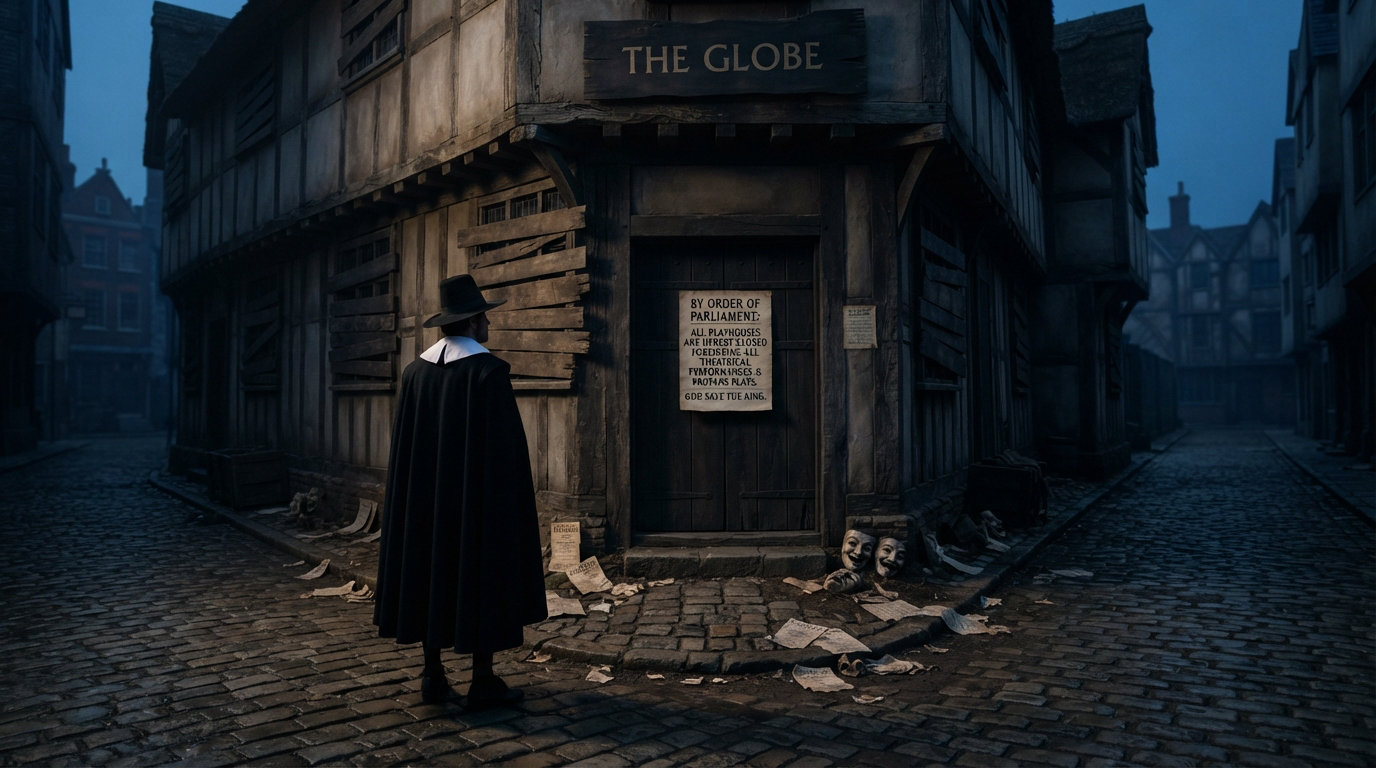
On September 2, 1642, the Long Parliament ordered every playhouse in London to shut its doors. The ordinance declared that public stage plays were full of “lascivious Mirth and Levity” and therefore incompatible with “these times of humiliation” as England plunged into civil war. Behind that order sat decades of Puritan anger toward the theater.
The Puritans were strict Protestants who wanted to purify the Church of England of anything they saw as worldly, idolatrous, or popish. They viewed stage plays as morally corrupting distractions from God. To them, the playhouse was a gathering place for drunkards, prostitutes, gamblers, and idle apprentices who should have been at work.
Our team has spent months tracing the history behind this conflict, and the story is far more layered than “Puritans hated fun.” Their opposition was rooted in theology, politics, public health fears, and social control. Understanding why the Puritans wanted to shut down the theaters helps explain why Elizabethan theater flourished when and where it did, and why it vanished for nearly two decades.
In this guide, we walk through the religious arguments, the specific biblical passages Puritans cited, the role of William Prynne’s infamous treatise, and the legislative timeline that finally silenced the English stage.
Table of Contents
Who Were the Puritans?
The Puritans emerged in the late 1500s as a reform movement within the Church of England. Their name came from their desire to “purify” the church of Catholic practices they considered unbiblical, including ornate vestments, stained glass, and elaborate ceremonies.
They believed in strict personal piety, Sabbath observance, and a life centered on scripture. Anything that pulled people away from prayer, work, or worship was suspect. That included maypole dancing, cockfighting, bear-baiting, and of course, the theater.
Puritans were not a fringe group. By the 1620s and 1630s, they held significant power in Parliament, the universities, and the merchant class of London. Their influence grew steadily until they effectively controlled the Long Parliament that convened in 1640 and passed the theater closure ordinance two years later.
Their theology drove their politics, and both pointed toward the same target: the playhouse.
Why the Puritans Wanted to Shut Down the Theaters
The Puritans’ campaign against the theater rested on five connected pillars. Each one reinforced the others, building a case that felt airtight to anyone who already viewed the world through a Calvinist lens. Here is how they built that argument, piece by piece.
Religious Objections: Theater as a Lie
At the theological core, Puritans believed theater was inherently dishonest. Acting required a person to pretend to be someone else, which violated the biblical principle that God desires truth in the inward parts. Cross-dressing on stage was a particular target, since Deuteronomy 22:5 explicitly forbids a man from wearing women’s clothing and vice versa.
Since all female roles were played by boys and young men in Elizabethan theater, every performance technically violated this commandment. Puritans cited this constantly and used it as proof that the stage was structurally sinful, not just occasionally offensive.
They also pointed to passages condemning revelry and wantonness in the New Testament. Romans 13:13 warns against “riotting and drunkennesse” and “chambering and wantonnesse,” language that mapped neatly onto the atmosphere of a packed playhouse on a summer afternoon.
The theater, in the Puritan view, was not just entertainment gone wrong. It was a structured violation of God’s law, repeated daily for paying audiences.
Moral Corruption and “Lascivious Mirth”
The official 1642 ordinance used a specific phrase: plays were full of “lascivious Mirth and Levity.” This was not random language. It reflected a deep Puritan conviction that comedy, music, and spectacle softened moral discipline and trained audiences in sin.
Puritan preachers described the playhouse as a “chapel of Satan.” Stephen Gosson, a former playwright turned Puritan pamphleteer, wrote in his 1579 tract “The School of Abuse” that plays inflamed lust and turned young minds toward vice. Philip Stubbes echoed this in his 1583 work “The Anatomie of Abuses,” arguing that theater encouraged fornication, adultery, and “all kind of naughtiness.”
They had a point about the atmosphere. Theaters were located in the seedy suburbs outside London’s city walls, surrounded by taverns and brothels. Pickpockets, sex workers, and gamblers worked the crowds constantly.
To Puritan eyes, the connection between playgoing and moral rot was obvious and damning. The playhouse did not just attract sin. It manufactured it.
Idleness, Crime, and Apprentices Skipping Work
Puritans also attacked theater on economic grounds. Plays were performed in the afternoon, during working hours. Young apprentices, who made up a large slice of the audience, regularly skipped work to attend.
The Lord Mayor of London complained repeatedly to the Privy Council about productivity losses. Employers lost labor, and the city lost order. Idle hands, the saying went, were the devil’s workshop, and no place had more idle hands than the playhouse yard.
The crowds also attracted crime. Pickpocketing, fraud, and prostitution were rampant around playhouses. In an age without professional police forces, policing thousands of people gathered in one wooden amphitheater was nearly impossible. Puritans saw this as proof that theaters bred disorder, not just entertainment.
Crowd Control and Public Disorder
Beyond crime, authorities worried about political assembly. The playhouse was one of the few places where common people gathered in large numbers, unsupervised by church or state. In a city simmering with tension between Crown and Parliament, that was dangerous.
The Master of the Revels censored plays for political content, but censorship was imperfect. Playwrights slipped commentary past censors through metaphor, allegory, and double meanings. A line about a tyrant king could be denied as fiction while audiences understood the reference perfectly.
Puritan members of Parliament feared that the stage could become a vehicle for anti-government propaganda or mob mobilization. Shutting the theaters removed a potential flashpoint during a period of growing unrest.
Disease and the Plague Closures
There was also a practical, non-religious reason to close theaters. When plague struck London, which happened frequently in the 1590s and early 1600s, authorities shut all playhouses to slow the spread of disease. Crowded wooden buildings were ideal transmission sites.
The Privy Council ordered closures during plague outbreaks in 1592 to 1594, which deeply affected Shakespeare’s company and may have pushed him toward writing narrative poetry. These closures proved that shutting theaters was administratively normal.
When the Puritans pushed for permanent closure in 1642, they could point to decades of precedent. The mechanism already existed. They simply refused to let the theaters reopen.
The Biblical Case Against Theater
No competitor we studied breaks down the specific scripture Puritans used, so we want to lay this out clearly. Puritan anti-theatrical writers built their arguments on concrete biblical passages. Here are the ones they cited most often.
Deuteronomy 22:5 forbade cross-dressing. Since boys played women’s roles in Elizabethan theater, every single play violated this commandment. Puritans returned to this verse again and again.
Romans 13:13 condemned “rioting and drunkenness” and “chambering and wantonness.” Puritans mapped this language directly onto the playhouse atmosphere, where beer flowed freely and prostitutes worked the crowds.
1 Thessalonians 5:22 instructed believers to “abstain from all appearance of evil.” The theater, surrounded by brothels and taverns in the suburbs, certainly looked evil from the outside.
Psalm 101:3, where David declares “I will set no wicked thing before mine eyes,” was quoted so often it became a Puritan slogan against stage spectacle. If you should not look upon wickedness, then watching actors portray murder, lust, and deceit was itself a sin.
These were not fringe interpretations. They were mainstream Calvinist readings that connected theater to idolatry, the same charge Protestants leveled against Catholic mass. The argument was consistent and internally logical within Puritan theology. That is what made it so powerful.
William Prynne and Histriomastix
The most famous Puritan attack on theater was “Histriomastix,” published in 1632 by the London lawyer William Prynne. The title translates to “The Scourge of Players.” It was a massive, thousand-page treatise compiling every conceivable argument against stage plays, drawing on scripture, classical philosophy, and church history.
Prynne argued that actors were “the scum of the earth” and that playgoing was a sin punishable by damnation. He wrote that theaters were “the Devil’s chapels” and that attending a play was worse than drinking or gambling. The book was encyclopedic, furious, and impossible to ignore.
It was also dangerous. The book appeared to mock Queen Henrietta Maria, who had recently participated in a court masque. Prynne’s timing could not have been worse.
The Star Chamber responded brutally. Prynne was fined, jailed for life, stripped of his law license, and branded on both cheeks with the letters S and L for “Seditious Libeller.” His ears were cropped with shears. He was forced to stand in the pillory.
The punishment backfired spectacularly. It made Prynne a Puritan martyr and hardened anti-theatrical sentiment across the country. When the Long Parliament finally closed the theaters a decade later, “Histriomastix” had already done the intellectual groundwork.
How Playwrights Mocked the Puritans
Playwrights did not take the criticism quietly. Shakespeare mocked Puritan hypocrisy through characters like Malvolio in “Twelfth Night,” a rigid, joyless steward who is told he acts like a “Puritan.” Malvolio is the villain of the comedy, and audiences clearly recognized the type.
Ben Jonson satirized religious killjoys even more directly in “Bartholomew Fair.” His character Zeal-of-the-Land Busy is a Puritan who attacks puppet theater as idolatry, only to be humiliated when a puppet points out that puppets do not wear clothes that violate Deuteronomy 22:5.
These portrayals show that audiences recognized Puritan anti-theatricalism and found it ridiculous. But the mockery also reveals real tension. The stage and the pulpit were competing for the same cultural space, and both sides knew it.
The Timeline: From Compromise to Permanent Ban
The road to closure was gradual, shaped by political shifts over five decades. Here is the full sequence:
The 1570s to 1580s: Puritan pamphleteers like Stephen Gosson and Philip Stubbes published blistering attacks on theater. Queen Elizabeth tolerated the plays but kept playhouses outside London’s city limits, in the suburbs of Southwark and Shoreditch, beyond the Lord Mayor’s direct jurisdiction. This was a political compromise that allowed theater to exist but quarantined it from the city proper.
The 1590s: Plague outbreaks forced repeated theater closures from 1592 to 1594. Shakespeare’s company toured the countryside to survive. The Privy Council used public health as grounds for shutting playhouses, establishing a legal precedent that would later be exploited.
1632: William Prynne published “Histriomastix” and was brutally punished by the Star Chamber, becoming a martyr and galvanizing Puritan opposition.
1640: The Long Parliament convened with a strong Puritan bloc holding real legislative power for the first time.
September 2, 1642: Parliament passed the ordinance closing all London theaters, citing the “lascivious Mirth and Levity” of plays as incompatible with wartime seriousness. The English Civil War had just begun weeks earlier.
1647 and 1648: Further ordinances tightened the ban. In 1648, authorities ordered the physical destruction of theater seating. Playhouses were converted into bear-baiting pits or dismantled entirely. The Globe was pulled down in 1644 to make room for tenement housing.
1660: Charles II was restored to the throne and theaters reopened. This marked the beginning of Restoration theater and the introduction of professional actresses to the English stage for the first time.
What Happened to the Actors?
When the theaters closed, thousands of performers and theater workers lost their livelihoods overnight. Some actors joined the army, on either the Royalist or Parliamentarian side. Others turned to manual labor or left England entirely to perform on the continent.
In 1643, a group of actors published a pamphlet called the “Remonstrance of the Players,” pleading to be allowed back to work. They argued that acting was an honest trade and that many families depended on it for survival. Parliament ignored the plea and passed even stricter laws.
Some actors staged secret, illegal performances in private homes, risking arrest and heavy fines. A few were caught and punished. But most simply disappeared from the historical record, their craft rendered criminal by an ordinance that outlasted the war it was meant to serve.
FAQs
Why did the Puritans destroy the Globe Theatre?
The Puritans did not personally burn down the Globe Theatre. The original Globe caught fire in 1613 during a performance of Henry VIII when a theatrical cannon ignited the thatched roof, and it was rebuilt the following year. However, Puritan authorities ordered the demolition of theater interiors after the 1642 closure ordinance, and the Globe was pulled down in 1644 to make room for tenement housing. So while the Puritans did not destroy the Globe by fire, their policies led directly to its physical dismantling during the ban.
What caused theaters to close down in the 1590s?
Theaters in the 1590s closed primarily because of plague outbreaks. When infection rates rose above a certain threshold, the Privy Council ordered all playhouses shut to prevent disease transmission. The most significant closure lasted from 1592 to 1594 and deeply affected Shakespeare’s company, the Lord Chamberlain’s Men. These closures were public health measures, not religious bans, though they established the administrative precedent that the government could shut theaters whenever it chose.
How did Puritan beliefs impact the closing of the theaters in 1642?
Puritan beliefs were the ideological foundation of the 1642 closure. Puritan members of the Long Parliament viewed theater as sinful, citing biblical prohibitions against cross-dressing, revelry, and moral corruption. When civil war began, they used the national crisis as justification to pass the September 2 ordinance banning plays as incompatible with the somber mood of a nation at war. Without Puritan influence in Parliament, the closure almost certainly would not have happened.
Why did Puritans dislike theatre?
Puritans disliked theatre for several interlocking reasons. Theologically, they believed acting was a form of lying and that cross-dressing violated Deuteronomy 22:5. Morally, they saw playhouses as centers of prostitution, gambling, and drunkenness. Socially, they worried that plays distracted apprentices from work and drew criminal crowds. Politically, they feared large unsupervised gatherings could turn into anti-government unrest. Together, these concerns made theatre the perfect symbol of everything the Puritan movement wanted to reform.
When did theater reopen after the Puritan ban?
Theater reopened in 1660 when Charles II was restored to the English throne. The ban had lasted eighteen years. Charles II, a theater enthusiast who had spent his exile in France enjoying French drama, immediately granted patents to two acting companies, the King’s Company and the Duke’s Company. This marked the beginning of Restoration theatre, which introduced professional actresses to the English stage for the first time and replaced boys in female roles.
Were the theaters closed by the Puritans true or false?
This is true. The Puritan-controlled Long Parliament passed an ordinance on September 2, 1642, officially closing all theaters in London. Additional ordinances in 1647 and 1648 reinforced and strengthened the ban. The theaters remained shut until the Restoration of the monarchy in 1660. While Puritanism was not the only factor, since civil war and public health concerns also played a role, the Puritan religious and political agenda was the primary driving force behind the closure.
Conclusion
The Puritan war on theater was not a simple case of people who hated fun. It was a coherent movement grounded in theology, reinforced by social and political concerns, and enacted through legislative power. The Puritans built their case from specific biblical passages, amplified it through polemicists like William Prynne, and finally executed it through the Long Parliament on September 2, 1642.
Understanding why the Puritans wanted to shut down the theaters illuminates the fragile conditions that allowed Shakespeare’s art to flourish. Elizabethan theater existed in a narrow window where royal tolerance, economic demand, and geographic compromise kept the Puritan opposition at bay. When the political balance shifted, the stage went dark for nearly two decades.
The story also carries a broader lesson about how religion, politics, and culture collide. When one group gains the power to define what is morally acceptable, the arts are often the first casualty. The theaters reopened in 1660, but the England that welcomed them back was forever changed.
Shakespeare’s world, with its open-air playhouses and groundlings standing shoulder to shoulder in the pit, had become history. The Puritans could not stop people from reading the plays or remembering the performances. But they succeeded, for eighteen years, in silencing the living stage that produced them.