
Imagine walking across London’s Southwark Bridge on a warm afternoon in 1600. You hear a trumpet sound from the riverbank as the flag rises above a timbered amphitheatre. The crowd cheers.
You join the throng pressing through the gate, pay a single penny to a man collecting coins in a wooden box, and step into the open yard of the Globe Theatre. The air smells of garlic, ale, and the warm dust of the season. Children dart between your legs.
Pickpockets work the crowd. Above you, musicians strike up a tune from the “heavens” — the roof over the stage. This is what it was like to attend a play in Shakespeare’s London.
In this guide, I will walk you through the full experience of attending a play in Shakespeare’s London — from the moment you crossed the Thames to the final trumpet blast that ended the show. I’ll cover the venues, the prices, the people, and the sights, sounds, and smells that defined a typical afternoon in the playhouse.
Table of Contents
The London Theatre Landscape in Shakespeare’s Time
London’s theatre scene in the late 1500s was concentrated in two main areas. Public playhouses clustered in Southwark, just across the Thames from the city walls, while private indoor theatres and royal court performances sat inside the city proper.
By 1600, six major public playhouses operated in or near London. The Theatre, the Curtain, the Rose, the Swan, the Globe, and the Fortune drew crowds of two to three thousand spectators at peak times.
Four were amphitheatres — open-roofed, polygonal wooden structures built around a central yard. These public playhouses hosted plays almost daily, and they became the heart of London’s entertainment scene.
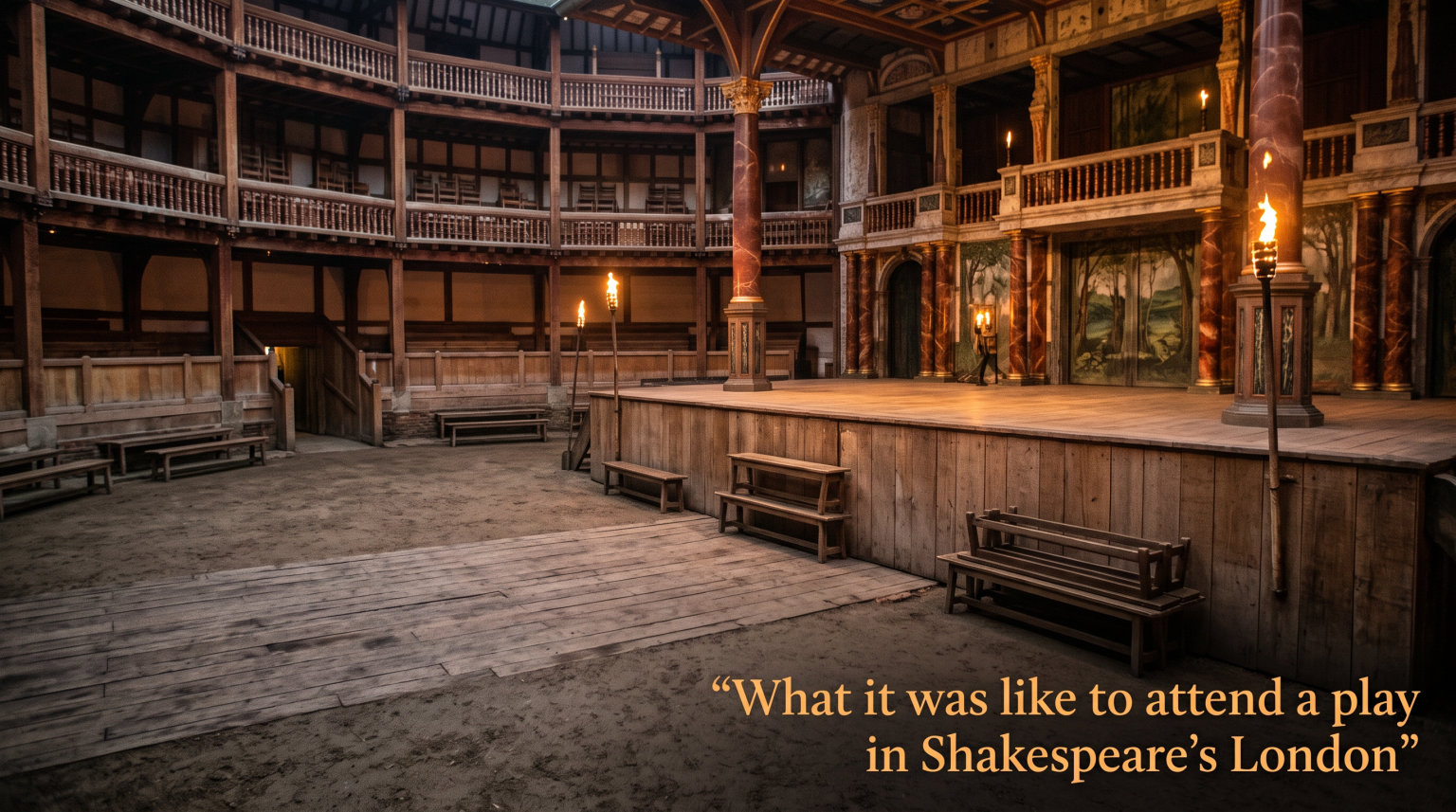
The Globe Theatre, completed in 1599 by the Lord Chamberlain’s Men (Shakespeare’s own company), was the most famous of these. It was a three-storey open-air playhouse with a thatched roof over the galleries. The stage projected into the yard, with a “tiring house” behind it for costume changes and a roof called “the heavens” above.
Private indoor theatres offered a more refined experience. The Blackfriars Theatre, used by Shakespeare’s company after 1609, was a candlelit hall with bench seating. These venues charged higher prices and attracted wealthier patrons who preferred music, masques, and boys’ companies performing in artificial light.
The royal court represented the third tier. Performances at Whitehall Palace during Christmas season featured the King’s Men and other top companies. Queen Anne and King James I attended often, and these private court performances shaped the most prestigious productions of the era.
Why Most Playhouses Sat in Southwark
Public playhouses were built outside the city walls because the Corporation of London restricted entertainment within the city. Southwark was effectively a pleasure district — home to bear-baiting rings, brothels, bowling alleys, and playhouses.
The Globe, the Rose, and the Hope all stood within a short walk of each other along the Bankside. Their location offered practical advantages, including riverboat access from the city and proximity to other entertainments.
Ticket Prices and Who Could Afford to Attend
Tickets were sold at three prices, and your ticket dictated where you stood or sat. A penny bought you standing room in the open yard. Twopence upgraded you to a seat in the covered galleries. Sixpence or more bought you a private box in the Lord’s Rooms above the stage.
A penny may sound cheap, but it represented real money in the 1590s. Most working people earned roughly sixpence a day, so a penny was about an hour’s wages. A loaf of bread cost around a halfpenny, and a skilled tradesman might earn eightpence to a shilling per day.
The galleries cost twice as much and offered cushioned seating, protection from rain, and a better view of the stage. Wealthier merchants, minor gentry, and middle-class Londoners filled these seats, often in their finest clothes.
The Lord Chamberlain’s Men and other companies also issued “passage” tickets, sometimes free, to influential patrons. These VIPs received complimentary admission in exchange for visible support of the company.
What a Penny Bought Compared to Today
Modernizing the cost helps. Shakespeare’s penny in 1600 had the purchasing power of about 10 to 15 pounds in today’s money. A twopence gallery ticket would be roughly equivalent to 20 to 25 pounds.
Sixpence for a Lord’s Room was serious money, perhaps the cost of a working person’s entire day or two. The cheapest seats, the penny standing spots, were the most popular and the most crowded.
Who Attended Plays in Shakespeare’s London
Playhouses in Shakespeare’s London drew a more diverse crowd than modern theatregoers might expect. The audience included apprentices, servants, and laborers packed into the yard, alongside merchants, gentry, and even nobles in the galleries and Lord’s Rooms.
Foreign visitors, scholars, and travelers also attended, especially at the more established venues. Men dominated the audience, but women were present in significant numbers and used the galleries as social gathering spaces.
Apprentices under 18 formed a large slice of the yard crowd. They had modest incomes and free time after work, and they loved the spectacle. The city of London tried repeatedly to limit apprentice attendance, fearing outbreaks of rowdiness, but failed to enforce attendance limits.
Foreign visitors — including French, Italian, Spanish, and Dutch travelers — attended plays and often wrote about them. Their accounts give us some of the most detailed descriptions of the era. One German traveler, Thomas Platter, attended a Julius Caesar performance at the Globe in 1599 and described the lively audience in detail.
Foreign students from the Inns of Court also attended frequently. They brought notebooks and sketched the costumes, the actors, and the special effects. Their sketches survive and give us our most accurate visual record of the era.
The Groundlings Explained
A groundling was a person who stood in the yard for a penny. The name comes from the fact that they stood on the bare ground, packed together without chairs or benches.
Groundlings stood for the entire performance — sometimes three hours or more — which is why they were typically younger working men and apprentices rather than older patrons.
Modern visitors to the reconstructed Globe in London today can still pay to stand as a groundling during summer performances. The experience has changed less than you might think.
A Live Theatre Experience: Walking Into the Playhouse
When you arrived at the Globe, you handed your penny to a “gatherer” at the door and walked into the open yard. The stage stood at one end, three storeys tall, with a thatched roof above.
Two giant columns held up the heavens, painted with zodiac signs and clouds. The tiring house at the back of the stage housed actors, costumes, and musicians. Three entrances led to the stage: a central door, a door on the left, and a door on the right, used for entrances and exits during performance.
Choosing a spot in the yard was strategic. Standing at the front rail put you within arm’s reach of the actors — close enough to catch a hand gesture or overhear a whispered line. Standing near the central doors gave you a clear view of the tiring house.
The galleries wrapped around three sides of the yard in two tiers. The lower gallery seated the more prosperous citizens, while the upper gallery held apprentices and servants. The Lord’s Rooms sat above the stage itself, directly over the central platform.
The Bare Stage and the Use of Language
The stage itself was mostly bare. The Folger Shakespeare Library describes it as “relatively bare” — playwrights relied on vivid words rather than scenery to set the scene.
A throne, a table, a few chairs, and a trapdoor in the floor made up the standard props. Scenery was minimal, painted backdrops rare, and lighting changes impossible in the open-air venues.
This means Shakespeare’s company used language to create location. When Hamlet says “I am too much i’th’sun,” the audience knew he was outside — even though nothing on stage had changed. When a play mentioned a balcony, the actors entered the second-storey gallery, which doubled as the upper stage.
Special effects were limited but powerful. Cannon fire created real smoke when the powder misfired, which is how the original Globe burned in 1613. Trapdoors allowed actors to appear or disappear, supporting the plays’ frequent ghosts and supernatural scenes.
Costumes and Actors
Costumes were the visual spectacle of Elizabethan theatre. The Lord Chamberlain’s Men wore the finest contemporary clothing available — sometimes worth more than the entire playhouse building.
Actors wore doublets, hose, ruffs, and gowns, often donated or borrowed from noble patrons. The wardrobe was valuable, kept in the tiring house, and one of the company’s biggest investments.
All roles were played by men and boys. Boys aged 10 to 14 played female characters, their voices unbroken and their faces less lined. Viola, Juliet, and Cleopatra were all played by teenage boys, and the convention shaped how scripts were written.
Audiences accepted the conceit. A boy in a wig playing Cleopatra was understood to be a queen, just as a boy in a beard playing a king was understood to be a king. The illusion worked because the language and the staging reinforced what the actors were showing.
Sights, Sounds, and Smells of an Elizabethan Playhouse
An afternoon at the Globe was a full-body experience. Imagine 2,000 people crammed into a wooden building, packed shoulder to shoulder, eating, drinking, shouting, and watching a play for three hours under open sky.
Sights: the playhouse was brightly lit by daylight, with afternoon sun slanting down into the yard. The audience could see the actors clearly, and the actors could see the audience. Costumes stood out in vivid colors — reds, yellows, blues. Gold-threaded doublets caught the light.
Sounds: a trumpet sounded three times before the play began, signaling the audience to settle down. Music came from the upper gallery, where a small band played viols, lutes, and recorders between scenes. The audience itself was loud — coughing, shouting, eating, calling out to friends.
Smells: this is where the modern experience differs most. The yard smelled of garlic, onions, and human sweat. The galleries smelled of stronger beer and wine. Tobacco smoke, exotic spices from orange peels, and the smell of gingerbread filled the air.
Beeswax candles gave off a sweet scent, while tallow candles gave off a tallow smell. The yard smelled of dust, while the galleries smelled of damp wood and cloth.
The Difference Between Open-Air and Candlelit Theatres
Indoor theatres like the Blackfriars used candles for lighting. The Folger notes that the shift from open-air to candlelit spaces changed the atmosphere entirely. The audience saw less of the surrounding crowd and more of the actors’ faces.
Music was softer, plays were shorter, and the experience felt more intimate. Public amphitheatres felt like outdoor sporting events, with the audience as part of the spectacle.
The open roof meant weather was a constant factor — rain spoiled performances, sun was a relief, and winter plays were rare. The reconstructed Globe in London today still operates mostly in summer, for the same reason.
Audience Behavior and Interaction
Elizabethan audiences were loud, social, and interactive — the opposite of modern theatre etiquette. The audience talked throughout the play, ate, drank, walked around, and called out to the actors.
They clapped, cheered, hissed, and booed. They threw apples and oranges onto the stage when displeased. Plays often started late because audiences took time to settle in.
Pickpockets worked the yard constantly. The pippin-sellers — orange and apple vendors — also moved through the crowd, shouting their wares. So did sellers of gingerbread, nuts, and ale. The audience was a marketplace as much as a spectator crowd.
Important passages got applause. Boring passages got talking. Bad actors got booed. Good actors got called back for encores, or more accurately, demands to repeat the scene. The Globe’s flag flew when the play was on, a visible signal to the rest of London that the show was running.
Audience comments shaped the play. Shakespeare’s company could hear the crowd and adjust the performance on the fly. A slow scene might get cut short, a popular scene might get extended. The audience was, in a real sense, a co-author of the theatrical experience.
Modern Comparison: What Would Shock a Modern Theatregoer
A modern theatregoer visiting the original Globe would be shocked by several things. First, the standing: three hours on your feet, packed in a crowd, with no chairs and no backs.
Second, the noise: constant talking, eating, calling out, and heckling. Third, the proximity: actors could see you, hear you, and respond to you. If you hissed, the actors would know.
The reconstructed Globe in London today tries to recreate the experience. Modern groundlings pay to stand in the yard, eat oranges, and participate in the play. Many visitors — especially those familiar with silent modern theatre — find the experience intense, interactive, and unlike anything they have done before.
FAQ
What was it like to attend a play in Shakespeare’s time?
Attending a play in Shakespeare’s London was a lively, social, and interactive experience. Audiences of all classes gathered in open-air playhouses like the Globe to watch performances for one to six pennies, stood for hours in the yard or sat in covered galleries, ate and drank throughout the show, and constantly reacted to the action with applause, hisses, and heckling.
How much did it cost to attend a Shakespeare play?
Tickets to the Globe Theatre cost one penny for standing room in the yard, two pence for a seat in the covered galleries, and sixpence or more for a private Lord’s Room box above the stage. A penny was roughly equivalent to one hour of skilled labor, or the cost of a loaf of bread.
What was London like during Shakespeare’s time?
London in Shakespeare’s time was a crowded, noisy city of roughly 200,000 people. The south side of the Thames, called Southwark, was the entertainment district — home to public playhouses, bear-baiting rings, and other diversions. The city proper was dominated by trade, with strict laws restricting entertainment inside the walls.
What was entertainment like in Shakespeare’s time?
Entertainment in Shakespeare’s London included public plays, bear-baiting, cockfighting, inn-yard performances, royal court masques, and street entertainment. Public playhouses operated almost daily, drawing crowds of two to three thousand to see works by Shakespeare, Marlowe, Ben Jonson, and others.
Where is the best place to sit at Shakespeare’s Globe?
The best place to sit at the reconstructed Globe Theatre today is one of the cushioned seats in the middle gallery, which offers a clear view of the stage and protection from weather. Standing in the yard as a groundling offers the most authentic experience, putting you within arm’s reach of the actors.
Final Thoughts on Attending a Play in Shakespeare’s London
Attending a play in Shakespeare’s London was a sensory experience modern theatregoers would barely recognize. It was loud, crowded, smelly, and interactive. The audience stood for hours, ate oranges, heckled, and cheered.
The stage was bare, the costumes were spectacular, and the language did all the work of scenery. Prices were low enough that apprentices could afford a penny standing ticket, yet high enough that the nobility paid sixpence for the Lord’s Rooms.
If you want to experience something close to the original in 2026, visit the reconstructed Globe Theatre in London today. Stand as a groundling. Eat an orange. Cheer the actors. You’ll get a taste of what it was like to attend a play in Shakespeare’s London, and you’ll understand why the experience shaped plays that still resonate four centuries later.