
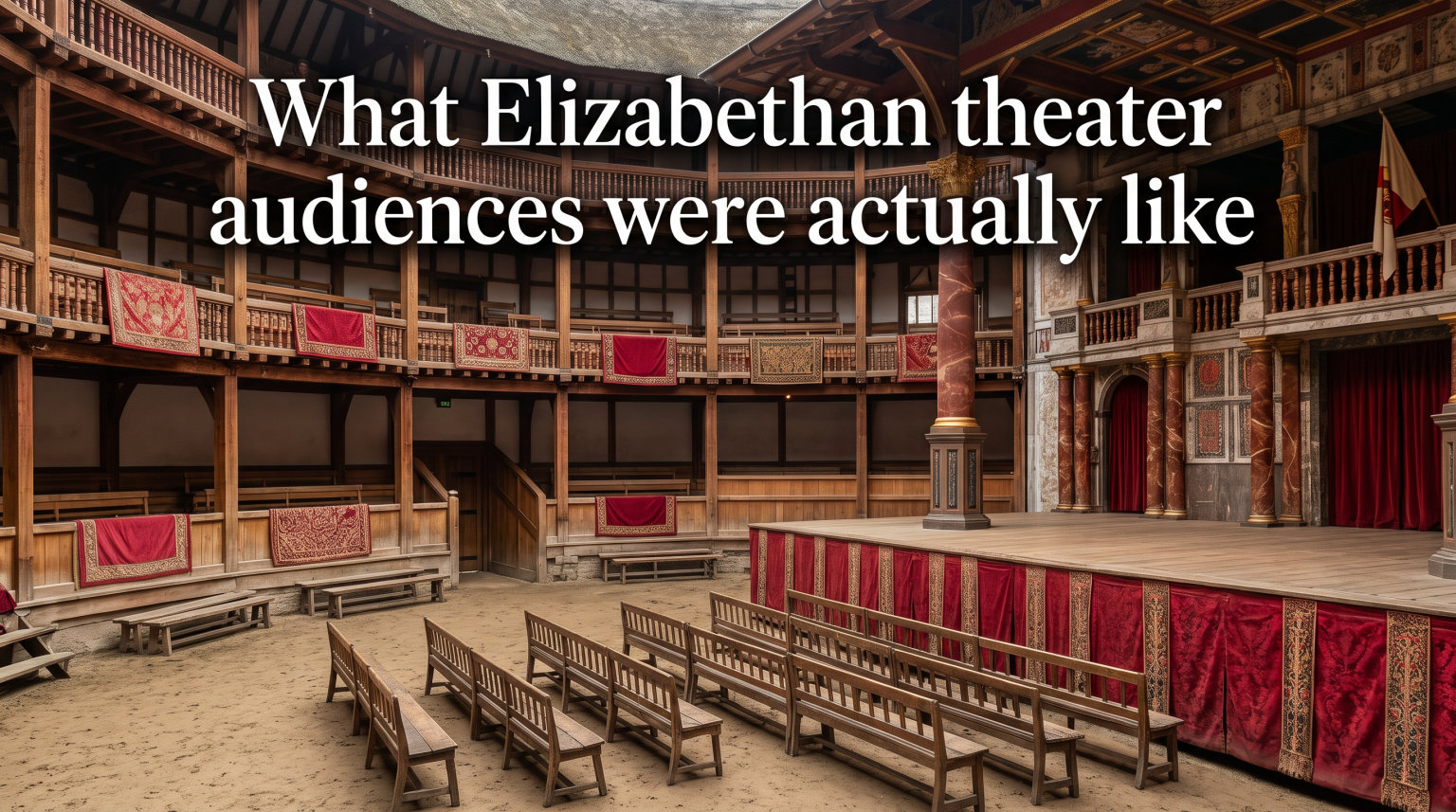
Elizabethan theater audiences were loud, diverse, and nothing like the polite crowds we know today. Up to 3,000 people packed into open-air playhouses like the Globe Theatre, and they came from every rung of society, from lords in velvet to apprentices who had scraped together a single penny for standing room. They clapped, they booed, they threw fruit at actors they disliked, and they treated a play the way a modern crowd treats a football match.
If you want to understand Shakespeare’s plays, you first have to understand the people he wrote them for. The experience of watching Hamlet or Henry V in 2026 is worlds apart from how those plays were first received. Here is what Elizabethan theater audiences were actually like, from the gallery seats to the muddy yard below.
Table of Contents
What Elizabethan Theater Audiences Were Actually Like
Elizabethan theater audiences were participatory, multi-class crowds of up to 3,000 people who stood, ate, drank, talked, and shouted their way through performances in open-air playhouses. They were not quiet observers. They saw themselves as part of the show, and playwrights wrote with that energy in mind.
The divide between rich and poor was built into the architecture itself. The wealthy paid extra to sit under cover in the galleries, while poorer attendees stood in the exposed central yard for the price of a penny. Everyone could see everyone else, which meant the audience watched not only the play but also one another.
Who Made Up the Crowd: A Class-by-Class Breakdown
Elizabethan audiences were among the most socially mixed gatherings in the period. A nobleman, a grocer’s apprentice, a merchant’s wife, and a visiting foreign diplomat might all watch the same play on the same afternoon, separated only by how much they had paid at the door.
Nobles and Courtiers in the Lord’s Rooms
Aristocrats and wealthy courtiers attended both public playhouses and private performances at court. In the public theatres, they paid handsomely for the lord’s rooms, the most expensive seats located behind or beside the stage. These seats offered poor views of the action but excellent visibility for the audience, which was the point. Being seen was part of the experience.
Records show Queen Elizabeth I and King James I hosted command performances at court, and nobles often sponsored playing companies directly. The Lord Chamberlain’s Men, Shakespeare’s own company, took their name from their noble patron.
Merchants, Craftsmen, and the Middle Class in the Galleries
The middle tier of the audience sat in the covered galleries that ringed the playhouse. These were the merchants, tradesmen, skilled craftsmen, lawyers’ clerks, and their families. They paid two or three pennies for a seat and could rent a cushion for extra comfort.
This group was literate, politically aware, and a major reason plays were thick with wordplay and contemporary references. They could follow complex plots and appreciated a clever pun, which gave Shakespeare room to write dense verse alongside the broader comedy aimed at the yard.
Apprentices, Servants, and the Working Poor Below
The cheapest tickets brought in apprentices, domestic servants, labourers, soldiers, and students. These were the groundlings, the standing crowd that filled the yard around the stage. For the price of a penny, roughly the cost of a loaf of bread or a pot of ale, they got three hours of entertainment and a chance to escape cramped lodgings and a hard week’s work.
Contemporary observers sometimes dismissed this group as a “rude” mob, but they made up a large share of the audience and were the loudest voices in the room. A play that lost the groundlings could lose the whole house.
The Groundlings: Shakespeare’s Standing-Room Audience
The groundlings were the cheapest audience members, paying one penny to stand in the open yard directly in front of the stage. The name itself comes from Hamlet, where the Prince jokes that the audience for a play is made up of “groundlings who for the most part are capable of nothing but inexplicable dumb shows and noise.”
That single line tells us a great deal. Shakespeare knew the groundlings were watching, and he wrote with them in mind. They stood shoulder to shoulder, often pressed against the stage itself, close enough to spit at an actor and close enough to be spat on in return. There was no seating, no shelter, and no break.
Three hours on your feet in an open yard, in all weathers, with no toilets and nowhere to sit, was a serious commitment. Yet the groundlings came in their thousands, and the playhouses depended on them. The yard held roughly half of the Globe’s 3,000-strong capacity.
Ticket Prices, Galleries, and the Lord’s Rooms
Seating in an Elizabethan playhouse worked on a strict pay-as-you-go principle. The more you spent, the higher you climbed, the drier you stayed, and the more comfortable your seat became. The system was transparent and unforgiving.
The groundlings paid one penny to stand in the yard. A second penny bought a seat in the lowest gallery, and a third moved you up to a better gallery with a cushion. Wealthier patrons paid sixpence for the lord’s rooms behind the stage, where they sat on stools in full view of the rest of the house.
The phrase “box office” likely comes from this era. Money was collected in a small box at the entrance, and after the performance the box was taken to a back room, the “office,” to be counted. The galleries rose three storeys high in the larger playhouses, packed with benches, and straw covered the yard floor to soak up the inevitable mess.
How Audiences Behaved: Clapping, Booing, and Thrown Fruit
Elizabethan audiences clapped and booed whenever they felt like it, and they were not shy about expressing displeasure. If a scene bored them, they talked over it. If an actor fumbled a line, they jeered. If the play truly offended them, they threw whatever came to hand, usually food they had brought with them.
Apples, nuts, and even stones were hurled at performers who failed to please. Foreign visitors to London were often shocked by the roughness of the crowds. In 1613, when the Globe burned down during a performance of Henry VIII, some accounts suggest the audience was so engrossed that they laughed off the fire before fleeing.
This was a participatory culture, not a passive one. Actors expected interruptions and sometimes answered hecklers directly. A stage projection meant the performers literally stood among the groundlings, close enough to touch. Modern theatergoers sit in the dark and stay quiet; Elizabethans stood in daylight and felt licensed to respond.
Food, Drink, and the Smell of the Playhouse
Food and drink were part of the experience from the moment you arrived. Sellers moved through the crowd offering apples, nuts, hazelnuts, biscuits, and ale. Hazelnut shells later turn up in excavations of Elizabethan playhouse sites, evidence of just how much the audience snacked.
Beer and ale flowed freely, and many in the crowd were drunk before the play was halfway through. There were no interval bars and no refreshment pause because there was no interval at all. Plays ran straight through, often two or three hours, and the audience simply carried on eating, drinking, and talking.
Pickpockets worked the crowds so regularly that the theatres hired staff to watch for them, and prostitutes were widely understood to be plying their trade among the groundlings. The yard was unpaved, exposed to weather, and after a hot afternoon with a packed crowd, the smell was famously overpowering. One contemporary writer called the standing crowd “stinkards,” and the nickname stuck.
Women in the Audience: A Forgotten History
Women attended Elizabethan theatres in significant numbers, despite a popular myth that they did not. Working women, wives of merchants, and even noblewomen were all part of the crowd. They sat in the galleries, stood in the yard, and appeared in the lord’s rooms depending on what they could pay.
Moralists complained constantly about women in the playhouses, claiming the crowds corrupted them or that prostitutes used the theatres as a hunting ground. Some Puritan critics singled out women attendees as a sign of the theatres’ moral decay. These complaints are themselves evidence that women were there in numbers large enough to worry critics.
Records are thinner for women than for men, which is why their presence is often overlooked in popular accounts. But the audience was never all-male, and a playhouse crowd would have looked, sounded, and smelled like a cross-section of London itself.
Why the Crowd Shaped Shakespeare’s Plays
Elizabethan audiences shaped what playwrights wrote. Shakespeare had to hold the attention of a lord in the gallery, a drunk apprentice in the yard, and a courtier’s wife on the side bench, all at once. That pressure produced the layered structure of his plays.
Groundlings loved broad comedy, sword fights, ghosts, and spectacle, which is why even the darkest tragedies break for clown scenes and bloodshed. The middle classes prized wit, wordplay, and clever plotting, which is why the verse is so dense. Nobles expected classical allusion and political sophistication, which is why the histories are threaded with Roman and Italian references.
The plays also competed for attention with bear-baiting, cock-fighting, and public executions across the river. A dramatist who could not hold a noisy crowd had no career. The direct address of soliloquies, the asides, and the deliberate breaking of the fourth wall all begin to make sense when you picture 3,000 people standing three feet from the actor, waiting to be entertained.
FAQs
What were Elizabethan audiences like?
Elizabethan audiences were diverse, rowdy, and highly participatory crowds of up to 3,000 people. They came from every social class, paid between one penny and sixpence for admission, and treated plays as live events they could shout at, applaud, or interrupt. They ate, drank, talked, and threw food during performances.
What did Elizabethan audiences do if they did not like a play?
If Elizabethan audiences did not like a play, they booed, hissed, talked over the actors, and sometimes threw food such as apples and nuts at the stage. Bad performances could lose the crowd entirely, and playwrights knew that losing the groundlings meant losing the whole house.
What were theatres like in Elizabethan times?
Theatres in Elizabethan times were open-air, wooden, multi-storey playhouses built in a roughly circular or polygonal shape. The central yard was uncovered, the stage projected into the crowd, and tiers of covered galleries surrounded the yard. The Globe, the Swan, and the Fortune could each hold around 3,000 spectators.
Who were the typical audiences for Elizabethan plays?
Typical audiences for Elizabethan plays included nobles and courtiers, wealthy merchants and craftsmen, their wives and families, apprentices, servants, soldiers, and students. Admission prices ranged from one penny for standing room to sixpence for the lord’s rooms, which meant almost anyone with a wage could afford to attend.
What do you call audience members who stood to watch Elizabethan theatre?
Audience members who stood to watch Elizabethan theatre were called groundlings. They paid a single penny to stand in the open yard around the stage for the full performance. The term comes from Hamlet, where Shakespeare describes them as ‘groundlings who for the most part are capable of nothing but inexplicable dumb shows and noise.’
How much did a ticket cost at the Globe Theatre?
A ticket at the Globe Theatre cost one penny to stand as a groundling in the yard, two pennies for a seat in the lowest gallery, three pennies for a better gallery seat with a cushion, and sixpence for the lord’s rooms behind the stage. One penny was roughly the price of a loaf of bread or a pot of ale at the time.
Conclusion
Elizabethan theater audiences were not the hushed, reverent crowds of a modern playhouse. They were standing, snacking, shouting cross-sections of London itself, drawn from every class and willing to make themselves heard. A penny got you into the yard, sixpence bought you a stool behind the stage, and almost everyone in between could find a seat.
Understanding what Elizabethan theater audiences were actually like changes how we read Shakespeare. The soliloquies were not introspective whispers; they were shouted to a thousand people standing three feet away. The clown scenes were not padding; they were survival tactics for keeping a noisy crowd on side. The plays we now study in silence were written to be heard above apples, ale, and argument.
If you want to dig deeper into the world behind the words, the next step is to look at the playhouses themselves, the daily life of the playing companies, and the bear-baiting pits that fought the theatres for the same crowds. The audience was only half the story, but it was the half Shakespeare had to win over every single afternoon.