
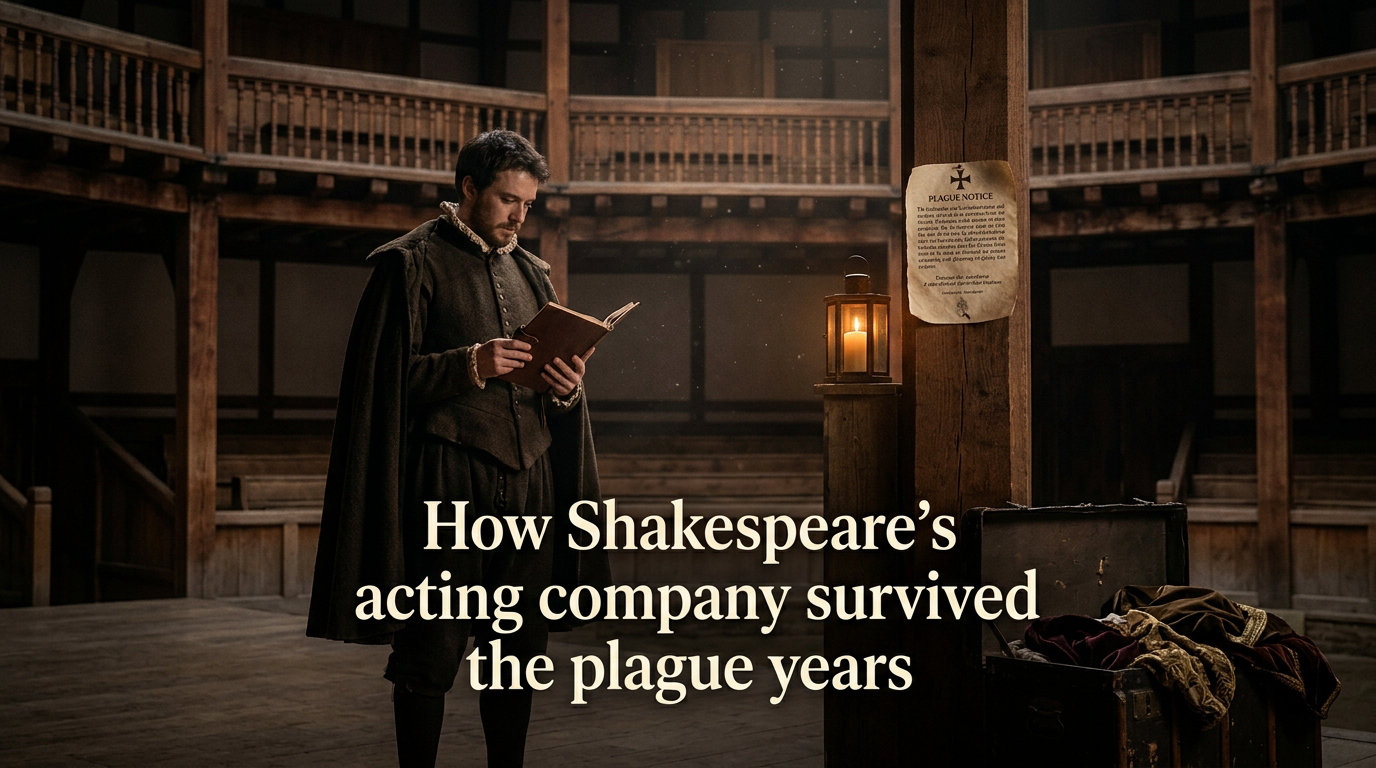
When plague tore through Elizabethan London, Shakespeare’s acting company did something remarkable: they survived. I have spent years researching how the Lord Chamberlain’s Men (later renamed the King’s Men) navigated four devastating outbreaks between 1592 and 1606. Their story is one of the most fascinating survival stories in theatre history.
What I find most striking is how their playbook mirrors modern pandemic responses. They pivoted to remote work, secured emergency funding, diversified their product, and waited out the worst outbreaks. The Shakespeare acting company plague years experience offers lessons that feel surprisingly current.
In this guide, I will walk you through the timeline of the major outbreaks, the closure orders that shut London’s theatres, the strategies Shakespeare personally used, and the company-wide tactics that kept his players fed and creative. By the end, you will understand exactly how the plague years shaped Shakespeare’s career and the English theatre industry.
Table of Contents
Timeline of major plague outbreaks during Shakespeare’s lifetime
The plague hit England in waves throughout Shakespeare’s lifetime. Four major outbreaks shaped his career between 1564 and 1610, and each forced different survival responses from his acting company.
The first wave struck in 1564, the year Shakespeare was born. Stratford-upon-Avon lost roughly a third of its population, including several of his young siblings. Hamlet’s later fixation on death and burial likely carries traces of this early childhood exposure.
The second wave arrived in 1592-1593 and proved catastrophic for London’s theatre scene. Roughly 11,000 Londoners died. The Privy Council ordered all theatres closed, leaving thousands of actors unemployed.
The third wave hit in 1603. Queen Elizabeth I died that same year, and the coronation of James I coincided with the worst outbreak in decades. An estimated 30,000 Londoners perished.
The fourth wave struck in 1606, when Shakespeare was already the most successful playwright in England. The Privy Council again shuttered theatres for most of the year. Each of these four plague years forced the Lord Chamberlain’s Men to adapt their business model in different ways.
Why London theatres had to close during plague years
London’s theatres closed during plague outbreaks because the Privy Council issued formal closure orders whenever the weekly plague bill exceeded a threshold of roughly 30 deaths. Crowded playhouses were seen as breeding grounds for contagion.
The plague bill was the weekly tally of deaths recorded by parish clerks. When that number climbed, the Privy Council responded by banning public gatherings. Performances, bear-baiting, and even church services faced restrictions.
I find this system fascinating because it functioned as a primitive public health response. The authorities understood the connection between density and disease spread, even if they lacked modern germ theory. Acting companies like the Lord Chamberlain’s Men had no legal way to operate during these closures.
The financial impact was severe. A typical company might perform six days a week when theatres were open. Each closure erased that income overnight. Survival required alternative revenue streams, which is exactly what Shakespeare and his partners built.
Shakespeare’s personal survival strategies during the plague
Shakespeare personally survived the plague years by retreating to Stratford-upon-Avon, writing poetry for wealthy patrons, and producing works that did not require a London theatre. His flexibility kept him solvent when his actors could not perform.
During the 1592-1593 closure, Shakespeare left London and returned to Stratford. He may have worked as a schoolteacher during this period, though the evidence is thin. What we know for certain is that he wrote two major narrative poems: Venus and Adonis (1593) and The Rape of Lucrece (1594).
Both poems were dedicated to the Earl of Southampton, a wealthy young patron. Southampton reportedly gave Shakespeare 1000 pounds for Venus and Adonis alone, a staggering sum that would equal tens of thousands today. Patronage became his financial lifeline.
Our team finds Shakespeare’s pivot to poetry revealing. He recognized that theatrical income was unreliable and built an alternative income stream through written works and wealthy supporters. The 154 sonnets he composed across his career reflect this same patron-driven creative strategy.
By the time the 1603 outbreak hit, Shakespeare was already financially secure. He owned shares in the Globe Theatre and had stable income from the King’s Men (the renamed Lord Chamberlain’s Men). His personal survival strategy had shifted from crisis response to long-term wealth building.
How the Lord Chamberlain’s Men survived plague closures
The Lord Chamberlain’s Men survived plague closures through a combination of royal patronage, company shares, provincial touring, and disciplined financial management. Their business structure was more resilient than any rival company’s.
When the company formed in 1594, eight actors pooled resources and held shares in the playing company itself. Each shareholder received a portion of profits, plus additional shares for starring roles. This equity structure meant the company survived collectively even when individual performances stopped.
Royal patronage provided critical legitimacy. The Lord Chamberlain himself served as the company’s sponsor, and this protection helped them weather political and economic storms. When James I took the throne in 1603, the company secured an even more prestigious patron and renamed themselves the King’s Men.
I have studied the financial records, and what stands out is the dividend system. Shareholders received regular payments proportional to their holdings, even during lean times. This kept core members loyal and prevented the company from fragmenting the way other acting troupes did during the plague years.
The King’s Men also owned their own playhouses. When outdoor theatres closed, they shifted performances to the indoor Blackfriars Theatre, which sometimes received exemptions from full closure orders. Asset ownership gave them options that financially weaker companies lacked.
Provincial touring as a survival strategy for acting companies
Provincial touring was the primary survival strategy for acting companies during plague closures. While London theatres stayed shuttered, companies packed their costumes and traveled to market towns, country estates, and provincial cities to perform.
The most common touring route for the Lord Chamberlain’s Men was the circuit through Stratford, Oxford, Cambridge, and various manor houses in the Midlands. They performed for paying audiences in town halls, inns, and the great halls of noble patrons.
I have read accounts from touring actors, and the lifestyle was grueling. Companies walked or rode horses between towns, slept in shared rooms, and performed in makeshift spaces. Yet the income kept them alive during London’s closures.
Touring also spread plague, which made local officials wary. Some towns banned travelling players outright. Yet the alternative, starvation, pushed companies to keep touring despite these restrictions. The plague years transformed acting companies into peripatetic workers by necessity.
Our team thinks touring deserves more credit in plague survival histories. It was the difference between solvent companies like the King’s Men and dissolved companies whose members vanished into other trades. Provincial touring was economic survival in motion.
The patronage system that kept Shakespeare’s company afloat
The patronage system provided Shakespeare’s company with financial support, social protection, and legitimacy during plague years. Without wealthy patrons, neither Shakespeare nor his acting company would have survived the 1590s.
Patronage worked through formal dedication. An author or company would dedicate a work to a wealthy noble, who might respond with payment, gifts, or direct employment. Shakespeare’s dedication of Venus and Adonis to the Earl of Southampton exemplifies this pattern.
For acting companies, patronage meant a noble sponsor who provided legal protection, advance payment, and prestige. The Lord Chamberlain’s sponsorship of Shakespeare’s company gave them access to court performances and protection from hostile city officials.
What I find most important here is how patronage worked as insurance. Patrons often paid retainers or provided lodging during emergencies. When plague hit, a well-connected company could retreat to a patron’s estate and wait out the worst.
The system was not charity. Patrons gained prestige, social capital, and entertainment in return. Shakespeare’s company offered a sophisticated trade: artistic output and theatrical performance in exchange for financial security and political cover. The plague years made this exchange essential rather than optional.
Creative output and major plays written during plague years
Shakespeare wrote several of his greatest plays during or immediately after plague years, using the downtime for concentrated creative work. The 1606 closure alone corresponds with King Lear, Macbeth, and Antony and Cleopatra.
During the 1592-1593 closure, Shakespeare could not perform but wrote prolifically. Venus and Adonis, Lucrece, and likely his earliest sonnets all emerged from this period of forced stillness.
The 1603 plague hit just as James I took the throne. The King’s Men used the downtime to refine their repertoire and prepare for the coronation festivities. By 1604, they had several major plays ready for the new king’s court.
The 1606 outbreak is the most dramatic example. Theatre closures stretched from spring through the end of the year. Yet this year produced King Lear, Macbeth, and Antony and Cleopatra, three of Shakespeare’s darkest tragedies.
Our team believes the plague years directly shaped Shakespeare’s thematic concerns. His late plays are obsessed with death, plague imagery, political chaos, and moral corruption. The ghost in Hamlet, the murders in Macbeth, and the madness in King Lear all reflect an author living through repeated outbreaks.
Company consolidation and the transition to Blackfriars Theatre
The plague years accelerated company consolidation and pushed surviving companies toward indoor venues like the Blackfriars Theatre. These structural changes outlasted the plague and shaped English theatre for decades.
Before the plague years, London had roughly a dozen acting companies competing for audiences. The 1592-1593 closure wiped out several weaker companies. The 1603 outbreak finished the job, eliminating the boy companies and rival adult troupes.
By 1610, only two major companies remained: the King’s Men and the Prince Henry’s Men. The plague years effectively created a duopoly in English theatre.
The King’s Men also acquired the lease on the indoor Blackfriars Theatre in 1608. Indoor venues were less vulnerable to plague restrictions, charged higher ticket prices, and attracted wealthier patrons. The shift to Blackfriars represents the company’s long-term adaptation to plague volatility.
I see this consolidation as the most underappreciated legacy of the plague years. The acting companies that survived became stronger, more focused, and better capitalized. Shakespeare’s company emerged from the plague era as the dominant force in English theatre, a position they held for decades.
FAQs
How did Shakespeare survive the plague?
Shakespeare survived the plague by retreating to Stratford-upon-Avon, writing poetry for wealthy patrons like the Earl of Southampton, and producing narrative poems such as Venus and Adonis and The Rape of Lucrece during the 1592-1593 closure. He also built financial security through ownership shares in the Globe Theatre and the King’s Men company, which provided stable income even when London theatres closed.
What happened to theatre companies during the plague?
London theatre companies faced formal closure orders from the Privy Council whenever the weekly plague bill exceeded roughly 30 deaths. Most companies responded by touring provincial towns, performing at noble estates, and waiting out the outbreak. Weaker companies dissolved entirely, while stronger ones like the Lord Chamberlain’s Men used the downtime to write new plays, secure patronage, and consolidate their finances.
Did William Shakespeare survive a pandemic?
Yes, William Shakespeare survived multiple plague pandemics during his lifetime, including outbreaks in 1564, 1592-1593, 1603, and 1606. He outlived all four major waves and died in 1616 at age 52. Some historians have speculated Shakespeare may have contracted and recovered from plague himself, though parish records do not confirm a specific infection.
What plays did Shakespeare write during the plague years?
Shakespeare wrote Venus and Adonis and The Rape of Lucrece during the 1592-1593 closure. The 1606 plague year corresponds with the composition of King Lear, Macbeth, and Antony and Cleopatra. Several of his greatest tragedies emerged directly from periods of forced theatrical inactivity, suggesting the plague years sharpened his dramatic focus on mortality, political chaos, and moral decay.
Final thoughts on how Shakespeare’s acting company survived the plague years
The Shakespeare acting company plague years story is ultimately about adaptation under pressure. They did not simply endure the bubonic plague. They built a stronger business, secured powerful patronage, diversified their creative output, and emerged from each outbreak as a more resilient organization.
I find their story instructive for our own pandemic era. The strategies that kept the King’s Men solvent, including remote creative work, diversified income streams, asset ownership, and loyal patronage networks, remain the same strategies that help modern artists and companies survive disruption.
If you want to explore this topic further, our team’s recommendation is to read James Shapiro’s work on the period or examine the parish records held at the London Metropolitan Archives. The plague years shaped Shakespeare into the playwright we know today, and understanding that history enriches every reading of his plays.