
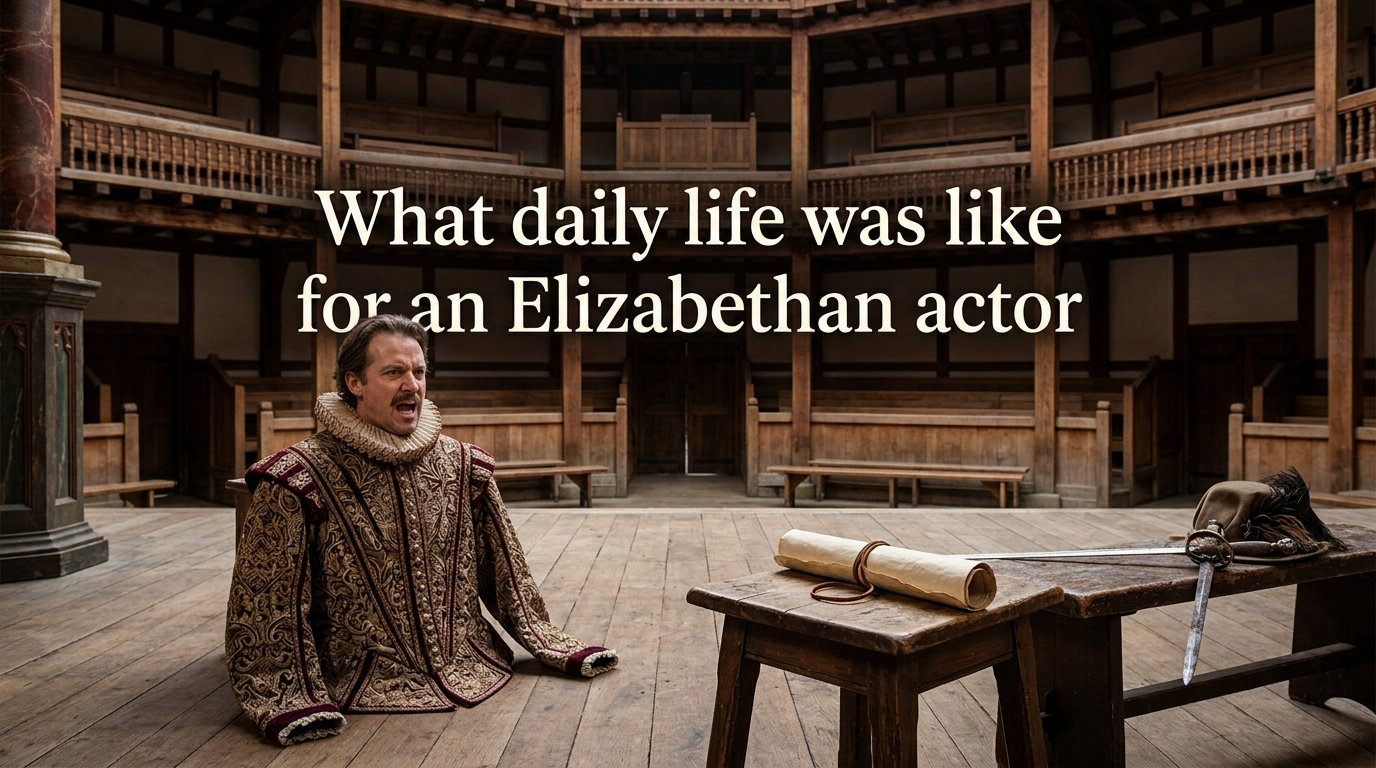
An Elizabethan actor’s daily life revolved around a punishing cycle: memorize lines from a handwritten “part” scroll before dawn, rehearse with the company in the morning, perform a different play each afternoon to a rowdy paying audience in natural daylight, then spend the evening at a tavern preparing for tomorrow’s entirely new role. That rhythm repeated six days a week during the playing season and left almost no room for rest.
Elizabethan actor daily life demanded extraordinary memory, physical endurance, and raw nerve. Companies rotated through 30 to 40 plays in a single season, which meant an actor held multiple major roles in active recall at the same time.
Our team has spent years studying Elizabethan theatre history, working through primary sources like Philip Henslowe’s diary and the scholarship of Tiffany Stern and G.E. Bentley. What emerges is a picture far more demanding and fascinating than most people imagine.
In this guide, we walk through what daily life was like for an Elizabethan actor, from the first morning rehearsal to the last call at the tavern. You will learn how the repertory system worked, how actors memorized hundreds of lines armed only with cue words, what physical skills the stage required, and why performers lived under constant legal threat as “masterless men.”
Table of Contents
What Daily Life Was Like for an Elizabethan Actor
An Elizabethan actor’s day broke into three phases built around the repertory system. Companies performed a different play each day, sometimes cycling through dozens of titles in a single season. An actor might play Hamlet on Monday, Romeo on Tuesday, and Falstaff on Wednesday, all while absorbing brand-new roles added to the repertory every week or two.
There were no directors, stage managers, or technical crews in the modern sense. Actors handled their own entrances, fought duels with real steel blades, and projected their voices over audiences who chatted, ate nuts, and occasionally threw food at the stage. The job called for total physical and mental commitment, every single day.
Here is what a typical performance day looked like, from dawn to last call.
Morning: Memorization and Group Rehearsal
The day began early, often around six in the morning. Before heading to the playhouse, an actor reviewed his part scroll, the long strip of paper that contained only his own character’s lines plus the last few words of whoever spoke before him. These cue lines told him when to enter and when to speak.
By eight or nine, the company gathered at the playhouse for group rehearsal. This was not the weeks-long, director-led process we expect today. Rehearsals focused on coordinating entrances, exits, fights, and stage business. Actors arrived with their lines already memorized, because the company had limited time before the afternoon show.
New plays posed the biggest challenge. A company might rehearse a new work for only a few days before performing it. The playwright was sometimes still making cuts and revisions on the fly, and actors had to absorb those changes instantly.
Afternoon: Performing Before a Paying Audience
Performances started around two o’clock in the afternoon, timed to catch the best natural light since playhouses like the Globe had no artificial lighting. The show ran for roughly two to three hours with no intermission.
The audience was nothing like the quiet, darkened crowd we know today. Groundlings stood in the open yard for a penny, eating, drinking, and shouting reactions at the actors. Those who paid more sat in the covered galleries. A performer had to hold the room through sheer vocal power and physical presence, competing with hawkers, conversations, and the occasional thrown orange.
Weather added another layer of difficulty. Outdoor amphitheatres offered no protection from rain, so a performance could be called off without notice. Plague outbreaks shut the playhouses entirely for months at a time, leaving actors with no income and forcing many companies to tour the countryside for survival.
Evening: The Tavern and Preparing for Tomorrow
After the performance, actors often retired to a nearby tavern. This was not purely leisure. The tavern served as an informal headquarters where company members ate, discussed the next day’s play, and sometimes worked through new scripts or revisions together.
For actor-sharers, the men who owned a financial stake in the company, evenings also involved business. They counted the day’s takings, debated which plays to keep in the repertory, and decided whether a new script justified the rehearsal time. The tavern was where creative decisions and financial pressures collided over a pint of ale.
For hired men, the rank-and-file actors who earned a weekly wage rather than a profit share, the evening offered a chance to eat a proper meal and steel themselves for the next day’s memorization demands. Rest was short, because morning would bring another play and another set of lines to hold in the mind.
The Part Scroll System: How Elizabethan Actors Memorized Their Lines
The part scroll was the single most important tool in an Elizabethan actor’s working life. Each actor received a long strip of paper containing only his own character’s speeches, each preceded by a two- or three-word cue from the preceding speaker. He never saw the full script.
This meant an actor had to memorize his entire role in isolation, with no sense of what other characters said around him. He learned his cue words, and when he heard them spoken onstage, he knew it was his turn to enter or speak. The system worked remarkably well, but it placed enormous pressure on individual memory.
Scholar Tiffany Stern’s research on the part system reveals just how demanding this was. An actor playing a large role like Hamlet or Richard III might carry several hundred lines in his head. And because the repertory system required him to perform different plays on consecutive days, he often held two or three major roles in active recall at once.
Cue mistakes were dangerous. If an actor missed a cue or entered at the wrong moment, the entire scene could unravel with no safety net. There were no prompters hidden in the wings. Discussions among theatre historians note that experienced actors developed personal mnemonic systems, pacing their rehearsals and associating cue words with physical movements to lock lines into muscle memory.
The part scroll also explains why Elizabethan plays contain so many repeated phrases and echo effects. Playwrights wrote with the cue system in mind, crafting speeches that built rhythmically so actors could anticipate their entrances from the sound and cadence of what came before.
When a play left the active repertory, an actor might not perform that role for months or even years. But if the company revived it, he had to relearn his part quickly, often within a few days. This cycle of learning, performing, forgetting, and relearning was the constant mental soundtrack of an Elizabethan actor’s career.
Physical and Performance Demands on the Elizabethan Stage
Elizabethan actors were athletes as much as artists. The Folger Shakespeare Library’s research notes that performers had to fence onstage with genuine skill, sing songs, play instruments, and execute the vigorous dances popular in the period. There were no stunt doubles and no understudies waiting in the wings.
Fencing ranked among the most demanding skills. Stage combat used real rapiers and daggers, and audiences expected convincing, dangerous-looking fights. Actors trained for years to deliver choreographed duels that looked deadly without actually drawing blood. A single misstep could end a career or worse.
Beyond combat, actors needed extraordinary voices. The Globe’s open yard held more than a thousand standing spectators, and there was no amplification of any kind. An actor projected from the thrust stage into open air, competing with street noise, hawkers selling food, and constant audience chatter. Vocal training was not a luxury but a survival skill.
Physical stamina mattered because performance days came thick and fast. During a busy repertory season, a company might stage six different plays in six consecutive days. An actor in a leading role could spend 15 to 20 hours a week on stage in full costume, performing in all weather, with barely a day of rest.
Then there were the costumes themselves. Companies invested heavily in elaborate garments that were sometimes worth more than the play scripts. Actors changed costumes quickly between scenes, managed heavy robes and props, and performed in layered clothing that turned a summer afternoon into a sweltering physical ordeal.
Social Status, Vagabonds, and Noble Protection
Being an actor in Elizabethan England was a legally precarious existence. The 1572 Vagabonds Act classified unlicensed entertainers as “sturdy beggars” and “masterless men,” subject to whipping, branding, or imprisonment. Without the right protection, a traveling company could be arrested on the road simply for plying their trade.
The solution was noble patronage. Theatre companies attached themselves to powerful aristocrats, adopting names like the Lord Chamberlain’s Men or the Lord Admiral’s Men. A noble patron’s license transformed actors from vagabonds into official retainers of a great household, granting them legal cover to travel and perform across the country.
Even with a patron, actors occupied an awkward social position. They had abandoned the protection of traditional trade guilds, the craft organizations that gave ordinary workers legal standing and community support. Actors existed outside the conventional social order, admired by audiences but distrusted by authorities.
The Puritan-leaning city fathers of London regularly tried to shut the playhouses down, citing public disorder, plague risk, and moral corruption. Actors survived this pressure only because their noble patrons outranked local officials and because Queen Elizabeth I herself enjoyed theatrical entertainment enough to protect the companies.
Financially, the profession split into two distinct tiers. Actor-sharers, who owned a stake in the company, could earn substantial incomes. Richard Burbage, the legendary leading man of the Lord Chamberlain’s Men, became a wealthy man through his share of the profits. William Kempe, the company’s star comic actor, was similarly celebrated. Hired men, by contrast, earned a fixed weekly wage recorded in Henslowe’s diary at roughly ten shillings, and lived far more modestly on the economic margins of London life.
FAQs
What were the facts about Elizabethan actors?
Elizabethan actors performed in repertory companies that staged a different play each day, memorized their lines from individual part scrolls containing only their own speeches plus cue words, rehearsed briefly in the morning, and performed in open-air playhouses during the afternoon. They needed skills in fencing, singing, dancing, and vocal projection, and they operated under the legal protection of a noble patron to avoid classification as vagabonds under the 1572 Act.
What was life like for actors in Shakespeare’s time?
Life for actors in Shakespeare’s time was demanding and unstable. They worked six days a week during the playing season, holding multiple roles in active memory, performing in all weather, and facing closure during plague outbreaks. Socially, they existed outside the trade guild system and relied on noble patronage to avoid arrest as masterless men. Leading actor-sharers like Richard Burbage could grow wealthy, while hired men lived on modest weekly wages.
How did Elizabethan actors memorize lines?
Elizabethan actors memorized lines from a part scroll, a long strip of paper containing only their character’s speeches preceded by short cue words from the previous speaker. They memorized independently, often holding two or three major roles in active recall at once. Experienced actors used mnemonic techniques and physical movement to reinforce memory during brief group rehearsals.
What time did Elizabethan plays start?
Elizabethan plays typically started around two o’clock in the afternoon. The timing took advantage of natural daylight, since outdoor playhouses like the Globe had no artificial lighting. A raised flag on the playhouse roof announced a performance that day, and shows ran for roughly two to three hours without intermission.
Were Elizabethan actors respected?
Elizabethan actors occupied a complicated social position. Audiences loved them, and leading performers like Richard Burbage and William Kempe became celebrities. However, civic authorities and Puritan critics viewed theatre as a source of disorder and vice, and the law classified unlicensed actors as vagabonds. Noble patronage provided legal respectability, but actors never fully escaped social suspicion.
How much were Elizabethan actors paid?
Pay depended on a performer’s status within the company. Hired men, the rank-and-file actors, earned a weekly wage of roughly ten shillings according to Henslowe’s diary. Actor-sharers, who owned a financial stake in the company, earned a share of the profits and could accumulate significant wealth, as Richard Burbage did with the Lord Chamberlain’s Men.
Conclusion
What daily life was like for an Elizabethan actor was, in short, a relentless test of memory, body, and nerve. Six-day work weeks, multiple roles in constant rotation, part-scroll memorization, and physical demands from fencing to vocal projection defined the profession from dawn to last call.
Socially precarious but artistically bold, these performers built the foundation of English theatre through sheer endurance and skill. As scholars continue to study primary sources like Henslowe’s diary in 2026, we are still uncovering just how much these actors accomplished with so little institutional support.
If you want to go deeper, start with Tiffany Stern’s work on the part system and G.E. Bentley’s studies of the Jacobean and Caroline stage. The records these researchers have pieced together paint a vivid and human portrait of the men who made Shakespeare’s words come alive.