
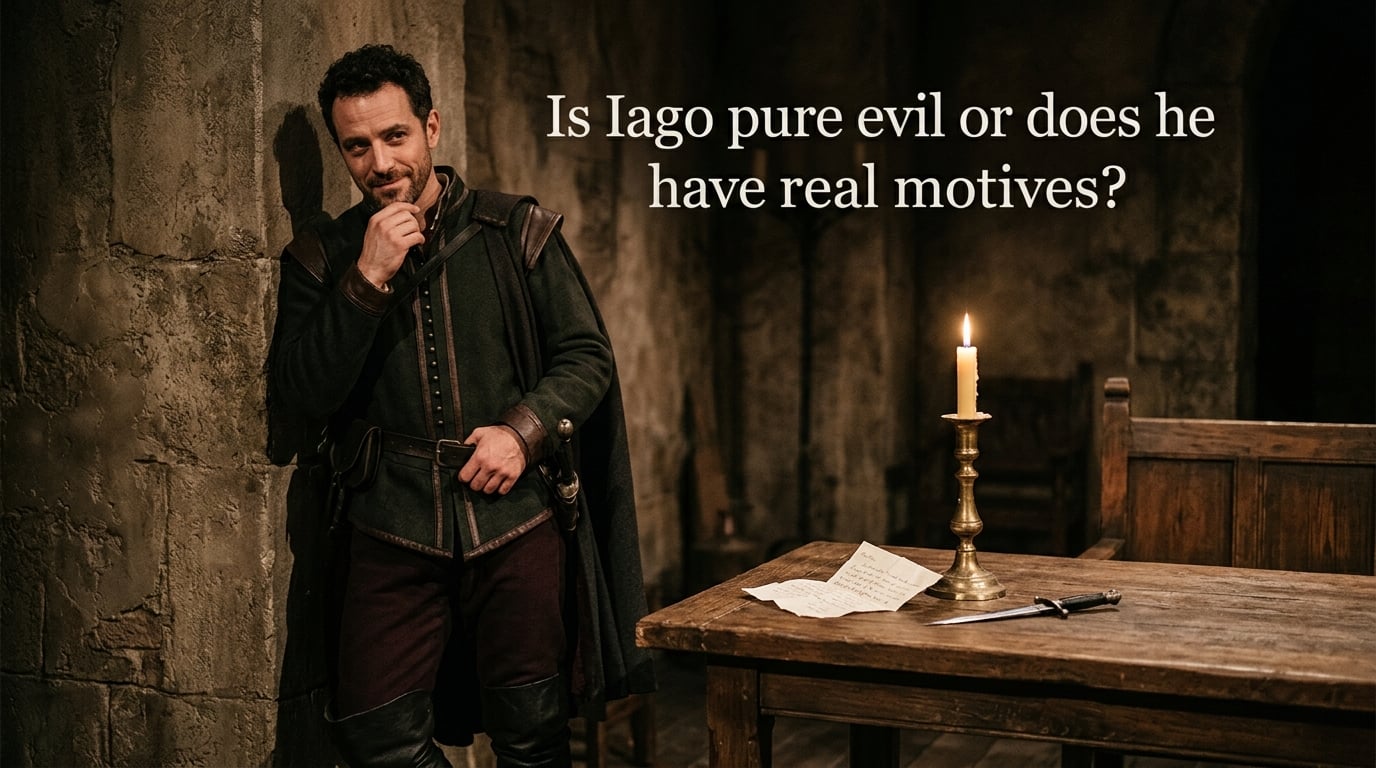
Few questions in Shakespeare studies ignite as much debate as this one: is Iago pure evil, or does he have real motives? I have spent years reading Othello, watching productions, and arguing with fellow literature fans about this character, and the answer is more interesting than either camp admits.
Iago is Shakespeare’s most chilling villain because he resists simple answers. He calls himself “honest Iago,” destroys four lives, and never offers a satisfying explanation for why. In this guide, I will walk you through every major theory about his motives, the textual evidence that supports each one, and the scholarly debate that has raged since Coleridge first coined the phrase “motiveless malignity” in 1813.
By the end, you will understand why this question still matters in 2026, and you will have a clear answer to defend in your next essay, book club, or heated late-night argument about Shakespeare.
Table of Contents
Who Is Iago in Othello? The “Honest” Standard-Bearer Explained
Iago is Othello’s standard-bearer, his ancient, and the play’s primary antagonist. He serves the Moorish general of Venice, fights beside him in battle, and wins the trust of nearly every character on stage. Everyone calls him “honest Iago,” a nickname that becomes the engine of the tragedy.
Unlike other Shakespeare villains, Iago does not seek power, revenge for a murdered family, or a throne. He wants Cassio’s lieutenant position, resents being passed over, and then engineers an elaborate scheme that ends with Othello smothering Desdemona, Cassio wounded, Roderigo dead, and his own wife Emilia murdered. He does all of this while maintaining his reputation as the most trustworthy man in Venice.
His role in the play is structural. Shakespeare needed a villain who could operate inside Othello’s inner circle, and Iago is the perfect infiltrator. He moves between Othello, Desdemona, Cassio, Roderigo, and Brabantio with the ease of a trusted advisor. His honesty reputation is not incidental. It is the weapon that makes his deception lethal.
The Motiveless Malignity Debate: What Coleridge Really Said
The most famous answer to the Iago question comes from Samuel Taylor Coleridge, who in 1813 called Iago’s villainy “motiveless malignity.” Coleridge argued that Iago’s stated reasons for his actions were lies, and that the real reason is a kind of delight in evil for its own sake. This single phrase has shaped almost every discussion of Iago for over two centuries.
The phrase is powerful because it captures something true about the play. When Iago explains himself, his explanations sound thin. He tells Roderigo he hates Othello “for [his] hand,” because Othello promoted Cassio over him, and because he suspects Othello has slept with his wife Emilia. None of these reasons seem big enough to justify multiple murders.
Here is the thing: Coleridge’s reading works on stage but breaks down on the page. Modern scholars, from A.C. Bradley to the editors of recent Arden editions, have pushed back hard. They argue that Iago gives us motives, that those motives are coherent enough, and that calling him “motiveless” lets us off the hook. The debate is not really about Iago. It is about whether human evil needs a reason or whether it can be its own reason.
Why the Debate Has Lasted 200 Years
I think the debate has lasted because both sides are right in different ways. Iago does feel motiveless when you watch him torture Othello in Act 4. He also gives us real, recognizable grievances when you read his soliloquies carefully. The disagreement is a feature of the play, not a flaw in the scholarship.
Case for Pure Evil: Why Iago Resists Easy Explanation
The strongest case for Iago as pure evil comes from what he does, not what he says. By the end of the play, Iago has engineered the murder of his own wife, the murder of his commander, the maiming of a fellow officer, and the suicide of an innocent woman. He has done this for no visible gain. He never takes Othello’s position, never wins Desdemona, never collects Roderigo’s money.
This is the core of the “pure evil” reading: Iago is a destroyer, not a seeker. He performs acts of cruelty that even other Shakespeare villains find excessive. Richard III kills to gain a throne. Macbeth kills to gain a kingdom. Iago kills because the act itself seems to please him.
The case for pure evil rests on three textual pillars:
Iago’s soliloquy in Act 1 Scene 3, where he admits his stated motives are “a dupe” and that he is “not what I am.”
His casual revelation of Cassio’s weakness, which shows he is studying victims for sport.
His final refusal to explain himself in Act 5, where the silence itself becomes the answer.
When Iago says “I am what I am,” he echoes a kind of self-defining evil. He is not moved by circumstance. He chooses, again and again, to damage others. The character feels pure because his malice has no terminus. It does not lead anywhere. It just keeps going.
The Theatrical Tradition
Actors who play Iago often describe him as a void. Simon Russell Beale, who played him for the National Theatre, has said the challenge is that there is no warm center to work from. The character is more interesting when played as someone who enjoys watching things burn. That is the theatrical version of the pure evil reading, and it has shaped how most audiences see him.
Case for Real Motives: The Professional Jealousy Theory
The professional jealousy theory is the oldest and most practical reading of Iago. He wanted Cassio’s lieutenant position. He was passed over. He resents the choice, and his resentment curdles into revenge. This motive is stated explicitly in the play and supported by Iago’s own soliloquies.
In Act 1 Scene 3, Iago says: “And I, God bless the mark, his Moorship’s ancient.” The word “ancient” here carries a double meaning. It is his rank, but it is also a pun on the obsolete sense of “old, dated, past it.” Iago feels diminished by his role and resentful that a less experienced officer, Cassio, has been promoted above him.
The professional jealousy theory has real strength. It explains Iago’s specific focus on Cassio, his need to destroy Cassio’s reputation with the brawl in Act 2, and his willingness to spend years plotting Cassio’s downfall. It also aligns with what we know about military culture and the sting of being passed over.
But it has a problem. Iago gets nothing from Cassio’s destruction. He does not receive the promotion he claims to want. By Act 5, he is still Othello’s ancient. The professional jealousy theory explains the spark of Iago’s resentment, but it does not explain the scale of his revenge.
Why “Passed Over” Is Not Enough
This is where the pure evil reading pulls ahead. If Iago is just a man angry about a promotion, his actions are wildly disproportionate. He murders five people to get a job he never gets. The motive does not match the crime. That mismatch is what drives scholars back to Coleridge’s phrase, and it is what keeps the professional jealousy theory from being a complete answer.
The Sexual Jealousy Theory and the Othello Bed Question
The sexual jealousy theory is older than you might think. The 17th-century actor and writer Hilary Laurie suggested that Iago had an affair with Othello’s wife, the unnamed bed partner, and that this unfaithfulness (real or imagined) drove his revenge. Other scholars have built on this idea, including W.H. Auden and the critic R.W. Babcock.
Iago himself raises the possibility twice. In Act 1 Scene 3, he says: “It is thought abroad that ‘twixt my sheets he has done my office.” He suggests Othello has slept with Emilia. In Act 2 Scene 1, he teases Othello with the line: “And for I know thou’rt full of love and honesty, and weigh’st thy words before thou givest them breath, therefore these stops of thine fright me the more.”
Modern productions sometimes lean into this theory by giving Iago and Othello a charged dynamic. There is no explicit evidence in the text that Iago’s jealousy is sexual, but the theory persists because it explains one piece of the puzzle that other theories miss: why Iago seems so obsessed with Othello personally, not just professionally.
Why This Theory Stays Alive
The sexual jealousy theory endures because it adds an emotional layer the professional jealousy theory lacks. A man passed over for promotion might resent his superior. A man passed over who also believes his superior has slept with his wife has a deeper wound. The theory does not have to be true to be useful. It helps us see Iago as a person in pain, not just a person in plot.
Racism and Prejudice in Iago’s Motive Mix
Any honest analysis of Iago has to address race. Othello is a Black Moor in a white Venetian society, and Iago’s language repeatedly calls attention to that fact. He uses animal imagery (“an old black ram,” “a Barbary horse”), plays on Brabantio’s racist fears about his daughter, and weaponizes racial anxiety throughout the play.
But here is the hard question: is Iago’s racism a motive, or is it a tool? Most scholars now treat racism in Othello as a social backdrop rather than the engine of Iago’s plot. Iago does not say “I will destroy Othello because he is Black.” He says “I will destroy Othello because he wronged me,” and the racial language is what he uses to recruit others to his side.
Still, racism is part of the motive mix. Iago is comfortable weaponizing prejudice because he inhabits it. He calls Othello “the Moor” in moments of contempt. He tells Roderigo that Desdemona’s marriage is “against all rules of nature” because she has chosen “a knave of common hire, a gondolier” before choosing Venetian men of her own race. The prejudice is real, even if it is not the sole cause of his actions.
How Elizabethan Context Shapes the Reading
In Elizabethan England, Black characters on stage were almost always played by white actors in blackface, and the racial anxiety in the play reflected real social fears. Modern readers sometimes strip the race dimension out of Iago’s motives to make him more universal. That is a mistake. Racism is not the deepest motive, but it is one of the layers, and ignoring it makes Iago less human, not more.
The Psychology of Evil: A Modern Lens on Iago
Modern psychology gives us another way into the question. The Lantern Theater Company in Philadelphia published a thoughtful piece treating Iago as a case study in psychological pathology. They compared him to high-Mach personalities, people who score high on tests of Machiavellianism, and they described him as someone who treats manipulation like a sport.
This reading has real support. Iago shows many traits psychologists associate with psychopathy: superficial charm, lack of remorse, emotional detachment, and impulsivity masked by careful planning. He also shows high-Mach traits: he sees other people as tools, he manipulates without guilt, and he takes pleasure in controlling outcomes.
On a Reddit thread I read recently, several users compared Iago to Walter White from Breaking Bad. Both characters are brilliant, arrogant, deeply hurt, and incapable of bearing insult to their pride. Both characters are also self-loathing. Walter White says “I am the one who knocks.” Iago says “I am not what I am.” The parallel works because both characters destroy others partly to avoid destroying themselves.
Does Calling Iago a Psychopath Help Us?
It helps a little, and it can also hurt. Labeling Iago a psychopath gives us vocabulary for his behavior, but it can also make us think his actions were inevitable. They were not. Shakespeare gives Iago choices at every turn, and he makes the cruel one. That is what makes him a character, not a case study.
Textual Evidence: What Iago’s Soliloquies Reveal
The strongest evidence for Iago’s motives comes from his soliloquies. In Act 1 Scene 3, alone on stage after Roderigo leaves, Iago says:
“I hate the Moor,
And it is thought abroad that ‘twixt my sheets
He has done my office. I know not if’t be true,
But I, for mere suspicion in that kind,
Will do as if for surety.”
He gives three reasons here: hatred of Othello, suspicion that Othello has slept with Emilia, and his need to act as if the suspicion were real. The first motive is unexplained. The second is “mere suspicion.” The third is a habit of mind, a way of turning imagined wrongs into action.
In Act 2 Scene 1, after the brawl, Iago delivers a shorter soliloquy: “That Cassio loves her, I do well believe’t. That she loves him, ’tis apt and of great credit.” He is constructing a story he can sell to Othello, but he also seems to be working through his own suspicions. The jealousy is half real and half invented.
The pattern across the soliloquies is telling. Iago does not give us one clear motive. He gives us a cluster of motives, some petty, some imagined, some rooted in real grievance. The cluster feels chaotic because Iago himself is chaotic. He is not a mastermind with a single plan. He is a man improvising his revenge as he goes.
The Honest Iago Paradox: Why Shakespeare Made Him Trusted
The most underappreciated fact about Iago is that his honesty reputation is not an accident. Shakespeare made every character in the play trust him. Othello says “Iago is most honest.” Desdemona says “Iago, my lord, you know I love you.” Cassio says “Good night, honest Iago.” Emilia says “You have known me for a very little time.” Everyone believes him.
This is the paradox at the heart of the play. Iago is honest in the sense that everyone believes he is honest, and dishonest in every other sense. He weaponizes his reputation. He does not work despite being trusted. He works because he is trusted.
Shakespeare understood that pure evil in literature has to be embedded somewhere. If Iago were openly sinister from the start, the play would not work. He has to be the man you would invite to dinner. He has to be the colleague you would confide in. He has to be honest.
The Modern Resonance of the Honest Iago
This is why Iago still feels modern in 2026. Every workplace has someone who seems trustworthy, who listens well, who knows everyone’s secrets, and who uses those secrets for leverage. Shakespeare did not invent the office sociopath, but he gave him a name and a playbook. The honest Iago is the kind of evil that hides in plain sight, and that is the kind of evil most readers and viewers recognize.
Final Verdict: Is Iago Pure Evil, Motivated, or Both?
After walking through every major theory, here is the answer I keep coming back to: Iago is both. He is genuinely motivated by professional jealousy, racial resentment, sexual suspicion, and wounded pride. He is also genuinely moved by something beyond any of those motives, a delight in destruction that Coleridge called “motiveless malignity” and that modern readers sometimes call psychopathy.
Shakespeare’s genius is that he wrote a character where these layers coexist without canceling each other out. Iago has real motives, and his real motives are not enough to explain what he does. The gap between motive and action is where the horror lives. It is the gap that has kept scholars arguing for 400 years, and it is the gap that makes Iago the most terrifying villain in the English language.
So when someone asks you whether Iago is pure evil or has real motives, the best answer is yes. He has real motives, and they are not enough. That is the trick Shakespeare played on us, and it is why we are still talking about it in
FAQs
What are Iago’s true motives in Othello?
Iago gives several motives in the play: resentment over being passed over for Cassio’s lieutenant position, suspicion that Othello has slept with his wife Emilia, racial contempt for Othello as a Moor in Venetian society, and a more general delight in manipulation and control. None of these motives individually justify his actions, which is why scholars still debate his true driving force.
Is Iago truly evil?
Iago is Shakespeare’s most clearly evil character because he destroys multiple lives, including his own wife’s, for no visible gain. He refuses to explain himself at the end of the play, and his actions go far beyond any stated grievance. By any reasonable measure, he is evil. The interesting question is whether his evil has a motive or exists on its own.
What does Coleridge mean by motiveless malignity?
In 1813, the poet and critic Samuel Taylor Coleridge described Iago’s villainy as ‘motiveless malignity,’ meaning that his stated reasons for harming Othello are lies or excuses, and that his real motive is a love of evil for its own sake. The phrase has shaped Iago criticism ever since, though many modern scholars argue it oversimplifies a more complex character.
How does Iago describe jealousy in Othello?
Iago famously warns Othello that jealousy is ‘the green-eyed monster which doth mock the meat it feeds on.’ He uses the metaphor to describe jealousy as a creature that consumes itself. The warning is ironic because Iago is engineering the very jealousy he pretends to caution against, making his speech one of the play’s most famous examples of dramatic irony.
How does racism play a role in Othello?
Racism shapes the world Iago moves through and the language he uses to recruit allies. He calls Othello a ‘Barbary horse’ and an ‘old black ram,’ plays on Brabantio’s fears about his daughter marrying a Moor, and uses racial disgust to turn Roderigo against Othello. The racism is not always Iago’s deepest motive, but it is one of the tools he uses, and it reflects the racial anxieties of Shakespeare’s England.
What is the analysis of Iago in Othello?
Modern analysis of Iago usually falls into three camps: those who follow Coleridge and see him as motivelessly evil, those who see him as psychologically motivated by jealousy and resentment, and those who view him through modern frameworks like psychopathy or Machiavellianism. The most nuanced readings combine all three, treating Iago as a character whose real motives coexist with a deeper delight in destruction.
If you want to keep reading about Shakespeare’s villains, explore our related essays on Macbeth’s ambition and Richard III’s deformity. Each one tackles the same central question Shakespeare keeps asking: what makes a person choose destruction?